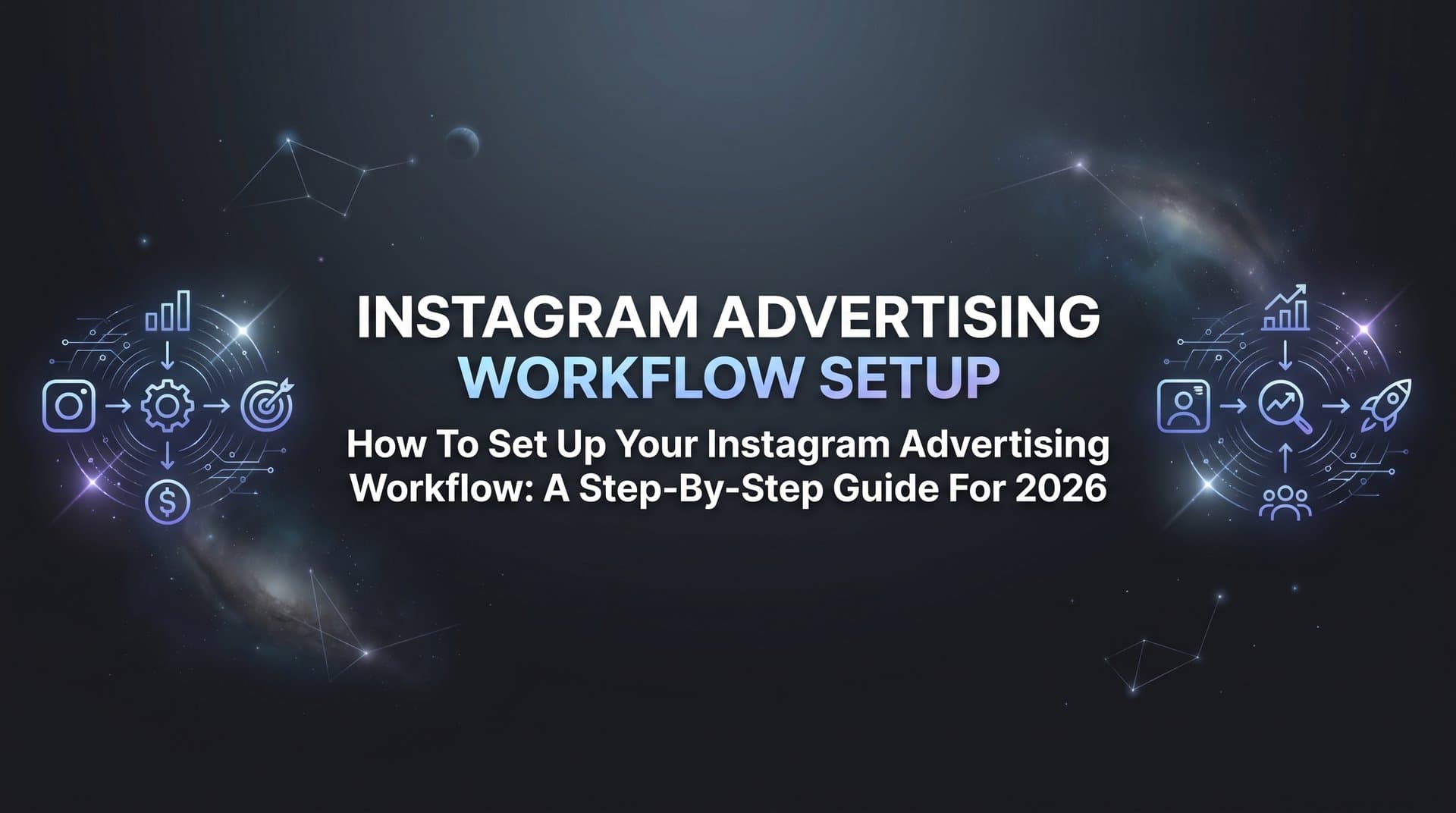
Running Instagram ads without a proper workflow is like trying to build a house without blueprints. You might get something standing, but it will take longer, cost more, and probably need constant repairs. A well-structured Instagram advertising workflow transforms chaotic ad management into a repeatable system that scales.
Whether you are launching your first campaign or managing dozens of accounts, the right workflow eliminates bottlenecks, reduces errors, and frees you to focus on strategy instead of scrambling between tabs.
This guide walks you through building a complete Instagram advertising workflow from scratch. By the end, you will have a system for creating ad creatives, launching campaigns, tracking performance, and continuously improving results. No more reinventing the wheel with every campaign.
Step 1: Connect Your Instagram Account to Meta Business Suite
Before you can run a single ad, your Instagram account needs proper integration with Meta's advertising infrastructure. This foundational step determines whether you will have accurate data, proper attribution, and full control over your campaigns.
Start by converting your Instagram account to a Professional or Business account if you have not already. Personal profiles cannot run ads or access Meta Business Suite features. Navigate to your Instagram settings, tap Account, and select Switch to Professional Account. Choose the category that best matches your business and complete the setup.
Next, link your Instagram account to a Facebook Business Page through Meta Business Suite. Log into business.facebook.com, navigate to Settings, then Instagram Accounts. Click Add and follow the authentication process. This connection allows you to run ads, access Ads Manager, and manage both platforms from a single interface.
Now comes the critical tracking setup. Install your Meta Pixel on your website if you have not already. Navigate to Events Manager in Business Suite, create a new pixel, and follow the installation instructions for your website platform. The pixel tracks visitor behavior and conversions, providing the data that powers your optimization and reporting.
But pixels alone are not enough in 2026. Privacy changes and browser restrictions have reduced pixel accuracy, making Conversions API essential for reliable tracking. The Conversions API sends conversion data directly from your server to Meta, bypassing browser limitations. Most modern website platforms offer simple Conversions API integrations through apps or plugins. Set this up alongside your pixel for the most accurate attribution possible.
Configure your payment methods in Business Settings under Payments. Add a credit card or other payment method, and consider setting account spending limits if you are managing budgets carefully. This prevents accidental overspending and gives you control over monthly ad costs. For a deeper dive into the complete Meta advertising campaign setup process, check out our detailed guide.
Verify everything is working by checking Ads Manager. You should see your Instagram account listed with full permissions. Create a test campaign to confirm you can select Instagram placements and that your pixel is firing correctly. Use the Meta Pixel Helper browser extension to verify pixel events are tracking on your website.
Success indicator: You can access Ads Manager, see your Instagram account with full permissions, your pixel shows as active in Events Manager, and Conversions API is successfully sending test events.
Step 2: Define Your Campaign Goals and Audience Segments
Launching ads without clear goals is like driving without a destination. You will burn fuel without knowing if you are getting closer to where you want to be. Before you create a single ad, document exactly what you are trying to achieve and who you are trying to reach.
Map your business objectives to Meta's campaign objectives. If you are building brand awareness, use the Awareness objective. If you need website traffic, choose Traffic. For sales and leads, select Conversions. Each objective tells Meta's algorithm what to optimize for, so choosing the right one directly impacts your results.
Most businesses should focus on Conversions campaigns once they have sufficient pixel data. This objective optimizes for actual business outcomes rather than vanity metrics. However, if you are launching a new product or entering a new market, starting with Traffic or Engagement campaigns can build initial data before switching to Conversions.
Create three to five core audience segments based on customer data and behavior. These might include cold audiences who have never interacted with your brand, warm audiences who visited your website or engaged with content, and hot audiences who added items to cart but did not purchase. Each segment requires different messaging and creative approaches.
Document your target metrics before spending a dollar. What is your acceptable cost per acquisition? What ROAS makes a campaign profitable? What click-through rate indicates strong creative performance? Write these numbers down. They become your benchmarks for evaluating success and making optimization decisions.
If you have existing customer data, build lookalike audiences from your best customers. Upload a customer list to Meta, create a Custom Audience, then generate lookalike audiences at one percent, three percent, and five percent similarity. These audiences contain people who share characteristics with your existing customers, often delivering better results than interest-based targeting.
For cold audiences, research your target demographic thoroughly. What age ranges convert best? Which geographic locations show the strongest interest? What interests and behaviors correlate with purchases? Use Meta's Audience Insights tool to explore potential targeting options, but avoid over-narrowing. Audiences below 50,000 people often struggle to deliver consistent results.
Create a simple spreadsheet documenting each audience segment. Include the targeting parameters, estimated size, and intended messaging angle. This documentation ensures consistency across campaigns and helps team members understand your targeting strategy without reverse-engineering ad sets. Following Instagram advertising best practices from the start will save you significant optimization time later.
Success indicator: You have written documentation of campaign objectives, three to five defined audience segments with targeting parameters, and specific benchmark metrics for CPA, ROAS, or other key performance indicators.
Step 3: Build Your Creative Production System
Creative production is where most advertising workflows break down. Without a system, you end up scrambling for assets, waiting on designers, and launching campaigns with whatever creatives you can scrape together. A proper creative production system changes everything.
Start by creating a creative brief template that covers every campaign. This template should include the campaign objective, target audience, key messaging points, visual style guidelines, and specific call-to-action. A good brief takes fifteen minutes to complete but saves hours of revision by aligning everyone on creative direction from the start.
Set up a folder structure for organizing assets. Create top-level folders for each campaign, then subfolders for different formats like Stories, Reels, feed posts, and carousels. Within each format folder, maintain version control by numbering iterations. This organization lets you find any asset instantly and prevents the chaos of scattered files across desktop folders and cloud drives.
Build templates for each ad format you regularly use. Stories ads work best at 9:16 aspect ratio with text in the middle third to avoid interface overlaps. Feed posts perform well at 1:1 square format. Reels need vertical video optimized for mobile viewing. Create master templates with your brand colors, fonts, and logo placement, then duplicate and customize for each campaign.
The traditional creative production bottleneck required designers for every variation. In 2026, AI tools have eliminated this constraint. You can generate image ads, video ads, and even UGC-style avatar content without hiring designers or video editors. Platforms leveraging AI-driven Instagram advertising let you create scroll-stopping creatives from a product URL, clone competitor ads from the Meta Ad Library, or build ads from scratch using AI.
The real advantage comes from speed and iteration. Instead of waiting days for a designer to create five variations, you can generate fifty variations in an hour and test them all. Use chat-based editing to refine any creative element until it matches your vision. This rapid iteration cycle means you find winning creatives faster and scale them while they are still fresh.
Establish a creative review process that balances quality control with speed. For most campaigns, a quick review by one team member is sufficient. Save extensive review cycles for major launches or brand campaigns. The goal is maintaining quality standards without creating approval bottlenecks that delay launches.
Build a swipe file of winning creatives from your campaigns and competitors. Screenshot ads that catch your attention. Save high-performing creatives from past campaigns. This swipe file becomes inspiration when creating new ads, helping you identify patterns in what works for your audience.
Success indicator: You can produce a complete set of ad creatives covering multiple formats and variations in under an hour, with organized files and clear version control.
Step 4: Structure Your Campaign Architecture
Campaign structure is the skeleton that holds your advertising workflow together. Poor structure creates confusion, makes optimization difficult, and wastes time hunting for specific ads. Proper structure makes everything faster and clearer.
Use a consistent naming convention for campaigns, ad sets, and ads. A good naming convention includes the objective, audience, and key variable being tested. For example: "CONV_Lookalike1%_CreativeTest_Jan2026" immediately tells you this is a conversion campaign targeting a one percent lookalike audience, testing creative variations, launched in January 2026.
Organize campaigns by objective first. Keep all conversion campaigns together, all traffic campaigns together, and all awareness campaigns together. This organization makes it easy to compare performance across similar campaign types and identify trends in what is working.
Within each campaign, structure ad sets by audience or placement strategy. If you are testing three different audiences, create three ad sets with identical settings except for the audience. This isolation lets you clearly see which audience performs best without confounding variables.
Set appropriate budgets at the campaign or ad set level based on your testing goals. Campaign Budget Optimization lets Meta distribute budget across ad sets automatically, which works well when you want the algorithm to find winners. Ad set budgets give you more control, which is useful when testing specific hypotheses or managing strict budget allocations.
Configure placements strategically rather than defaulting to Advantage+ for everything. While Advantage+ placements let Meta optimize across all available placements, sometimes you want to isolate Instagram-only performance or test specific placements like Stories versus Reels. Manual placement selection gives you this control.
For most Instagram-focused campaigns, select Instagram Feed, Instagram Stories, Instagram Reels, and Instagram Explore as your placements. Exclude Facebook and Audience Network if you want pure Instagram data. This isolation makes performance analysis cleaner and ensures your creatives are optimized for Instagram's specific formats. Understanding the complete Instagram ad campaign workflow helps you structure campaigns for maximum efficiency.
Create a campaign structure template document that your team can reference. Include naming convention rules, budget allocation guidelines, and placement strategies. This documentation ensures consistency even when different team members build campaigns.
Consider using a spreadsheet to plan campaign structure before building in Ads Manager. Map out campaign names, ad set configurations, and ad variations. This planning step catches structural issues before you spend time building everything, and it serves as a blueprint for rapid campaign creation.
Success indicator: Anyone on your team can look at your Ads Manager and immediately understand the campaign structure, what is being tested, and how budgets are allocated without asking questions.
Step 5: Launch Campaigns with Bulk Variations
Creating ads one by one is the slowest part of traditional campaign management. You select a creative, write copy, choose an audience, and repeat the process dozens of times. Bulk launching transforms this tedious process into a rapid deployment system.
Start by preparing all your creative assets, copy variations, and audience segments before you begin building. Organize everything in a spreadsheet with columns for creative file names, headline variations, primary text options, and audience names. This preparation makes bulk launching smooth and error-free.
Use bulk creation tools to deploy dozens of ad variations simultaneously. Instead of creating each ad individually, you upload your creative assets, input your copy variations, and let the system generate every combination. If you have five creatives and three copy variations, you instantly create fifteen ads instead of manually building each one.
Platforms like AdStellar take this further by mixing multiple creatives, headlines, audiences, and copy at both the ad set and ad level. You can create hundreds of ad variations in minutes by selecting which elements to combine. The system generates every combination and launches them to Meta in clicks, not hours. Explore Instagram advertising automation tools to find the right solution for your workflow.
Set up proper A/B tests by isolating variables. If you are testing creatives, keep everything else constant. If you are testing audiences, use the same creatives across all ad sets. This isolation lets you attribute performance differences to the specific variable being tested rather than confounding factors.
Schedule your launches during optimal times based on your audience data. Check when your target audience is most active on Instagram using Insights data. Launching campaigns when your audience is online can provide an initial engagement boost that signals quality to Meta's algorithm.
Before hitting publish, review your bulk setup carefully. Check that budgets are correct, placements are configured properly, and tracking is enabled. Bulk launching is powerful, but errors multiply quickly when you are creating dozens of ads at once. A five-minute review prevents costly mistakes.
Start with smaller test budgets when launching bulk variations. You want enough budget for each variation to gather meaningful data, but not so much that poor performers waste significant spend. A general guideline is budgeting at least three times your target CPA per ad set to allow for proper testing.
Success indicator: You can launch a full test matrix of twenty-plus ad variations covering multiple creatives, copy options, and audiences in a single session lasting less than thirty minutes.
Step 6: Monitor Performance and Surface Winners
Launching campaigns is only half the battle. Without proper monitoring, you will miss opportunities to scale winners and waste budget on underperformers. A structured monitoring system catches problems early and identifies success quickly.
Create a daily and weekly review schedule with specific metrics to check. Daily reviews should focus on spend pacing, obvious winners or losers, and technical issues like disapproved ads. Weekly reviews dive deeper into performance trends, creative fatigue, and optimization opportunities.
Use leaderboards or dashboards to rank creatives, audiences, and copy by performance. Instead of manually comparing metrics across dozens of ads, a leaderboard instantly shows your top performers ranked by ROAS, CPA, CTR, or whatever metric matters most to your business. This visual ranking makes optimization decisions obvious.
AdStellar's AI Insights feature automatically creates these leaderboards, ranking your creatives, headlines, copy, audiences, and landing pages by real metrics. Set your target goals and the AI scores everything against your benchmarks, letting you instantly spot winners and reuse them in future campaigns.
Set clear rules for pausing underperformers and scaling winners. For example, pause any ad that spends two times your target CPA without a conversion. Scale winners by increasing budgets twenty-five percent every three days as long as efficiency holds. These rules remove emotion from optimization decisions and create consistent performance.
Track attribution properly with UTM parameters and conversion tracking. Add UTM parameters to all your ad links so you can track performance in Google Analytics alongside Meta's reporting. This cross-platform validation catches attribution discrepancies and gives you a complete picture of campaign performance. Addressing Meta advertising workflow inefficiencies in your monitoring process prevents wasted spend.
Monitor frequency to catch creative fatigue before it tanks performance. When frequency climbs above three, your audience is seeing the same ads too often. This repetition leads to declining engagement and rising costs. Refresh creatives or expand audiences before fatigue sets in.
Check placement performance to identify where your ads work best. You might discover that Reels dramatically outperform Stories for your audience, or that Feed ads drive better conversion rates despite lower CTR. These insights inform future campaign structure and creative optimization.
Document your findings in a simple tracking spreadsheet. Note which creatives performed best, which audiences converted most efficiently, and which copy angles resonated. This documentation becomes the foundation for your next campaign and builds institutional knowledge over time.
Success indicator: You can identify your top three performing creatives, best audience segment, and most effective copy variation within forty-eight hours of campaign launch using clear performance data.
Step 7: Iterate and Scale Your Winning Ads
Finding winners is valuable, but the real leverage comes from systematically building on success. Each campaign should inform the next, creating a continuous improvement loop that compounds results over time.
Document winning elements in a centralized hub for future campaigns. When you find a creative that crushes it, save it with notes on why it worked. When an audience segment consistently converts, document the targeting parameters. This winner's hub becomes your playbook for future campaigns.
Create new variations based on top performers rather than starting from scratch. If a specific image style works well, create more ads in that style. If a particular value proposition resonates, test different ways of communicating it. This approach stacks wins instead of constantly searching for entirely new concepts.
Gradually increase budgets on winners while maintaining efficiency metrics. Sudden budget jumps can destabilize performance as the algorithm adjusts. Increase budgets by twenty to twenty-five percent every few days, monitoring CPA and ROAS closely. If efficiency holds, continue scaling. If metrics deteriorate, hold steady and let the algorithm stabilize. Learning how to scale Instagram advertising properly prevents the common pitfalls that tank performance.
Build a continuous learning loop where each campaign informs the next. Review performance data after every campaign. What patterns emerged? Which hypotheses proved correct? What surprised you? These insights shape your strategy for the next campaign, creating compound improvements over time.
Test incrementally rather than making wholesale changes. Change one variable at a time so you can attribute performance shifts to specific changes. This disciplined approach builds reliable knowledge about what works for your specific business and audience.
Consider the lifecycle of your winning ads. Even the best creative eventually fatigues. Plan refresh cycles where you create new variations of winning concepts before performance declines. This proactive approach maintains momentum instead of reacting to drops.
Scale horizontally by applying winning formulas to new audiences and markets. If you find a creative and audience combination that works brilliantly, test it with lookalike audiences or in new geographic markets. This expansion multiplies the value of your winners.
Success indicator: Your second campaign outperforms your first using documented insights from winners, and you can clearly trace performance improvements back to specific learnings from previous campaigns.
Putting It All Together
You now have a complete Instagram advertising workflow blueprint. Let's recap the essential components:
Foundation: Meta Business Suite connected with proper pixel and Conversions API tracking. Payment methods configured and spending limits set.
Strategy: Campaign goals and audience segments documented with clear benchmark metrics for success.
Creative System: Production templates and AI-powered tools ready to generate variations quickly without creative bottlenecks.
Structure: Consistent naming conventions and campaign architecture that anyone can understand at a glance.
Execution: Bulk launching process for deploying test matrices in minutes instead of hours.
Optimization: Performance monitoring schedule with leaderboards surfacing winners automatically.
Iteration: Winners hub and continuous learning loop that compounds improvements over time.
Building this workflow takes initial effort, but the payoff compounds with every campaign. You will spend less time on repetitive tasks, catch problems faster, and consistently improve results. Most importantly, you will have the mental bandwidth to focus on strategy and creative innovation instead of drowning in tactical execution.
Start with step one today. Connect your accounts, set up proper tracking, and establish your foundation. Within a week, you can have a complete Instagram advertising workflow running smoothly. Each step builds on the previous one, creating a system that scales with your business.
The difference between struggling advertisers and successful ones often comes down to systems. Talent and creativity matter, but without a workflow that captures learnings and scales winners, you are constantly starting from zero. With this workflow in place, every campaign makes the next one better.
Ready to transform your advertising strategy? Start Free Trial With AdStellar and be among the first to launch and scale your ad campaigns ten times faster with our intelligent platform that automatically builds and tests winning ads based on real performance data.