Let's talk about the moment the budget reality hits. You've decided to invest in UGC ads for Instagram. You've seen the authentic, creator-style content performing well in your feed. You know it converts. So you start reaching out to creators, or you get a quote from a UGC agency, and the numbers stop you cold. What seemed like a straightforward creative investment turns out to be a layered, unpredictable expense that compounds at every stage of production.
If that experience sounds familiar, you are not alone and you are not doing it wrong. Instagram UGC ad creation is genuinely expensive, and the reasons go well beyond what most marketers anticipate when they first budget for it. The visible costs are just the beginning. The hidden ones are where budgets quietly disappear.
This article breaks down exactly where those costs come from, why Instagram specifically drives the price higher than other platforms, and what the hidden expenses are that most teams only discover after they have already committed to a UGC strategy. More importantly, it explains how AI-powered creative tools are fundamentally changing the economics of UGC-style ad production, and what that means for teams who need a constant pipeline of fresh creatives without a constantly expanding production budget.
The Real Price Tag Behind a Single UGC Ad
Most marketers budget for the creator fee. That is the number they see first, and it feels manageable. But the creator fee is just the first layer of a cost structure that stacks quickly and unpredictably.
Here is how the layers typically build up:
Creator sourcing and negotiation: Finding the right creator for your brand takes time and often money. Whether you are using a UGC marketplace or reaching out directly, you are investing hours in reviewing profiles, sending briefs, negotiating rates, and managing back-and-forth communication before a single frame of footage is captured.
Marketplace platform fees: If you are using a UGC platform to find creators, that platform typically charges a subscription fee on top of taking a percentage of creator payments. The rate you see quoted by a creator is not the rate you actually pay once platform fees are factored in.
Usage rights and licensing: Many creators price their content for organic posting only. The moment you want to run that content as a paid ad, boost a post, or use it in a whitelisting campaign, you are entering a separate negotiation. Usage rights fees are common, and they are often a genuine surprise for brands that assumed the initial payment covered everything.
Revision rounds: Creative briefs rarely produce exactly what you envisioned on the first submission. Revision rounds are normal, but they are also costly. Depending on the creator's terms, revisions may be billed separately or limited in number, meaning significant changes require a new brief and a new fee.
Beyond the direct costs, there is the multiplier problem. A single creator submission does not guarantee a usable ad. Performance marketers know that not every piece of UGC hits the mark creatively, and you often need to brief multiple creators on the same concept to end up with one or two assets worth testing. That means you are paying for several deliverables to get one winner.
Then there is the time cost, which rarely appears in any budget spreadsheet. From initial brief to final approved asset, traditional UGC production typically involves weeks of coordination: briefing, waiting for submissions, reviewing, requesting revisions, negotiating licensing, and finally uploading to Ads Manager. That is weeks your campaign is not running, and hours of your team's time that could have been spent on strategy. This kind of Instagram ad creation bottleneck is one of the most underestimated drains on marketing team capacity.
When you add it all together, a single usable UGC ad often costs significantly more than the creator's quoted rate suggests. And that is before you factor in the Instagram-specific pressures that push costs even higher.
Why Instagram Raises the Creative Bar (and the Bill)
Not all social platforms are equally demanding when it comes to creative production. Instagram is one of the most demanding, and that demand translates directly into higher costs.
Instagram's visual-first culture has conditioned its users to expect a certain level of production quality, even from content that is designed to look authentic and unpolished. The bar for what reads as "good UGC" on Instagram is higher than on many other platforms. Creators who produce content that performs well on Instagram typically charge more because they have the skills, the equipment, and the audience understanding to clear that bar consistently.
Format complexity is another cost driver that often goes underestimated. Instagram is not a single placement. It is Feed, Stories, Reels, and Explore, each with different aspect ratios, different pacing expectations, and different viewer behaviors. A vertical 9:16 video optimized for Reels does not automatically work as a Feed ad or a Story without editing. A single creator deliverable rarely covers all placements without additional work, which means either paying for multiple versions upfront or accepting that your content will underperform in certain placements.
Instagram's algorithm has also shifted heavily toward Reels and short-form video, which means static image UGC consistently underperforms video content in terms of reach and engagement. That pushes brands toward video production, which is inherently more expensive than static creative. Video requires more from creators in terms of equipment, editing capability, and time investment, and those costs are reflected in their rates. Understanding the full scope of Instagram ad video creation helps teams budget more accurately from the start.
Perhaps the most structurally expensive aspect of Instagram advertising is creative fatigue. This is a well-documented challenge among performance marketers: ads that perform well initially see declining click-through rates and rising CPMs as the target audience becomes overexposed to the same creative. It is not a sign that your ad was bad. It is simply how the platform works.
The practical consequence is that Instagram advertising requires a continuous pipeline of fresh creative, not a one-time production. You cannot brief a creator, receive your UGC, and expect to run that content indefinitely. You need new hooks, new formats, and new angles on a regular basis. For teams relying on traditional creator-sourced UGC, that means the production cycle never ends, and neither does the expense.
Hidden Costs That Quietly Drain Your Ad Budget
The costs covered so far are at least partially visible at the planning stage. The hidden costs are the ones that surface after you have committed to a UGC strategy, often at the worst possible moment.
Usage rights scope creep: This is the most common budget surprise in UGC campaigns. A creator delivers content, you pay the agreed fee, and then you want to whitelist the ad or run it through a dark post. Suddenly you are back in negotiation. Whitelisting and dark posting, which means running paid ads through a creator's personal handle rather than your brand page, require separate licensing agreements that many creators price as a premium. Brands that discover this after building a campaign around a specific piece of content have very little negotiating leverage.
Iteration costs: In a traditional ad workflow, changing the hook on a video or testing a different call to action is a relatively low-cost operation. In a UGC workflow, it often means starting over. If you want to test whether a different opening line improves your click-through rate, you need a new brief, a new creator submission, and a new round of review. Every iteration is a production event, not an edit. This makes the kind of systematic Instagram ad creative testing that performance marketers rely on prohibitively expensive when using traditional UGC production.
Internal coordination overhead: Someone on your team is managing this entire process. They are sending briefs, following up on submissions, reviewing content against brand guidelines, chasing late deliverables, handling licensing negotiations, and uploading final assets to Ads Manager. That is a meaningful time investment that rarely gets accounted for in the UGC budget, but it represents real cost in terms of team capacity and opportunity cost.
Retakes and quality failures: Not every creator delivers content that meets the brief. When a submission misses the mark significantly, you face a choice between paying for a retake, accepting substandard creative, or starting the sourcing process again with a different creator. Any of those options costs something, whether in money, time, or ad performance.
These hidden costs compound in ways that are difficult to predict at the outset. A UGC campaign that looked affordable in the planning spreadsheet can end up consuming a significant portion of the media budget before a single ad goes live.
How AI Ad Creation Is Rewriting the Economics
The cost structure of traditional UGC production exists because every step requires human coordination: finding creators, briefing them, waiting for submissions, managing revisions, negotiating licenses, and handling logistics. AI-powered creative tools remove most of those steps entirely, which is why they represent a genuine shift in the economics rather than just a marginal efficiency improvement.
The core capability is straightforward: AI tools can generate UGC-style avatar content, image ads, and video ads directly from a product URL, without hiring a creator, a designer, or an actor. The visual output is designed to match the aesthetic of authentic creator content, including the informal framing, direct-to-camera style, and conversational tone that makes UGC ads perform well on Instagram. Automated ad creation for Instagram has matured to the point where the output is genuinely competitive with creator-sourced content.
The speed advantage is substantial. What traditionally required weeks of creator coordination can now be produced in minutes. More importantly, iterations cost nothing additional. Want to test a different hook? Generate it. Want to try a different call to action? Generate it. The per-revision cost in a traditional UGC workflow is effectively zero with AI generation, which fundamentally changes how teams can approach creative testing.
This is where bulk variation testing becomes a meaningful strategic advantage. Because there is no per-unit cost for each creative variation, teams can generate hundreds of combinations simultaneously: different hooks, different formats, different messaging angles, different visual treatments. Instead of guessing which single UGC ad will perform and committing budget to that guess, you can test many options at once and let performance data tell you what works. Bulk Instagram ad creation makes this kind of high-volume testing accessible to teams of any size.
AdStellar is built around exactly this workflow. The AI Ad Creative feature generates scroll-stopping image ads, video ads, and UGC-style avatar content from a product URL. You can also clone competitor ads from the Meta Ad Library or let the AI build creatives from scratch. Every creative can be refined through chat-based editing, which means adjusting messaging or visual elements is a conversation, not a production brief. No designers, no video editors, no actors, and no usage rights negotiations.
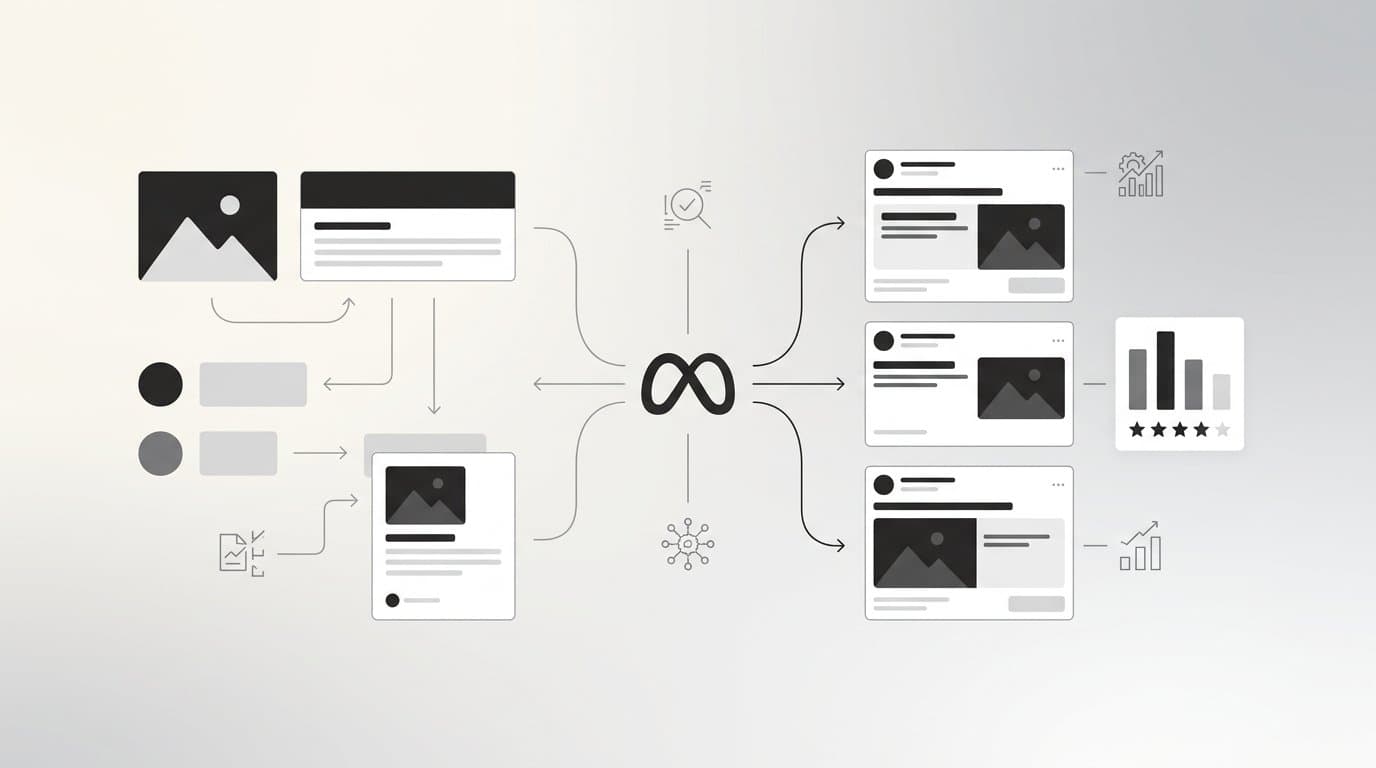
The Bulk Ad Launch feature takes this further by generating every combination of creatives, headlines, audiences, and copy, then launching them to Meta in minutes rather than hours. For performance marketers who understand that finding winning creative is a volume game, this capability changes what is actually possible within a normal team's capacity and budget.
The result is not just cheaper creative production. It is a fundamentally different relationship with creative testing: one where iteration is fast, volume is high, and the cost structure is predictable rather than compounding.
From Creative to Campaign Without Leaving One Platform
Generating great creative is only part of the challenge. The other part is getting it into a campaign, measuring performance, and making smart decisions about what to scale and what to cut. Traditional workflows require stitching together multiple tools for each of those steps, which adds both complexity and cost.
An integrated AI platform handles the full workflow in one place, and that integration matters more than it might initially seem. When your creative generation, campaign building, and performance analysis all live in the same system, the data flows between them without manual export, reformatting, or interpretation lag. Teams exploring top Instagram ad management platforms increasingly prioritize this kind of end-to-end integration over point solutions.
AdStellar's AI Campaign Builder analyzes your past campaigns and ranks every creative, headline, and audience by performance. It then builds complete Meta Ad campaigns in minutes, with AI-optimized audiences and copy decisions explained transparently so you understand the strategy behind each choice. The AI gets smarter with each campaign it runs, meaning the recommendations improve over time as it accumulates more data about what works for your specific account.
The AI Insights feature replaces the manual spreadsheet work that performance marketers know well. Leaderboards rank your creatives, headlines, copy, audiences, and landing pages by real metrics: ROAS, CPA, and CTR. You set your target goals and the AI scores everything against your benchmarks, so identifying winners and understanding why they are winning requires analysis rather than guesswork. This kind of systematic creative ranking is standard practice in sophisticated performance marketing teams. Automating it removes the hours of manual analysis that typically happen between campaign runs.
The Winners Hub takes this one step further. Your best-performing creatives, headlines, audiences, and other assets are all surfaced in one place with their actual performance data attached. When you are building the next campaign, you are not starting from scratch or trying to remember which version of a headline performed well three months ago. You select proven assets directly and build from a foundation of documented performance rather than intuition.
This end-to-end integration is the core differentiator for teams that have tried to build similar workflows by connecting separate tools. Each handoff between tools in a fragmented stack is a point of friction, a potential for data loss, and an additional subscription cost. A single platform that handles creative generation, campaign building, bulk launching, and performance analysis eliminates all of those friction points simultaneously.
Putting It All Together: A Smarter Path to UGC-Style Ads
The case for rethinking how you produce UGC-style Instagram ads is not primarily about cutting corners. It is about removing the structural inefficiencies that make traditional UGC production slow, unpredictable, and expensive for most teams.
The traditional pipeline involves creator sourcing, briefing, waiting, revisions, licensing negotiations, platform fees, internal coordination, and a production cycle that never really ends because Instagram's creative fatigue demands constant fresh content. Each of those steps carries a cost, and most of them compound in ways that are difficult to budget for accurately at the outset.
AI-generated UGC-style content removes most of those costs simultaneously. Not just one layer, but the sourcing, the licensing, the revision cycle, the coordination overhead, and the unpredictability. What remains is a creative workflow that is fast, iterative, and built around performance data rather than gut instinct about which single ad to bet on.
The goal is not to eliminate creativity from your advertising. It is to remove the bottlenecks and overhead that make creativity prohibitively expensive. When iteration is fast and volume is high, you can make smarter creative decisions based on actual performance rather than hoping your one UGC investment lands.
AdStellar brings together AI ad creative generation, campaign building, bulk launching, and performance analysis in one platform. It is designed for performance marketers who need a continuous pipeline of high-quality creative without the production overhead that makes traditional UGC campaigns so costly to sustain.
Start Free Trial With AdStellar and be among the first to launch and scale your ad campaigns faster with an intelligent platform that automatically builds and tests winning ads based on real performance data. Generate your first UGC-style ad without a creator, a designer, or a production budget, and see what your creative pipeline looks like when the bottlenecks are gone.