Most businesses running Meta ads face the same quiet frustration: they know exactly what they want to say, but they struggle to make it look good enough to stop the scroll. For years, limited ad design skills meant choosing between two uncomfortable options: hire an expensive designer or settle for creatives that underperform. Neither is sustainable, especially for lean teams and growing agencies managing multiple clients.
The good news is that the gap between design skill and ad performance has never been smaller. AI-powered tools, smarter workflows, and strategic creative frameworks now allow marketers to produce scroll-stopping ads without ever opening a design program.
This article covers seven practical strategies that any digital marketer, Meta Ads manager, or agency can use to produce compelling ad creatives, launch campaigns confidently, and surface winning combinations without relying on design expertise. Whether you are running your first Facebook campaign or managing dozens of accounts, these strategies will help you close the design gap and focus on what actually drives results.
1. Use AI to Generate Ad Creatives Directly from Your Product URL
The Challenge It Solves
The blank canvas is one of the most common creative bottlenecks in Meta advertising. Even experienced marketers can spend hours trying to figure out where to start, what visual to use, what copy to pair it with, and how to make it all feel cohesive. For anyone with limited design skills, that blank canvas quickly becomes a wall.
The Strategy Explained
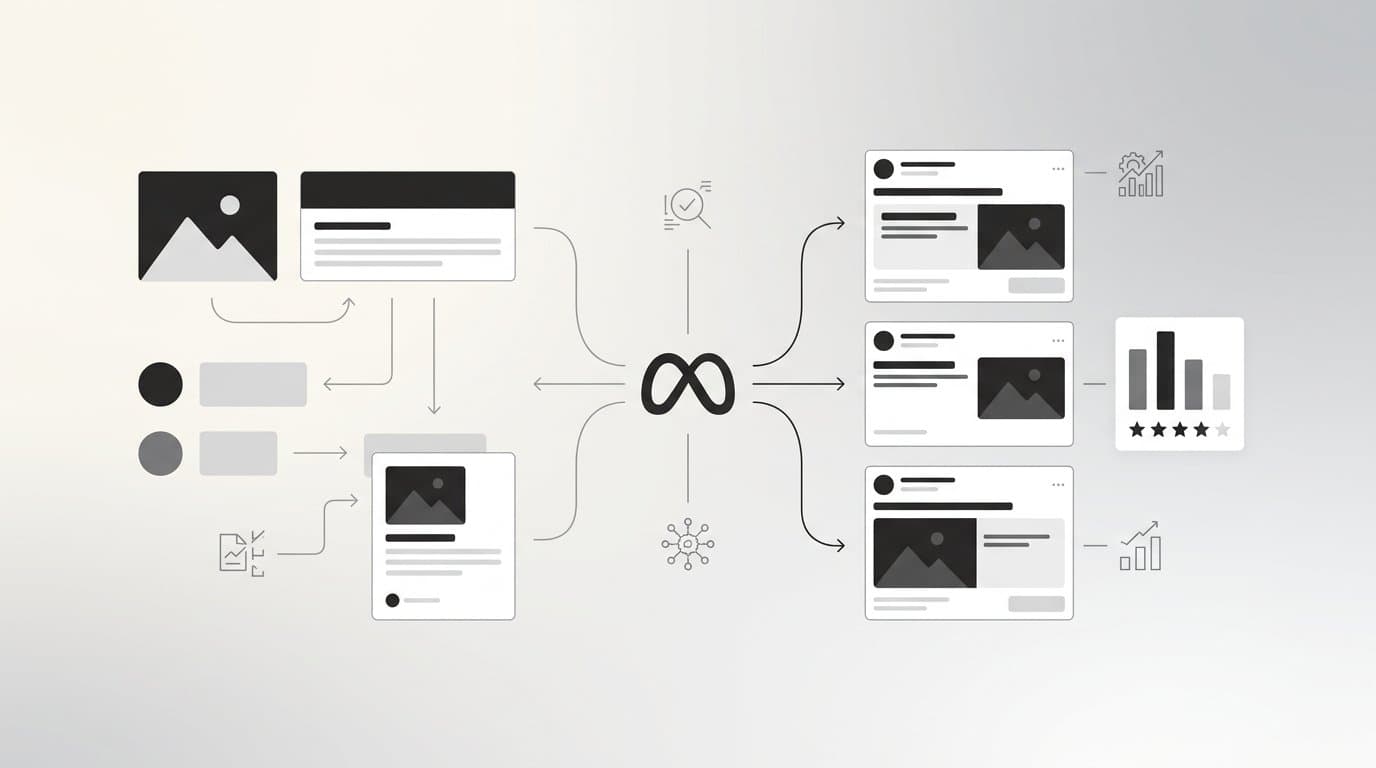
Modern AI ad platforms can pull your product details, brand assets, and messaging directly from a URL and generate ready-to-launch image ads, video ads, and UGC-style creatives automatically. You skip the design phase entirely and move straight to refinement.
Platforms like AdStellar let you input a product URL and generate multiple creative formats in minutes. From there, you can refine any ad through a chat-based editing interface, adjusting visuals, copy, and format without touching design software. No Photoshop, no Canva templates, no back-and-forth with a freelancer.
Implementation Steps
1. Enter your product or landing page URL into an AI creative tool and let it extract your product details, imagery, and core messaging automatically.
2. Review the generated creative variations across formats, including static image ads, video ads, and UGC-style avatar content, and select the strongest starting points.
3. Use chat-based editing to refine headlines, adjust visuals, or swap out elements until each creative aligns with your campaign goals.
4. Export or launch directly to Meta without ever opening a separate design program.
Pro Tips
Generate multiple creative formats from the same URL in a single session. A single product page can yield image ads, short video ads, and UGC-style content simultaneously, giving you a full creative set to test without additional effort. The more formats you test early, the faster you identify which resonates with your audience.
2. Clone Competitor Ads from the Meta Ad Library Instead of Starting Blank
The Challenge It Solves
One of the most time-consuming parts of ad creative development is figuring out what will actually resonate with your target audience. Without design experience or a large testing budget, many marketers end up guessing. This leads to wasted spend on creatives that never had a real chance of performing.
The Strategy Explained
The Meta Ad Library is a publicly available tool that lets you view active ads from any advertiser on Facebook and Instagram. It is one of the most underused resources in performance marketing. Rather than guessing what works, you can study what competitors and category leaders are actively running and spending on right now.
The key insight here is that if a competitor has been running the same ad for weeks or months, it is almost certainly performing. You are not copying their creative. You are learning from their structure, format, and messaging approach, then adapting those proven patterns to your own brand. AI tools like AdStellar can take this a step further by cloning competitor ad structures directly from the Meta Ad Library and rebuilding them with your brand's assets and messaging.
Implementation Steps
1. Open the Meta Ad Library and search for competitors or brands in your category that are actively running ads.
2. Filter by active ads and look for creatives that have been running for an extended period, as longevity typically signals strong performance.
3. Analyze the structure: note the format, hook style, visual layout, call-to-action placement, and copy length.
4. Use an AI creative tool to rebuild that structure with your own product, brand colors, and messaging rather than starting from a blank template.
Pro Tips
Look beyond your direct competitors. Brands in adjacent categories that target a similar audience often reveal creative approaches you have not considered. A direct-to-consumer brand selling a completely different product may be using a hook structure or visual format that works brilliantly for your audience too.
3. Lean on Proven Ad Frameworks Instead of Creative Intuition
The Challenge It Solves
Creative intuition is unreliable, even for experienced designers. What looks good and what converts are often two different things. Marketers with limited design skills tend to second-guess their creative choices constantly, which leads to either decision paralysis or inconsistent output that lacks strategic structure.
The Strategy Explained
Replacing intuition with frameworks removes subjectivity from the creative process. Proven ad structures have been tested across millions of campaigns and consistently drive performance regardless of visual polish. The quality of the framework matters more than the quality of the design.
Several frameworks perform reliably on Meta. The problem-solution format opens with a pain point your audience recognizes, then positions your product as the answer. The social proof format leads with results, reviews, or testimonials before explaining the offer. The direct offer format skips the build-up and leads immediately with the value proposition, price, or promotion. Each of these structures works because they match how people actually process information in a fast-moving feed, not because they look sophisticated.
Implementation Steps
1. Choose a framework that matches your campaign objective: problem-solution for awareness, social proof for consideration, and direct offer for conversion-focused campaigns.
2. Write your ad copy against the framework structure before worrying about the visual. The copy structure should drive the creative direction, not the other way around. Understanding what to include in ad copy at each stage makes this process significantly faster.
3. Apply the framework to your AI-generated creative by using chat-based editing to align the headline, body copy, and visual hierarchy with the chosen structure.
4. Test one framework per ad set initially so you can identify which structure your audience responds to before layering in creative variations.
Pro Tips
Keep a swipe file of high-performing framework examples from the Meta Ad Library. When you spot an ad that clearly follows a specific structure and has been running for a long time, save it as a reference. Over time, you will build a personal library of proven frameworks tailored to your specific market and audience.
4. Launch Multiple Variations at Once and Let Performance Data Choose the Winner
The Challenge It Solves
One of the biggest mistakes marketers with limited design experience make is launching a single creative and hoping it performs. When it does not, they are back to square one with no data to guide the next attempt. This cycle is slow, expensive, and demoralizing.
The Strategy Explained
Bulk ad launching flips the model entirely. Instead of betting on a single creative, you generate dozens or hundreds of variations by mixing different creatives, headlines, audiences, and copy combinations, then let real performance data determine the winner. You remove creative judgment from the equation and replace it with evidence.
Meta's own guidance on creative variation and A/B testing, available through Meta Blueprint, reinforces this approach. Testing multiple variations simultaneously accelerates the learning phase and surfaces winning combinations faster than sequential testing. Tools like AdStellar's Bulk Ad Launch feature automate the combination process, generating every possible variation at both the ad set and ad level and launching them to Meta in minutes rather than hours.
Implementation Steps
1. Prepare a set of creative assets including at least three to five image or video variations, multiple headline options, and two to three copy variations.
2. Use a bulk launching tool to generate every combination automatically rather than building each ad individually in Ads Manager.
3. Set a consistent budget across variations to ensure fair comparison during the initial testing phase.
4. Monitor performance using leaderboard metrics like ROAS, CPA, and CTR after a sufficient spend period, then pause underperformers and scale what is working.
Pro Tips
Resist the urge to pause variations too early. Give each combination enough spend to generate statistically meaningful signals before making decisions. The creative you least expected to win often turns out to be your top performer, which is exactly why data should drive the decision, not instinct.
5. Build a Winners Hub to Reuse What Already Works
The Challenge It Solves
Many marketers, especially those managing multiple accounts or campaigns, treat every new campaign as a fresh start. They recreate similar creatives from scratch, rediscover the same winning audiences, and repeat testing they have already done. This is an enormous waste of time and budget, and it is especially common when there is no organized system for capturing past wins.
The Strategy Explained
A Winners Hub is a centralized repository of your best-performing creatives, headlines, audiences, and copy, organized with real performance data attached. Every time you launch a new campaign, you start with proven elements rather than untested ideas. This fundamentally changes the risk profile of every campaign you run.
Think of it like building a playbook. The first few campaigns are your research phase. Every campaign after that should be building on what you already know works. AdStellar's Winners Hub feature does this automatically, surfacing your top performers across every campaign and making them immediately available for reuse in new campaigns with a single click.
Implementation Steps
1. After each campaign cycle, identify your top-performing creatives, headlines, audiences, and copy based on your primary KPIs.
2. Tag and organize these winners in a central location with performance data attached so you know not just what won, but by how much and in what context.
3. Before building any new campaign, review your Winners Hub first and select proven elements as the foundation of your new creative mix.
4. Treat your Winners Hub as a living document: update it after every campaign and retire elements that have fatigued over time.
Pro Tips
Note the context alongside each winner. A creative that performed exceptionally during a seasonal promotion may not translate to an evergreen campaign. Capturing the conditions under which each element won helps you deploy proven assets at the right time rather than assuming every winner works in every context.
6. Use UGC-Style Avatar Ads to Bypass Video Production Entirely
The Challenge It Solves
Video consistently outperforms static formats in engagement on Meta platforms, but video production has historically required cameras, lighting, actors, scripts, and editing skills. For marketers without a production team or video editing experience, this has meant either avoiding video entirely or paying significant costs to produce it. Both options limit your creative reach.
The Strategy Explained
UGC-style content, meaning authentic-looking video ads that feel like organic user posts rather than polished brand productions, tends to perform strongly on Meta because it blends naturally into the feed environment. Audiences are accustomed to scrolling past obvious ads, but content that looks like a genuine recommendation from a real person earns attention differently. The Instagram ad design bottleneck is a real challenge that UGC-style formats help bypass entirely.
AI avatar technology now allows you to generate UGC-style video ads without cameras, actors, or video editing software. You write a script, select an avatar, and the AI produces a finished video that looks and feels like authentic user-generated content. Platforms like AdStellar include UGC avatar ad generation as part of their AI creative suite, making professional-quality video content accessible to any marketer regardless of technical skill.
Implementation Steps
1. Identify the core message or testimonial angle you want the video to communicate, focusing on a single benefit, result, or pain point per video.
2. Write a short, conversational script that sounds like something a real customer would say rather than a formal brand statement. Keep it natural and specific.
3. Select an AI avatar that matches your target audience demographic and generate the video through your AI creative platform.
4. Review and refine the output using chat-based editing tools, then launch directly to Meta alongside your static creative variations for head-to-head testing.
Pro Tips
The most effective UGC-style scripts focus on a specific problem and a specific result. Vague, generic testimonials do not perform as well as concrete, relatable moments. Write your script as if a real customer is telling a friend exactly what changed for them after using your product. Specificity is what makes UGC content feel credible.
7. Let AI Campaign Intelligence Replace Creative Guesswork
The Challenge It Solves
Even with strong creatives and bulk testing in place, building a complete Meta campaign still requires dozens of decisions: which audiences to target, which headlines to pair with which creatives, how to structure ad sets, and how to allocate budget across combinations. Without deep campaign experience, these decisions often come down to guesswork, which undermines even the best creative work.
The Strategy Explained
AI campaign intelligence tools analyze your historical campaign data and use it to make informed decisions about every element of your next campaign. Rather than guessing which audience to target, the AI identifies which audiences have performed best for your specific creatives and goals. Rather than manually pairing headlines with visuals, the AI ranks every combination by predicted performance based on real data.
AdStellar's AI Campaign Builder uses specialized AI agents that analyze past campaign performance, rank creatives, headlines, and audiences by real metrics, and build complete Meta campaigns with full transparency into every decision. You can see exactly why the AI made each recommendation, which means you are learning campaign strategy through AI-powered platforms at the same time the AI is executing it. The system gets smarter with every campaign you run, continuously refining its recommendations based on your specific account data.
Implementation Steps
1. Ensure your campaign history is connected to your AI platform so the system has sufficient data to analyze. The more historical data available, the more accurate the recommendations.
2. Set your campaign goal clearly before the AI builds the campaign, whether that is optimizing for ROAS, CPA, CTR, or another primary metric.
3. Review the AI's campaign recommendations and the rationale behind each decision before launching. Understanding the reasoning helps you build strategic intuition over time.
4. After the campaign runs, feed the results back into the system and review how performance compared to predictions. Use this feedback loop to continuously improve future campaign builds.
Pro Tips
Do not skip the transparency review step. One of the most valuable aspects of AI campaign builders with full decision rationale is that they accelerate your own learning. Every campaign becomes a masterclass in performance marketing strategy, not just an execution task. Over time, your instincts improve because they are being calibrated against real data rather than assumptions.
Putting It All Together: Your Implementation Roadmap
Running strong Meta ad campaigns does not require a design degree or a dedicated creative team. Every strategy in this article shares a common thread: replace subjective design decisions with data-driven systems, AI generation, and proven frameworks.
The most effective starting point depends on your biggest current bottleneck. If blank-canvas paralysis is your problem, begin with product URL generation or competitor cloning from the Meta Ad Library. If you are producing creatives but unsure which will win, move to bulk launching and leaderboard analysis. If you want to build a sustainable creative engine that compounds over time, prioritize your Winners Hub and let AI campaign intelligence do the heavy lifting.
Here is a practical sequence for getting started:
Week 1: Generate your first round of creatives using a product URL and a competitor cloning session. Aim for at least five to ten variations across formats.
Week 2: Apply proven frameworks to structure your copy, then bulk launch all combinations. Let the data run before making any decisions.
Week 3: Review performance leaderboards, identify your early winners, and populate your Winners Hub with top performers.
Week 4 and beyond: Use AI campaign intelligence to build your next campaign on top of proven elements, continuously feeding results back into the system.
Platforms like AdStellar bring all of these capabilities into a single workflow, from generating your first creative to launching optimized campaigns and surfacing your top performers automatically. The goal is not to become a better designer. The goal is to run better ads.
With the right tools and strategies, limited design skills stop being a barrier and start being irrelevant. Start Free Trial With AdStellar and be among the first to launch and scale your ad campaigns faster with an intelligent platform that automatically builds and tests winning ads based on real performance data.