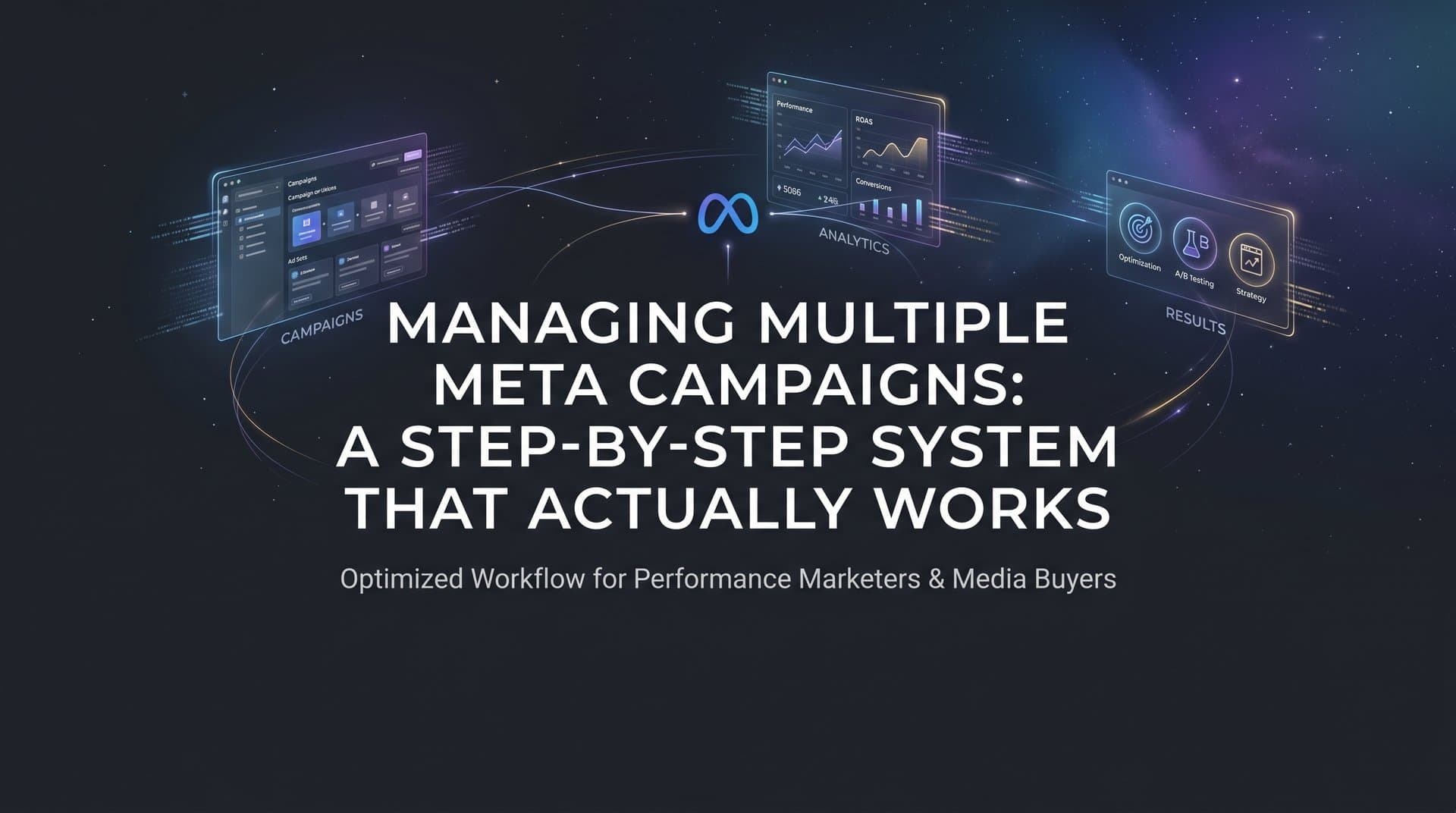
Let's be direct about something: managing multiple Meta campaigns isn't hard because you lack skill. It's hard because the complexity compounds faster than any human can manually track. Add a new campaign, and you add new creatives to monitor, new audiences to watch, new budgets to balance, and new data to interpret. Do that five or ten times, and your Ads Manager starts to feel less like a control room and more like a room that's actively on fire.
The marketers who scale Meta ad accounts successfully aren't necessarily smarter or more experienced than those who struggle. They just have better systems. They've stopped trying to hold everything in their head and started building repeatable frameworks that do the thinking for them.
This guide gives you that framework. Six concrete steps that transform multi-campaign management from reactive chaos into a structured, scalable operation. You'll learn how to organize your account so it's instantly readable, build a creative pipeline that never runs dry, set rules that make optimization decisions for you, and use AI to handle the heavy lifting that currently eats your time.
A few things this guide assumes: you already know your way around Meta Ads Manager, you understand what campaign objectives are, and you're past the beginner stage. This isn't a primer on how to run Facebook ads. It's a system for running a lot of them without losing your margins or your mind.
Whether you're managing three campaigns or thirty, the same principles apply. The goal is a system that scales with your account, not a set of one-time fixes you'll forget about next month. Let's build it.
Step 1: Build a Campaign Structure You Can Actually Navigate
Before you can optimize anything, you need to be able to find it. That sounds obvious, but a surprising number of ad accounts are organized in ways that make even basic navigation a guessing game. Campaigns named after dates, random product launches, or whoever happened to build them that week create friction every single time you open Ads Manager.
Start with a consistent naming convention and apply it everywhere: campaigns, ad sets, and individual ads. A good naming structure captures the objective, audience segment, funnel stage, and creative type in a single scannable string. Something like CONV | COLD | TOF | VideoAd | Aug2026 tells you everything you need to know before you click into it. When you're managing dozens of campaigns, the ability to filter and identify assets instantly is not a luxury. It's a survival skill.
Next, organize campaigns by objective first, then by audience segment or funnel stage. Grouping by product launch date or campaign number is a habit that makes sense when you have three campaigns and becomes a disaster at thirty. When your account is structured around what each campaign is trying to accomplish and who it's talking to, patterns become visible. You can compare cold audience campaigns against each other. You can see which retargeting campaigns are pulling weight. You can spot where budget is flowing and where it's being wasted.
Use CBO strategically: Campaign Budget Optimization lets Meta distribute budget across ad sets toward the best performers automatically. For accounts managing multiple ad sets within a campaign, CBO reduces the number of manual budget decisions you need to make daily. It's not a magic fix, but it removes a significant layer of routine work.
Build a master reference document: Create a spreadsheet or shared document that maps every active campaign to its goal, target audience, creative set, and current budget. This becomes your single source of truth. When a teammate asks why a campaign exists, you have an answer. When you return from a week off, you can get up to speed in minutes.
Watch for audience overlap: Duplicate campaigns targeting the same audiences compete against each other in Meta's auction, driving up your own CPMs. Use Meta's Audience Overlap tool to diagnose this before it quietly inflates your costs.
The success indicator for this step is simple: you can open your Ads Manager and immediately understand what every campaign is doing and why. If that's not true right now, restructuring is your first priority before anything else in this guide will stick. A solid Meta ads campaign structure is the foundation everything else depends on.
Step 2: Set Up a Creative Rotation System Before You Scale
Creative fatigue is one of the most consistent performance killers in Meta advertising. As audiences see the same ad repeatedly, engagement drops, costs rise, and ROAS quietly erodes. The problem is that most marketers only notice it after the damage is done. A proper rotation system prevents that.
Start with a minimum creative threshold. Each ad set should have at least three to five distinct creatives running at any given time. This gives Meta's algorithm enough variation to optimize delivery and reduces the speed at which any single creative burns out. Running one or two creatives per ad set is one of the most common mistakes in multi-campaign management, and it's completely avoidable.
Replace ads based on frequency metrics, not calendar dates. When frequency climbs past a threshold that signals your audience has seen the ad too many times, that's your cue to refresh, not an arbitrary monthly schedule. The right threshold varies by campaign type and audience size, but watching frequency alongside CTR trends gives you an early warning before performance tanks.
Categorize your creatives: Organize every asset by format (image, video, UGC-style) and by angle (social proof, problem-solution, product demo, testimonial). When you know what types and angles are currently in rotation, you can make intentional decisions about what to add next rather than just grabbing whatever is available.
Here's where the production bottleneck usually hits. Keeping three to five creatives fresh across multiple campaigns requires a steady flow of new assets. For most teams, waiting on designers or video editors is the single biggest constraint on how fast they can test and iterate.
AdStellar's AI Creative Hub removes that bottleneck entirely. You can generate image ads, video ads, and UGC-style avatar creatives directly from a product URL, or let the AI build from scratch. No designers, no video editors, no back-and-forth feedback cycles. When a creative is fatiguing, you can have replacements ready in minutes rather than days. This is where Meta ads creative automation delivers its most immediate impact on campaign performance.
Another underused tactic: clone competitor ads directly from the Meta Ad Library. If a competitor has been running the same ad for months, it's almost certainly working for them. AdStellar lets you pull those ads and adapt the angles for your own campaigns, giving you a shortcut to test proven concepts in your market without starting from a blank page.
The success indicator here is that no ad set is running only one or two creatives, and you have a backlog of ready-to-launch assets waiting. If your creative pipeline is always empty, you're always behind. Build the backlog first, then maintain it.
Step 3: Define Clear Performance Benchmarks for Every Campaign
One of the fastest ways to slow down your optimization process is to make decisions based on how you feel about a campaign rather than what the data says. When you're managing multiple campaigns simultaneously, gut-based decisions don't scale. Rules do.
Every campaign needs a primary KPI tied to its objective. Conversion campaigns get measured on ROAS or CPA. Lead generation campaigns get measured on CPL. Top-of-funnel awareness campaigns get measured on CPC or CTR. These aren't interchangeable. Applying the wrong KPI to a campaign creates confusion and leads to bad calls.
Once you've assigned the right KPI, set specific pause thresholds. A common and practical rule: pause any ad that has spent two times your target CPA without generating a conversion. This isn't a universal law, but having a specific, documented rule means you're not staring at a struggling ad for three days wondering if you should pull it. The rule decides for you.
Document everything in your master reference document: Your benchmarks belong in the same place as your campaign structure map. When a new team member joins, or when you return to a campaign after focusing elsewhere, the benchmarks are right there. Decisions become traceable. Optimization becomes a process, not an improvisation.
AdStellar's AI Insights leaderboards make benchmark tracking significantly faster at scale. Instead of pulling data manually across multiple campaigns, leaderboards rank your creatives, headlines, copy, and audiences by real metrics like ROAS, CPA, and CTR. You set your target goals, and the AI scores everything against your benchmarks, so spotting underperformers takes seconds rather than a full analysis session. Teams that struggle with Meta ad performance tracking at scale find this kind of centralized view transformative.
Avoid benchmark bleed between funnel stages: This is a common and costly mistake. A retargeting campaign talking to warm audiences who already know your product will almost never hit the same CPA as a cold audience campaign. Holding both to the same standard means you'll either kill good retargeting campaigns too early or let bad cold campaigns run too long. Segment your benchmarks by funnel stage and set expectations accordingly.
The success indicator for this step: every optimization decision you make can be traced back to a pre-defined rule, not a feeling. When someone asks why you paused an ad, you have a specific, documented answer.
Step 4: Implement a Daily and Weekly Review Cadence
One of the most damaging habits in multi-campaign management is checking campaigns constantly without a clear purpose. Logging in six times a day to poke at numbers feels productive. It rarely is. Worse, making changes before Meta's algorithm has enough data to optimize resets the learning phase repeatedly, which actively hurts performance.
The fix is a structured review cadence with two distinct modes: a daily check and a weekly deep dive. These serve completely different purposes and should never be conflated.
The daily check (five to ten minutes): This is a triage session, not an analysis session. You're looking for three things only. First, spend pacing: is budget flowing as expected, or is something underspending or overspending dramatically? Second, frequency alerts: has any campaign crossed your fatigue threshold overnight? Third, pause triggers: has any ad hit the benchmark threshold that signals it should be turned off? If none of those conditions are met, you close the tab and move on. No tweaking, no second-guessing.
The weekly deep dive (thirty to sixty minutes): This is where actual strategic decisions happen. You're comparing performance across campaigns to identify patterns. Which audiences are consistently winning? Which creative angles are performing across multiple campaigns, not just one? Which copy variations are showing up in your top performers repeatedly? This is also when you plan the next creative batch, decide which tests to launch, and make any structural changes to campaigns. A well-defined Meta advertising campaign planning process turns these weekly sessions from open-ended reviews into focused, time-boxed decisions.
AdStellar's Winners Hub makes the weekly review significantly more efficient. Your top-performing creatives, headlines, and audiences are collected in one place with real performance data attached. Instead of digging through individual campaigns to reconstruct what's working, you start the review with a clear, organized picture. Winning elements can be selected directly from the hub and added to your next campaign without rebuilding from scratch.
Build a simple review template: Use the same questions every week. What is winning and why? What needs to be paused based on benchmarks? What new creative needs to be launched? What tests are currently running and what do the early results suggest? Consistency in your review process means you never miss anything and your sessions take a predictable amount of time.
The common pitfall to avoid: Checking campaigns too frequently and making micro-adjustments before the algorithm has enough data. Every significant change you make can trigger a new learning phase. Multiply that across multiple campaigns and you're in a constant state of reset, which means your campaigns never fully optimize. Trust your benchmarks, trust the cadence, and resist the urge to intervene without a specific rule-based reason.
The success indicator: your review sessions take a predictable amount of time and always produce a clear, prioritized action list.
Step 5: Use Bulk Launching to Test More Variables Without More Work
Testing is how you find winners. But traditional ad testing, where you build and launch ads one at a time, creates a painful tradeoff: the more variables you want to test, the more time you spend on setup. At scale, this becomes a genuine bottleneck that limits how fast you can iterate.
Bulk launching breaks that tradeoff. Instead of creating ads individually, you generate hundreds of combinations of creatives, headlines, audiences, and copy simultaneously and push them all to Meta at once. The setup time stays roughly the same whether you're launching ten combinations or two hundred. If you've been scaling Meta campaigns manually, this shift alone can reclaim hours of setup time every week.
Before you launch anything, define your hypothesis. Testing without a hypothesis produces data without insight. Know what you're trying to learn: does this creative angle outperform the current control? Does this audience segment respond better to social proof or product demos? Does shorter copy outperform longer copy for this objective? A clear hypothesis means your results build institutional knowledge, not just noise.
Test the right variables first: In the early stages of a campaign, creative angles and audience segments typically produce the largest performance differences. Minor copy tweaks matter, but they rarely move the needle as dramatically as finding the right angle or the right audience. Prioritize high-impact variables before optimizing the details.
AdStellar's Bulk Ad Launch feature is built specifically for this kind of structured testing at scale. You mix multiple creatives, headlines, audiences, and copy at both the ad set and ad level. AdStellar generates every combination and launches them to Meta at once. What would take hours of manual setup in Ads Manager happens in a few clicks. For marketers managing multiple campaigns, this is one of the highest-leverage features available because it lets you run more tests in the same amount of time without adding proportional work.
Document every test: Record the start date, the hypothesis, and the expected outcome before results come in. This discipline separates teams that accumulate genuine knowledge about their audience from teams that run tests and forget what they were testing. Over time, your test documentation becomes one of your most valuable assets: a record of what works, what doesn't, and why.
The success indicator: you are consistently running structured tests rather than making random changes, and your winning rate improves over time because you're building on documented insights rather than starting from scratch with each campaign.
Step 6: Automate Campaign Building with AI to Remove the Manual Bottleneck
Building campaigns manually is time-consuming even when you're doing it well. You're pulling historical data, evaluating which audiences performed, deciding which creatives to bring forward, writing new copy, setting budgets, and assembling everything in Ads Manager. For a single campaign, that might take a few hours. Across multiple campaigns running simultaneously, it becomes a significant drain on your most valuable resource: strategic thinking time.
AI-powered campaign builders change this equation fundamentally. Rather than starting from a blank slate every time, the AI analyzes your historical performance data and builds campaigns based on what has already worked in your specific account. It's not guessing. It's pattern-matching against real results. Understanding how AI works for Meta ads campaigns helps you set realistic expectations for what the technology can and can't do before you integrate it into your workflow.
AdStellar's AI Campaign Builder does exactly this. It analyzes your past campaigns, ranks every creative, headline, and audience by performance, and assembles complete Meta Ad campaigns in minutes. Critically, it shows you the rationale behind every decision. You can see why a particular audience was selected, why a specific creative was prioritized, and what performance signal drove each choice. This transparency matters for two reasons: it lets you catch anything that doesn't make sense before launch, and it helps you understand what patterns are actually driving performance in your account over time.
Review before you launch: AI campaign builders are powerful, but they're not infallible. Always sanity-check audience selections and budget allocations before pushing anything live. The AI is working from historical data, which means it can only optimize for patterns that already exist. If your account has a gap in its data, the AI will have a gap in its recommendations. Your job is to catch those gaps before they become expensive mistakes.
Connect accurate attribution data: AdStellar integrates with Cometly for attribution tracking. This matters because the AI learns from conversion data. If that data is inaccurate, the AI's recommendations will be too. Meta's reported metrics and actual business outcomes don't always align, especially in accounts with overlapping audiences. Accurate attribution ensures the AI is optimizing toward real results, not just reported ones.
The compounding advantage: The longer you use an AI campaign builder, the better it gets at your specific account. It learns which creative types resonate with your audiences, which copy angles convert, which audience segments are worth prioritizing. This creates a compounding advantage over time. Campaigns built six months into using the system will outperform campaigns built on day one, because the AI has more signal to work from. Teams exploring Meta ads campaign automation at a broader level will find this compounding effect is one of the strongest arguments for adopting AI-driven workflows early.
The success indicator: campaign setup time drops significantly, and new campaigns consistently launch with stronger baseline performance than the manually built campaigns that preceded them.
Putting It All Together: Your Multi-Campaign Management Checklist
Managing multiple Meta campaigns stops being difficult when you stop managing them manually. The six steps in this guide aren't a collection of isolated tactics. They're a connected system where each piece reinforces the others. A clear structure makes your benchmarks easier to apply. Your benchmarks make your review cadence faster. Your review cadence makes your bulk tests more focused. Your bulk tests feed better data into your AI campaign builder. The system compounds.
Before you move on, run through this checklist to confirm your foundation is in place:
Naming conventions set: Every campaign, ad set, and ad follows a consistent, readable naming structure.
Creative minimums met: Every active ad set has at least three to five distinct creatives in rotation, with a backlog ready to launch.
Benchmarks documented: Every campaign has an assigned primary KPI and a specific pause threshold recorded in your master reference document.
Review schedule blocked: Daily triage (five to ten minutes) and weekly deep dives are on your calendar as non-negotiable recurring sessions.
Bulk tests running: You have at least one structured test active with a documented hypothesis and expected outcome.
AI campaign builder connected: Historical data is feeding into your campaign build process, and attribution tracking is in place to ensure the AI learns from accurate conversion data.
The goal is a system that scales with you. When you add new campaigns, they slot into the existing structure. When you need new creatives, the pipeline is already running. When you need to make optimization decisions, the benchmarks make them for you.
If you want to implement the AI-powered steps in this guide immediately, Start Free Trial With AdStellar and get seven days to see how the AI Creative Hub, Campaign Builder, Bulk Ad Launch, and Winners Hub work together as a complete system. Campaign complexity is manageable. You just need the right structure and the right tools in place to handle it.