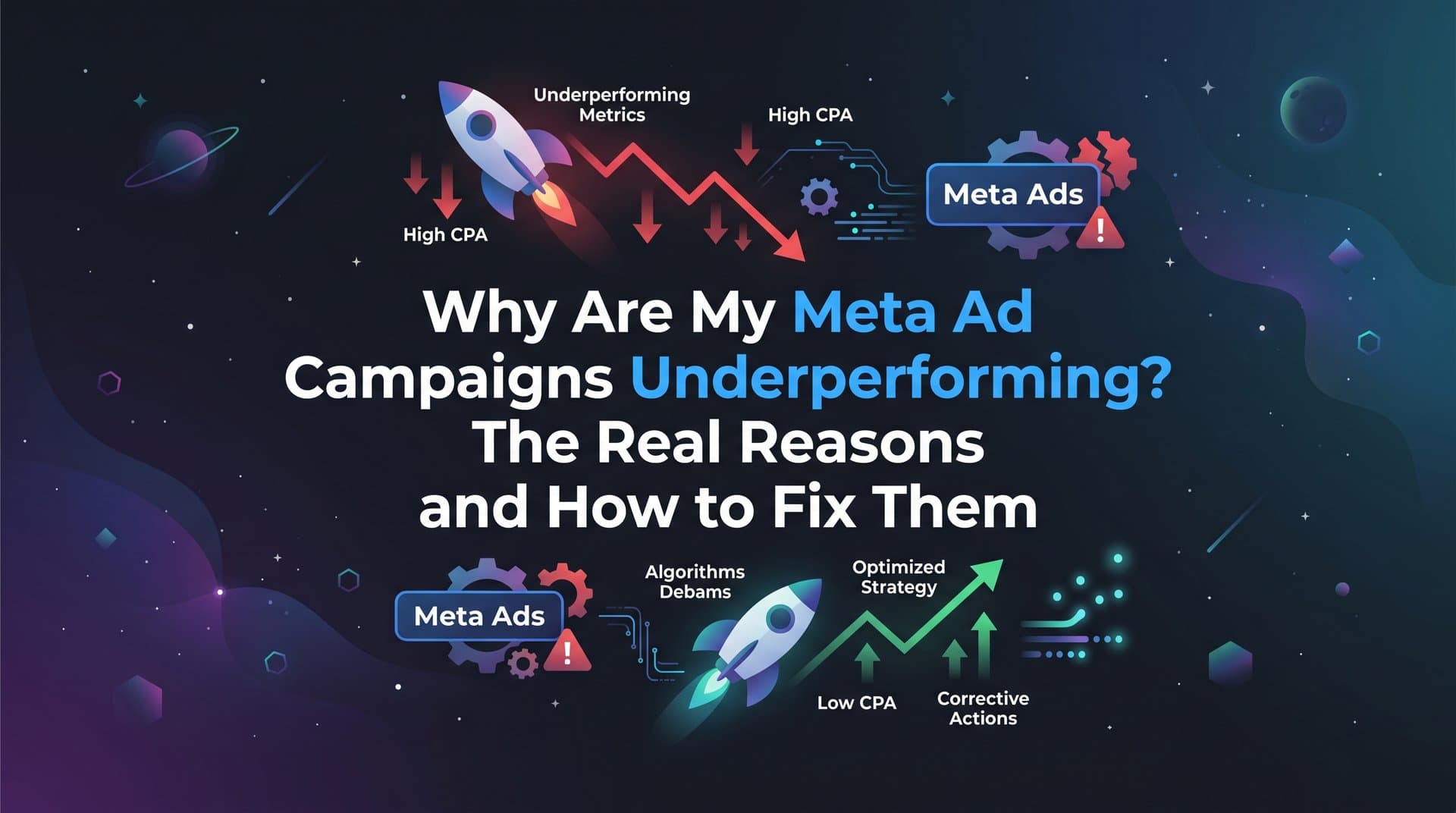
Meta ad campaigns are supposed to drive growth. You set them up, fund them, and wait for the results. But sometimes the results just do not come. The budget drains, the metrics look mediocre, and you are left wondering whether the problem is your creative, your audience, your bidding strategy, or something else entirely.
If this sounds familiar, you are not alone. Underperforming Meta ad campaigns are one of the most common frustrations in digital marketing, and the reasons are rarely obvious from the surface. A campaign can look perfectly structured on paper and still fail to deliver. That is not a reflection of your skill as a marketer. It is a reflection of how many moving parts are involved in making Meta ads work.
This article is a diagnostic guide. Rather than a beginner walkthrough of how to set up ads, it is designed for advertisers who are already running campaigns and wondering why they are not performing as expected. We will walk through the real root causes, from creative fatigue and targeting misalignment to tracking gaps and optimization missteps, and give you a clear framework for identifying and fixing what is actually broken.
The Hidden Culprits Behind Poor Campaign Performance
When a Meta campaign underperforms, the instinct is often to blame the budget or the audience. But the causes tend to run deeper, and three in particular are responsible for a large share of struggling campaigns.
Creative fatigue: This is one of the most overlooked reasons campaigns plateau. When the same audience sees the same ad repeatedly, engagement drops. Click-through rates fall, frequency climbs, and costs rise. Meta's algorithm interprets declining engagement as a signal to reduce delivery or increase the cost of reaching people. The creative that drove strong results in week one can become a liability by week four if it has not been refreshed. Rotating creatives and introducing new formats regularly is not optional at scale. It is a core part of keeping campaigns alive.
Audience targeting misalignment: Ad sets that reach people who are too broad, too narrow, or already saturated with your messaging will underperform regardless of how good your creative is. Over the past few years, Meta's best practices have shifted toward broader targeting with algorithmic refinement, particularly through tools like Advantage+ audiences. Many advertisers are still running tightly segmented ad sets built around older targeting logic, which fragments budget and prevents the algorithm from finding the people most likely to convert.
Campaign structure problems: The way your campaigns are organized has a direct impact on how well Meta's algorithm can do its job. Over-segmented ad sets compete with each other in the auction, split your budget inefficiently, and prevent any single ad set from accumulating enough data to optimize properly. Conflicting objectives across campaigns, for example running a traffic campaign and a conversion campaign to the same audience simultaneously, can also create internal competition that drives up costs without improving results.
Meta's algorithm needs data to learn. When your structure is fragmented, the learning is fragmented too. Consolidating ad sets, aligning objectives with actual business goals, and giving each ad set enough budget to gather meaningful signals are foundational fixes that often produce immediate improvements.
The challenge is that none of these problems are visible at a glance. You need to look at frequency data to catch creative fatigue, audience overlap reports to spot targeting conflicts, and campaign architecture to identify structural inefficiencies. Most advertisers only look at top-line metrics like ROAS and CPA, which tell you something is wrong but not where to look.
When Your Ad Creative Is Working Against You
Creative is the single most influential variable in Meta ad performance. Two campaigns with identical targeting, budgets, and objectives can produce wildly different results based on creative quality alone. Yet creative problems are often the last thing advertisers investigate when campaigns underperform.
Low-quality or generic creatives: The Meta feed is relentlessly competitive. Users scroll fast, and your ad has a fraction of a second to earn attention before it disappears. Generic stock imagery, cluttered layouts, or headlines that could apply to any brand in any category will not stop the scroll. The visual format matters as much as the message. A static image that works on a desktop feed may fall flat in Stories. A video that performs well for a warm retargeting audience may feel out of place to a cold prospecting audience seeing your brand for the first time.
Creative-to-audience fit: Even a well-designed ad can underperform if the tone, style, or offer does not match the specific audience seeing it. A high-energy UGC-style video might resonate with a younger prospecting audience but feel jarring to existing customers being retargeted with a loyalty offer. A polished product image might work for a premium brand audience but miss the mark with a value-driven segment. The message and the messenger need to match the person receiving them, and this requires intentional thinking about who is actually in each ad set.
Testing too few creative variations: This is where many advertisers fly blind. Running one or two creatives per ad set gives you almost no signal about what is actually driving or limiting performance. Without enough variety, you cannot identify whether a weak result is caused by the image, the headline, the copy, the offer, or the format. You need multiple variations running simultaneously to generate the comparative data that makes optimization possible.
The practical challenge here is volume. Creating enough creative variations to run meaningful tests is time-consuming and expensive when done manually. This is where AI-powered creative generation changes the equation. Platforms like AdStellar let you generate image ads, video ads, and UGC-style creatives from a product URL, clone competitor ads directly from the Meta Ad Library, and refine any ad through chat-based editing. Instead of spending days briefing designers and waiting for revisions, you can produce dozens of creative variations quickly and get them into testing rotation immediately.
The goal is not to produce more ads for the sake of volume. It is to generate enough variation that the algorithm has real options to work with, and that you have real data to learn from. Creative testing at scale is how you move from guessing to knowing.
Tracking Gaps That Make Every Decision a Guess
Here is a scenario that plays out more often than most advertisers realize: a campaign appears to be underperforming based on Meta's reporting, but the actual business results tell a different story. Or the reverse, a campaign looks profitable in Meta Ads Manager but the revenue simply is not showing up. Both situations trace back to the same root cause: tracking gaps.
Broken or incomplete conversion tracking: Meta's algorithm optimizes toward the conversion events you tell it to prioritize. If your pixel is misfiring, your conversion events are not configured correctly, or your Conversions API is not passing server-side data, the algorithm is optimizing toward incomplete or inaccurate signals. It may be chasing proxy metrics like link clicks or landing page views rather than actual purchases or leads. This is a particularly significant problem in the post-iOS privacy landscape, where browser-based pixel tracking alone often undercounts conversions substantially. Server-side tracking via Meta's Conversions API has become increasingly important for maintaining data quality.
Attribution window mismatches: Meta's default attribution settings may not align with your actual sales cycle. If your product typically takes several days of consideration before a purchase, a 1-day click attribution window will undercount conversions and make your campaigns look less profitable than they are. Conversely, a broad attribution window can overcount by crediting Meta for conversions that were influenced by other channels. Understanding your attribution settings and aligning them with your actual customer journey is essential for making accurate decisions.
Lack of granular performance data: Even when tracking is working correctly, many advertisers only look at campaign-level metrics. Without reliable performance data broken down by creative, audience, copy, and landing page, you cannot diagnose what is actually broken. A campaign with a poor overall ROAS might contain one ad set with excellent performance that is being dragged down by others. Without that granularity, you might pause the whole campaign when you should have paused two ad sets and scaled the third.
AdStellar's integration with Cometly for attribution tracking addresses this directly, giving advertisers a cleaner view of which campaigns, creatives, and audiences are driving real business outcomes rather than relying solely on Meta's native reporting.
The Testing and Optimization Mistakes Most Advertisers Make
Even advertisers who have solid creative, clean tracking, and sensible campaign structure can undermine their results through poor optimization habits. These mistakes are extremely common, and they often come from a place of good intentions.
Killing ads too early: Meta's learning phase requires each ad set to accumulate roughly 50 optimization events before the algorithm stabilizes delivery. This is documented in Meta's own Business Help Center and is a foundational principle of how the platform works. Pausing or editing an ad set before it exits the learning phase denies the algorithm the data it needs to find its optimal audience and delivery pattern. Many advertisers see a weak first few days and pull the plug before the campaign has had a real chance to perform. Patience during the learning phase is not passive. It is strategic.
Making too many changes at once: Every significant edit to an ad set, whether it is a budget change, audience adjustment, or creative swap, resets the learning phase. When you make multiple changes simultaneously, you also lose the ability to understand which change caused a shift in performance. Good optimization is methodical. Change one variable at a time, give it enough time and budget to generate meaningful data, then evaluate and iterate. This is the same principle behind proper A/B testing: isolate variables to learn from them.
Scaling budgets too aggressively: When a campaign shows early promise, the natural impulse is to pour more budget into it immediately. But aggressive budget increases disrupt delivery, inflate CPMs, and force the algorithm back into a learning phase before it has found its optimal audience. Gradual budget scaling, typically in increments that give the algorithm time to adjust, tends to produce more stable and sustainable results than large sudden increases.
The common thread across all three of these mistakes is impatience. Meta's algorithm needs time and data to work. Giving it that space, while resisting the urge to constantly intervene, is one of the most underrated skills in performance marketing.
How AI-Powered Platforms Change the Underperformance Equation
The diagnostic work described in this article is valuable, but it is also time-intensive. Manually auditing creatives, reviewing audience overlap, checking attribution settings, and iterating on campaign structure requires significant expertise and hours of analysis. This is where AI-powered ad platforms are fundamentally changing what is possible for individual marketers and agencies alike.
Removing guesswork from campaign building: Rather than relying on intuition or past experience to decide which creatives, headlines, audiences, and copy combinations to use, AI can analyze your historical campaign data and identify which elements have actually driven results. AdStellar's AI Campaign Builder does exactly this. It analyzes past campaigns, ranks every creative, headline, and audience by real performance metrics, and builds complete Meta ad campaigns in minutes. Every decision comes with a transparent explanation so you understand the strategy behind it, not just the output. And the system gets smarter with each campaign it processes.
Bulk creative generation and variation testing: One of the biggest barriers to effective creative testing is the sheer volume of work required to produce enough variations. AdStellar's Bulk Ad Launch feature lets you mix multiple creatives, headlines, audiences, and copy at both the ad set and ad level. The platform generates every combination and launches them to Meta in clicks rather than hours. Instead of manually building and launching one ad at a time, you can run dozens of variations simultaneously and let performance data determine which combinations deserve more budget.
Continuous performance scoring and winner identification: AdStellar's AI Insights feature includes leaderboards that rank your creatives, headlines, copy, audiences, and landing pages by real metrics including ROAS, CPA, and CTR. You set your target goals and the AI scores everything against your benchmarks, so you can instantly identify what is working rather than spending hours pulling reports and building pivot tables. The Winners Hub collects your best-performing creatives, headlines, and audiences in one place with real performance data attached, so you can select any winner and add it directly to your next campaign.
This kind of continuous feedback loop addresses the core problem that causes most Meta campaigns to underperform: the gap between what you think is working and what the data actually shows. When performance scoring is automated and always on, budget naturally flows toward what drives results rather than what looks good on paper.
A Practical Diagnostic Framework for Underperforming Campaigns
If your Meta campaigns are underperforming right now, here is a structured approach to diagnosing the problem. Work through these steps in order before making any changes, because the sequence matters.
Step 1: Start with the data layer. Before drawing any conclusions about creative or audience, verify that your tracking foundation is solid. Check that your Meta pixel is firing correctly on the right pages. Confirm that your conversion events are configured to track the outcomes that actually matter to your business. Review your Conversions API setup to ensure server-side data is being passed accurately. Check your attribution window settings and make sure they align with your sales cycle. None of the analysis that follows is reliable if the data feeding it is incomplete or inaccurate.
Step 2: Audit your creatives against your audience segments. Pull performance data at the ad level and look for relevance gaps. Are certain creatives generating high CPMs with low CTR? That typically signals a creative-to-audience fit problem. Are frequency scores rising while engagement metrics fall? That is creative fatigue. Map each creative to the audience seeing it and ask honestly whether the tone, format, and offer are appropriate for that specific segment. Use performance data to rank what is working at each funnel stage, prospecting versus retargeting, and identify which creatives deserve more investment versus which need to be replaced.
Step 3: Review campaign structure and budget allocation. Look at whether your ad sets are competing with each other in the auction. Check for audience overlap between ad sets targeting similar segments. Evaluate whether your campaign objectives align with where each audience is in the buying journey. A conversion objective makes sense for a warm retargeting audience but may be premature for a cold prospecting audience that has never heard of your brand. Ensure budget is concentrated enough in each ad set to generate the optimization events needed to exit the learning phase. Following Meta ads campaign structure best practices can help you avoid the most common architectural mistakes.
Step 4: Evaluate your testing methodology. Are you running enough creative variations to generate meaningful comparative data? Are you giving tests enough time and budget before drawing conclusions? Are you changing one variable at a time so you can actually learn from the results? If you have been making frequent changes reactively, consider stabilizing your campaigns for a defined period and letting the algorithm accumulate data before intervening again.
Step 5: Build a systematic improvement cycle. Underperforming campaigns are rarely fixed with a single change. The goal is to establish a repeatable process: test new creatives regularly to combat fatigue, review performance data at the granular level weekly, make one structural change at a time and document the result, and continuously feed winning elements back into new campaigns. This is what separates advertisers who consistently improve from those who are always starting over.
Turning Diagnosis Into Results
Underperforming Meta ad campaigns almost always trace back to a combination of factors rather than a single cause. Creative fatigue accumulates quietly while you are focused on audience settings. Tracking gaps distort the data you are using to make decisions. Structural problems fragment the algorithm's learning. Optimization missteps undo the progress you have made. The frustration is real, but so is the path forward.
The key insight is that reactive changes rarely fix systematic problems. Pausing an ad because it looks bad today, or doubling the budget because yesterday's numbers looked promising, is not optimization. It is noise. A structured diagnostic approach, working through data integrity, creative relevance, campaign structure, and testing methodology in a deliberate sequence, gives you a real foundation for improvement.
The good news is that the tools available to Meta advertisers today make this process significantly faster and more reliable than it used to be. AI-powered platforms can surface the insights that used to require hours of manual analysis, generate the creative volume that used to require a full production team, and continuously score performance so winning elements are always visible.
AdStellar brings all of this together in one platform. From generating scroll-stopping image ads, video ads, and UGC-style creatives to building complete Meta campaigns with AI, launching hundreds of ad variations in minutes, and surfacing your winners with real-time leaderboard insights, it is designed to eliminate the guesswork that causes most campaigns to underperform. Start Free Trial With AdStellar and launch and scale your ad campaigns faster with an intelligent platform that automatically builds and tests winning ads based on real performance data.