Scaling Meta ads sounds straightforward on paper: find what works, spend more money, watch results multiply. In practice, it rarely plays out that way. Advertisers who scale too fast often watch their ROAS collapse. Those who scale too slowly leave revenue on the table. And many get stuck somewhere in the middle, unsure why a campaign that performed brilliantly at $100/day falls apart at $500/day.
Meta ad scaling challenges are not just budget problems. They are creative problems, audience problems, structural problems, and data problems all happening at once. Audiences saturate. Ad fatigue sets in faster than your creative team can produce new assets. Winning campaigns stop winning without warning. Attribution gets murky at higher spend levels. And the operational complexity of managing hundreds of ad variations manually becomes unsustainable fast.
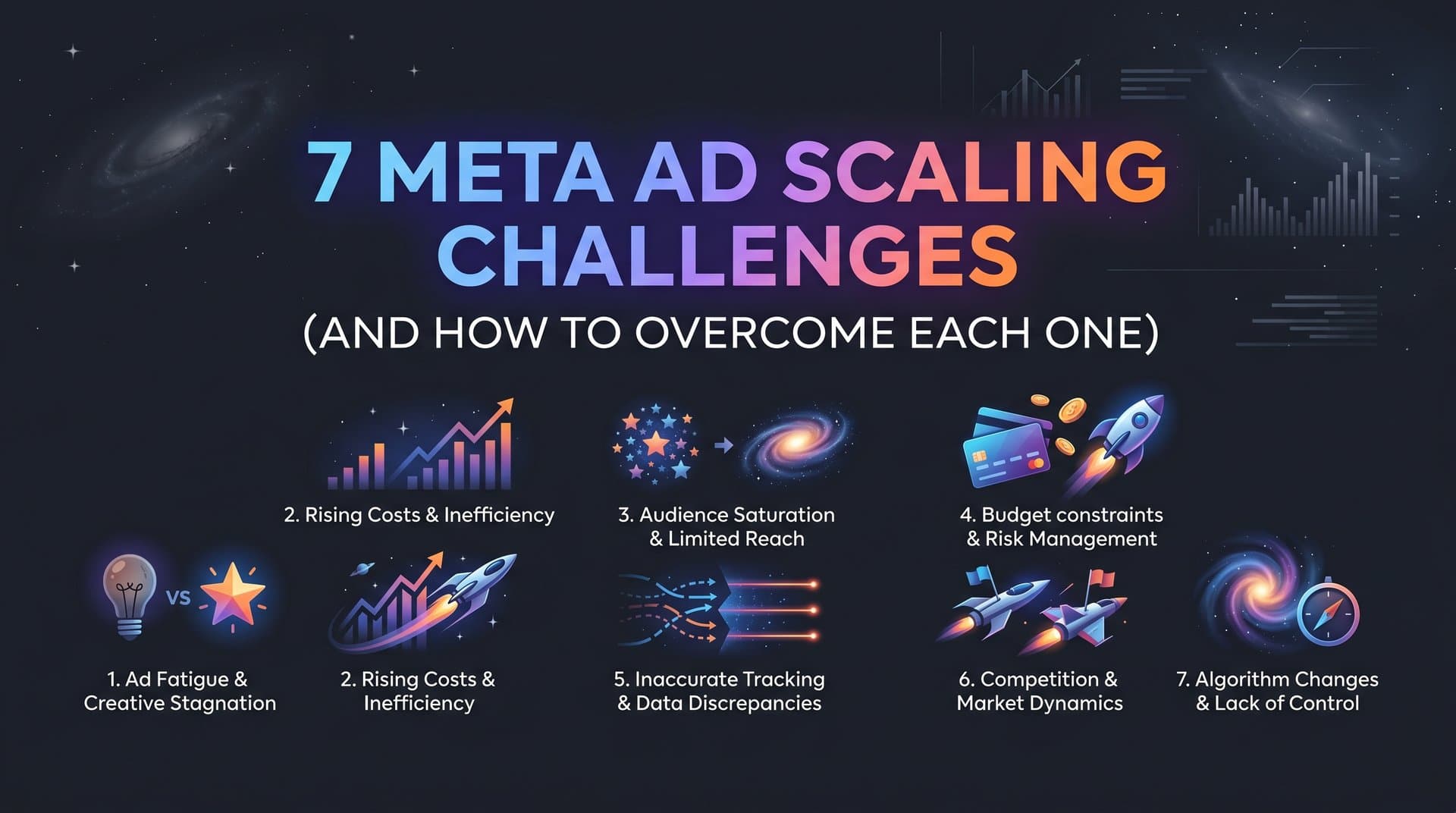
This guide breaks down the seven most common Meta ad scaling challenges performance marketers face and gives you a concrete strategy for tackling each one. Whether you are managing a growing DTC brand, running campaigns for agency clients, or trying to push a proven offer to a larger audience, these strategies will help you scale with confidence rather than guesswork.
Each section addresses a distinct obstacle. So rather than reading this as a general overview, use it as a diagnostic tool. Identify exactly where your scaling efforts are breaking down, and apply the right fix for that specific problem.
1. Creative Fatigue Kills Momentum Before You Can Scale
The Challenge It Solves
As your budget increases, your target audience sees your ads more frequently. Frequency climbs. Engagement drops. CPMs rise. What started as a winning creative slowly becomes wallpaper that users scroll past without a second glance. Creative fatigue does not just reduce performance gradually. It can cause a previously strong campaign to collapse seemingly overnight, leaving you scrambling to diagnose what changed.
The Strategy Explained
The solution is not to produce more ads reactively when fatigue hits. It is to build a systematic creative refresh pipeline that runs continuously in the background. This means having a steady supply of new image ads, video ads, and UGC-style content ready to rotate in before performance starts to decline.
Meta's own guidance recommends monitoring frequency as an early warning signal. Different formats also fatigue at different rates. Video ads, UGC-style content, and static image ads each have their own engagement curves, so rotating across formats extends the effective lifespan of your messaging without requiring entirely new creative concepts every time.
Competitor research is another underused lever. The Meta Ad Library is publicly accessible and lets you view active ads from any advertiser. Studying what competitors are running gives you creative intelligence that can inform your own refresh strategy.
Implementation Steps
1. Monitor frequency metrics weekly. When average frequency climbs past a threshold you define (many advertisers use 3-4 as a signal), treat it as a trigger to introduce fresh creative.
2. Build a creative queue using AI-generated assets. Platforms like AdStellar let you generate image ads, video ads, and UGC-style avatar content from a product URL, or clone competitor ads directly from the Meta Ad Library, so you always have new variations ready to deploy.
3. Rotate formats deliberately. If your current rotation is heavy on static images, introduce video or UGC-style content to reach the same audience with a different sensory experience.
4. Use chat-based creative refinement to iterate on existing winners rather than always starting from scratch. Small changes to visuals, copy overlays, or hooks can meaningfully extend a creative's lifespan.
Pro Tips
Do not wait for performance to drop before refreshing creatives. Build the habit of introducing new variations proactively every two to three weeks at scale. The advertisers who scale most successfully treat creative production as a continuous operation, not a reactive one. Having an AI creative tool in your workflow removes the bottleneck of depending on designers or video editors to keep up with demand.
2. Audience Saturation Drains Performance as Budgets Grow
The Challenge It Solves
When you increase spend on a tightly defined audience, you exhaust that pool faster. The same people see your ads repeatedly. Cost per acquisition climbs. Reach starts to compress. Many advertisers interpret this as a creative problem when it is actually an audience problem. No matter how good your creative is, if you are showing it to the same saturated segment over and over, performance will deteriorate.
The Strategy Explained
Sustainable scaling requires expanding your audience strategy in parallel with your budget. This means layering multiple audience types rather than relying on a single tight segment. Lookalike audiences are a core tool here. Expanding from a 1% lookalike to broader tiers (2-5% or higher) increases your reachable pool while still maintaining relevance based on your best customer data.
Broad targeting has also become increasingly viable as Meta's algorithm has matured. Many performance marketers find that minimal audience restrictions, combined with strong creative and compelling offers, allow Meta's algorithm to find buyers across a much wider pool than manual targeting would identify. Results vary by industry and offer, but it is worth testing alongside structured lookalike expansion.
Implementation Steps
1. Audit your current audience structure. Identify which ad sets are targeting the same or overlapping segments and consolidate or diversify accordingly.
2. Build a tiered lookalike strategy. Run 1%, 2-3%, and 4-5% lookalikes simultaneously, treating each tier as a separate audience layer with its own budget allocation.
3. Test broad targeting alongside your structured audiences. Launch an ad set with minimal restrictions and let Meta's algorithm optimize delivery, comparing performance against your more defined segments.
4. Use AI-powered targeting tools to identify high-value audience segments based on behavioral and demographic signals without requiring manual audience research for every new campaign.
Pro Tips
Audience expansion is not about reaching everyone. It is about reaching more of the right people. When you layer broad, interest-based, and lookalike audiences across separate ad sets, you give Meta's algorithm more surface area to find buyers while protecting against any single segment becoming saturated. Review audience overlap regularly as you add new ad sets to avoid competing against yourself.
3. Budget Scaling Triggers the Learning Phase Reset
The Challenge It Solves
Meta's learning phase is the period during which its algorithm gathers data to optimize delivery. Once an ad set exits the learning phase, performance stabilizes. The problem is that significant budget increases can push ad sets back into learning, causing a temporary but sometimes severe performance dip. Many advertisers make the mistake of interpreting this instability as a campaign failure and pulling the plug before the algorithm has a chance to restabilize.
The Strategy Explained
The key is protecting algorithm stability while still moving budgets upward. Meta's documented guidance suggests that large, sudden budget increases (commonly discussed as jumps of more than 20-25% at once) are more likely to trigger a learning phase reset than gradual increases. Incremental scaling, where you increase budgets in smaller steps over time, reduces this risk significantly.
Campaign consolidation is another important structural lever. Fewer ad sets with larger individual budgets give the algorithm more data per ad set, which helps it exit the learning phase faster and stay out of it longer. Advantage Campaign Budget (formerly CBO) can also help by distributing spend automatically across ad sets in ways that maintain learning phase stability.
Implementation Steps
1. Scale budgets incrementally rather than in large jumps. Many advertisers use a rule of increasing budgets by no more than 20% at a time, waiting several days between increases to allow the algorithm to adjust.
2. Consolidate your campaign structure. If you have many small ad sets with fragmented budgets, consider merging them into fewer, larger ad sets to give the algorithm more data to work with.
3. Enable Advantage Campaign Budget on campaigns where you want Meta to distribute spend efficiently across multiple ad sets without manual allocation.
4. Monitor learning phase status in Ads Manager. If an ad set re-enters learning after a budget change, give it time to stabilize before making additional changes.
Pro Tips
Patience is genuinely a competitive advantage during budget scaling. The advertisers who scale most smoothly are the ones who resist the urge to make multiple changes simultaneously. Change one variable at a time, give the algorithm space to respond, and only then make the next adjustment. This disciplined approach feels slow in the moment but produces far more stable performance curves over time.
4. Testing at Scale Becomes Operationally Overwhelming
The Challenge It Solves
At small budgets, testing a handful of creative and audience combinations manually is manageable. At scale, the number of combinations you need to test to find winners grows exponentially. Manually creating and launching hundreds of ad variations is time-intensive, error-prone, and simply not sustainable. Most teams end up testing far fewer combinations than they should, which means they miss winning variations that could significantly improve performance.
The Strategy Explained
The solution is to automate variation generation and launch. Bulk ad creation tools let you define your creative assets, headlines, copy, and audience segments once, and then generate every combination automatically. What would take days of manual work in Ads Manager can be accomplished in minutes.
Dynamic Creative Optimization (DCO) is Meta's native version of this approach, allowing you to upload multiple creative components and let the algorithm identify the best-performing combinations in real time. Combining DCO with external bulk launching tools gives you both breadth of testing and speed of execution.
Implementation Steps
1. Define your testing matrix before launching. List every creative variation, headline, copy variant, and audience segment you want to test. This structure makes bulk generation straightforward.
2. Use AdStellar's Bulk Ad Launch feature to mix multiple creatives, headlines, audiences, and copy at both the ad set and ad level. AdStellar generates every combination and launches them to Meta in clicks, not hours.
3. Enable Dynamic Creative Optimization within Meta for campaigns where you want the algorithm to automatically identify the best-performing asset combinations within an ad set.
4. Set clear performance benchmarks before launching so you have objective criteria for identifying winners and cutting underperformers quickly.
Pro Tips
The goal of bulk testing is not to run as many ads as possible. It is to generate enough real performance data to make confident decisions quickly. Structure your tests so each variable is isolated where possible, making it easier to understand which specific element drove performance differences. More data, faster, with less manual work is the operational advantage that separates scalable teams from those stuck in spreadsheets.
5. Attribution Gaps Make It Hard to Know What Is Actually Working
The Challenge It Solves
At lower spend levels, Meta's native attribution is often good enough to guide decisions. At higher spend levels, the picture gets murkier. Different attribution windows (1-day click, 7-day click, 1-day view, 7-day view) can produce dramatically different reported ROAS figures for the same campaign. Cross-device journeys, iOS privacy changes, and longer consideration cycles all create gaps between what Meta reports and what is actually driving conversions. Scaling decisions made on unreliable attribution data are, at best, educated guesses.
The Strategy Explained
The fix is layering third-party attribution on top of Meta's native reporting to get a more complete and trustworthy picture of performance. Third-party platforms use first-party data and multi-touch attribution models that are not dependent on Meta's pixel alone, giving you a more accurate view of which campaigns, creatives, and audiences are genuinely driving revenue.
Goal-based performance scoring adds another layer of clarity. Rather than evaluating ads purely on Meta's reported metrics, you define your actual business goals (target ROAS, target CPA, target CTR) and score every ad element against those benchmarks. This makes it much easier to compare performance across campaigns and make scaling decisions with confidence.
Implementation Steps
1. Audit your current attribution setup. Understand which attribution window Meta is using for your campaigns and how that affects reported performance numbers.
2. Integrate a third-party attribution platform. AdStellar integrates with Cometly, which provides multi-touch and first-party data attribution that supplements Meta's native reporting, particularly valuable at higher spend levels where customer journeys are more complex.
3. Set consistent attribution windows across all campaigns so performance comparisons are apples-to-apples rather than skewed by different measurement approaches.
4. Use goal-based scoring to evaluate every creative, audience, and campaign against your defined benchmarks rather than relying solely on platform-reported metrics.
Pro Tips
Attribution is not a set-it-and-forget-it task. As you scale, customer journeys become more complex and the gap between reported and actual performance can widen. Review your attribution setup regularly, especially after significant budget increases or structural campaign changes. The advertisers who scale most confidently are the ones who trust their data, and that trust is built on attribution infrastructure, not assumptions.
6. Identifying Winners Fast Enough to Reinvest in Them
The Challenge It Solves
Slow winner identification is one of the most expensive inefficiencies in Meta advertising. While you are waiting to accumulate enough data to confidently identify a top performer, budget is flowing to underperformers. And once you do identify a winner, the process of extracting that insight and redeploying it in a new campaign is often manual and time-consuming. At scale, this delay compounds into significant wasted spend.
The Strategy Explained
The solution is a structured system for ranking performance and surfacing winners in real time. Leaderboard-style rankings that sort creatives, headlines, copy, and audiences by actual metrics like ROAS, CPA, and CTR make it immediately obvious what is working and what is not. You do not need to dig through spreadsheets or cross-reference multiple reports. The ranking does the analysis for you.
Equally important is having a centralized place to store and redeploy proven assets. When your best-performing creatives, headlines, and audience configurations are organized in one place with their performance data attached, adding them to new campaigns becomes a fast, low-risk decision rather than a research project.
Implementation Steps
1. Use AdStellar's AI Insights leaderboards to rank your creatives, headlines, copy, audiences, and landing pages by real metrics. Set your target goals and let AI score everything against your benchmarks so top performers surface automatically.
2. Define a minimum data threshold before calling a winner. Establish how much spend or how many impressions an ad needs before you make a scaling decision, so you are not acting on statistically insignificant early results.
3. Move proven assets to AdStellar's Winners Hub immediately. This centralizes your best-performing creatives, headlines, and audiences with their real performance data, ready to be pulled into any new campaign instantly.
4. Build a regular review cadence. Schedule weekly winner identification sessions where you review leaderboard rankings, update your Winners Hub, and flag top performers for reinvestment in upcoming campaigns.
Pro Tips
Reusing proven assets is not laziness. It is smart scaling. Every time you launch a new campaign anchored by a confirmed winner, you reduce risk and accelerate time to performance. Think of your Winners Hub as a library of validated creative intelligence. The bigger and more current it is, the faster every subsequent campaign can get off the ground and start performing.
7. Scaling Without a System Creates Chaos, Not Growth
The Challenge It Solves
Ad-hoc scaling decisions produce inconsistent results. When each campaign is built differently, tested differently, and evaluated differently, there is no way to learn systematically from what works. You end up re-solving the same problems repeatedly, making the same structural mistakes, and relying on individual judgment calls that do not transfer across campaigns or team members. At a certain point, the complexity of managing a scaled Meta ad operation without a repeatable system becomes the biggest obstacle to growth.
The Strategy Explained
Building a repeatable scaling playbook means connecting every part of your workflow into a coherent system. Creative generation feeds into bulk launching. Bulk launching feeds into performance tracking. Performance tracking feeds back into creative generation and campaign building. Each step informs the next, and the system improves with every cycle.
AI-powered campaign building is a critical component of this loop. Rather than manually analyzing past performance data to decide which creatives, headlines, and audiences to include in a new campaign, AI agents can do that analysis automatically, rank every element by performance, and build complete campaigns in minutes. Full transparency into the AI's reasoning means you understand the strategy, not just the output, which makes it easier to refine and improve over time.
Implementation Steps
1. Document your current workflow from creative briefing to campaign launch to performance review. Identify every manual step that could be automated or systematized.
2. Use AdStellar's AI Campaign Builder to automate the analysis and campaign construction process. The AI analyzes your past campaigns, ranks every creative, headline, and audience by performance, and builds complete Meta Ad campaigns in minutes with full explanations for every decision.
3. Establish a consistent campaign structure template. Standardize how you name campaigns, organize ad sets, set budgets, and define testing parameters so every campaign follows the same logical structure.
4. Create a performance review rhythm. Weekly reviews of leaderboard rankings, Winners Hub updates, and creative refresh decisions should be scheduled, not reactive. Consistency in review cadence is what transforms a collection of campaigns into a learning system.
Pro Tips
The goal of a scaling system is not to remove human judgment. It is to focus human judgment on the decisions that actually require it: strategy, creative direction, and offer development. Everything else, the analysis, the variation generation, the campaign construction, should be handled by tools that do it faster and more consistently than any person can. When your system handles the operational complexity, you get to focus on the thinking that drives real competitive advantage.
Your Implementation Roadmap
Scaling Meta ads is not about finding one trick that unlocks unlimited growth. It is about solving a series of interconnected challenges in the right order. Start by ensuring your creative pipeline can keep up with demand. Protect your audience reach by diversifying targeting layers. Respect the learning phase by scaling budgets gradually and consolidating campaign structure. Build a testing process that generates real data without requiring manual labor at every step. Fix your attribution so you know what is actually driving conversions. Identify winners fast and have a system ready to reinvest in them. And tie it all together with a repeatable playbook that removes guesswork from every scaling decision.
The challenges in this guide do not operate in isolation. Creative fatigue and audience saturation often appear together. Attribution gaps make winner identification harder. And without a system connecting all the pieces, even solving individual problems produces inconsistent results. The advertisers who scale most successfully treat these challenges as a unified problem, not seven separate ones.
Platforms like AdStellar are built specifically for this kind of systematic scaling. From generating scroll-stopping image ads, video ads, and UGC-style creatives with AI, to bulk launching hundreds of ad variations in minutes, to surfacing winners through real-time leaderboards and goal-based scoring, AdStellar handles the operational complexity so you can focus on strategy. The AI Campaign Builder analyzes your historical data and builds complete campaigns with full transparency into every decision. The Winners Hub keeps your proven assets organized and ready to redeploy. And the Cometly integration gives you attribution data you can actually trust.
If you are ready to stop hitting scaling walls and start building a Meta ad system that grows with your ambitions, Start Free Trial With AdStellar and be among the first to launch and scale your ad campaigns faster with an intelligent platform that automatically builds and tests winning ads based on real performance data.