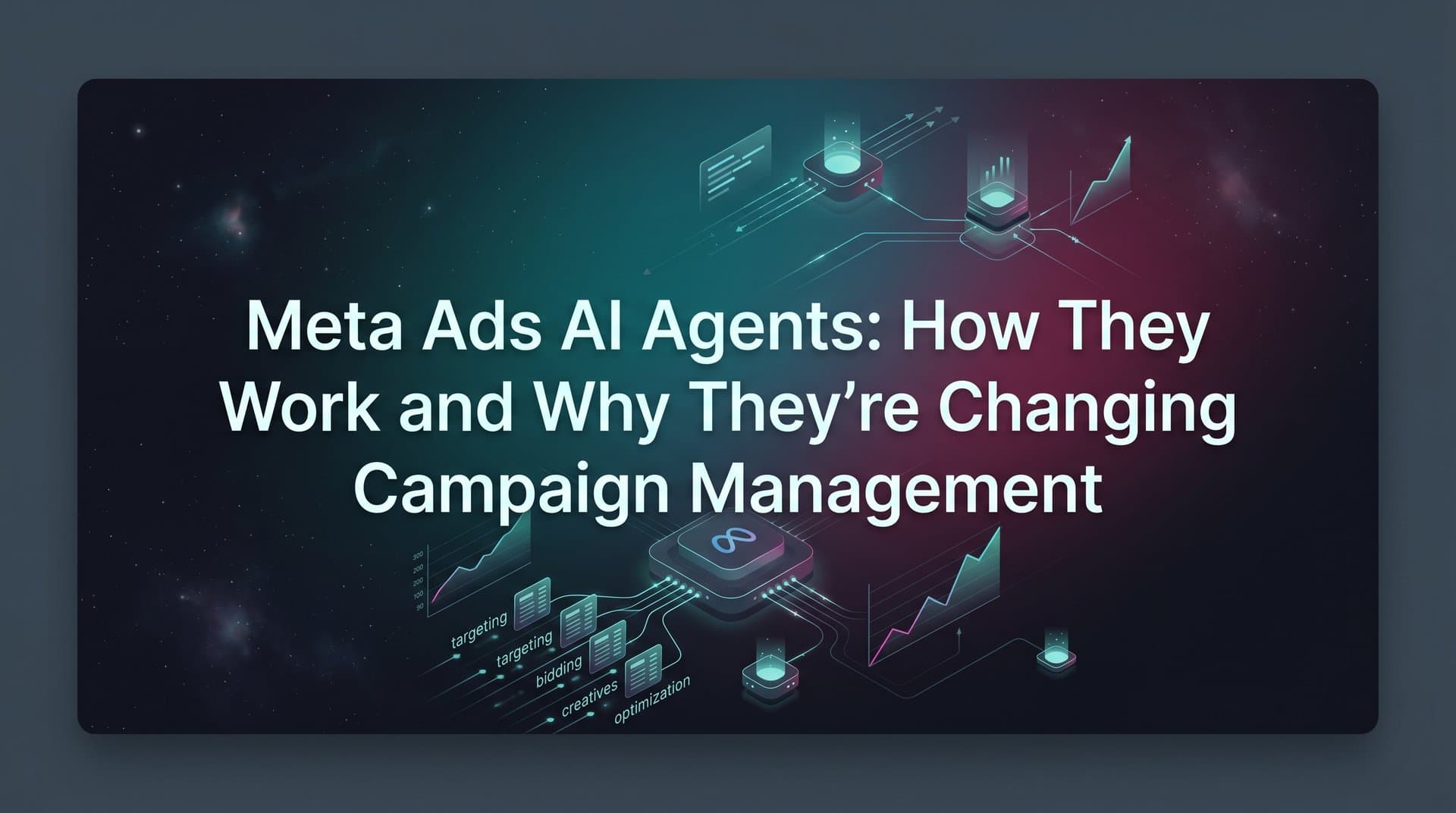
Managing Meta ads in 2026 is genuinely complex. At any given moment, you're juggling creative fatigue, audience overlap, bid competition, placement performance, and copy variations across dozens of ad sets. Most marketers handle this through a combination of gut instinct, manual adjustments, and basic automation rules. It works, until it doesn't.
The problem with manual campaign management isn't effort. It's speed and scale. The Meta auction environment shifts constantly, and the window between a creative going stale and your CPA climbing is often shorter than your next scheduled check-in. By the time you notice the signal, budget has already been wasted.
This is where Meta ads AI agents change the equation. Not by removing marketers from the process, but by handling the parts of campaign management that require continuous attention and rapid decision-making across hundreds of variables simultaneously. Think of them as a force multiplier: you set the direction, define the goals, and maintain control over brand and strategy, while the agent handles the analysis, construction, and optimization at a speed and scale no human team can match.
By the end of this article, you'll understand exactly what AI agents do inside a Meta campaign, how they differ from the basic automation you might already be using, and what the practical workflow looks like when you put them to work. Let's start with the distinction that matters most.
From Simple Automation to Intelligent Decision-Making
If your Meta campaigns already have rules set up, like pausing an ad when CPA exceeds a threshold or increasing budget when ROAS hits a target, you have automation. But you don't have an AI agent. The difference is more significant than it might seem.
Rule-based automation is reactive. You define a condition in advance, and when that condition is met, the system executes a single predefined action. It's useful, but it's fundamentally limited by what you anticipated when you wrote the rule. It can't weigh competing signals, adapt to patterns it wasn't programmed to recognize, or pursue a broader goal through a sequence of decisions.
An AI agent operates differently. Rather than waiting for a threshold to trigger a single action, an agent pursues a goal by reasoning across multiple variables and taking a sequence of steps to achieve an outcome. If the goal is lowering CPA, the agent doesn't just pause expensive ads. It analyzes which creative formats are driving the highest-quality clicks, identifies which audiences are converting at lower cost, considers how bid strategy is affecting delivery, and adjusts across all of these dimensions in a coordinated way.
This concept of "agency" is what separates these systems from conventional automation. The agent has a goal, a set of tools it can use to pursue that goal, and the ability to sequence actions intelligently rather than executing isolated tasks. It's the difference between a thermostat and a building management system that anticipates occupancy patterns, weather forecasts, and energy costs before making adjustments.
For Meta specifically, this distinction matters enormously. The platform's auction is dynamic. Ad relevance scores shift as audiences see your creative repeatedly. Competition for placements changes by time of day, day of week, and season. New audiences emerge as Meta's algorithm learns from campaign behavior. A static rule set, no matter how carefully constructed, will always lag behind these changes. An AI agent that processes multiple signals simultaneously and adjusts campaign elements in response is inherently better suited to this environment.
The practical implication: if you're evaluating whether your current setup qualifies as AI-powered, ask whether it can pursue a goal across multiple campaign dimensions without you defining every possible condition in advance. If the answer is no, you have automation, not an agent.
What Happens Inside an AI-Driven Campaign
Understanding what AI agents actually do inside a campaign removes a lot of the mystery around them. The core functions break down into three interconnected areas: analysis, construction, and ongoing optimization.
Performance Analysis: Before an agent builds anything, it analyzes historical data across every campaign element it has access to: creatives, headlines, audience segments, placements, copy variations, and landing pages. It's looking for patterns that predict future results, not just what performed well in aggregate, but which combinations of elements drove results for which audiences under which conditions. This pattern recognition is where the value of past campaign data becomes apparent. The more history the agent has to work with, the more precise its predictions.
Campaign Construction: Using those patterns, the agent selects which ad elements to combine, how to structure ad sets, and which variation combinations are most likely to perform against the stated goal. This isn't random generation. It's informed selection based on what has worked before, applied to the current campaign context. An agent building a campaign for a returning advertiser with two years of performance history will construct something very different from one starting with a blank slate.
Ongoing Optimization: Once campaigns are live, the agent continuously scores running ads against goal benchmarks. Whether the target is ROAS, CPA, CTR, or a combination, the agent measures every active element against those benchmarks in real time. Winners get flagged for scaling. Underperformers get identified early, before they drain budget. The agent surfaces this information so marketers can make informed decisions quickly, without having to manually audit dozens of ad sets to find the signal in the noise.
What ties these three functions together is the feedback loop. Analysis informs construction, construction generates performance data, and that data feeds back into the next round of analysis. Each campaign cycle makes the agent's recommendations more accurate. This compounding improvement over time is one of the most significant advantages of agent-driven campaign management compared to both manual management and static automation.
The Creative Layer: Where AI Agents Start
Ask any experienced Meta advertiser what drives performance more than anything else, and the answer is almost always creative. Audiences and budgets matter, but the creative is what stops the scroll, earns the click, and determines whether Meta's algorithm rewards your ad with favorable delivery. Everything else is optimization around the creative foundation.
This is why well-designed AI agents prioritize creative generation as the starting point of the campaign workflow. If the creative isn't strong, no amount of audience refinement or bid strategy will compensate. Getting creative right, and getting it right across multiple formats and variations, is where the agent's impact is felt most immediately.
The generation process typically starts with inputs: a product URL, a brief, or a set of brand guidelines. From there, the agent can produce image ads, video ads, and UGC-style content without requiring designers, video editors, or actors. The ability to generate UGC-style creatives is particularly valuable given how well this format performs in Meta's feed environment, where content that looks native to the platform consistently outperforms content that reads as overtly promotional.
Another capability that changes the competitive dynamic is the ability to clone competitor ads directly from the Meta Ad Library. Rather than guessing what's working in your category, an agent can analyze what competitors are running, identify patterns in their top-performing formats, and generate creative variations that compete directly with proven approaches. This turns competitor research from a manual, time-consuming task into an automated input for creative generation.
Chat-based refinement adds a layer of human control that's easy to underestimate. Once the agent generates an initial set of creatives, marketers can direct adjustments through conversation: change the tone, shift the messaging angle, adjust the format, or emphasize a different product benefit. The agent handles the production while the marketer maintains control over brand direction. This keeps the human judgment that matters, brand voice, offer positioning, and creative strategy, in the hands of the people who understand the business, while removing the production bottleneck that slows most creative testing programs down.
Platforms like AdStellar have built this creative layer directly into their AI Campaign Builder, allowing marketers to generate image ads, video ads, and UGC-style content from a product URL or by cloning competitor ads, then refine everything through chat before it ever goes live.
Building and Launching Campaigns at Scale
Once the creative layer is handled, AI agents move into campaign construction and launch. This is where the operational advantage becomes most visible, particularly for teams that have experienced how long it takes to manually build out a comprehensive testing structure.
The agent's approach to campaign construction is combinatorial. It takes multiple creatives, multiple headlines, multiple audience segments, and multiple copy variations, then generates every meaningful combination and structures them into a complete campaign. What would take a skilled media buyer several hours to build manually, the agent assembles in minutes. And because the combinations are informed by historical performance data, they're not random variations. They're structured tests designed to surface actionable insights quickly.
Transparency is a design choice that separates good AI agents from black-box tools, and it matters more than many marketers initially realize. When an agent selects a particular audience or prioritizes a specific creative combination, it should be able to explain why. Which historical signals pointed to this audience? What performance patterns suggested this creative format would work for this offer? Marketers who understand the rationale behind AI decisions can evaluate them, push back when something doesn't align with business context the agent doesn't have, and learn from the agent's analysis over time. Agents that can't explain their reasoning create dependency without understanding, which is a problem when results need to be defended or strategy needs to shift.
Bulk launching is the practical outcome of this construction process. Instead of building and launching ad sets one at a time, hundreds of ad variations go live simultaneously. This enables a scale of testing that simply isn't achievable through manual execution. The more variations running, the faster the agent can identify winners, and the sooner budget can be concentrated on what's actually converting.
For context on what this means operationally: a campaign that might have taken a full day to build and launch manually can be constructed, reviewed, and pushed live in a fraction of that time. The hours saved aren't just a convenience. They're hours that can be redirected toward strategy, offer development, and the higher-level decisions that actually require human judgment.
Surfacing Winners and Feeding the Learning Loop
Launching a large number of ad variations is only valuable if you can identify which ones are actually working. This is where the performance intelligence layer of AI agents becomes critical, and where leaderboard-style ranking changes how marketers interact with campaign data.
Rather than digging through ad manager reports to compare performance across dozens of ad sets, an AI agent surfaces rankings automatically. Every element of the campaign, creatives, headlines, copy, audiences, and landing pages, gets scored against real metrics: ROAS, CPA, CTR, and whatever goal benchmarks the marketer has set. The leaderboard view makes it immediately clear what's winning, what's underperforming, and where budget should be flowing. No manual analysis required to get to that answer.
The Winners Hub concept takes this a step further. Instead of identifying a top-performing creative and then having to track it down again when building the next campaign, winners are stored in a centralized location with their full performance data attached. When it's time to build the next campaign, proven elements are ready to pull in immediately. This eliminates the common pattern of starting from scratch with each new campaign and repeatedly testing variations of things that have already been validated or invalidated.
The continuous learning loop is what makes AI agents more valuable over time rather than just immediately useful. Every campaign that runs generates new data: which creative formats resonated with which audiences, how different headlines affected conversion rates, how bid strategies interacted with delivery patterns. That data feeds back into the agent's model, improving its predictions for the next campaign. An advertiser who has been running campaigns through an AI agent for six months will see meaningfully better recommendations than they did in month one, because the agent has more signal to work with.
This compounding improvement is one of the strongest arguments for adopting AI agents early rather than waiting. The learning curve for the agent runs in parallel with your campaigns. The sooner it starts accumulating data, the sooner its recommendations reach a level of precision that produces consistent results. Marketers looking to scale Meta ads efficiently will find this compounding data advantage particularly meaningful over time.
What to Expect When You Make the Shift
Adopting AI agents for Meta campaign management involves a genuine workflow change, and setting accurate expectations from the start makes the transition smoother and the results more meaningful.
The first thing to understand is that AI agents perform best when they have historical campaign data to learn from. An established account with months or years of performance history gives the agent rich signal to work with: it knows which creative formats have worked, which audiences have converted, and which combinations have driven the best results for your specific business. A newer account without that history will still benefit from AI-driven campaign construction and creative generation, but the recommendations will become more precise as data accumulates. This isn't a limitation unique to AI agents. It reflects the reality that all optimization, whether human or machine-driven, improves with better information.
The practical workflow shift looks like this: instead of spending time manually building campaigns, selecting audiences, writing copy variations, and configuring ad sets, marketers move into a directing role. You define the goal, provide brand inputs, and review the AI-generated strategy before approving the launch. The agent handles the construction, the combination logic, and the ongoing optimization. Your time shifts from execution to oversight and strategy.
This shift is where human judgment remains genuinely irreplaceable. Brand voice is something marketers understand in ways that require context an agent doesn't always have. Offer strategy, whether to lead with price, urgency, social proof, or a specific benefit, involves business knowledge that sits outside campaign data. And interpreting results in the context of what's happening in the broader business, a product launch, a seasonal shift, a competitive move, requires the kind of contextual reasoning that AI agents currently augment rather than replace.
The most effective use of AI agents isn't handing over control. It's directing the agent with clear goals and brand context, reviewing its output with a critical eye, and focusing your own attention on the strategic decisions that compound over time.
The Complete Picture
Meta ads AI agents represent something more significant than a new feature set. They represent a complete operational shift in how campaigns are built, launched, and optimized. The progression runs from creative generation through campaign construction to winner identification and continuous learning, and each stage feeds the next in a loop that improves with every campaign cycle.
The marketers who will get the most out of this shift are those who understand what they're directing. Creative quality, offer strategy, and brand context still require human input. What AI agents remove is the execution bottleneck: the hours spent building ad sets, the slow feedback cycles, the manual analysis required to find the signal in campaign data.
AdStellar brings all of these agent capabilities into one platform. From generating image ads, video ads, and UGC-style creatives from a product URL or by cloning competitor ads, to constructing complete Meta campaigns with full AI rationale, to bulk launching hundreds of variations and surfacing top performers through real-time leaderboard rankings and a centralized Winners Hub, the entire workflow lives in one place. The AI gets smarter with every campaign, and every decision comes with the transparency to understand why it was made.
If you're ready to move from manual campaign management to a workflow where AI handles the execution and you focus on strategy, Start Free Trial With AdStellar and experience the full campaign workflow from creative to conversion.