Marketing agencies running Meta ad campaigns for multiple clients face a compounding challenge: the more clients you take on, the harder it becomes to maintain quality, speed, and performance across every account. Manual campaign builds, one-off creative requests, and spreadsheet-based reporting eat up hours that could go toward strategy and growth.
The math is simple but brutal. If building one client campaign takes four hours, building ten takes forty. And that's before you factor in creative revisions, audience research, performance reviews, and reporting cycles. At some point, the agency stops growing because the team is buried in execution.
Meta ads automation changes that equation entirely. By systematically removing repetitive tasks from your workflow, you can scale your client roster without scaling your headcount. The agencies that are growing fastest right now aren't necessarily the ones with the biggest teams. They're the ones that have built smart, automated systems around their Meta advertising operations.
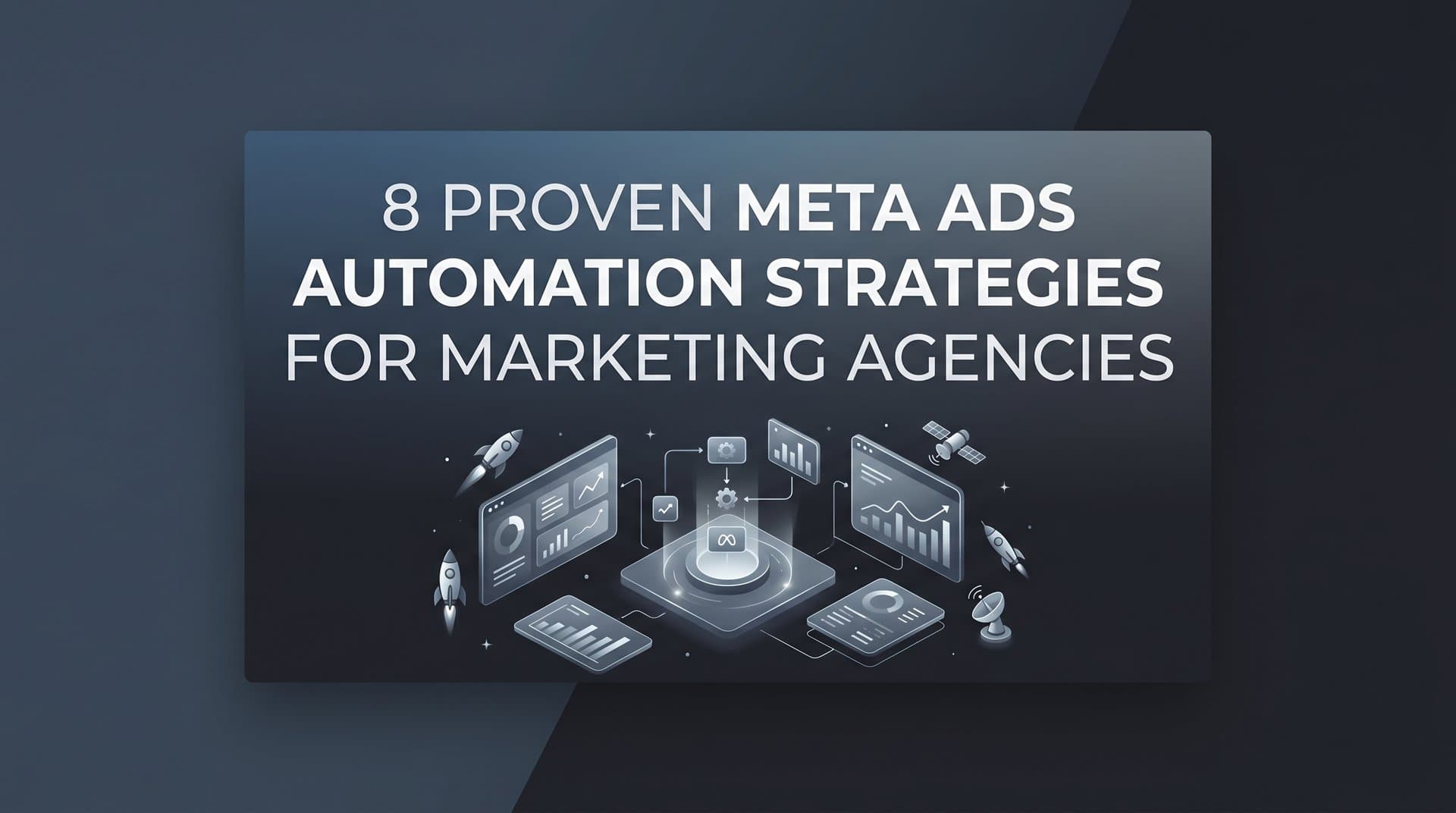
This article breaks down eight proven automation strategies that agencies are using right now to build faster, test smarter, and report with confidence. Whether you manage five client accounts or fifty, these approaches will help you deliver better results in less time.
1. Automate Creative Production at Scale
The Challenge It Solves
Creative production is one of the biggest operational bottlenecks agencies face. Every client needs fresh ad creatives on a regular basis, and when that work runs through a designer, timelines stretch, revision cycles multiply, and costs add up fast. Across ten or twenty client accounts, this becomes a serious constraint on how quickly you can test and iterate.
The Strategy Explained
AI-powered creative generation removes the designer dependency entirely. Instead of briefing a designer, waiting for drafts, and going back and forth on revisions, you generate image ads, video ads, and UGC-style creatives directly from a product URL. The AI pulls relevant visual and copy elements and assembles ad-ready creatives in minutes.
One particularly powerful application is cloning competitor ads directly from the Meta Ad Library. Rather than starting from scratch, you can identify what's already working in a client's competitive landscape and use that as a creative starting point. This approach compresses the research-to-production cycle significantly. Understanding Meta ads creative automation is essential for agencies looking to remove this bottleneck permanently.
Implementation Steps
1. Collect product URLs or brand asset packages from each client at onboarding, so you have everything needed to generate creatives without back-and-forth requests.
2. Use an AI creative tool like AdStellar's AI Creative Hub to generate multiple creative formats (image, video, UGC) for each client from a single input, creating a batch of testable variations in one session.

3. Use the Meta Ad Library to research top-performing competitor ads for each client's niche, then clone those formats as additional creative starting points.
4. Refine creatives using chat-based editing rather than redesigns, adjusting copy, visuals, or format through simple prompts.
Pro Tips
Build a standardized creative brief template for each client that captures their brand voice, key product benefits, and target audience. Feed this into your AI creative process consistently so every generated ad reflects the client's positioning rather than generic output. The more structured your inputs, the stronger your creative outputs.
2. Build Campaigns with AI Agents Instead of Manual Setup
The Challenge It Solves
Manual campaign setup is time-consuming and error-prone, especially when you're building across multiple client accounts simultaneously. Selecting audiences, writing headlines, choosing creatives, and structuring ad sets requires dozens of small decisions per campaign. When you're doing this from scratch every time, you're also leaving historical performance data completely unused.
The Strategy Explained
AI campaign builders replace the manual decision-making process by analyzing historical performance data to select the elements most likely to succeed. Instead of guessing which audience to target or which headline to lead with, the AI reviews what has worked before and assembles a complete campaign based on that evidence. This is where AI marketing agents for ads deliver a genuine competitive advantage over traditional manual workflows.
The key differentiator with modern AI campaign tools is transparency. Rather than producing a black-box output, platforms like AdStellar's AI Campaign Builder explain every decision with full rationale. You understand why a particular audience was selected or why a specific headline was prioritized. This matters for agencies because you need to be able to explain strategy to clients, not just show results.

Implementation Steps
1. Ensure each client account has sufficient historical campaign data connected to the AI system before running your first AI-built campaign. The more data available, the more informed the AI's decisions will be.
2. Define clear campaign goals upfront (ROAS target, CPA target, awareness objective) so the AI can score and select elements against the right benchmarks.
3. Review the AI's campaign rationale before launching. Use this as a client communication tool, sharing the strategic reasoning behind campaign decisions in your reporting.
4. Run AI-built campaigns alongside manually built ones initially to build confidence in the approach and compare performance outcomes.
Pro Tips
Treat the AI's decision transparency as a client retention tool. When clients can see the strategic logic behind their campaigns, not just the performance numbers, they develop greater trust in your agency's capabilities. Document the AI's rationale in your monthly reports as a value-add that differentiates you from agencies that only share metrics.
3. Use Bulk Ad Launching to Test Hundreds of Variations
The Challenge It Solves
Finding a winning ad combination requires testing. But when each variation has to be manually set up in Ads Manager, the number of tests you can realistically run is severely limited by time. Agencies often end up testing far fewer combinations than they should, which means they're leaving performance gains on the table.
The Strategy Explained
Bulk ad launching automates the combination and creation of ad variations at scale. You provide multiple creatives, multiple headlines, multiple copy variations, and multiple audiences, and the system generates every possible combination and launches them all to Meta in a fraction of the time manual setup would require.
This approach is grounded in a foundational principle of paid media: the more variations you test, the higher the probability of finding a top performer. Bulk launching doesn't just save time. It fundamentally increases the scale of your testing operation, which directly improves your odds of discovering winning combinations for each client. Agencies serious about this approach should explore how Meta ads automation compares to manual creation across every stage of the campaign lifecycle.
Implementation Steps
1. For each client campaign, prepare a batch of creative assets (at minimum three to five per format), headline variations, and copy options before entering the bulk launch workflow.
2. Define audience segments in advance, including cold audiences, retargeting segments, and lookalike audiences based on customer lists or high-value events.
3. Use AdStellar's Bulk Ad Launch feature to mix and match all elements at both the ad set and ad level, generating hundreds of combinations automatically.

4. Set budget parameters and launch the full variation set, then let performance data accumulate before making optimization decisions.
Pro Tips
Resist the urge to cut variations too early. Give each combination enough budget and time to generate statistically meaningful signals before pausing underperformers. The whole point of bulk launching is to let the data surface winners, so don't override the process with premature manual intervention.
4. Implement Dynamic Creative Optimization Across Client Accounts
The Challenge It Solves
Manually optimizing which creative elements are served to which audience segments is virtually impossible at scale. Each user responds differently to different visual styles, headlines, and value propositions. Without automation, you're either serving everyone the same ad or spending enormous time managing creative splits manually across every client account.
The Strategy Explained
Dynamic Creative Optimization (DCO) is a native Meta Ads feature that automatically identifies and serves the best-performing combination of creative elements to each user based on their behavior and preferences. According to Meta's official Ads Manager documentation, DCO allows you to upload multiple headlines, images, descriptions, and CTAs, and Meta's algorithm handles the combination and delivery optimization.
For agencies, the strategic value of DCO is that it turns Meta's own algorithm into a continuous optimization engine for every client account. Once set up correctly, it reduces the need for constant manual creative adjustments while simultaneously improving personalization at the individual user level. Agencies looking to systematize this process should review best practices for Meta ad automation to ensure DCO is configured correctly from the start.
Implementation Steps
1. Standardize your DCO setup process into a repeatable checklist that can be applied consistently across every new client campaign, covering asset requirements, naming conventions, and optimization event selection.
2. For each client, prepare the full suite of creative assets DCO requires: multiple images or videos, multiple headline variations, multiple primary text options, and multiple CTAs.
3. Enable DCO at the ad level in Meta Ads Manager and select the appropriate optimization event aligned with the client's campaign goal.
4. Monitor performance at the asset level using Meta's creative reporting breakdown to identify which individual elements are driving the most conversions.
Pro Tips
Use DCO insights as a feedback loop for your broader creative strategy. When Meta's algorithm consistently favors a particular headline style or image format across a client's campaigns, that's a signal worth incorporating into future creative briefs and AI generation prompts.
5. Centralize Performance Data with AI-Powered Insights
The Challenge It Solves
Agencies managing multiple client accounts typically end up with performance data scattered across individual Ads Manager accounts, spreadsheets, and reporting tools. Pulling together a clear picture of what's working requires significant manual effort each week, and by the time the analysis is complete, the data is already stale. This creates a constant lag between performance reality and optimization decisions.
The Strategy Explained
AI-powered insights replace scattered reporting with centralized, ranked performance data. Rather than manually sorting through metrics to figure out which creatives, headlines, or audiences are performing best, leaderboard-style dashboards surface that information automatically against goal-based benchmarks. A dedicated Meta ads performance tracking dashboard is what separates agencies that react to data from those that act on it proactively.
Platforms like AdStellar's AI Insights rank every element, including creatives, headlines, copy, audiences, and landing pages, by real metrics like ROAS, CPA, and CTR. You set the target goals for each client, and the AI scores everything against those benchmarks. The result is instant clarity on what's winning and what needs to be cut, without hours of manual analysis.

Implementation Steps
1. Define goal-based benchmarks for each client account (target ROAS, acceptable CPA, minimum CTR) before connecting their data to your insights platform.
2. Connect all client accounts to a centralized AI insights dashboard so performance data flows in automatically without manual exports.
3. Review leaderboard rankings weekly to identify top performers and underperformers across every client, using the ranked data to inform optimization decisions rather than gut instinct.
4. Use the insights output directly in client reporting, replacing manual spreadsheet summaries with data-backed performance narratives.
Pro Tips
When presenting AI insights to clients, frame the leaderboard rankings in terms of business outcomes, not just ad metrics. A creative that ranks first by ROAS is a business result, not just a marketing win. This framing helps clients understand the direct connection between your optimization work and their revenue.
6. Build a Winners Hub to Reuse Proven Assets
The Challenge It Solves
One of the most common agency inefficiencies is rebuilding from scratch every time a new campaign launches. Top-performing creatives, high-converting headlines, and proven audience segments get buried in old campaigns and are rarely systematically reused. This means agencies are constantly reinventing the wheel instead of compounding on what already works.
The Strategy Explained
A Winners Hub is a structured library of your best-performing assets, organized with real performance data attached. Rather than hunting through old campaign folders for a creative that performed well six months ago, you have an instantly accessible collection of proven elements ready to deploy into new campaigns.
This approach is particularly powerful for agencies because it creates compounding returns over time. Every campaign you run generates potential winners that feed the library. Every new campaign you build can draw from that library, starting from a higher performance baseline than a cold start. The longer you run this system, the stronger your asset library becomes. This is one of the core reasons why Meta ads workflow automation delivers outsized returns compared to piecemeal optimization efforts.
Implementation Steps
1. After each campaign cycle, identify the top-performing creatives, headlines, audiences, and copy variations based on your goal metrics and add them to your Winners Hub with performance data attached.
2. Tag winners by client, industry, objective, and format so they're easy to filter and find when building future campaigns.
3. When starting a new campaign for any client, begin by reviewing the Winners Hub for relevant proven elements before generating new assets. Use winners as the baseline and build variations from them.
4. Use AdStellar's Winners Hub to centralize this library across all client accounts, with real performance data attached to every saved asset.

Pro Tips
Don't limit your Winners Hub to creatives alone. The most underutilized winners are often audience segments and headline formulas. A headline structure that consistently drives high CTR for one client in a given industry is likely worth testing for similar clients. Treat your winners library as a cross-client learning resource, not just a storage folder.
7. Automate Audience Targeting with AI-Based Segmentation
The Challenge It Solves
Manual audience research and interest stacking is time-consuming, and the results are often inconsistent across account managers. Beyond the initial setup, audiences require ongoing maintenance. Ad fatigue sets in as the same users see the same ads repeatedly, and without a systematic refresh process, performance gradually erodes across every client account.
The Strategy Explained
AI-based audience segmentation moves beyond manual interest selection by analyzing historical performance data to identify which audience types actually convert for each client. Rather than building audiences based on assumptions about who might be interested, you're building them based on evidence of who has already responded.
This includes leveraging Meta's lookalike audience feature, which is documented in Meta's Business Help Center as a way to reach new users who share characteristics with existing customers or high-value events. Combine lookalike audiences with AI-ranked performance data and you have a systematic approach to audience selection that improves with every campaign cycle. Agencies managing this across many accounts benefit significantly from a purpose-built Meta ads management tool for agencies that keeps audience data organized and actionable.
Implementation Steps
1. For each client, build seed audiences from high-value events (purchases, leads, high-intent page views) rather than broad demographic pools. These become the foundation for lookalike expansion.
2. Use AI insights to rank existing audience segments by performance metrics, identifying which audience types consistently deliver against goal benchmarks across each client's campaigns.
3. Set a regular audience refresh schedule (typically every four to six weeks depending on campaign scale) to introduce new segments and prevent fatigue from setting in.
4. Test audience exclusions systematically to ensure you're not wasting budget serving ads to users who have already converted or who consistently underperform.
Pro Tips
Build a cross-client audience intelligence system by tracking which audience types perform consistently well within specific industries or product categories. Over time, this gives you a head start when onboarding new clients in familiar verticals. You're not starting from zero. You're starting from a foundation of tested, validated audience knowledge.
8. Integrate Attribution Tracking to Close the Reporting Loop
The Challenge It Solves
Without accurate attribution, agencies are optimizing in the dark. Meta's pixel provides useful data, but it doesn't always give a complete picture of how ad spend is translating into actual business outcomes, especially when clients have longer sales cycles or multiple touchpoints before conversion. Agencies that can't clearly connect ad spend to revenue are constantly vulnerable to budget cuts.
The Strategy Explained
Integrating attribution tracking with your Meta campaigns creates full-funnel visibility, connecting the ad that drove a click to the conversion that closed the deal. This accurate conversion data feeds back into AI campaign decisions, improving the quality of optimization over time. It also gives agencies the proof points needed to justify client spend with confidence. Understanding Meta ads performance metrics in depth is a prerequisite for building attribution models that clients will trust.
AdStellar integrates with Cometly for attribution tracking, which connects campaign performance data to downstream conversion events. This closes the loop between ad delivery and business outcomes, giving both the AI and the agency a clearer picture of true campaign performance rather than relying solely on platform-reported metrics.
Implementation Steps
1. Audit each client's current attribution setup to identify gaps between Meta-reported conversions and actual business outcomes (revenue, pipeline, customer acquisitions).
2. Implement a dedicated attribution platform alongside Meta's native tracking to capture cross-channel and multi-touch conversion data.
3. Connect attribution data to your AI campaign platform so optimization decisions are informed by accurate conversion signals rather than proxy metrics.
4. Build attribution reporting into your standard client deliverables, showing the full journey from ad impression to conversion with clear revenue attribution.
Pro Tips
Use attribution data to have more strategic conversations with clients about budget allocation. When you can show exactly which campaigns, audiences, and creatives are driving the most revenue, budget decisions become data-driven rather than opinion-based. This positions your agency as a strategic partner rather than just a campaign manager.
Putting These Strategies to Work
Eight strategies is a lot to absorb at once, so here's a practical way to think about implementation. Start with the strategies that address your biggest current bottleneck. If creative production is consuming most of your team's time, begin with AI creative generation and bulk ad launching. If reporting is your pain point, prioritize centralized AI insights and attribution integration first.
The strategies that compound most quickly are the Winners Hub and AI campaign building, because they get better as your data library grows. The sooner you start systematically capturing top performers and feeding historical data into AI decisions, the faster your agency's performance baseline improves across every client account.
All eight of these strategies are built into a single platform with AdStellar. From AI creative generation and competitor ad cloning to bulk launching, AI-powered campaign building, leaderboard insights, and attribution integration, everything your agency needs to automate and scale Meta advertising operations is in one place. No stitching together separate tools. No switching between platforms mid-workflow.
If you're ready to stop trading time for growth and start building the kind of automated, data-driven agency operation that can handle more clients without more headcount, Start Free Trial With AdStellar and be among the first to launch and scale your ad campaigns 10x faster with an intelligent platform that automatically builds and tests winning ads based on real performance data.