Most advertisers treat their Meta ads budget like a democracy, giving every campaign an equal vote. The problem? Not all campaigns deserve equal funding. While you're spreading $5,000 evenly across ten different campaigns, three of them are quietly delivering 80% of your conversions, four are barely breaking even, and the rest are burning cash with nothing to show for it.
The gap between profitable Meta advertisers and those stuck in the red often comes down to one critical difference: strategic budget allocation. It's not about spending more. It's about directing your existing budget toward what actually works and ruthlessly cutting what doesn't.
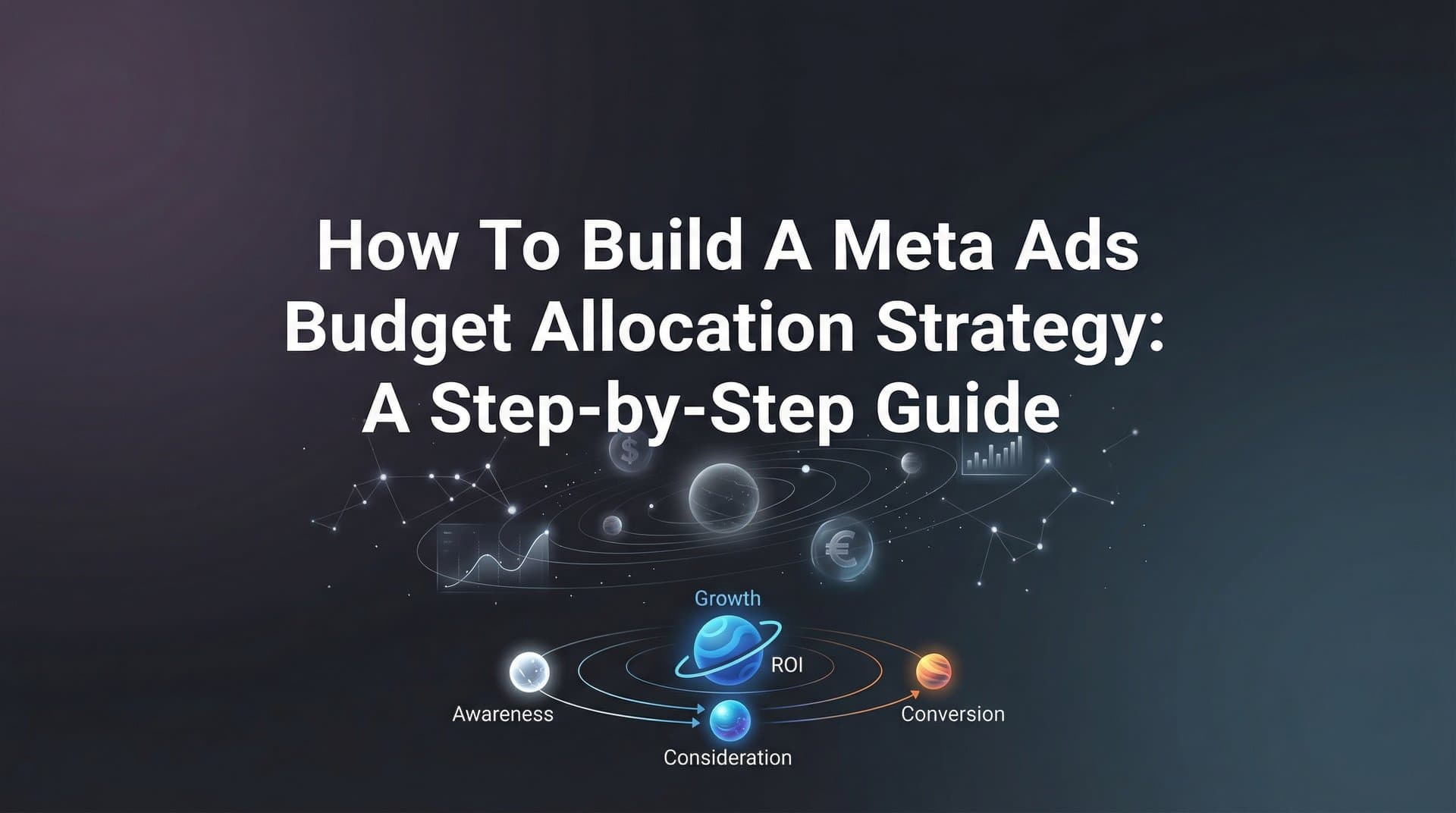
This guide walks you through building a budget allocation strategy that treats your ad spend like the limited resource it is. You'll learn how to audit where your money currently goes, identify which campaigns deserve more fuel, create a testing framework that doesn't drain your budget, and set up triggers that automatically shift dollars toward winners.
Whether you're managing $3,000 per month or scaling to six figures in ad spend, these principles work at every level. By the end, you'll have a repeatable system for allocating your Meta ads budget based on real performance data instead of gut feelings or outdated rules of thumb.
Step 1: Audit Your Current Budget Distribution and Performance Baseline
Before you can fix your budget allocation, you need to understand where your money currently goes and what it's actually producing. Start by exporting your Meta Ads Manager data for the past 30 to 90 days. Three months gives you enough data to spot patterns without including outdated seasonal variations.
Pull reports at three levels: campaign, ad set, and individual ad. You're looking for the complete picture of how your budget flows through your account structure. Export metrics including spend, impressions, clicks, conversions, cost per result, and ROAS if you're tracking revenue.
Calculate your current spend distribution. What percentage of your total budget goes to prospecting versus retargeting? How much flows to image ads versus video? Which campaign objectives (conversions, traffic, engagement) consume the most spend? Create a simple spreadsheet that shows these percentages clearly.
Now identify your key performance indicators and establish baseline benchmarks. For most e-commerce advertisers, this means ROAS, CPA, CTR, and conversion rate. Calculate the average for each metric across your entire account, then segment by campaign type. Your retargeting campaigns should show dramatically different numbers than cold prospecting.
Here's where it gets revealing: sort your campaigns by total spend, then add a column showing their ROAS or CPA. You'll likely discover campaigns eating 20% of your budget while delivering only 5% of your results. Flag these underperformers in red. Then identify the inverse: low-spend campaigns punching above their weight with exceptional efficiency. Those get flagged in green.
Document everything in a baseline report. Write down your current tier allocations even if they're accidental, your average metrics by campaign type, and the specific campaigns in your red and green categories. This baseline becomes your measuring stick for improvement over the next 90 days. Understanding common Meta ads budget allocation problems helps you identify what to look for during your audit.
The audit often reveals uncomfortable truths. That campaign you launched six months ago and forgot about? Still spending $30 per day with a 0.8 ROAS. The experimental audience you meant to test for a week? It's been running for two months. These discoveries are valuable because they show you exactly where to start cutting.
Step 2: Define Your Campaign Tiers and Budget Percentages
Your Meta ads account needs a hierarchy. Not all campaigns deserve equal treatment, and your budget allocation should reflect that reality. Create three distinct tiers that organize your campaigns by proven performance and strategic purpose.
Tier 1: Proven Winners (60-70% of budget) These are campaigns that have consistently delivered at or above your target ROAS or CPA for at least 30 days. They've exited the learning phase, they're stable, and they're profitable. This tier gets the lion's share of your budget because it represents known quantities with predictable returns.
Tier 2: Active Testing (20-30% of budget) This tier funds structured experiments: new audience segments, fresh creative angles, different ad formats, or alternative messaging approaches. These campaigns have passed initial viability checks but haven't yet proven themselves as long-term winners. The testing tier is your pipeline for future Tier 1 campaigns.
Tier 3: Experimental Concepts (10% of budget) Reserve a small portion for wild cards and emerging opportunities. This might include testing completely new products, exploring untested platforms within Meta (like Messenger ads), or experimenting with unconventional creative formats. This tier has the highest failure rate, but it's also where breakthrough discoveries happen.
Adjust these percentages based on your business stage and risk tolerance. Established brands with proven product-market fit might push Tier 1 to 75% and reduce experimentation to 5%. Startups still finding their ideal customer might flip the script with 40% in testing and 40% in experimentation. For a deeper dive into tier frameworks, explore proven Meta ads budget allocation strategies that scale.
The key is making the split intentional rather than accidental. When you don't define tiers, your budget defaults to whatever campaigns you set up most recently or whichever ones you're manually checking. That's not strategy. That's drift.
Create clear promotion and demotion criteria between tiers. A Tier 2 testing campaign that maintains 3X ROAS for 30 consecutive days gets promoted to Tier 1 and receives a budget increase. A Tier 1 campaign that drops below 2X ROAS for two weeks gets demoted to Tier 2 with reduced spend while you diagnose the problem.
Document your tier structure in a shared spreadsheet or project management tool. Every campaign in your account should have a tier assignment, and anyone managing your ads should understand what each tier means for budget allocation decisions.
Step 3: Set Performance Thresholds for Each Campaign Objective
Vague goals produce vague results. Your budget allocation strategy needs specific performance thresholds that trigger actions. These thresholds vary by campaign objective and audience temperature, so create separate benchmarks for each category.
Start with your minimum acceptable ROAS or maximum acceptable CPA for each campaign type. Cold prospecting campaigns targeting new audiences typically require different thresholds than warm retargeting campaigns. If your retargeting campaigns need to hit 5X ROAS to justify their budget, your cold campaigns might only need 2.5X because they're building your audience for future retargeting.
Define learning phase benchmarks separately. Meta's algorithm needs time and data to optimize delivery. For conversion campaigns, this typically means 50 conversions per week at the ad set level. During the learning phase, apply more generous thresholds. A new campaign might get 7-10 days and $500-1000 in spend before you judge its performance, depending on your average CPA.
Create red flag thresholds that trigger immediate budget cuts or pauses. If a campaign exits the learning phase but delivers ROAS below 1X (spending more than it generates), that's a red flag. If CPA exceeds 2X your target for three consecutive days after learning, another red flag. These thresholds prevent runaway spending on campaigns that clearly aren't working.
Set promotion criteria for moving campaigns from testing to proven winner status. This might be: "Maintain target ROAS or better for 30 consecutive days with minimum $1,000 total spend and at least 50 conversions." The specific numbers depend on your business, but the principle remains constant: campaigns earn bigger budgets through sustained performance, not single lucky days. A solid campaign structure for Meta ads makes threshold tracking much easier.
Account for audience temperature in your thresholds. Your benchmarks should look something like this: Cold prospecting campaigns need 2X ROAS minimum, warm audiences (engaged with your content but haven't purchased) need 3.5X ROAS, and hot retargeting (abandoned carts, past purchasers) need 5X ROAS. Each audience type has different conversion rates and customer lifetime values, so they warrant different efficiency standards.
Write these thresholds down and review them monthly. As your account matures and you gather more data, you'll refine these numbers based on what's actually achievable in your market.
Step 4: Build Your Testing Budget Framework
Testing without structure is just gambling with a different name. Your testing budget needs guardrails that ensure you gather meaningful data without hemorrhaging cash on inconclusive experiments.
Calculate your minimum viable test budget based on your average CPA and the conversions needed for statistical significance. If your average CPA is $50 and you need at least 30 conversions to draw reliable conclusions, your minimum test budget is $1,500. Going below this threshold means you're making decisions based on insufficient data.
Structure your A/B tests to isolate single variables. Test one thing at a time: creative, audience, or copy. When you change multiple variables simultaneously, you can't determine which change drove the results. If you want to test both a new creative and a new audience, run them as separate tests with controlled variables. A well-defined Meta ads creative testing strategy ensures your experiments produce actionable insights.
Set test duration rules based on conversion volume rather than arbitrary time periods. A test isn't complete after "one week." It's complete after you've gathered enough conversions to reach statistical confidence. For most Meta campaigns, this means running until you hit 30-50 conversions per variation. High-volume accounts might reach this in 3-4 days. Lower-volume accounts might need 2-3 weeks.
Create a testing calendar that prevents overlapping experiments from contaminating each other's data. If you're testing new creative this week, don't simultaneously launch an audience test. Stagger your experiments so you can clearly attribute performance changes to specific variables.
Use bulk launching to test multiple creative variations efficiently. Instead of manually creating dozens of ads to test different images, headlines, and copy combinations, generate every variation and launch them simultaneously. Learning how to launch multiple Meta ads at once saves hours of manual setup while testing comprehensively.
Build kill switches into every test. Before launching, decide: "If this test doesn't achieve X metric by Y spend, I'm pulling the plug." This prevents the sunk cost fallacy from keeping bad tests running longer than they should. If your new creative test hits $800 in spend with zero conversions, you don't need to wait for $1,500 to confirm it's not working.
Reserve your testing budget for questions that matter. Don't waste 20% of your monthly budget testing whether your button should be blue or green. Test big swings: new customer segments, different value propositions, alternative product angles, or creative formats you haven't tried. Small optimizations belong in your proven winner campaigns where you're already seeing results.
Step 5: Create Budget Reallocation Triggers and Rules
The best budget allocation strategy in the world fails if you don't actually reallocate based on performance. You need clear triggers that prompt action and rules that guide your decisions when those triggers fire.
Define your check-in schedule. Daily monitoring catches major issues quickly but can lead to overreaction based on normal variance. Weekly reviews provide enough data to spot real trends without creating whiplash from constant changes. Set daily check-ins for campaigns in learning phase or recent launches, and weekly reviews for established campaigns.
Set automatic scaling rules for winners. When a campaign exceeds your target ROAS by 20% or more for three consecutive days, increase its budget by 20%. This gradual scaling prevents the sudden budget jumps that reset Meta's learning and tank performance. If a campaign maintains exceptional performance (2X your target ROAS for two weeks), consider a more aggressive 50% budget increase.
Establish kill switch criteria that remove human emotion from the decision. If a campaign exits learning phase and misses your minimum threshold for five consecutive days, pause it. No exceptions, no "let's give it a few more days." Failed campaigns rarely reverse course. They just consume budget that could go to winners.
Create reallocation protocols for shifting budget from losers to winners. When you pause an underperforming campaign spending $100 per day, don't just leave that money unallocated. Immediately redistribute it to your top three performing campaigns, splitting the freed budget proportionally based on their current spend levels. Consider using automated Meta ads budget allocation tools to handle these shifts in real-time.
Use AI insights and leaderboards to quickly identify top performers worthy of budget increases. Instead of manually comparing dozens of metrics across campaigns, leverage tools that automatically rank your creatives, audiences, and campaigns by actual performance. When your leaderboard shows a creative delivering 4X ROAS while most others hit 2X, that's a clear signal to shift more budget toward that winner and create variations testing similar angles.
Document every reallocation decision in a simple log. Note the date, which campaign received more or less budget, the trigger that prompted the change, and the performance outcome over the next 14 days. This log becomes your playbook, revealing which types of reallocations consistently improve results and which ones don't.
Build buffer rules that prevent overreaction to single-day anomalies. If a normally strong campaign has one bad day, that's not a trigger. If it has three consecutive bad days or a bad week, that's a pattern worth addressing. The buffer protects you from making changes based on normal statistical variance.
Step 6: Implement Seasonal and Scaling Adjustments
Your budget allocation strategy can't be static because your market isn't static. Seasonal patterns, competitive intensity, and growth phases all require planned adjustments to how you distribute spend.
Map your budget calendar around peak seasons and sales events relevant to your business. E-commerce brands need elevated budgets during Q4 holiday shopping. B2B companies might increase spend at the start of fiscal quarters when budgets refresh. Service businesses often see seasonal demand shifts based on weather or school calendars. Identify your high-intent periods and plan budget increases 2-3 weeks before they begin.
Plan budget increases for product launches and major promotions. A new product launch isn't the time to maintain your normal 60/20/20 tier split. Temporarily shift to 40/40/20, moving budget from proven winners into aggressive testing of the new product across multiple audiences and creative angles. Once you identify what works, you can return to your standard allocation. Use a Meta ads campaign planning checklist to ensure nothing falls through the cracks during these transitions.
Build buffer budgets for competitive periods when CPMs typically rise. During Black Friday, Valentine's Day, or major industry events, your normal $50 CPA might inflate to $75 simply due to increased competition for ad space. Rather than panic and pause campaigns, anticipate this by setting higher CPA thresholds for these periods and allocating 20-30% more budget to maintain visibility.
Create scaling protocols that increase spend gradually to avoid audience fatigue. When you're ready to scale a winning campaign from $100 to $500 per day, don't make the jump overnight. Increase by 20% every 3-4 days: $100 to $120 to $144 to $173. This gradual scaling gives Meta's algorithm time to find additional inventory and prevents the performance crashes that often follow aggressive budget increases.
Document historical performance by season to inform future allocation decisions. After each peak season or major event, record what worked: which campaigns scaled successfully, which audiences responded best, what creative angles drove results. Next year, you'll start with proven playbooks instead of guessing. Your Q4 2025 performance data becomes your Q4 2026 budget allocation blueprint.
Adjust your tier percentages during different business phases. Growth phase might mean 50/30/20 (proven/testing/experimental) as you aggressively search for new winners. Profitability phase might shift to 75/20/5 as you optimize known winners and reduce risky experiments. Clearly define which phase you're in and align your allocation accordingly.
Step 7: Track, Measure, and Optimize Your Allocation Strategy
A budget allocation strategy without measurement is just a budget allocation guess. You need systematic tracking that reveals whether your allocation decisions are actually improving results or just shuffling money around with no net benefit.
Set up a weekly reporting dashboard that tracks spend distribution versus results. Create a simple view showing what percentage of budget went to each tier, what ROAS or CPA each tier delivered, and how these numbers compare to the previous week. This dashboard answers the critical question: "Is my allocation strategy working better this week than last week?"
Compare month-over-month allocation efficiency using blended ROAS. Calculate your total ad spend divided by total revenue generated across all campaigns. Track this number monthly. If your blended ROAS improves from 3.2X to 3.8X over three months while maintaining or increasing spend, your allocation strategy is working. If it stays flat or declines, something needs to change.
Identify patterns in which campaign types and audiences deserve more budget. After 90 days of disciplined allocation, review your data for trends. Do your video ads consistently outperform image ads? Do certain audience segments deliver better ROAS regardless of creative? Do retargeting campaigns show higher efficiency during specific days of the week? These patterns inform where you should proactively shift more budget.
Refine your tier percentages based on accumulated performance data. If your testing tier consistently graduates campaigns to proven winners, maybe it deserves 35% instead of 20%. If your experimental tier rarely produces anything useful, maybe it should shrink to 5%. Let real results reshape your allocation framework rather than sticking rigidly to initial percentages. An intelligent Meta ads budget optimizer can surface these insights automatically.
Use the Winners Hub approach to catalog proven elements for future budget prioritization. Maintain a running list of your best-performing creatives, headlines, audiences, and offers with their actual performance metrics. When building new campaigns, start by allocating more budget to variations of these proven winners rather than treating everything as an equal experiment. Your winners list becomes your budget allocation shortcut.
Schedule monthly strategy reviews where you step back from daily optimization and examine bigger trends. Are you allocating enough to testing, or have you become too conservative? Are you scaling winners fast enough when they emerge? Are your thresholds too strict or too lenient? These reviews prevent your allocation strategy from calcifying into outdated rules that no longer serve your current business reality.
Track the velocity of your reallocation decisions. How quickly do you move budget from losers to winners? If underperforming campaigns run for weeks before you cut them, you're leaving money on the table. Measure your average time from "threshold missed" to "budget reallocated" and work to shorten this window.
Putting It All Together
A smart Meta ads budget allocation strategy transforms your ad spend from a reactive scramble into a systematic engine for growth. The difference between advertisers who scale profitably and those who burn through budgets often comes down to this: intentional allocation based on real performance data.
Start with your audit to understand where your money currently flows and what it produces. Build clear tiers that prioritize proven winners while maintaining meaningful room for testing and experimentation. Set firm performance thresholds that trigger budget increases for winners and cuts for losers. Create reallocation rules that remove emotion from these decisions and ensure you act on the data.
Account for seasonal patterns and scaling dynamics. Your allocation strategy should flex with your business cycles rather than remaining static year-round. Track everything systematically so you can measure whether your allocation decisions actually improve efficiency over time.
The key is consistency. Check your data on schedule, move budget toward what works, and cut what doesn't. Most advertisers know this intellectually but fail in execution. They let underperforming campaigns run too long out of hope or optimism. They don't scale winners aggressively enough out of fear. They make allocation decisions based on which campaigns they remember to check rather than systematic performance reviews.
Your implementation checklist for this week: Export your last 90 days of Meta ads data and calculate your current spend distribution. Define your three budget tiers with specific percentage allocations. Set ROAS or CPA thresholds for each campaign type and audience temperature. Create your reallocation triggers and document them in writing. Schedule your first weekly budget review session and commit to it.
Your budget allocation strategy will improve with every cycle as you gather more performance data and refine your benchmarks. The campaigns you launch next month will benefit from the allocation lessons you learn this month. That's the compounding advantage of systematic budget management.
Ready to transform your advertising strategy? Start Free Trial With AdStellar and be among the first to launch and scale your ad campaigns 10× faster with our intelligent platform that automatically builds and tests winning ads based on real performance data. Our AI Creative Hub generates scroll-stopping image ads, video ads, and UGC creatives, while our AI Campaign Builder analyzes your historical performance to allocate budget toward proven winners. The Winners Hub surfaces your top-performing elements with real metrics, and our AI Insights leaderboards rank every creative, audience, and campaign so you can instantly identify where your budget should flow. One platform from creative to conversion, with the intelligence to optimize your allocation strategy automatically.