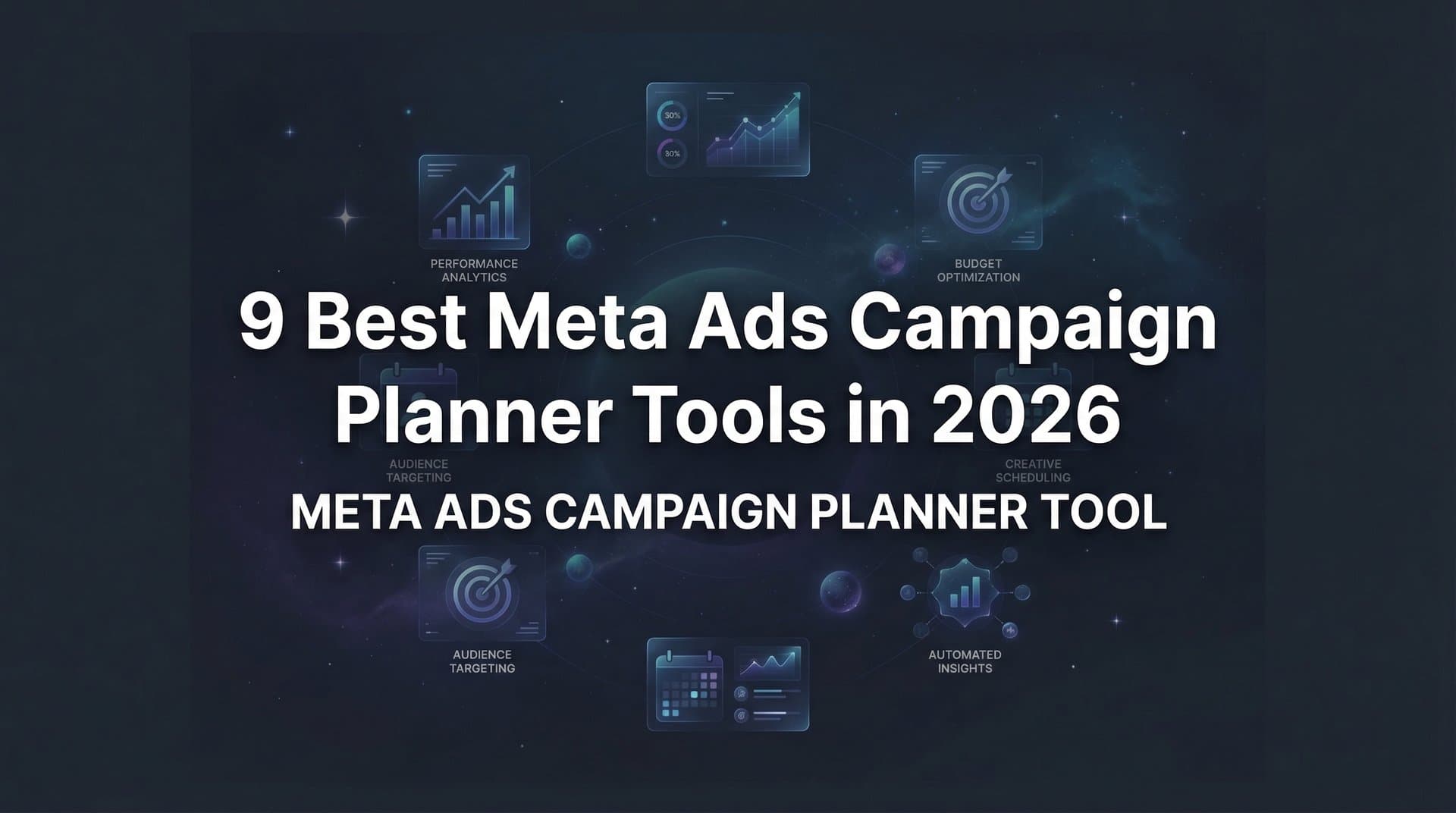
Planning Meta ad campaigns manually is time-consuming and prone to inconsistency—especially when you're managing multiple accounts or launching campaigns at scale. The right campaign planner tool can transform how you structure ad sets, allocate budgets, and coordinate creative assets before anything goes live.
This guide covers nine tools that help marketers plan, organize, and execute Meta advertising campaigns more efficiently. We've evaluated each based on planning capabilities, automation features, ease of use, and value for different team sizes. Whether you need AI-powered campaign building or simple spreadsheet-style organization, you'll find options that match your workflow.
1. AdStellar AI
Best for: Marketers who want fully autonomous AI campaign planning and execution at scale
AdStellar AI is an AI-powered Meta ad campaign builder that uses seven specialized agents to autonomously plan, build, and launch campaigns in under 60 seconds.

Where This Tool Shines
AdStellar AI eliminates the manual decision-making bottleneck in campaign planning. Instead of spending hours deciding on audience segments, budget splits, and ad set structures, you get a complete campaign blueprint generated by AI agents that analyze your historical performance data.
The transparency layer sets it apart from other AI tools. Every decision made by the AI agents comes with clear rationale explaining why specific targeting, budgets, or creative elements were selected. This means you're not blindly trusting a black box—you understand the strategic thinking behind each campaign component.
Key Features
7 Specialized AI Agents: Director, Page Analyzer, Structure Architect, Targeting Strategist, Creative Curator, Copywriter, and Budget Allocator work together to build complete campaigns.
Winners Hub: Automatically identifies and stores your top-performing ad elements for easy reuse across future campaigns.
AI Insights Dashboard: Provides custom goal scoring and performance recommendations based on your specific objectives.
Bulk Ad Launch: Deploy multiple campaign variations simultaneously, making it 20× faster than manual builds.
Full AI Rationale: Every decision comes with transparent reasoning so you understand exactly why the AI made specific choices.
Best For
Digital marketers and agencies managing multiple Meta ad accounts who need to launch campaigns quickly without sacrificing strategic quality. Particularly valuable for teams that struggle with campaign consistency or spend too much time on repetitive planning tasks.
Pricing
See the pricing page for current plans. Includes unlimited workspaces and secure direct Meta API integration.
2. Meta Ads Manager
Best for: Marketers who prefer native Meta tools without third-party integrations
Meta Ads Manager is Meta's native campaign management platform with built-in planning, drafting, and A/B testing tools.

Where This Tool Shines
As the source platform for all Meta advertising, Ads Manager gives you direct access to every feature without API limitations. The draft mode lets you plan entire campaigns, save them for review, and publish when ready—useful for teams with approval workflows.
The native integration means you're always working with real-time data. Audience estimates, reach projections, and budget recommendations reflect current platform conditions without the lag that sometimes affects third-party tools.
Key Features
Campaign Draft Mode: Build and save campaigns before publishing, allowing for internal review and refinement.
Native A/B Testing: Split test audiences, creative, and placements with built-in experiment frameworks.
Audience Insights: Access reach estimation and demographic data directly from Meta's user base.
Advantage+ Campaigns: Leverage Meta's AI-powered campaign types that automate targeting and placement decisions.
Budget Optimization: Automatic budget distribution across ad sets based on performance signals.
Best For
Solo marketers and small teams who want to avoid additional software costs. Also ideal for those who prefer learning one platform deeply rather than managing multiple tools.
Pricing
Free to use. You only pay for your actual ad spend on the platform.
3. Madgicx
Best for: Performance marketers focused on audience optimization and creative testing
Madgicx is an AI-powered ad management platform focused on audience targeting, creative insights, and automation tactics.

Where This Tool Shines
Madgicx excels at finding hidden audience segments within your existing customer data. The AI Audiences feature analyzes your pixel data and identifies micro-segments that often outperform broader targeting approaches.
The Creative Insights dashboard scores your ad creative based on performance patterns, helping you understand which visual elements, messaging angles, and formats resonate most. This takes the guesswork out of creative planning and helps you brief designers with data-backed direction.
Key Features
AI Audiences: Automatically generates and tests audience segments based on your conversion data and behavior patterns.
Creative Insights: Scores ad creative performance and identifies winning elements across your campaigns.
Automation Tactics: Pre-built rule sets for common optimization scenarios like budget scaling and underperformer pausing.
Ad Copy AI: Generates headline and description variations based on your best-performing copy.
Unified Dashboard: Combines data from Meta, Google, and TikTok for cross-platform performance comparison.
Best For
E-commerce brands and performance marketing teams that run high-volume testing and need advanced audience segmentation. Works well for marketers who want AI assistance but still maintain hands-on campaign control.
Pricing
Starts at $44/month, with pricing tiers based on monthly ad spend volume.
4. Revealbot
Best for: Marketers who want visual automation without coding knowledge
Revealbot is an automation platform for Meta ads with a visual rule builder and bulk campaign creation tools.

Where This Tool Shines
Revealbot's visual automation builder makes complex conditional logic accessible to non-technical marketers. You can create "if this, then that" rules that automatically adjust bids, pause underperformers, or scale winners based on your specific performance thresholds.
The bulk creation feature dramatically speeds up campaign launches when you're testing multiple variations. Instead of manually duplicating ad sets, you can define parameters once and generate dozens of variations with different audiences, budgets, or creative combinations.
Key Features
Visual Automation Builder: Drag-and-drop interface for creating conditional rules without writing code.
Bulk Campaign Creation: Generate multiple campaign variations from templates with different parameters.
Multi-Channel Notifications: Receive alerts via Slack, email, or webhooks when automation rules trigger.
Custom Metrics: Define your own KPIs and use them as triggers for automation rules.
Scheduled Actions: Set automations to run at specific times, useful for dayparting strategies.
Best For
Mid-sized marketing teams and agencies that manage multiple client accounts. Particularly valuable for those who want automation power without the enterprise price tag or learning curve.
Pricing
Starts at $99/month, with higher tiers based on the number of connected ad accounts and automation complexity.
5. Smartly.io
Best for: Enterprise brands needing dynamic creative at scale across channels
Smartly.io is an enterprise creative and campaign management platform with dynamic creative optimization.

Where This Tool Shines
Smartly.io solves the creative production bottleneck for large brands running hundreds of ad variations. The dynamic creative templates let you build one master template that automatically generates localized versions with different product images, prices, and copy based on your data feeds.
The predictive budget allocation feature uses machine learning to forecast performance and distribute budgets across campaigns before they launch. This helps enterprise teams make strategic planning decisions with confidence rather than relying purely on historical data.
Key Features
Dynamic Creative Templates: Build master templates that automatically generate variations from product feeds and data sources.
Cross-Channel Campaign Management: Plan and execute campaigns across Meta, TikTok, Pinterest, and Snapchat from one platform.
Predictive Budget Allocation: AI forecasting that recommends budget distribution based on expected performance.
Creative Testing at Scale: Systematically test thousands of creative variations with automated performance analysis.
Enterprise Collaboration Tools: Workflow management, approval chains, and role-based access for large teams.
Best For
Large e-commerce brands, retail companies, and agencies with substantial ad budgets who need to maintain brand consistency while personalizing creative at scale. Best suited for teams with dedicated creative operations resources.
Pricing
Custom pricing based on ad spend volume and feature requirements. Typically requires minimum annual commitments.
6. AdEspresso
Best for: Small businesses wanting simplified campaign creation with guided workflows
AdEspresso is a user-friendly Meta ads tool focused on simplified campaign creation and split testing.

Where This Tool Shines
AdEspresso removes the intimidation factor from Meta advertising with a campaign creation wizard that walks you through each decision. The interface simplifies complex concepts like audience layering and placement selection without dumbing them down.
The automatic A/B testing feature is particularly valuable for small teams without dedicated analysts. You define what you want to test (audiences, images, headlines), and AdEspresso automatically creates all the combinations and tracks which performs best.
Key Features
Campaign Creation Wizard: Step-by-step guided workflow that simplifies the planning process for beginners.
Automatic A/B Testing: Generates all possible combinations of your test variables and tracks performance.
Campaign Approval Workflows: Built-in review process for teams that need sign-off before campaigns go live.
Performance Analytics: Clear reporting with actionable recommendations for optimization.
Template Library: Pre-built campaign structures for common objectives like lead generation or e-commerce sales.
Best For
Small business owners and marketing generalists who don't run Meta ads full-time. Also works well for agencies managing campaigns for local businesses that need simple reporting.
Pricing
Starts at $49/month for basic features, with higher tiers adding more accounts and advanced testing capabilities.
7. Hootsuite Ads
Best for: Social media managers who want unified organic and paid content planning
Hootsuite Ads is a social media management platform with integrated ad planning and boosting capabilities.

Where This Tool Shines
Hootsuite Ads bridges the gap between organic social management and paid advertising. You can plan both content types in the same calendar, making it easier to coordinate messaging and maintain consistent brand voice across paid and organic channels.
The post boosting feature lets you promote organic content that's already performing well without rebuilding it as a formal ad campaign. This speeds up the process of capitalizing on viral moments or high-engagement posts.
Key Features
Unified Content Calendar: Plan organic posts and paid campaigns in the same scheduling interface.
Post Boosting: Turn high-performing organic content into ads directly from the dashboard.
Team Collaboration Tools: Assign tasks, review content, and manage approvals within the platform.
Cross-Platform Publishing: Manage Meta, LinkedIn, Twitter, and Instagram campaigns from one place.
Social Listening Integration: Use audience insights from organic conversations to inform ad targeting.
Best For
Marketing teams that manage both organic social media and paid advertising. Particularly useful for brands that prioritize content strategy and want advertising to amplify their best organic work.
Pricing
Advertising features are included in Hootsuite's paid plans, which start at $99/month for the Professional tier.
8. Skai (formerly Kenshoo)
Best for: Enterprise marketers needing advanced budget forecasting and portfolio optimization
Skai is an enterprise marketing platform with advanced budget forecasting and cross-channel optimization.

Where This Tool Shines
Skai's portfolio budget optimization helps enterprise teams allocate budgets across dozens or hundreds of campaigns based on predicted performance. The forecasting models incorporate seasonality, market conditions, and historical trends to recommend how much to invest in each campaign.
The attribution modeling goes beyond Meta's native attribution to show how different touchpoints contribute to conversions. This helps CMOs understand the true value of Meta advertising within their broader marketing mix and make more informed budget allocation decisions.
Key Features
Portfolio Budget Optimization: AI-driven budget recommendations across your entire campaign portfolio.
Predictive Forecasting: Revenue and performance projections based on historical data and market trends.
Cross-Channel Campaign Management: Unified planning for Meta, Google, Amazon, and other advertising platforms.
Advanced Attribution Modeling: Multi-touch attribution that shows the true contribution of each marketing channel.
Executive Reporting: High-level dashboards designed for C-suite visibility into marketing performance.
Best For
Large enterprises with complex marketing operations spanning multiple channels and regions. Works best for organizations with dedicated marketing operations teams that can leverage the advanced features.
Pricing
Custom pricing based on ad spend volume and feature requirements. Typically requires annual contracts and implementation support.
9. Sprinklr
Best for: Global enterprises needing unified customer experience management with advertising
Sprinklr is a unified customer experience platform with advertising management and AI-powered insights.
Where This Tool Shines
Sprinklr connects advertising to the broader customer experience by integrating campaign planning with customer service data, social listening, and brand monitoring. This means you can plan Meta campaigns informed by real customer feedback and sentiment trends.
The brand governance controls are particularly valuable for global companies with strict brand guidelines. You can set up approval workflows that ensure all campaigns meet brand standards before they launch, while still allowing regional teams autonomy within defined parameters.
Key Features
AI-Powered Campaign Recommendations: Suggests campaign structures and targeting based on customer behavior patterns.
Enterprise Workflow Tools: Multi-level approval chains with role-based permissions for complex organizational structures.
Brand Governance Controls: Automated checks that ensure campaigns meet brand guidelines before publishing.
Unified Reporting: Combines advertising performance with customer service metrics and social sentiment data.
Global Asset Library: Centralized repository for approved creative assets accessible across all regional teams.
Best For
Fortune 500 companies and global brands that need to coordinate advertising across multiple regions while maintaining brand consistency. Best suited for organizations that view advertising as one component of a broader customer experience strategy.
Pricing
Custom enterprise pricing based on user count, features, and implementation requirements. Requires significant investment and dedicated resources.
Finding Your Perfect Campaign Planning Partner
The right Meta ads campaign planner depends entirely on your team size, technical comfort level, and how much control you want over the planning process.
If you're looking for maximum speed and want AI to handle strategic decisions, AdStellar AI eliminates the planning bottleneck entirely. Its seven specialized agents build complete campaigns in under a minute, making it ideal for agencies and marketers launching campaigns at high volume.
For teams that prefer staying within native tools, Meta Ads Manager provides everything you need without additional costs. It's the most straightforward option for solo marketers or small teams just getting started.
Mid-market options like Madgicx and Revealbot offer the sweet spot between automation and control. Madgicx excels at audience discovery and creative optimization, while Revealbot provides powerful automation with a visual interface that doesn't require coding knowledge.
Enterprise teams managing massive budgets across channels should consider Smartly.io for dynamic creative capabilities, Skai for advanced forecasting and portfolio optimization, or Sprinklr for integrated customer experience management. These platforms require significant investment but deliver the governance and scale features that large organizations need.
Ready to transform your advertising strategy? Start Free Trial With AdStellar AI and be among the first to launch and scale your ad campaigns 10× faster with our intelligent platform that automatically builds and tests winning ads based on real performance data.
Annual Paid Media Campaign Calendar Planning Across Meta, Google, and LinkedIn
Planning a full-year paid media calendar across Meta, Google, and LinkedIn requires more than knowing your budget. It requires aligning your campaign structure to seasonal demand, platform-specific audience behavior, and creative refresh cycles — well before Q4 crunch arrives. Here’s a practical framework for annual planning across all three platforms.
Start with platform-level demand mapping
Each platform has different seasonal peaks. Meta advertising tends to spike around consumer retail moments (Black Friday, Valentine’s Day, back-to-school). Google Search follows intent — people search when they’re ready to buy, so budget should track keyword search volume trends. LinkedIn performs best during B2B buying cycles: Q1 (new budgets) and Q3 (pre-Q4 planning). Build your annual calendar by overlaying these three demand curves before allocating budget.
Block out creative refresh windows
Ad fatigue is predictable. Most Meta creatives see performance drop after 2–3 weeks at scale. Plan four to six creative refreshes per year per platform and build them into your editorial calendar now. Tools like AdStellar AI compress the production-to-launch cycle — generating new ad variations and rebuilding campaigns in under 60 seconds — which makes it feasible to refresh creatives on a tight schedule without overwhelming your team.
Structure your campaign calendar by quarter
- Q1 (Jan–Mar): New year intent on Google (resolutions, planning). Meta prospecting to build audiences before mid-year. LinkedIn brand and lead-gen campaigns targeting newly-budgeted buyers.
- Q2 (Apr–Jun): Test new creatives on Meta with smaller budgets before summer slowdown. Build Google remarketing audiences from Q1 traffic. LinkedIn thought leadership content to warm B2B pipeline.
- Q3 (Jul–Sep): Back-to-school and early holiday research on Google. Retargeting pushes on Meta. LinkedIn ramps up for Q4 B2B purchasing decisions.
- Q4 (Oct–Dec): Maximum budget deployment across all three platforms. Meta BFCM campaigns require creative assets and audience lists built months in advance. Google Shopping and Performance Max campaigns need product feeds optimized before October.
Use a campaign planner tool to centralize the calendar
Managing a multi-platform annual calendar in a spreadsheet leads to missed launches and budget gaps. The tools in this guide — AdStellar AI for Meta, Skai for cross-channel portfolio management, and Smartly.io for enterprise creative orchestration — all provide planning interfaces that let you coordinate campaigns across platforms without losing visibility into the full-year picture. If budget is the constraint, Meta Ads Manager’s draft mode plus a shared Google Sheet for the Google and LinkedIn schedule is a serviceable starting point.
Annual Paid Media Budget Allocation Across Meta, Google, and LinkedIn
Annual planning requires more than knowing when to run campaigns — it requires knowing how much to allocate to each platform relative to your business model and funnel stage goals. Here's a practical framework for distributing paid media budget across Meta, Google, and LinkedIn for a full year.
Starting allocation benchmarks by business type
| Business type | Meta | ||
|---|---|---|---|
| DTC e-commerce | 60–70% | 25–35% | 0–5% |
| B2B SaaS | 20–30% | 30–40% | 30–45% |
| Lead gen (local) | 40–50% | 45–55% | 0–5% |
| Enterprise software | 15–25% | 25–35% | 40–55% |
These are starting points, not rules. Adjust quarterly based on CPA and ROAS data from each channel, not just initial assumptions.
How to sequence budget deployment through the year
Q1 — Audience building phase (Jan–Mar): Allocate 15–20% of annual budget. Focus on top-of-funnel prospecting on Meta and awareness campaigns on Google Display to build retargeting pools ahead of peak seasons. LinkedIn: brand awareness and thought leadership for B2B pipeline development targeting newly-budgeted buyers.
Q2 — Testing phase (Apr–Jun): Allocate 20–25% of annual budget. This is the most valuable testing window — CPMs are lower than Q4 and you have time to iterate. Test new creative angles on Meta, build and validate keyword lists on Google Search, and test LinkedIn audience segments before committing larger Q3/Q4 budgets.
Q3 — Scale phase (Jul–Sep): Allocate 25–30% of annual budget. Scale proven Meta campaigns ahead of holiday season. Increase Google Shopping budgets for back-to-school. LinkedIn B2B campaigns target pre-Q4 buying decisions.
Q4 — Maximum deployment (Oct–Dec): Allocate 30–40% of annual budget. The highest-CPM quarter, but also the highest-conversion period for most consumer brands. Meta BFCM campaigns require creative assets and custom audiences built months in advance. Google Shopping and PMax campaigns need product feeds optimized before October. LinkedIn typically scales back for most advertisers as business decision-making slows in December.
Platform-specific annual planning rules
Meta: Build your retargeting audiences in Q1 and Q2 when CPMs are lower. Every Meta campaign you run builds pixel data — plan your annual calendar with the understanding that strong Q4 retargeting requires consistent Q1–Q3 prospecting investment. Tools like AdStellar AI can analyze your historical campaign performance to identify which audiences and creatives to reactivate each quarter rather than rebuilding from scratch.
Google: Match budget to search volume seasonality. Use Google Trends to identify your product category's monthly search volume peaks, then over-index budget 4–6 weeks before the peak begins (it costs less to be present during ramp-up than at the peak). Maintain brand keyword campaigns year-round at a baseline; this is the highest-ROAS spend regardless of season.
LinkedIn: B2B budgets follow fiscal calendar awareness. January, April, and September are high-engagement months as business buyers start new planning cycles. LinkedIn CPCs are high year-round, so prioritize conversion-focused offers (webinars, reports, demos) rather than pure awareness, and sequence retargeting campaigns 2–3 weeks after your top-of-funnel content campaigns.
The 10% innovation reserve
Regardless of your allocation model, hold 10% of annual paid media budget in reserve for platform experiments, emerging channels, and mid-year course corrections. This reserve prevents the situation where your annual plan locks you into a channel that's underperforming while a better opportunity goes unfunded.
Cross-Platform Creative Coordination for Annual Paid Media Campaigns
Cross-Platform Creative Coordination for Annual Paid Media Campaigns
Annual paid media planning often focuses on budget and calendar, but creative coordination across Meta, Google, and LinkedIn is where most multi-platform campaigns break down. Each platform has distinct creative requirements, aspect ratios, and audience expectations — and managing creative production for all three simultaneously without a coordination system leads to inconsistent messaging and production bottlenecks. Here's how to build that system.
Creative asset matrix by platform and campaign phase
Start your annual creative planning with an asset matrix that maps required formats to each campaign phase:
- Meta (Facebook/Instagram): 1:1 square (feed), 9:16 vertical (Stories/Reels), 1.91:1 horizontal (link ads). Video under 15 seconds performs best in Stories; 30–60 seconds in feed. Plan for 4–6 creative refresh cycles per year.
- Google: Responsive Display Ad assets (headlines: 30 chars, descriptions: 90 chars, images in multiple ratios), YouTube 6-second bumpers, and 15–30 second skippable pre-roll. Display creative typically refreshes quarterly.
- LinkedIn: 1.91:1 single image, square video (1:1), Document Ads (PDF carousels), and Message Ads. LinkedIn creative has a longer fatigue window (4–8 weeks) due to lower ad frequency than Meta.
The "campaign theme" approach to cross-platform messaging consistency
Rather than designing separate creative strategies for each platform, build annual campaigns around quarterly themes that adapt to each platform's format and audience context. A Q2 "efficiency" theme might manifest as:
- Meta: Video testimonials showing time saved (emotional, personal, visual)
- Google: Benefit-focused responsive search ad headlines targeting high-intent keywords ("Save 5 hours per week on ad campaigns")
- LinkedIn: Document Ad featuring a "2026 Paid Media Efficiency Report" that generates leads while reinforcing the efficiency message
The theme gives your audience a consistent signal across touchpoints without forcing every platform to run identical creative — which would feel awkward given how different LinkedIn B2B audiences and Meta prospecting audiences behave.
Production timeline planning for multi-platform launches
Cross-platform campaign launches require more lead time than single-platform ones. Work backwards from your target launch date:
If you are still choosing software for this stage, our guide to the best Facebook ad campaign planning tools compares the main options.
- 8 weeks before launch: Finalize campaign theme, messaging brief, and creative requirements per platform
- 6 weeks before launch: Creative production begins for all formats
- 4 weeks before launch: First round of creative review and revisions
- 2 weeks before launch: Upload assets to all platforms; set up campaign structures in draft/paused status
- 1 week before launch: Final review, QA on all ad previews, confirm audience lists and pixel integrity
Tools like AdStellar AI compress the Meta portion of this timeline significantly — generating campaign structures and ad variations in under 60 seconds from your brief — which frees your team's planning bandwidth for the Google and LinkedIn executions that require more manual setup.
Measuring cross-platform campaign coherence
At the end of each quarterly campaign, audit creative consistency across platforms by reviewing brand voice, visual identity adherence, and core message alignment. A simple scorecard (1–5 rating on each dimension per platform) surfaces where creative drift occurs most — typically LinkedIn, where B2B copy norms can pull writers away from your brand's established voice. Build this audit into your campaign retrospective before planning the next quarter's creative.