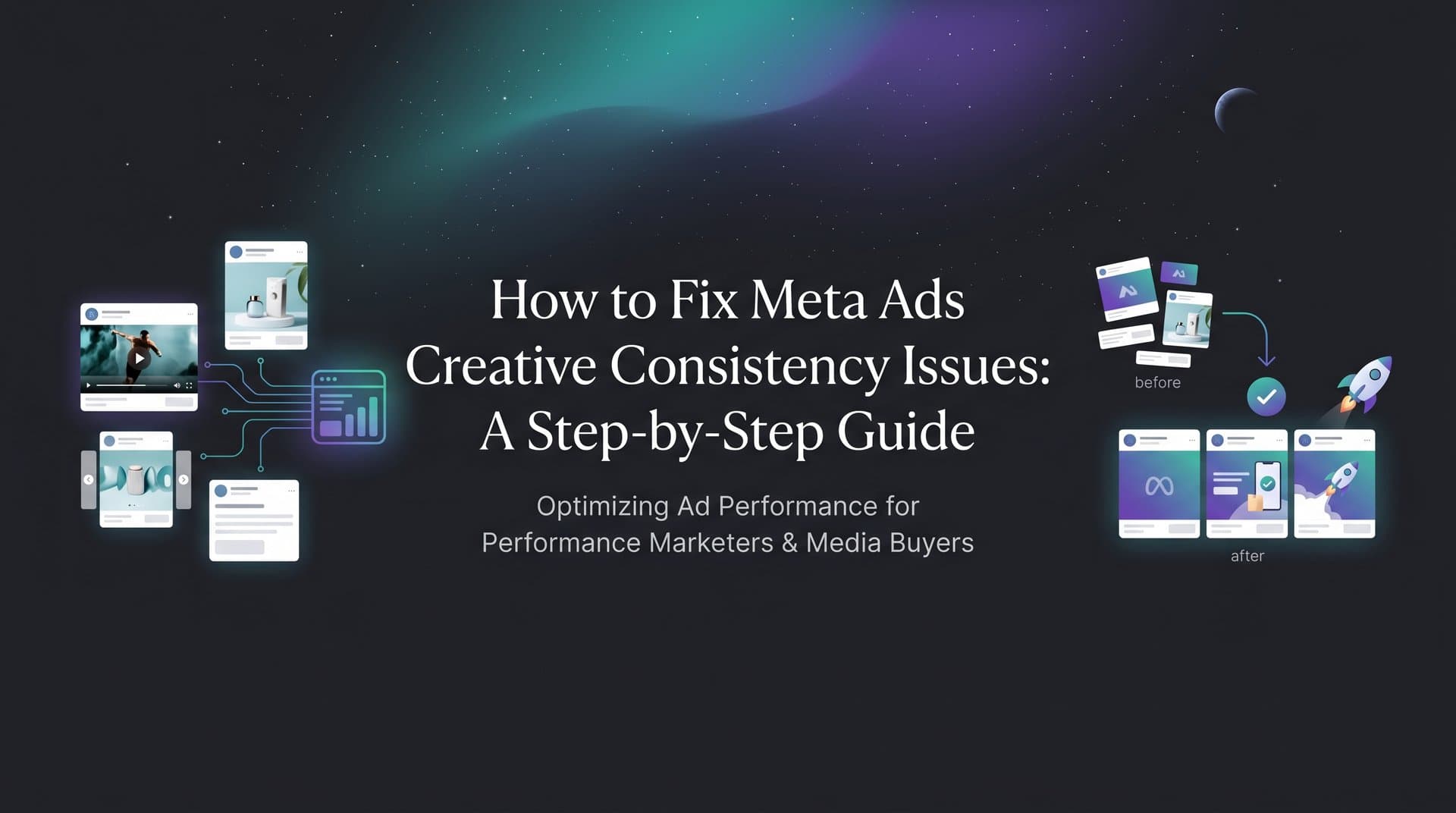
Creative consistency is one of those problems that sneaks up on you. You launch a few campaigns, test some new angles, bring in a freelancer for a batch of ads, and suddenly your Meta account looks like five different brands sharing the same ad account. Each ad is technically fine on its own, but together they tell no coherent story.
This matters more than most advertisers realize. Meta's algorithm uses creative signals to optimize delivery, and when those signals are inconsistent, the learning phase slows down. Audiences who see your ads repeatedly but can't form a clear mental picture of your brand are less likely to convert. And your cost per result tends to reflect that confusion.
The good news is that meta ads creative consistency issues are entirely fixable. They're not a talent problem or a budget problem. They're a systems problem, and systems can be built.
This guide walks you through six concrete steps: auditing your current ads to find where consistency breaks down, building a creative framework that keeps everything aligned, consolidating your proven winners into a reusable library, setting up a production system that enforces standards at scale, structuring your testing so it generates learning without creating chaos, and using performance data to keep your framework current over time.
Each step builds on the last. By the end, you'll have a repeatable process that produces cohesive, high-performing ad creative without requiring a large team or a design background. Let's get into it.
Step 1: Audit Your Current Ads for Inconsistencies
Before you fix anything, you need to see the full picture. Pull all of your active and recently paused ads from Meta Ads Manager and view them side by side. This visual review is often the moment advertisers realize how fragmented their creative has become. What felt like reasonable variety during production looks like brand chaos when you see it all at once.
Focus your audit on four key areas. First, visual style: are your colors consistent across ads? Are you using the same fonts or wildly different typography from one creative to the next? Does the imagery feel cohesive, or are some ads lifestyle-focused while others are stark product shots with no connecting visual thread?
Second, messaging: does each ad communicate the same core value proposition, or does every ad feel like it's selling a slightly different product? Pay close attention to CTA phrasing and offer language. "Shop Now" and "Get Yours Today" might seem interchangeable, but when mixed with "Learn More" and "Start Free" across the same account, the overall signal becomes muddy.
Third, brand elements: is your logo consistently placed and sized? Is your product presented the same way across ads, or does it look different depending on who produced the creative?
Fourth, format: are you using the correct aspect ratios for each placement? Are some ads overloaded with text while others are nearly blank? Format inconsistency often flies under the radar but affects both ad quality scores and audience experience.
As you work through this review, document everything in a simple spreadsheet. Create columns for the ad name, creative type, placement, and a specific description of the inconsistency found. Keep it simple. You're not writing an essay; you're building a reference list.
Here's the step most teams skip: pull your performance data alongside the visual audit. Look at ROAS, CPA, and CTR for each ad you're reviewing. You'll often find a pattern where the most visually inconsistent ads are also the weakest performers. This correlation helps you prioritize what to fix first rather than treating every inconsistency as equally urgent.
One common pitfall worth flagging: teams tend to audit visuals carefully but gloss over copy tone. An ad with perfectly on-brand colors but a completely different voice from your other ads still creates a consistency problem. Audit copy with the same rigor you apply to design.
Success indicator: You have a documented list of every active ad flagged with its specific inconsistency type, and you know which of those inconsistencies are also correlated with weaker performance metrics.
Step 2: Define Your Creative Framework Before Building Anything New
This is the step that prevents the problem from recurring. Before you produce a single new ad, you need a creative framework that every ad passes through. Think of it as the filter between "idea" and "live campaign."
Start with a one-page creative brief that locks in your non-negotiables. This document should cover your primary brand colors (with hex codes, not just color names), approved fonts, logo usage rules, and image style guidelines. On that last point, be specific. "Lifestyle imagery" is vague. "Lifestyle imagery featuring real people using the product in natural settings, warm tones, no stock photo aesthetics" is a guideline someone can actually follow.
Next, define your core messaging pillars. These are typically two to four key value propositions that every ad should reinforce in some form. They don't need to be stated word-for-word in every ad, but every ad should connect back to at least one of them. If an ad doesn't map to a messaging pillar, it probably shouldn't exist.
Establish format rules for each placement. Feed images, Stories, Reels, and carousel formats each have different best practices for text placement, aspect ratio, and visual hierarchy. A framework that ignores placement-specific rules will break down the moment someone produces a Story ad without guidance.
The most important structural decision in your framework is drawing a clear line between fixed elements and variable elements. Fixed elements are the things that must never change: your logo, your brand colors, your core offer. Variable elements are the things you deliberately test: headline phrasing, CTA button text, background color variations within your approved palette, hook styles.
This distinction matters enormously. When teams don't separate fixed from variable, testing becomes the source of inconsistency. Every test introduces a new visual style or a new tone, and suddenly the account is fragmented again. A clear framework channels your testing energy toward variables that generate learning without eroding brand coherence.
Keep the framework short and visual. A ten-page brand guidelines document that nobody reads helps nobody. One well-designed page with visual examples of approved and non-approved executions will get used. One that requires a thirty-minute read will not.
Success indicator: Any team member, freelancer, or AI tool can produce an on-brand ad using only this framework as a reference, without needing to ask clarifying questions.
Step 3: Consolidate Your Winning Creative Elements
Now that you know what's inconsistent and you have a framework to prevent future inconsistency, it's time to extract value from your history. Go back to your audit data and your performance metrics and identify which ad elements have actually driven results.
The key here is to group your top performers by element type rather than by campaign. Most advertisers look at campaign-level performance and think about what worked in Campaign A versus Campaign B. What you want instead is a cross-account view: which headlines have driven the best CTR? Which visual styles have produced the lowest CPA? Which CTA phrases correlate with the highest conversion rates? Which audience pairings have delivered the strongest ROAS?
When you organize your data this way, patterns emerge that are invisible at the campaign level. You might discover that a particular hook structure outperforms others consistently regardless of which campaign it appeared in. Or that a specific visual style drives strong CTR but weak conversions, which tells you something about the gap between your creative and your landing page.
Build what you might call a Winners Library: a centralized reference document that captures your proven headlines, copy angles, visual styles, and audience combinations, with their actual performance data attached. This library becomes the foundation for all future creative production. You are not starting from scratch with every new campaign. You are remixing and iterating on what already works, which is both faster and more likely to produce results.
For teams using AdStellar, the Winners Hub handles this automatically. It collects your best performing creatives, headlines, and audiences in one place with real performance data attached, so you can pull proven elements directly into your next campaign without manually hunting through old ad accounts or spreadsheets.
One common pitfall to avoid: teams frequently archive old campaigns without extracting the winning elements first. The campaign disappears into the archive, and all of the institutional knowledge it contains goes with it. Every time a new campaign starts from scratch, you're paying to relearn things you already know. Your Winners Library prevents that waste.
Success indicator: You have a documented library of at least five to ten proven creative elements, each with performance data attached, that are ready to deploy in your next campaign.
Step 4: Build a Consistent Creative Production System
Having a framework and a Winners Library is only useful if your production process actually enforces them. This step is about operationalizing everything you've built so far into a system that runs reliably, even when you're producing ads at high volume or working with multiple contributors.
Start with templates for each ad format. These templates should lock in your fixed brand elements while leaving clearly designated spaces for the variable elements you identified in Step 2. A good template makes it structurally difficult to produce an off-brand ad, because the brand elements are already in place and the only decisions left are the ones you want to be variable.
Next, build a production checklist that every ad must pass before it goes live. Keep it concrete and binary: brand colors confirmed, logo present and correctly sized, headline maps to an approved messaging pillar, CTA is from the approved list, format matches placement specifications. Each item is either a yes or a no. There's no partial credit.
Define a naming convention for every ad so you can track creative families and variations in Ads Manager without confusion. Something like [Brand]-[Format]-[Audience]-[Variable]-[Date] gives you enough information to understand what an ad is without opening it. When you're managing hundreds of ads, a consistent naming convention is the difference between an organized account and a chaotic one.
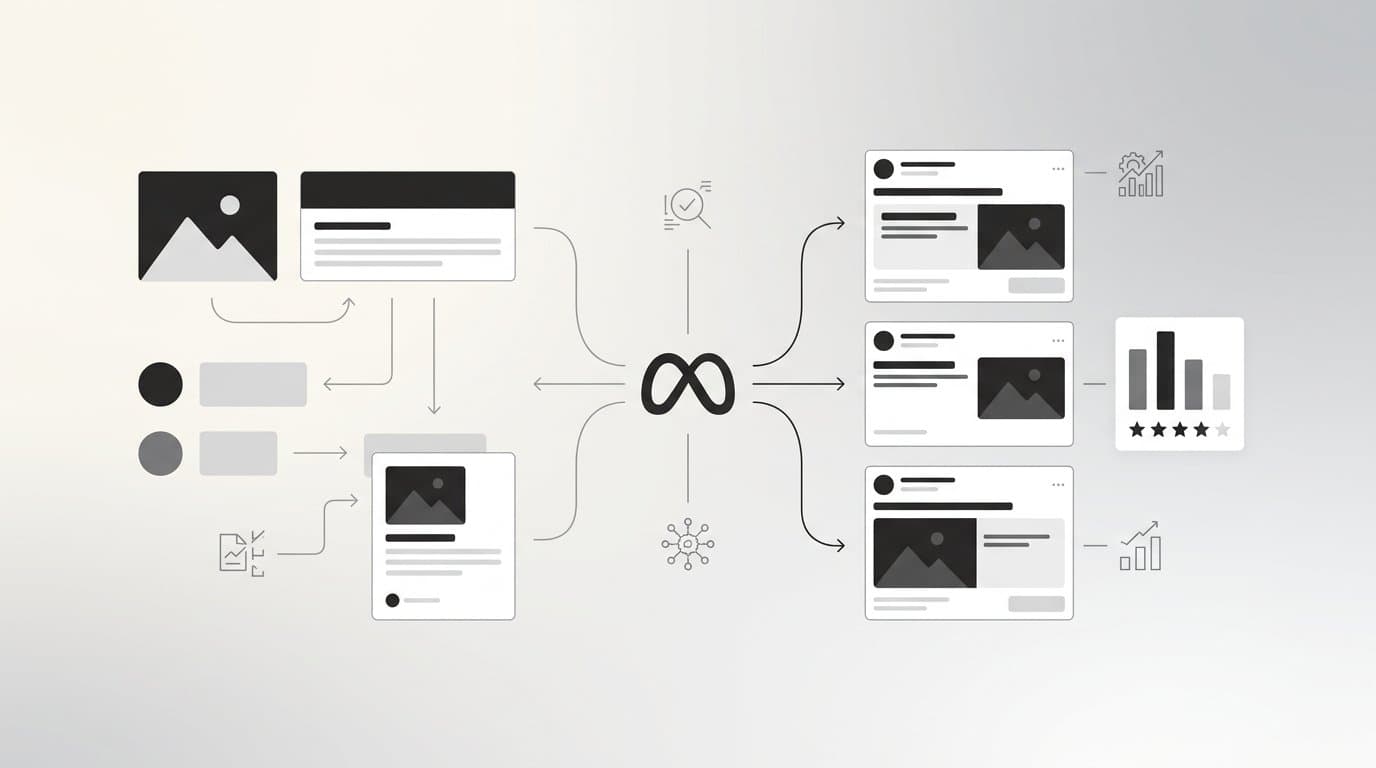
For teams producing high volumes of ads, manual production at this scale introduces human error, which is one of the primary sources of creative inconsistency in the first place. AI-powered creative tools solve this by generating on-brand variations at scale without requiring a designer for every iteration. AdStellar's AI Creative Hub generates image ads, video ads, and UGC-style creatives from a product URL, and allows chat-based editing to refine any ad until it matches your standards. Because the AI works from your brief and your approved elements, the output stays consistent without slowing down your production velocity.
One important note on checklist placement: build the checklist into your approval workflow as a required step, not as an afterthought that someone remembers to run occasionally. If the checklist is optional, it will be skipped under pressure. If it's a required gate before launch, it becomes part of the culture.
Success indicator: Every ad that goes live has passed the production checklist and fits within the creative framework you defined in Step 2. No exceptions.
Step 5: Structure Your Testing to Protect Consistency
Here's a paradox that trips up a lot of advertisers: creative testing is necessary for improving performance, but unstructured testing is one of the primary causes of creative consistency problems in the first place. When you test without a framework, you end up with wildly different ad styles coexisting in the same account, each one pulling the brand in a different direction.
The solution is not to test less. It's to test more deliberately.
The core principle of structured creative testing is simple: change one variable at a time. Keep all other elements fixed. Run each test long enough to gather data that is actually meaningful before drawing conclusions. This sounds obvious, but in practice most teams violate it constantly by launching tests that change the headline, the visual, the CTA, and the audience simultaneously and then trying to figure out why performance changed.
Organize your tests into clear categories: headline tests, visual style tests, CTA tests, and format tests. Never mix variables across categories within the same test. If you're running a headline test, the visuals, CTA, and audience should be identical across every variation. If you're running a visual style test, the headline and CTA stay fixed. This discipline is what makes your test results actionable rather than ambiguous.
Document every test with four pieces of information: the hypothesis you're testing, the specific variable being changed, the control creative you're testing against, and the result once the test concludes. This documentation serves two purposes. First, it prevents your team from re-testing the same things because nobody remembers what was already tried. Second, it builds an institutional knowledge base that makes every future test more informed than the last.
Scaling structured testing manually is genuinely difficult. Building each variation by hand creates a production bottleneck that either slows your testing velocity or causes teams to cut corners on the "one variable at a time" rule. AdStellar's Bulk Ad Launch feature addresses this directly. You can create hundreds of ad variations in minutes by mixing creatives, headlines, audiences, and copy at both the ad set and ad level. AdStellar generates every combination and launches them to Meta quickly, which means you can run rigorous, structured tests at a scale that would be impractical to build manually.
One more common pitfall: launching too many variables at once because you're eager to find a winner fast. This approach almost always produces uninterpretable results. You see a performance change but have no idea what caused it, so you can't replicate it or build on it. Patience in testing is not a luxury; it's what makes your testing budget produce actual learning.
Success indicator: Every active test has a documented hypothesis and a single variable. Results are logged in a running test tracker that your whole team can access and reference.
Step 6: Use Performance Data to Reinforce Consistency Over Time
Creative consistency is not a static achievement. It's an ongoing practice. The framework you build today will need to evolve as your audience changes, your product evolves, and the Meta platform shifts. The goal is not to lock everything in forever. The goal is to make changes deliberately, based on data, rather than reactively, based on whoever had the last idea.
Set a regular cadence for reviewing your creative performance. For active campaigns, weekly reviews are appropriate. You're looking at ROAS, CPA, and CTR across your creative families to identify which visual styles and messaging angles are maintaining performance and which are starting to decline. This is different from checking whether individual ads are performing. You're looking for patterns across your consistent elements.
When a consistent element starts to decline in performance, the right response is to update your creative framework, not to abandon consistency altogether. There's an important distinction between "this visual style is no longer working and needs to evolve" and "let's just try something completely different and see what happens." The first is strategic iteration. The second is how you end up back at square one with a fragmented account.
AdStellar's AI Insights leaderboards make this kind of review much faster. They rank your creatives, headlines, copy, audiences, and landing pages by real metrics like ROAS, CPA, and CTR, and score everything against your target goals. Instead of manually cross-referencing spreadsheets to figure out which consistent elements are working, you can see at a glance which elements are performing above your benchmarks and which need attention.
Use these insights to update your Winners Library on an ongoing basis. The library you built in Step 3 should reflect what's working now, not just what worked six months ago. Creative performance shifts over time, and a Winners Library that isn't regularly updated becomes a historical archive rather than a useful production tool.
Set a quarterly review specifically for your creative framework. Look at what the data has told you over the past three months and ask whether your fixed elements still make sense, whether any of your messaging pillars need refreshing, and whether your format guidelines reflect current best practices for each placement. This quarterly rhythm keeps your framework current without requiring constant revision.
Success indicator: Your creative framework has been updated at least once based on performance data. Your Winners Library reflects current top performers, not just historical ones. Your team has a shared understanding of what's working now and why.
Putting It All Together
Fixing meta ads creative consistency issues is not a one-time project. It's an ongoing discipline, and the payoff compounds over time. Consistent creative builds brand recognition with your audience, gives Meta's algorithm cleaner signals to optimize delivery, and makes your campaigns easier to manage as they scale.
To recap the process: audit your existing ads to find where consistency breaks down. Define a clear creative framework before building anything new. Consolidate your winning elements into a library you can reuse. Build a production system that enforces consistency at scale. Structure your testing so it generates learning without creating chaos. Use performance data to keep your framework current and your Winners Library relevant.
Each step builds on the last. The result is a creative operation that scales without losing coherence, produces better performance with less guesswork, and gives your team a clear process to follow rather than reinventing the approach with every new campaign.
If you want to accelerate this process, AdStellar brings together AI creative generation, structured campaign building, bulk ad launching, and performance insights in one platform. You can maintain creative consistency and test at scale without a large team or a complex toolstack. Start Free Trial With AdStellar and see how quickly a consistent, high-performing creative system comes together.