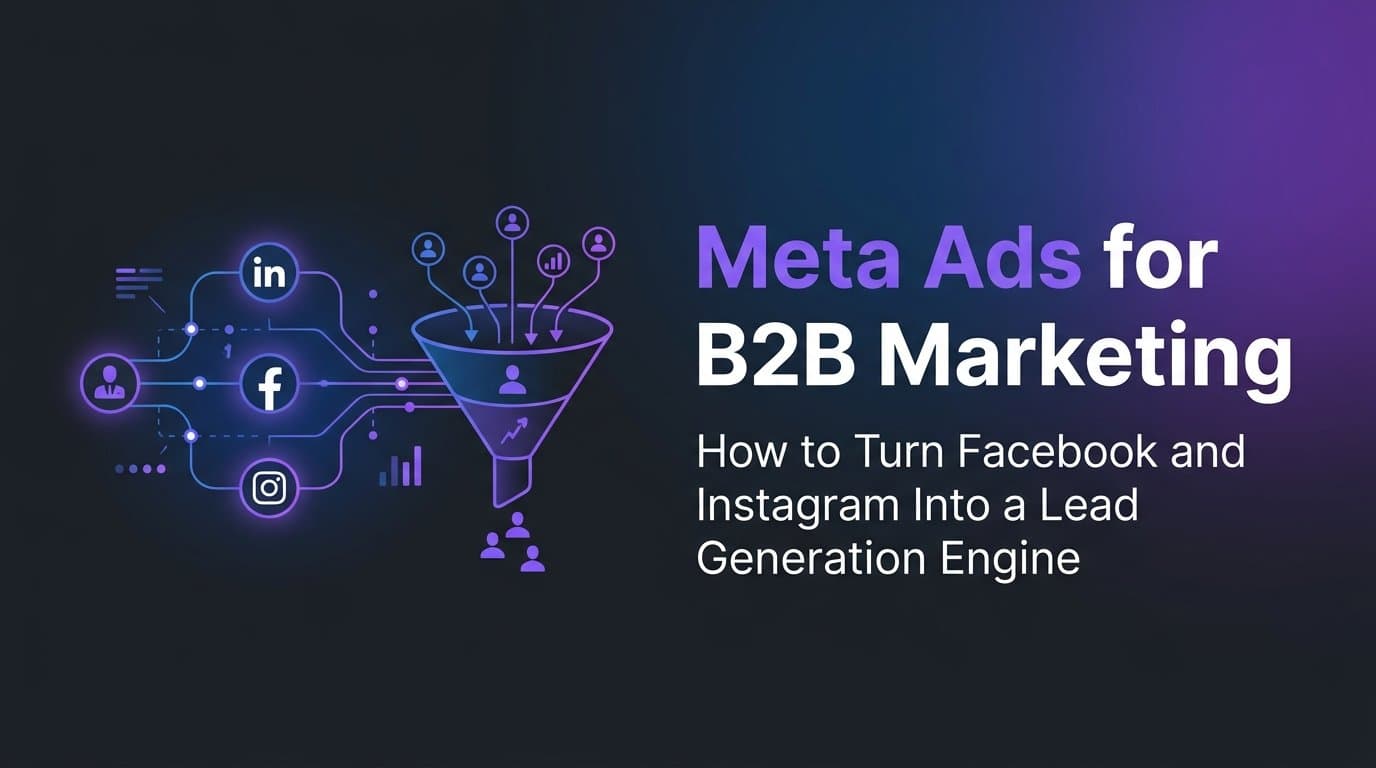
Let's address the assumption directly: Meta is for B2C brands selling leggings, skincare, and kitchen gadgets. If you're selling enterprise software, professional services, or B2B solutions, you belong on LinkedIn. Right?
Not quite. That assumption is costing B2B marketers real pipeline.
The honest challenge is real. B2B buying cycles are long, decision-makers are hard to reach, and the idea of a CFO pausing their Saturday scroll to request a software demo feels like a stretch. But that framing misses something important about how B2B buyers actually behave, and where they actually spend their time.
Meta's platform reaches billions of active users every month. A meaningful portion of those users are the directors, VPs, and business owners you're trying to reach. They're not on Meta in their professional capacity, but they're there. And that creates an opportunity that most B2B competitors are ignoring entirely.
The B2B marketers who have cracked Meta aren't doing anything magical. They're applying the right audience strategy, building creative that speaks to professional pain points, and measuring what actually matters for longer sales cycles. This guide breaks down exactly how to do that, from targeting mechanics to scaling without burning budget.
Why B2B Buyers Are on Meta (Even If They Don't Admit It)
Here's a simple truth that often gets overlooked: job titles don't disappear when people close their laptops. The procurement manager who evaluates your category of software also watches Instagram Reels. The VP of Marketing who approves your type of tool also scrolls Facebook during their commute. They are the same person in two different contexts.
This is actually an advantage, not a limitation. On LinkedIn, you're competing for attention in a professional mindset where everyone is selling something. On Meta, you can reach the same decision-maker when their guard is slightly lower and their attention is more relaxed. That's a different kind of brand impression, and for top-of-funnel awareness, it can be more effective.
Meta's targeting doesn't offer native job title filters the way LinkedIn does, but it offers something surprisingly useful: behavioral signals. Categories like "Business Decision Makers," "Small Business Owners," and various industry interest segments let you approximate professional attributes. These aren't perfect proxies for job titles, but layered with other filters, they get you meaningfully closer to your target persona than a broad interest audience would.
The other factor worth understanding is where Meta fits in the B2B buying journey. Most enterprise and mid-market purchases don't start with a Google search or a LinkedIn ad click. They start with passive awareness, a brand name that surfaces repeatedly until it becomes familiar, a concept that lodges in someone's mind before they're actively in-market. Meta excels at exactly this kind of ambient exposure.
By the time your prospect starts actively researching solutions, you want them to already recognize your brand. Meta campaigns that run consistently at the top of the funnel make your brand part of the consideration set before the evaluation phase even begins. That's not a soft, untrackable outcome. It's a measurable advantage when you connect Meta exposure to downstream pipeline data in your CRM. For a deeper look at how Facebook advertising for B2B marketing differs from traditional approaches, the strategic differences are worth understanding before you build your first campaign.
The skepticism around Meta for B2B is understandable, but it's largely based on running B2C-style campaigns and measuring them with B2C-style metrics. When you approach the platform with a B2B strategy, the results look very different.
Building a B2B Audience That Actually Converts
The biggest mistake B2B marketers make on Meta is relying entirely on interest-based targeting and hoping the algorithm figures out the rest. Interest targeting alone is a starting point, not a strategy. The real power comes from combining multiple audience signals into something that actually resembles your ideal customer profile.
Start with what you already have. Custom Audiences are the foundation of any serious B2B Meta strategy. Upload your CRM contacts, email subscribers, and past customers to create audiences of people who already know your brand. These warm audiences consistently outperform cold interest-based targeting because the trust barrier is already partially lowered. Someone who downloaded your whitepaper six months ago is far more likely to respond to a demo offer than someone who has never heard of you.
Website visitor retargeting works the same way. Install the Meta Pixel on your site, segment visitors by the pages they viewed (pricing page visitors deserve a different message than blog readers), and serve them ads that match where they are in the funnel. This is basic retargeting logic, but B2B teams often skip it in favor of chasing cold audiences.
Once you have Custom Audiences performing well, Lookalike Audiences become a powerful expansion tool. Meta analyzes the characteristics of your seed audience and finds other users who share similar behavioral patterns. A Lookalike built from your actual customers or your highest-converting leads will naturally skew toward professional profiles that resemble your buyers, even without explicit job title targeting.
For cold audience targeting, the layering approach is where B2B campaigns get interesting. Start with a broad behavioral category like "Business Decision Makers" or "Small Business Owners." Layer in industry-specific interests relevant to your category. Then add demographic filters like age ranges that skew toward mid-career professionals. No single filter gets you to your target persona, but the combination narrows the audience meaningfully. An AI targeting strategy for Meta ads can accelerate this layering process by identifying high-signal combinations your manual testing might miss.
A few practical combinations worth testing:
SaaS and software buyers: Layer technology interest categories with business decision-maker behaviors and company size indicators where available. Exclude student and entry-level demographic signals to reduce noise.
Professional services targets: Combine industry-specific interest categories with behaviors indicating active business ownership or management responsibility. Layer in income brackets as a proxy for seniority.
Enterprise audiences: Use CRM-based Custom Audiences as your primary targeting, supplemented by Lookalikes. Cold interest targeting for enterprise-level buyers tends to be less precise and more expensive to optimize.
The key principle across all of this is that B2B audiences on Meta are inherently smaller than B2C audiences. Resist the temptation to over-narrow your targeting to the point where Meta's algorithm doesn't have enough data to optimize. Find the balance between precision and sufficient audience size, typically aiming for at least several hundred thousand users in your target segment before launching.
Choosing the Right Campaign Objective for B2B Goals
Campaign objective selection is where many B2B Meta campaigns go wrong before a single ad is served. Choosing the wrong objective means Meta optimizes for the wrong behavior, and your budget gets spent reaching people who will never become qualified leads.
For most B2B lead generation use cases, Meta's native Lead Generation objective with Instant Forms is the most friction-free option. Instant Forms pre-populate with the user's Meta profile data, meaning a busy VP can submit their contact information in two taps without ever leaving their feed. For gated content offers like whitepapers, webinar registrations, and early-stage demo requests, this format consistently outperforms sending users to an external landing page, particularly on mobile. Understanding how Meta ads for lead generation work at each funnel stage will help you configure these objectives correctly from the start.
The tradeoff with Instant Forms is lead quality. Because the barrier to submission is low, you can attract contacts who are less committed than someone who navigated to your website and filled out a form manually. Combat this by making your form questions specific enough to qualify intent. Ask about company size, current tools, or specific pain points. A slightly longer form will reduce volume but improve the quality of what comes through.
Traffic and Conversion objectives serve a different purpose. Use them when your goal is to drive users to a specific destination, such as a webinar registration page, a product demo request form on your website, or a free trial signup. These objectives work best for mid-funnel content where you want the prospect to engage with your full brand experience rather than just submitting a form.
Conversion campaigns are particularly powerful when your Meta Pixel is properly configured with meaningful B2B events. If Meta can optimize toward "demo request submitted" rather than just "website visit," the algorithm will find users who are more likely to take that specific action. This requires patience during the learning phase, but the quality of traffic improves significantly once the algorithm has enough conversion data to work with.
Awareness and Reach objectives belong at the top of your funnel, especially for brand-building campaigns targeting cold audiences. Don't expect these to generate leads directly. Their job is to create the familiarity that makes your retargeting and lead generation campaigns more effective downstream.
Think of your Meta campaign structure as a three-layer system: awareness campaigns building brand recognition with cold audiences, lead generation or traffic campaigns capturing interest from engaged prospects, and retargeting conversion campaigns closing warm leads who have already interacted with your brand. Each layer feeds the next. Reviewing Meta ads campaign structure best practices before you build will save you from costly structural mistakes that are hard to fix mid-flight.
Ad Creative That Speaks to Business Buyers
B2B creative on Meta has to solve a specific tension: it needs to earn attention in a personal social feed while communicating professional value. The lifestyle imagery and aspirational visuals that work for consumer brands will get ignored by someone who is mentally in "personal time" mode but professionally motivated by business outcomes.
The solution is to lead with the problem, not the product. Your target buyer is a marketing director frustrated by wasted ad spend, an operations manager drowning in manual processes, or a sales leader watching deals stall in the pipeline. Speak to that frustration directly in your headline and first line of copy. If they recognize their own situation in your ad, they'll stop scrolling.
Business outcome framing outperforms feature lists in almost every B2B creative test. "Cut your cost per lead in half" will outperform "Advanced audience targeting capabilities" because one speaks to what the buyer wants and the other speaks to what the product does. Your creative should bridge the gap between the pain your buyer feels and the result your product delivers.
On format, the B2B assumption is often that polished, corporate-looking static ads are the right choice. In practice, video and UGC-style formats frequently outperform them, especially for SaaS and service businesses where credibility is a key purchase barrier. A short-form video where a real customer explains how they solved a specific problem builds trust in a way that a designed banner ad simply cannot.
Carousel ads are particularly useful for B2B because they let you tell a sequential story: the problem on card one, the solution on card two, social proof on card three, and a clear call to action on card four. They also work well for showcasing multiple product features or use cases to an audience that might have different primary pain points.
Systematic creative testing is non-negotiable for B2B campaigns. Your audience is smaller and more expensive to reach than a B2C audience, which means you cannot afford to run a single creative and hope it works. You need to test multiple headlines, multiple visual formats, and multiple value propositions to find the combinations that resonate.
This is where the operational reality of B2B Meta advertising gets challenging. Creating enough creative variations to run meaningful tests typically requires a designer, a copywriter, and a media buyer working in coordination. Tools like AdStellar remove that dependency by generating image ads, video ads, and UGC-style creatives directly from a product URL, letting you produce and test multiple variations without a creative team. For B2B teams that are stretched thin, that capability changes the economics of Meta advertising entirely.
Measuring B2B Performance Beyond Click-Through Rate
CTR is a vanity metric for B2B Meta campaigns. A 2% click-through rate means nothing if none of those clicks turn into qualified pipeline. The measurement framework you build will determine whether you can actually optimize your campaigns toward business outcomes or just toward engagement signals that feel good but don't generate revenue.
Start by configuring your Meta Pixel to track the events that actually matter for B2B. Generic page views and session starts are noise. The events you want to capture are demo requests, content downloads, free trial signups, webinar registrations, and contact form completions. Each of these represents a meaningful step in your B2B funnel, and each should be set up as a distinct conversion event in Meta's Events Manager.
With proper Pixel configuration, you can optimize campaigns toward these specific milestones and report on cost per meaningful conversion rather than cost per click. Cost per demo request is a B2B metric. Cost per click is not. A well-configured Meta ads performance tracking dashboard makes it far easier to monitor these B2B-specific conversion events in one place rather than piecing together data from multiple sources.
The measurement challenge that's unique to B2B is the attribution gap created by long sales cycles. Someone who clicks a Meta ad in January might not close as a customer until April. Standard last-click attribution will give Meta zero credit for that conversion, even if the initial brand exposure was what put your company on the prospect's radar. This is why connecting Meta data to your CRM is essential.
Use UTM parameters on all Meta ad links to track traffic sources in your CRM. Tag every lead that comes through Meta campaigns with their source information. Then, when deals close, you can look back at the full attribution picture and understand what Meta actually contributed to revenue, not just to form fills. Pipeline influenced by Meta, even when it wasn't the last touchpoint, is a legitimate business metric worth tracking.
For reporting, the metrics that matter most for B2B Meta campaigns are cost per qualified lead (not just any lead), pipeline value influenced, and opportunity-to-close rate by traffic source. These require more setup than standard Meta reporting provides, but they're the numbers that will tell you whether your campaigns are actually working or just generating activity.
Scaling Your B2B Meta Campaigns Without Wasting Budget
Scaling B2B Meta campaigns is a discipline that most teams get wrong in the same way: they find something that looks like it's working and immediately pour more budget into it before they've confirmed it actually works. The result is a larger version of a campaign that was never properly validated, and a much larger bill to show for it.
The right approach is to prove before you scale. Run your initial campaigns with enough budget to generate statistically meaningful data, but not so much that a poor performer can drain your budget before you identify the problem. For B2B audiences, this often means running smaller, tightly targeted tests across multiple creative variations and audience segments, then identifying the combinations that produce qualified leads at an acceptable cost before increasing spend.
Budget consolidation is a principle that runs counter to how many B2B teams structure their campaigns. The instinct is to spread budget across many ad sets to maximize coverage. In practice, this fragments your data and slows Meta's learning algorithm significantly. Each ad set needs a minimum number of conversion events per week to exit the learning phase and start optimizing effectively. Too many ad sets competing for a limited budget means none of them accumulate enough data to learn properly. Automated budget optimization for Meta ads addresses exactly this problem by consolidating spend toward the ad sets that are actually learning and converting.
Consolidate your budget into fewer, better-defined ad sets. Let the algorithm optimize within broader audience parameters rather than trying to manually control every targeting variable. This is counterintuitive for performance marketers who are used to granular control, but Meta's algorithm genuinely performs better with more room to find the right users within a defined segment.
The operational challenge of B2B Meta scaling is the creative refresh cycle. As you scale spend, your audience sees your ads more frequently, and creative fatigue sets in faster. You need a steady pipeline of new creative variations to maintain performance as budgets increase. For most B2B teams without dedicated creative resources, this is the bottleneck that limits how aggressively they can scale.
This is precisely where AI-powered platforms change the equation. AdStellar's Bulk Ad Launch feature lets you launch multiple Meta ads at once, mixing creatives, headlines, audiences, and copy at both the ad set and ad level. The AI Campaign Builder analyzes past campaign performance, ranks every creative and audience combination by real metrics like ROAS and CPA, and builds complete Meta campaigns without requiring a media buyer to manually configure every element. The Winners Hub surfaces your best-performing creatives and audiences so you can instantly reuse what's working in your next campaign.
For B2B teams that are running lean, this kind of automation isn't a luxury. It's what makes running sophisticated, well-tested Meta campaigns operationally feasible without hiring a full media buying team.