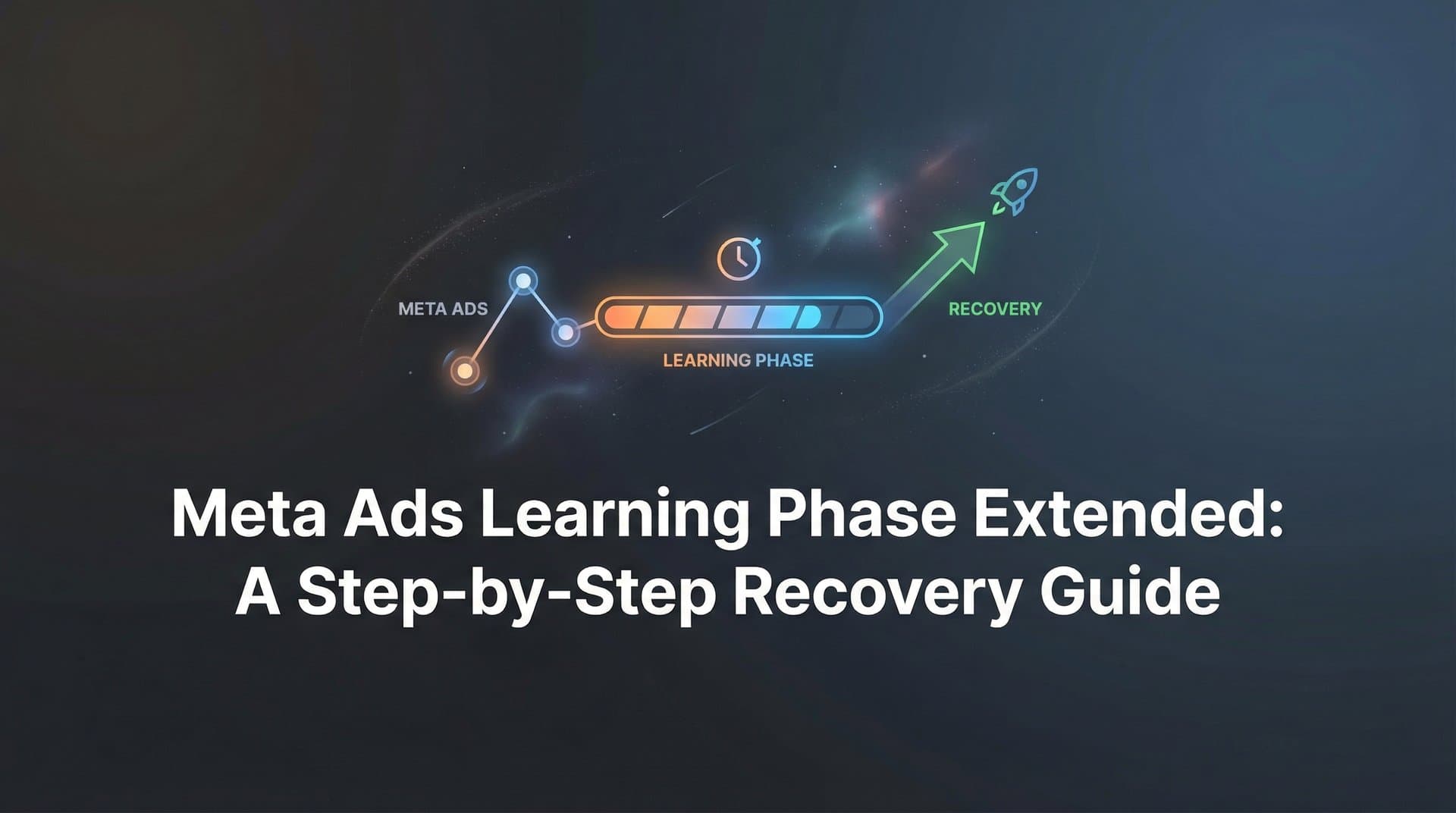
Your Meta ads campaign has been running for two weeks, but instead of the smooth optimization you expected, you're staring at a "Learning Limited" badge in Ads Manager. Your budget is draining at a steady pace, but the results are all over the place. One day you get five conversions, the next day zero, then three, then one. The algorithm isn't learning, and every dollar feels like a gamble rather than an investment.
The learning phase exists because Meta's algorithm needs data to understand who responds to your ads. Specifically, it needs approximately 50 optimization events per ad set within a 7-day window to stabilize performance and start delivering consistent results. When your campaigns can't hit this threshold, they get stuck in an extended learning phase, unable to optimize effectively.
The frustrating part? An extended learning phase is almost always preventable and fixable. The root cause typically falls into one of five categories: audiences too narrow for your budget, insufficient budget for your optimization goal, too many ad sets splitting your conversion data, excessive creative variations diluting performance signals, or frequent edits that keep resetting the learning process.
This guide provides a systematic recovery plan. You'll learn how to diagnose exactly why your campaigns are stuck, implement targeted fixes based on the specific issue, and build prevention systems so future campaigns exit learning phase on schedule. Whether you're managing a single struggling campaign or an entire account plagued by learning limited status, you'll have a clear action plan by the end.
Step 1: Diagnose Why Your Learning Phase Is Extended
Before you can fix the problem, you need to understand what's causing it. Start by opening Meta Ads Manager and locating the campaigns showing "Learning Limited" status. Hover over this badge, and Meta will often provide specific reasons why the campaign cannot gather sufficient data.
The most common explanation you'll see is that the ad set isn't generating enough optimization events. This immediately tells you that your issue is volume-related, but you need to dig deeper to understand why the volume is insufficient.
Pull up your ad set performance for the past seven days and count your optimization events. If you're optimizing for purchases, count your purchase conversions. If you're optimizing for leads, count your lead submissions. Compare this number to the 50-event threshold. If you're seeing 15 purchases across seven days, you're only hitting 30% of the required volume.
Now examine your campaign structure. How many active ad sets are you running? If you have five ad sets each generating 15 conversions weekly, that's 75 total conversions being split across multiple learning phases. Consolidating these into two ad sets would give you approximately 37 conversions per ad set, much closer to the target. Understanding Meta ads learning phase struggles helps you identify these structural issues faster.
Check your audience size in each ad set. Meta displays estimated audience reach when you view targeting parameters. If your audience is under 500,000 people, you may not have enough addressable users to generate sufficient conversion volume, especially with limited budgets.
Review your daily budget relative to your target cost per acquisition. If your CPA typically runs $40 and your daily budget is $50, you're only generating about one conversion per day, which equals seven conversions weekly. That's 86% short of the requirement.
Document everything: current audience size, daily budget per ad set, number of ad sets running, number of creatives per ad set, your optimization event, and your actual 7-day conversion count. This baseline data will guide every fix you implement in the following steps.
Step 2: Consolidate Ad Sets to Concentrate Data
Once you've diagnosed the issue, the fastest path to recovery often involves consolidation. When you're running multiple ad sets that each generate some conversions but none hit the 50-event threshold, you're fragmenting your data and preventing any single ad set from learning effectively.
Calculate your total weekly conversions across all active ad sets. Let's say you have four ad sets each generating 20 conversions weekly. That's 80 total conversions being distributed across four separate learning phases. If you consolidated these into two ad sets, each would receive approximately 40 conversions weekly, much closer to the optimization threshold.
Look for opportunities to merge similar audiences. If you're running separate ad sets for "fitness enthusiasts interested in yoga" and "fitness enthusiasts interested in pilates," these audiences likely have significant overlap and similar user behavior. Combining them into a single "fitness enthusiasts" ad set with broader interest targeting concentrates your conversion data. Following campaign structure best practices ensures you avoid this fragmentation from the start.
The same principle applies to lookalike audiences. Instead of running separate ad sets for 1% lookalikes of purchasers, email subscribers, and website visitors, test consolidating these into a single ad set with all three lookalike audiences stacked. Meta's algorithm will automatically optimize delivery toward whichever audience segment performs best.
Campaign Budget Optimization provides another consolidation path. Instead of setting individual budgets for each ad set, enable CBO at the campaign level and let Meta distribute your total budget across ad sets based on performance. This ensures your budget flows to the ad sets generating the most conversions, helping them exit learning phase faster while starving underperformers of resources.
When consolidating, pause rather than delete your original ad sets. This preserves your historical data in case you need to reference it later. Create new consolidated ad sets with your merged targeting, then monitor performance for the first 48 hours to ensure the transition is working as expected.
Step 3: Expand Your Audience Targeting
Narrow targeting feels safe. You're showing ads to exactly the people you think will convert. But when your audience is too small, you cannot generate enough volume to exit the learning phase, no matter how relevant those users seem.
Start by examining your interest targeting. If you're layering multiple specific interests together, you're creating audience intersections that may be too restrictive. Instead of targeting users interested in "organic skincare" AND "sustainable living" AND "yoga," test each interest separately or reduce the number of stacked interests.
Advantage+ audiences represent Meta's broadest targeting option. When you enable this feature, you provide some audience suggestions, but the algorithm has freedom to show ads beyond your specified parameters if it identifies users likely to convert. Many advertisers resist this approach because it feels like losing control, but the algorithm often finds valuable audience segments you wouldn't have targeted manually. Exploring Facebook ads learning phase optimization techniques can help you leverage these broader targeting options effectively.
If you're using lookalike audiences, increase your percentage threshold. A 1% lookalike in the United States typically reaches about 2 million people. Expanding to a 3% lookalike increases your reach to approximately 6 million people, tripling your addressable audience while still maintaining similarity to your source audience.
Review your exclusion lists. Every exclusion you add shrinks your audience. If you're excluding past purchasers, past website visitors, and email subscribers, you may be removing a significant portion of your addressable market. Consider whether these exclusions are truly necessary or if you're over-optimizing for audience purity at the expense of volume.
Test broad targeting with strong creative. Some of the most successful Meta advertisers run campaigns with minimal targeting restrictions, relying on compelling creative to attract the right users. When your creative clearly communicates who the product is for, you don't need tight targeting parameters to find your buyers.
Step 4: Adjust Budget to Support Learning Requirements
Your budget needs to support your optimization goal. If conversions are expensive and your budget is small, you mathematically cannot generate enough events to exit the learning phase.
Calculate your minimum viable daily budget using this formula: target CPA multiplied by 50, divided by 7 days. If your typical cost per purchase is $30, you need at least $214 daily budget per ad set to generate the required 50 weekly conversions. Running with a $50 daily budget in this scenario guarantees learning limited status. Understanding Meta ads budget allocation issues helps you avoid these common pitfalls.
If increasing your budget to the calculated minimum isn't financially viable, you have two options. First, you can temporarily switch to a higher-funnel optimization event that occurs more frequently and costs less. Instead of optimizing for purchases, optimize for Add to Cart or Initiate Checkout events. These actions happen more often, allowing you to hit the 50-event threshold with a smaller budget.
The tradeoff is that higher-funnel events don't directly optimize for your ultimate goal of purchases. You'll generate more Add to Cart actions, but the conversion rate from cart to purchase may be lower than if you optimized directly for purchases. However, exiting the learning phase with a higher-funnel event is often better than remaining stuck in learning limited while optimizing for purchases.
When you do increase budgets, make changes gradually. Meta's algorithm treats budget increases exceeding 20% as significant edits that can reset the learning phase. If you need to move from $50 daily to $200 daily, implement the change in stages: $50 to $60, wait 24 hours, then $60 to $72, and so on until you reach your target.
Campaign Budget Optimization helps here too. Instead of funding multiple underfunded ad sets, consolidate your total budget at the campaign level. A $200 daily campaign budget supporting two ad sets is more effective than four ad sets each receiving $50 daily.
Step 5: Optimize Creative Strategy for Faster Learning
Every additional creative you add to an ad set dilutes your conversion data. If you're running 12 different ad variations in a single ad set and generating 48 weekly conversions, those conversions are split across 12 ads. No single creative receives enough data to optimize effectively.
Limit your ad variations to three to six creatives per ad set. This concentration ensures each creative receives meaningful data while still providing enough variety for the algorithm to identify top performers. If you want to test more creative concepts, launch them in separate campaigns rather than stuffing them all into one ad set. Learning how to launch multiple Meta ads at once without fragmenting data is essential for scaling.
Use proven creative elements from your past winners. If you have historical data showing that user-generated content style videos outperform polished product shots, lead with UGC creatives in your new campaigns. Starting with creative formats that have demonstrated strong performance increases your chances of generating conversions quickly during the learning phase.
Dynamic creative offers an alternative approach. Instead of creating multiple complete ad variations, you upload multiple headlines, primary text options, images, and calls-to-action. Meta's algorithm automatically tests combinations and optimizes toward the best-performing elements. This approach concentrates data at the ad level rather than splitting it across separate ads.
Prioritize high-engagement creative formats. Video ads and UGC-style content typically generate stronger engagement than static images, which can help you accumulate the signals Meta's algorithm needs faster. If you're stuck in learning phase with static image ads, test introducing video variations to boost overall ad set performance.
Tools like AdStellar streamline creative optimization by analyzing your historical performance data to identify winning elements. The AI Creative Hub generates scroll-stopping image ads, video ads, and UGC-style avatar content, while the Winners Hub surfaces your top-performing creatives with real performance data so you can reuse proven elements in future campaigns.
Step 6: Prevent Future Learning Phase Extensions
Fixing an extended learning phase is valuable, but preventing the issue from recurring is even better. Build systems that ensure your campaigns launch with learning phase requirements already met.
Establish a no-edit window for the first seven days after campaign launch. Every significant edit resets the learning phase, sending you back to day zero. Resist the urge to tweak targeting, adjust budgets, or pause underperforming ads during this initial period unless performance is catastrophically bad. Let the algorithm gather its required data before you start optimizing. Using Meta ads campaign automation helps you resist the temptation to over-optimize during this critical window.
Create a pre-launch checklist that you review before activating any campaign. Verify that your audience size exceeds one million people, your daily budget supports at least seven conversions per day based on historical CPA, you're launching with six or fewer creatives per ad set, and you're using Campaign Budget Optimization if running multiple ad sets. A comprehensive campaign planning checklist ensures you don't miss critical setup requirements.
Set up monitoring alerts for campaigns approaching learning limited status. You can create custom rules in Ads Manager that notify you when an ad set has been in learning phase for more than 10 days or when weekly conversion volume drops below 40 events. Early warning gives you time to make adjustments before the situation becomes critical.
Build a systematic testing framework that incorporates learning phase requirements. Instead of launching five narrow audience tests simultaneously, launch one properly funded test, let it exit learning phase, evaluate results, then launch the next test. Sequential testing takes longer but produces more reliable data because each test completes the learning phase.
Document your learnings from each campaign. Track which audience sizes, budget levels, and creative strategies consistently exit learning phase fastest. Over time, you'll develop benchmarks specific to your account that guide future campaign setup decisions.
Your Path to Consistent Campaign Performance
Escaping an extended learning phase requires diagnosis first, then systematic fixes. Start by identifying whether your issue stems from insufficient budget, fragmented ad sets, narrow audiences, or excessive creative variations. Consolidate your ad sets to concentrate conversion data, expand your targeting to increase addressable reach, adjust budgets to support your optimization goals, limit creative variations to prevent data dilution, and build prevention systems for future campaigns.
Use this verification checklist before considering your fix complete: each ad set generates at least 50 optimization events weekly, audience size exceeds one million people, daily budget equals at least your target CPA multiplied by seven, you're running six or fewer creatives per ad set, and you haven't made significant edits in the past seven days.
The fixes outlined in this guide work, but they require discipline. The temptation to keep tweaking, testing narrow audiences, or launching with insufficient budgets is strong. Resist it. Meta's algorithm is powerful when you give it the data it needs to optimize.
AdStellar eliminates much of this manual optimization by using AI to analyze your historical performance data and build campaigns that meet learning phase requirements from launch. The AI Campaign Builder examines your past campaigns, ranks every creative, headline, and audience by performance, and constructs complete Meta ad campaigns with the right structure to exit learning phase quickly. The Bulk Ad Launch feature creates optimized ad variations efficiently without fragmenting your data across too many ads, while AI Insights surface top performers so you can reuse proven elements.
Implement these fixes today and monitor your campaigns over the next seven days. Track your daily optimization events, watch for the learning phase status to change from "Learning Limited" to "Learning" to "Active," and document which specific changes produced the strongest impact. Start Free Trial With AdStellar and experience how AI-powered campaign building and creative generation can help you launch campaigns that exit learning phase faster and scale more predictably.