Clicks are coming in, but the conversions are not. You are spending real money on Meta ads, your CTR looks reasonable, and yet the results are not showing up where it matters. Sound familiar? A low conversion rate on Meta ads is one of the most frustrating problems a marketer can face because the cause is rarely obvious from the surface.
Is it the creative? The audience? The landing page? The offer itself? Without a clear diagnostic process, most advertisers end up guessing, making random changes, and burning more budget in the process. The temptation is to tweak the creative because it is the most visible element, but that might not be where the problem lives at all.
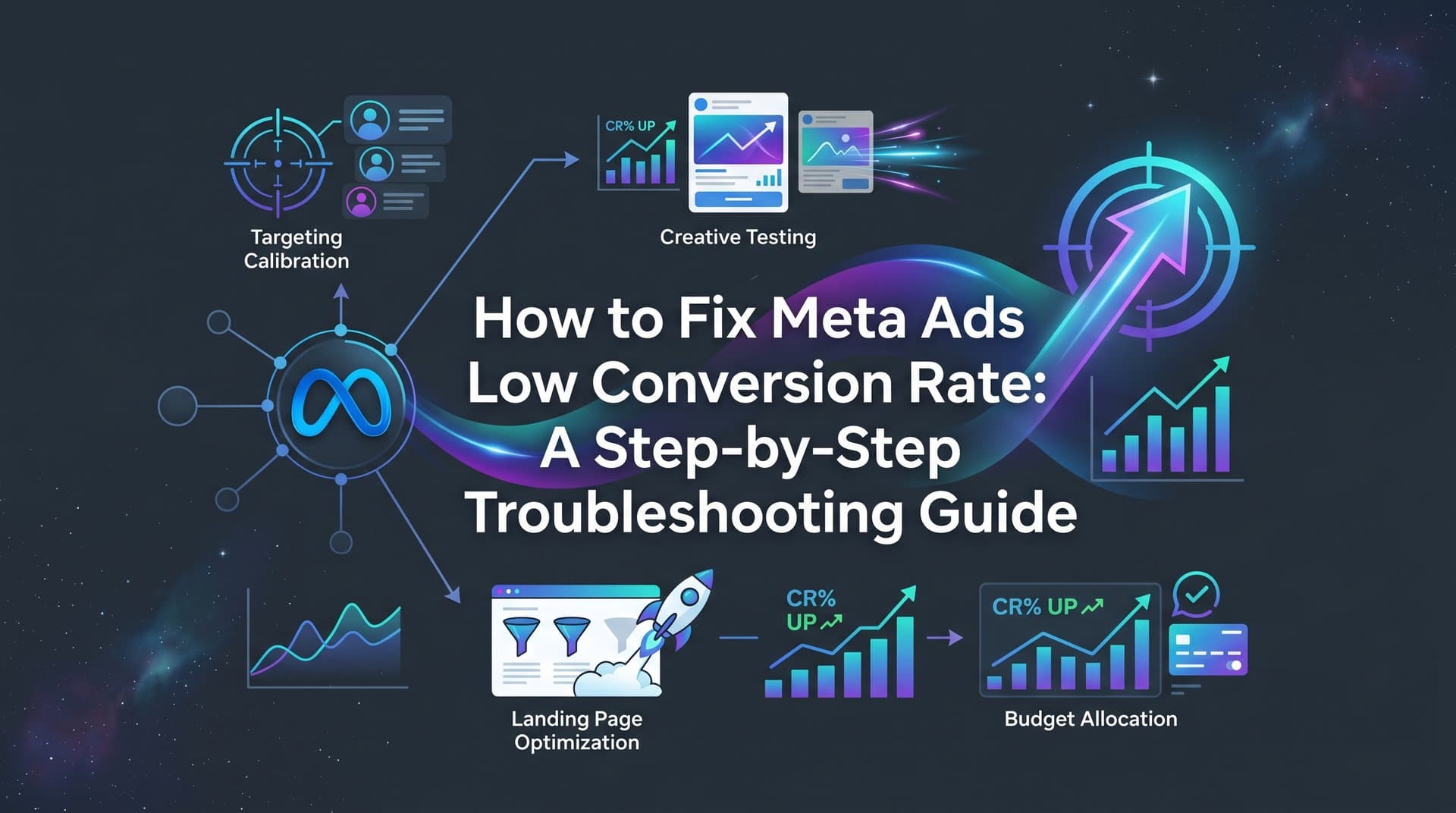
This guide gives you a structured, step-by-step framework to identify exactly why your Meta ads are underperforming on conversions and what to do about it. You will start by auditing your tracking setup to make sure you are measuring the right things, then work through your audience targeting, creative performance, ad copy, landing page experience, and finally your offer and funnel alignment.
Each step builds on the last so you can isolate the real problem rather than chasing symptoms. Whether you are managing campaigns for a single brand or running ads across multiple client accounts, this process will help you move from guessing to knowing.
By the end, you will have a clear picture of where conversions are leaking and a concrete action plan to fix it. Let us get into it.
Step 1: Verify Your Conversion Tracking Before Anything Else
Before you change a single creative or adjust a single audience, you need to confirm that your conversion data is actually accurate. This sounds obvious, but a surprising number of campaigns are optimized against bad data. If your tracking is broken or misconfigured, every decision you make downstream will be built on a faulty foundation.
Start in Meta Events Manager. Check that your Meta Pixel or Conversions API is firing correctly on the pages that matter, particularly your thank-you pages, order confirmation pages, and any other key conversion events. Look for warnings, event quality scores, and any flags indicating that events are misfiring or not being received.
Watch for duplicate pixel fires. This happens when the Pixel fires multiple times for a single conversion, inflating your reported numbers and making your campaign look more effective than it actually is. Events Manager will flag deduplication issues if they exist, but you should also manually test by completing a conversion yourself and watching what fires in real time.
Check your attribution window settings. Meta allows attribution windows of 1-day click, 7-day click, 1-day view, or 7-day view. If your product has a longer consideration cycle and you are using a 1-day click window, you may be significantly undercounting conversions. Conversely, if you are using a 7-day view window for an impulse purchase product, you may be over-attributing. Make sure your attribution window reflects how your customers actually make purchasing decisions.
Cross-reference your numbers. Meta-reported conversions and your actual backend data will rarely match perfectly, but large discrepancies are a red flag. Pull your order data from your CRM or ecommerce platform and compare it against what Meta is reporting for the same time period. If you are using a third-party attribution tool like Cometly, this cross-referencing becomes much easier and gives you a clearer picture of which campaigns are actually driving revenue versus which ones are just claiming credit.
Confirm you are optimizing for the right event. One of the most common and costly mistakes in Meta advertising is setting campaign optimization to a high-volume event like PageView or Add to Cart when the actual goal is Purchase. Meta will optimize to get you more of whatever event you tell it to, so if you are asking for PageViews, that is exactly what you will get, at the expense of actual conversions. Understanding your Facebook ads conversion rate benchmarks helps you set realistic targets before you begin.
Success indicator: Meta Events Manager shows your conversion event firing accurately, with no warnings, no duplicate fires, and an event match quality score that gives you confidence in the data you are working with.
Step 2: Diagnose Whether Your Audience Is the Problem
Once you have confirmed your tracking is solid, the next question is whether you are showing your ads to the right people. Audience issues are one of the most common causes of a Meta ads low conversion rate, and they are often misdiagnosed because the symptoms can look like a creative problem or a landing page problem on the surface.
Pull your audience breakdown reports inside Ads Manager. Break down performance by age, gender, placement, and device, and look at CPM, CTR, and conversion rate by segment. You are looking for patterns: segments that click but never convert, segments that have dramatically higher CPMs, or segments where your ad is barely delivering at all.
Check for audience overlap. If you are running multiple ad sets targeting similar audiences, those ad sets are competing against each other in the auction. This drives up your CPMs and can suppress delivery to your most valuable users. Use Meta's Audience Overlap tool to identify where this is happening and consolidate or separate your targeting accordingly.
Look at your frequency scores. For cold audiences, frequency above three to four is generally a warning sign. When the same people are seeing your ad repeatedly and not converting, you are likely dealing with audience fatigue. The instinct is to fix the creative, but if your audience pool is too small, new creatives will hit the same wall. Expanding your audience or introducing exclusions can resolve this faster than creative changes alone.
Evaluate funnel and audience alignment. Cold traffic and warm retargeting audiences behave very differently. If you are running a direct purchase campaign to people who have never interacted with your brand, you are asking for a significant commitment from someone with no existing trust. Cold traffic typically converts better on lower-commitment offers like free trials, lead magnets, or introductory discounts. Pushing a high-ticket direct purchase to a cold audience and expecting strong conversion rates is a common mismatch that no amount of creative optimization will fully fix. A well-structured Meta ads targeting strategy can help you align your audience selection with the right funnel stage from the start.
Consider rebuilding your lookalike audiences. Lookalike audiences built from your actual purchaser lists or high-value customer segments tend to outperform broad interest-based targeting for conversion-focused campaigns. If your current lookalikes are built from general website visitors rather than converters, rebuilding them from a purchaser seed audience is often worth testing. Exploring automated Meta ads targeting tools can speed up this process significantly.
Success indicator: You can identify at least one audience segment with meaningfully better or worse conversion rates than your average, giving you a clear direction for where to focus next.
Step 3: Audit Your Ad Creatives for Conversion Signals
Here is something that trips up a lot of Meta advertisers: a high click-through rate does not mean your creative is working. CTR and conversion rate tell different stories, and conflating the two leads to bad decisions. A creative that generates curiosity clicks will look great on CTR while quietly draining your budget without producing results. What you actually want is a creative that attracts the right intent.
Sort your active ads by CTR and conversion rate separately. Look for ads where these two metrics diverge significantly. A creative with a high CTR but low conversion rate is likely attracting people who are interested but not ready to buy, or worse, people who clicked by mistake. A creative with a lower CTR but higher conversion rate is often doing something more valuable: communicating clearly to a smaller, higher-intent audience.
Evaluate what your creative is actually communicating. Ask yourself three questions about each ad. Does it clearly state what the product or service is? Does it show the product in use or demonstrate the outcome it delivers? Does it speak to a real, specific pain point that your target customer actually has? If the answer to any of these is unclear or vague, that creative is likely generating interest without generating intent.
Check your format diversity. Static images, video ads, and UGC-style content often perform very differently for the same offer and the same audience. UGC-style content tends to perform well because it blends into organic feed content and reduces the perception of being an advertisement. Video can communicate more nuance and build more trust in a short window. Static images can be highly effective when the visual and headline combination is strong. If you are only running one or two formats, you are missing significant testing surface area. A structured Meta ads creative testing strategy will help you evaluate each format systematically.
Address the creative volume problem. Running only one or two creatives is one of the most common bottlenecks in Meta advertising. Without enough creative variations in rotation, you have no data to determine what is actually working. This is where many advertisers get stuck because producing new creatives takes time, budget, and resources they do not always have.
Platforms like AdStellar solve this directly. You can generate image ads, video ads, and UGC avatar ads from a product URL without a production team, then refine any creative through chat-based editing. You can also clone competitor ads directly from the Meta Ad Library to understand what formats are already resonating in your market. The goal is to get enough creative variations into testing that performance data, not gut feel, determines what runs.
Success indicator: You have at least three to five distinct creative concepts in rotation, covering multiple formats, with enough spend on each to draw meaningful conclusions about which ones are driving actual conversions.
Step 4: Evaluate Your Ad Copy and Offer Alignment
Creative gets the attention. Copy closes the deal. Or at least, it should. If your ad copy is not doing its job, even the strongest visual will fail to convert. This step is about reading your own ads with genuinely fresh eyes and asking whether the words are actually doing the work.
Start with your headlines. Does the headline clearly state what the user gets and why it matters to them right now? Vague, clever headlines that prioritize wit over clarity are a common conversion killer. The person scrolling through their feed has a fraction of a second to decide whether to keep scrolling or engage. Clarity wins almost every time.
Check for message match. This is one of the most fundamental principles in conversion rate optimization and one of the most frequently violated. The promise made in your ad copy must match exactly what the landing page delivers. If your ad promises a free trial and the landing page leads with a pricing table, trust breaks immediately. If your ad is about a specific product benefit and the landing page talks about something else entirely, you have created friction that most users will not push through. Every click that bounces because of message mismatch is wasted spend. Reviewing your approach to fixing low ad conversion rates can surface additional copy-level issues you may have missed.
Audit your call to action. Vague CTAs consistently underperform specific ones. "Learn More" tells the user nothing about what happens next. "Get Your Free Trial" or "Shop the Collection" sets a clear expectation and attracts clicks from people who actually want that outcome. Review every CTA across your active ads and ask whether it is specific, benefit-oriented, and aligned with where the user is in the funnel.
Assess your offer strength for cold traffic. A direct purchase ask to someone who has never heard of your brand is a high bar. Cold traffic has no existing trust in your brand, no familiarity with your product, and no urgency unless you create it. Consider whether your offer structure is appropriate for the audience you are targeting. Free trials, limited-time discounts, lead magnets, and bundle deals can dramatically change conversion behavior by lowering the perceived risk of taking action.
Success indicator: Your ad copy and landing page headline are clearly aligned, your CTA sets a specific expectation for what happens after the click, and your offer is calibrated to the trust level of the audience you are targeting.
Step 5: Fix Landing Page Issues That Kill Conversions
You can have perfect tracking, the right audience, a compelling creative, and strong copy, and still lose conversions on the landing page. The landing page is where intent either converts into action or evaporates. For many campaigns with a Meta ads low conversion rate, this is exactly where the leak is happening.
Start with page load speed on mobile. The majority of Meta ad traffic arrives on mobile devices, and slow pages destroy conversion rates before a user has even seen your offer. Use Google PageSpeed Insights or a similar tool to check your mobile load time. If your page is taking more than three seconds to load, you are losing a significant portion of the traffic you paid to acquire before they ever see your headline.
Install session recording or heatmap tools. Tools like Hotjar or Microsoft Clarity let you watch how real users interact with your landing page after clicking your ad. You can see exactly where people scroll, where they click, and where they leave. This kind of behavioral data is far more diagnostic than aggregate bounce rates because it shows you the specific friction points rather than just telling you that friction exists.
Evaluate your page focus. A landing page built for paid traffic should have one job: convert the visitor on a single, specific action. If your page has a navigation menu with multiple links, competing CTAs, or sections that pull the user toward other parts of your site, you are diluting focus and giving users an easy exit. Dedicated landing pages consistently outperform general website pages for paid traffic because they eliminate distractions and keep the user oriented toward one decision.
Check your social proof placement. For cold traffic, trust must be established quickly. Testimonials, reviews, trust badges, and real customer results should be visible above the fold or very close to it. If your social proof is buried at the bottom of the page, most cold traffic users will never see it before deciding whether to convert or leave. Pairing strong landing page trust signals with smart Meta ads budget allocation strategies ensures you are sending the right volume of traffic to pages that are actually ready to convert.
Simplify your form or checkout flow. Every additional field in a form and every additional step in a checkout process reduces completion rates. Audit your conversion flow and remove every field or step that is not absolutely necessary. If you are asking for information you do not immediately need, remove it.
Success indicator: Your landing page loads in under three seconds on mobile, has a single clear conversion action, and social proof is visible without scrolling for the majority of users.
Step 6: Build a Systematic Testing Process to Find What Works
Here is the hard truth about fixing a Meta ads low conversion rate: there is no single tweak that solves everything. Conversion rate improvement is a testing discipline, and the advertisers who consistently improve are the ones who test systematically rather than reactively.
The most important rule is this: stop making multiple changes at once. When you change the creative, the copy, and the audience simultaneously, you have no way of knowing which change produced the result. Isolate one variable per test so you can attribute results accurately and build genuine knowledge about what works for your specific offer and audience.
Follow a testing priority order. Not all variables are created equal. Changes to your offer tend to produce the largest swings in conversion rate. Audience changes come next, followed by creative, then copy, then landing page elements. This order reflects the relative impact each lever typically has, though every account is different. Start with the highest-leverage variables before refining the smaller details.
Set minimum spend thresholds before evaluating results. Pausing ads too early based on insufficient data is one of the most common and costly mistakes in Meta advertising. An ad that looks like it is failing after 500 impressions might be a strong performer at 5,000 impressions. Define your minimum spend or impression threshold before you start a test and commit to it, even when early results look discouraging. Understanding how to scale Meta ads efficiently becomes much easier once you have reliable test data to act on.
Scale your creative testing volume. One of the biggest constraints in systematic testing is creative production. If it takes days or weeks to produce each new creative variation, your testing cadence will be too slow to generate meaningful learning. AdStellar's Bulk Ad Launch feature addresses this directly. You can create hundreds of ad variations combining different creatives, headlines, audiences, and copy in minutes rather than hours, then launch them to Meta in clicks. The AI Insights leaderboard then surfaces top performers ranked by real metrics like ROAS, CPA, and CTR, so you stop guessing which combinations are working and start scaling what the data confirms.
Document everything. Every test you run should have a documented hypothesis, a defined success metric, a minimum evaluation threshold, and a recorded result. Without documentation, you end up running the same experiments repeatedly, and institutional knowledge walks out the door every time a team member changes. A simple spreadsheet tracking your tests and outcomes will compound in value over time.
Success indicator: You have a documented testing calendar with clear hypotheses, defined success metrics, minimum spend thresholds, and a consistent process for scaling winners into your main campaigns.
Your Conversion Rate Troubleshooting Checklist
Work through this checklist in order. Each item corresponds to one of the six steps above. Bookmark it and return to it whenever a campaign starts underperforming.
Tracking verified: Meta Pixel or Conversions API is firing correctly on conversion pages, no duplicate fires, event match quality is strong, and you have cross-referenced Meta-reported conversions against backend data or a tool like Cometly.
Attribution confirmed: Your attribution window matches your actual purchase cycle and you are optimizing for the right conversion event, not a proxy event like PageView or Add to Cart.
Audience segments analyzed: You have reviewed performance by segment, checked for audience overlap, assessed frequency scores, and confirmed that your offer is appropriate for the traffic temperature you are targeting.
Creative formats audited: You have separated CTR from conversion rate, evaluated message clarity and pain point relevance, and have multiple creative formats in rotation with enough spend to draw conclusions.
New creative variations queued: You have a pipeline of new creative concepts ready to test, covering image, video, and UGC formats.
Ad copy and offer reviewed: Headlines are clear, message match between ad and landing page is confirmed, CTAs are specific and benefit-oriented, and your offer is calibrated to your audience's trust level.
Landing page assessed: Page load speed is under three seconds on mobile, the page has a single conversion focus, social proof is visible above the fold, and your form or checkout flow is as short as possible.
Systematic testing process in place: You are testing one variable at a time, following a priority order, setting minimum spend thresholds, and documenting every test and result.
Platforms like AdStellar consolidate creative generation, campaign building, and performance analysis in one place, which makes working through this entire process significantly faster. Instead of juggling separate tools for creative production, campaign management, and performance reporting, everything lives in one workflow.
If you are ready to generate and test new creatives without needing a design team, Start Free Trial With AdStellar and see how quickly you can move from diagnosis to action.