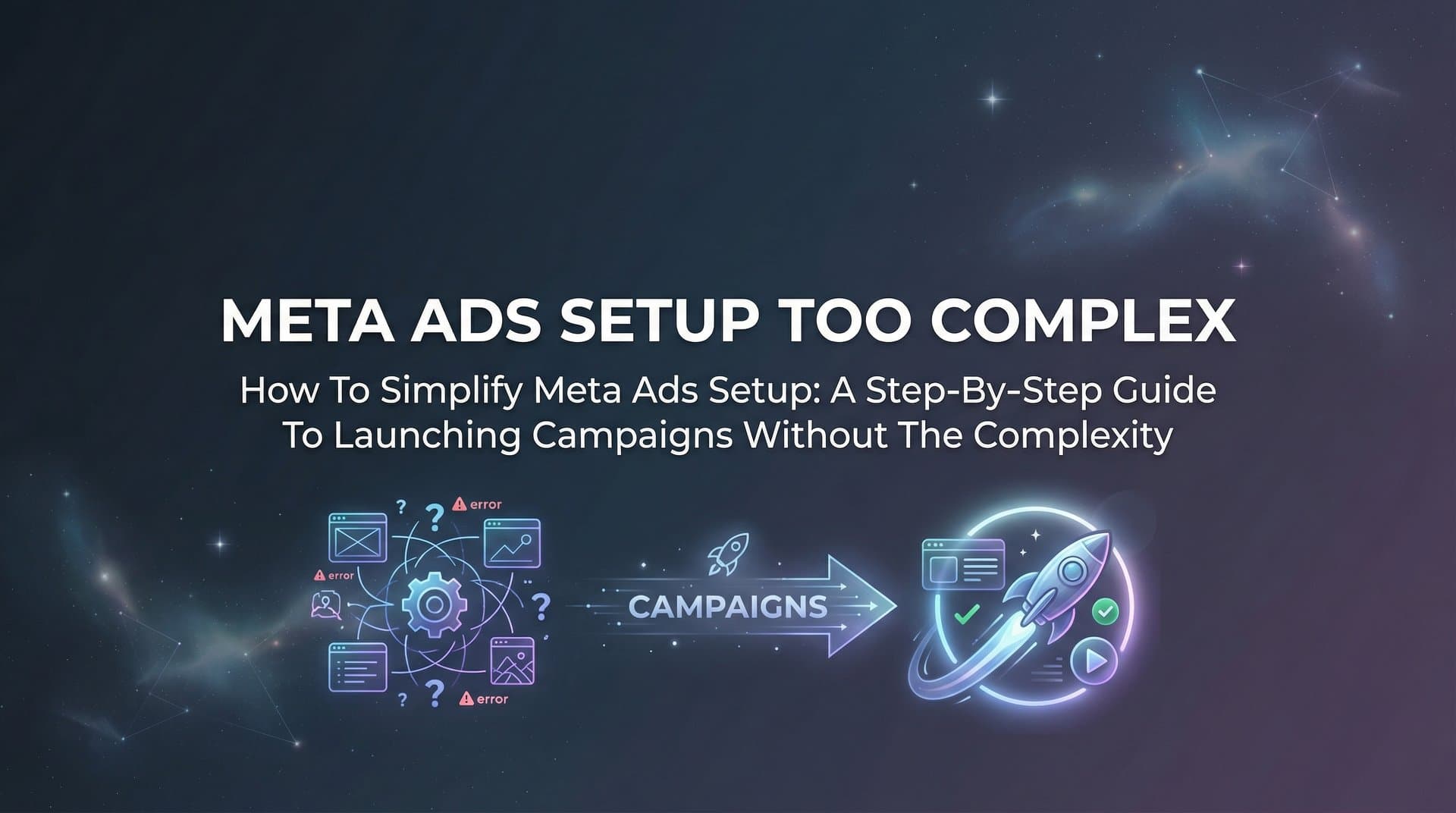
Meta Ads Manager opens on your screen, and within seconds, the familiar weight settles in. Campaign objectives, audience layers, placement toggles, budget settings, creative specs—all demanding decisions before you've even started. The platform that promises to connect you with billions of users somehow feels like it's designed to keep you from launching anything at all.
You're not imagining it. Meta ads setup has become genuinely complex.
What started as a straightforward advertising platform has evolved into a sophisticated system with nested options, automation features that require understanding to use effectively, and enough configuration possibilities to paralyze even experienced marketers. The result? Campaigns that sit in draft mode for days, settings that get misconfigured in the rush to launch, or hours burned on what should take minutes.
But here's what most advertisers miss: the complexity isn't mandatory. You don't need to master every feature, toggle every advanced setting, or understand every automation option to launch campaigns that perform. You need a system—a clear, repeatable process that cuts through the noise and gets you from concept to live ad without the confusion.
This guide gives you exactly that. Six straightforward steps that transform Meta's overwhelming interface into a manageable workflow. Whether you're launching your first campaign or your hundredth, you'll learn how to move decisively through setup without second-guessing every choice or getting lost in options you don't need yet.
By the end, you'll have a framework that makes Meta advertising feel less like solving a puzzle and more like following a recipe. Let's simplify this.
Step 1: Define Your Campaign Goal Before Touching Ads Manager
The biggest mistake happens before you even log into Ads Manager: starting without clarity. You open the platform, see "Create Campaign," and immediately face Meta's six objective options—Awareness, Traffic, Engagement, Leads, App Promotion, Sales—without a clear sense of which one actually matches what you're trying to accomplish.
This creates a cascade of confusion. Choose the wrong objective, and every subsequent decision becomes harder. Your optimization options change. Your bidding strategies shift. Your creative requirements adapt. You end up second-guessing whether you should have picked "Traffic" instead of "Engagement" or wondering if "Leads" would have been better than "Sales."
Skip all of that friction by doing this first: write a one-sentence campaign brief before you touch Ads Manager.
The format is simple: "I want to reach [specific audience] with [specific offer] so they will [specific action]."
For example: "I want to reach small business owners interested in productivity tools with our free trial offer so they will sign up for our software." That sentence immediately tells you everything. Your audience is small business owners. Your offer is a free trial. Your desired action is a signup. Which Meta objective matches? Leads or Sales, depending on whether you're optimizing for the signup itself or purchases that follow.
This clarity eliminates the guessing game. When you can explain your campaign in 15 seconds or less, you know exactly which objective to choose, which audience parameters make sense, and which creative approach will work. Without this clarity, you'll spend 20 minutes toggling between objectives, reading descriptions, and wondering if you're making the right choice. Understanding Meta campaign builder vs Ads Manager differences can also help you select the right tool for your workflow.
Map your business goal to Meta's framework: Want people to know your brand exists? Awareness. Want website visits? Traffic. Want engagement on your content? Engagement. Want contact information? Leads. Want app installs? App Promotion. Want purchases or conversions? Sales.
The success indicator for this step is brutally simple: can you explain what you're trying to accomplish in one clear sentence? If you're hedging, adding qualifiers, or using words like "maybe" or "ideally," you're not ready to build yet. Get this clarity first, and everything else becomes easier.
Step 2: Prepare Your Assets and Tracking Before You Build
Nothing kills momentum faster than getting halfway through campaign setup and realizing you don't have the right image dimensions, your landing page isn't ready, or you forgot to set up tracking. You pause the build, context-switch to find assets, lose your train of thought, and when you return to Ads Manager, you're starting from scratch mentally.
Eliminate this friction entirely by preparing everything before you click "Create Campaign." Think of it like mise en place in cooking—having all your ingredients measured and ready before you start actually cooking. The setup process becomes smooth and fast when you're not scrambling for components mid-build.
Your pre-build checklist should include: At minimum three creative variations (images or videos that meet Meta's specs), three headline variations, three primary text variations, your destination URL, and UTM parameters for tracking where your traffic comes from. Having variations ready isn't optional—it's how you avoid putting all your budget behind a single untested creative that might not resonate.
But here's the piece that trips up most advertisers: tracking verification. You can build a perfect campaign, but if your Meta Pixel isn't firing correctly or your Conversions API isn't configured, you're flying blind. You won't know which ads drive results, which audiences convert, or how to optimize performance.
Verify tracking before you build: Open Meta's Events Manager and navigate to the Event Testing tool. Load your landing page in another tab and complete your desired action—fill out a form, add something to cart, complete a purchase, whatever you're optimizing for. Watch the Event Testing tool in real-time. You should see your event fire within seconds. If you don't see it, your tracking isn't working, and you need to fix that before spending a dollar on ads.
This five-minute check prevents the nightmare scenario where you spend your entire budget, see decent click-through rates, but have zero visibility into what happened after people reached your site. Many advertisers discover tracking issues only after campaigns have run for days, by which point they've wasted budget and lost optimization opportunities. If you're struggling with Meta ads taking too long to create, having assets pre-staged is the fastest fix.
Why this preparation matters: When your assets are ready and your tracking is verified, campaign setup takes 10-15 minutes instead of an hour. You move through Ads Manager decisively, uploading creatives you've already prepared, pasting copy you've already written, and launching with confidence that you'll actually be able to measure results. The setup process stops feeling overwhelming because you've eliminated the variables that create confusion.
Quick test before moving to the next step: Can you open a folder right now and see your three creative variations, your three headlines, your three primary texts, and your destination URL with UTM parameters? If yes, you're ready. If not, pause and gather these assets first.
Step 3: Structure Your Campaign Using the Simplified Framework
Here's where most advertisers overcomplicate everything. They create five ad sets to test different audiences, three ads per ad set for creative testing, multiple campaign objectives running simultaneously, and end up with a fragmented mess where no single element gets enough budget or data to actually optimize.
The solution is counterintuitive: use less structure, not more.
The 1-2-3 framework works like this: One campaign with a single objective. Two ad sets within that campaign for testing (we'll cover what to test in the next step). Three ads per ad set, giving you six total ads running. That's it. No complex matrices, no elaborate testing grids, no splitting your budget across ten different combinations.
Why does this simplified structure work better than complex setups? Because Meta's algorithm needs volume to optimize. When you fragment your budget across too many ad sets, none of them get enough spend to exit the learning phase—the period where Meta is still figuring out who to show your ads to and how to bid effectively. You end up with a dozen ad sets perpetually stuck in learning, delivering inconsistent results and burning budget without meaningful optimization. For a deeper dive into organizing your accounts, check out our Meta ads campaign structure guide.
The 1-2-3 structure concentrates your budget and data. Your two ad sets each get substantial spend, allowing them to accumulate the conversion events needed for Meta's algorithm to optimize effectively. Your three ads per set give you creative variety without over-fragmentation. You're testing enough to find winners but not so much that you dilute your results.
When you're building in Ads Manager: Skip the advanced options on your first setup. Use Advantage+ placements (automatic placement across Facebook, Instagram, Audience Network, and Messenger) instead of manually selecting where your ads appear. Use automatic bidding instead of trying to set manual bid caps. Let Meta's automation handle the technical optimization while you focus on the strategic decisions that actually matter—your audience, your creative, your offer.
Think of it this way: Meta has spent billions of dollars developing machine learning systems that optimize ad delivery. Those systems work best when you give them flexibility and volume. Manual controls and complex structures often fight against the algorithm instead of working with it.
When to expand beyond this structure: After you've run campaigns with the 1-2-3 framework and have clear data showing what works. Once you know which audiences convert, which creative styles resonate, and which offers drive results, then you can add complexity strategically. Our campaign structure best practices article covers when and how to scale up. But starting simple gives you the clean data you need to make those expansion decisions confidently.
The structure you're building now isn't your forever structure—it's your clarity structure. It eliminates the paralysis of too many choices and gets you to results faster. You can always add complexity later when you have data to guide those decisions.
Step 4: Set Up Targeting Without Overthinking Audiences
Audience targeting is where advertisers spend the most time and often get the least return. They create hyper-specific audience combinations—"Women, ages 28-34, interested in yoga AND meditation AND wellness, who have traveled internationally in the past year, with household income above $75k"—and end up with an audience of 50,000 people that's too small for Meta's algorithm to optimize effectively.
The targeting landscape has fundamentally shifted. Meta's machine learning has become sophisticated enough that broad targeting often outperforms narrow, detailed specifications. The algorithm can find your ideal customers within a larger audience pool faster than you can manually define them through interest combinations. If you're wrestling with Meta ads targeting complexity, understanding this shift is essential.
For your first ad set, use interest stacking: Choose 3-5 related interests and combine them with an OR relationship, not AND. Instead of requiring someone to match all five interests, you're saying "show my ads to people interested in any of these five things." For a productivity software campaign, that might be: project management OR remote work OR business software OR productivity tools OR team collaboration. This creates an audience large enough for optimization while staying relevant to your offer.
For your second ad set, use Advantage+ Audience: This is Meta's broad targeting option that relies entirely on the algorithm to find your ideal customers based on your campaign objective and the actions people take. You provide minimal constraints—maybe just age range and location—and let Meta's system identify patterns in who converts. Many advertisers find this performs as well or better than manually defined audiences, especially after the algorithm has conversion data to learn from.
Why run both? Because you're testing whether your manual targeting intuition or Meta's automated discovery performs better. Sometimes your interest-stacked audience will win because you understand your market. Sometimes Advantage+ Audience will win because the algorithm identified patterns you wouldn't have considered. You won't know until you test, and the 1-2-3 structure makes this test clean and interpretable. An AI Meta ads targeting assistant can help you identify high-potential segments faster.
Verify your audience size falls between 1-10 million: When you're setting up each ad set, Ads Manager shows you a potential reach estimate. If it's below 1 million, you're probably too narrow—broaden your interests or expand your geographic targeting. If it's above 10 million, you might be too broad for your first campaign—add a few more relevant interests to focus the targeting slightly. This range gives Meta enough volume to optimize while maintaining relevance to your offer.
The common trap to avoid: assuming that more specific equals better. Hyper-narrow targeting limits Meta's ability to find unexpected high-performers and often results in higher costs because you're competing for a small audience. Broader targeting with smart creative typically outperforms narrow targeting with generic creative.
Your targeting decisions shouldn't take more than five minutes per ad set. Choose your interests or select Advantage+ Audience, verify the size looks reasonable, and move on. The real optimization happens after launch when you have data showing which approach actually drives results.
Step 5: Configure Budget and Schedule for Stress-Free Launches
Budget configuration creates more anxiety than it should. Advertisers agonize over whether to set campaign budgets or ad set budgets, whether to use daily or lifetime budgets, and how much to spend without wasting money or limiting performance. The decisions feel high-stakes because they involve real dollars.
Simplify this by understanding one key principle: your budget needs to be sufficient for Meta's algorithm to learn and optimize. Too little budget, and you'll never exit the learning phase. Too much budget without a proven campaign, and you're taking unnecessary risk. The sweet spot is mathematical, not emotional. If you've experienced Meta ads budget allocation issues, you know how costly misconfiguration can be.
Use Campaign Budget Optimization (CBO) for your first campaigns: This means you set one budget at the campaign level, and Meta automatically allocates it between your two ad sets based on which is performing better. You're not manually splitting budget or trying to predict which ad set deserves more spend. The algorithm handles distribution, shifting budget toward better-performing audiences as data accumulates. Set this as a daily budget, not lifetime, so you maintain control and can pause if needed without commitment to a full spend.
Calculate your starting budget using this formula: Take your target cost-per-acquisition (what you're willing to pay for a conversion) and multiply by 2-3x. That's your minimum daily budget. Why? Because Meta's algorithm needs to generate approximately 50 conversion events per week per ad set to exit the learning phase and optimize effectively. If your target CPA is $20 and you're running two ad sets, you need roughly $100-120 per day to generate enough conversions for optimization. Starting lower means you'll stay in learning phase longer, seeing inconsistent results and higher costs.
If you don't know your target CPA yet, use your product price or customer lifetime value as a guide. For a $100 product, starting with $50-75 per day makes sense. For a $1,000 service, $150-200 per day is reasonable. The key is giving the algorithm enough budget to find patterns and optimize delivery.
Set your schedule for minimum 7 days: The learning phase typically requires 3-7 days, depending on your conversion volume. Launching a campaign for 2-3 days doesn't give you meaningful data—you're seeing learning phase fluctuations, not actual performance. Commit to at least one week of runtime before making major decisions. This doesn't mean spending blindly for a week; it means giving the campaign enough time to stabilize before you evaluate whether it's working.
The common mistake that resets everything: pausing your campaign or making major changes during the learning phase. Every time you pause for more than a few hours or change targeting, budget, or creative significantly, you reset the learning phase and start over. The algorithm loses its optimization progress. If you need to make changes, do them all at once rather than daily tweaks that constantly reset learning.
Budget reality check: If the calculated budget feels too high for your comfort level, either adjust your expectations for how quickly you'll see results or wait until you're ready to invest appropriately. Running campaigns with insufficient budget is like trying to test a new recipe by making one-quarter of the recommended portion—the ratios are off, the results are unpredictable, and you can't draw meaningful conclusions. Better to wait and launch properly than to launch underfunded and get discouraging results that don't reflect your campaign's actual potential.
Step 6: Launch, Monitor, and Know When to Intervene
You've built your campaign. Your assets are uploaded, your targeting is set, your budget is configured. Now comes the moment that separates confident advertisers from anxious ones: clicking "Publish" and knowing what to watch for afterward.
Before you publish, use Review mode: Ads Manager offers a final review screen that catches approximately 90% of common errors—missing pixels, broken links, policy violations, budget issues, targeting problems. This two-minute review prevents the frustration of launching a campaign only to have it rejected or discover a broken tracking link after you've spent budget. Check every section marked with a warning icon. Verify your destination URL loads correctly. Confirm your tracking events are listed in the conversion tracking section.
Once you publish, resist the urge to check performance every hour. The first 48 hours are learning phase chaos—your cost per result will fluctuate wildly, your delivery might be inconsistent, and your metrics won't reflect final performance. This is normal and expected, not a sign that your campaign is failing.
What actually matters in the first 48 hours: Are your ads delivering at all? Check that you're getting impressions and clicks. Is your tracking firing? Verify that you're seeing conversion events in Events Manager, even if they're not showing up in Ads Manager yet (there's often a delay). Are you hitting any spending limits or account restrictions? Sometimes new accounts or payment methods trigger spending limits that pause delivery.
What doesn't matter yet: Your cost per acquisition, your return on ad spend, your conversion rate. These metrics are meaningless during learning phase because you don't have statistical significance. Making optimization decisions based on 10 conversions is like trying to predict the weather based on one day's temperature—the sample size is too small to be reliable.
The 50-conversion rule: Your data becomes statistically meaningful when you've generated approximately 50 conversion events per ad set per week. Before that threshold, you're looking at noise, not signal. A $10 CPA might become $30 tomorrow, or a $50 CPA might drop to $20—the algorithm is still learning, and early results don't predict final performance. Wait until you cross 50 conversions before making major strategic decisions about whether the campaign is working.
Red flags that require immediate action: Zero delivery after 24 hours (check for account restrictions or policy violations). Tracking events not firing at all (your pixel or Conversions API has a problem). Ads rejected for policy violations (review Meta's advertising policies and edit your creative or copy). Spending your entire daily budget in the first hour with zero conversions (your targeting might be too broad or your bid strategy too aggressive—consider adding some targeting constraints).
Normal learning phase fluctuations that don't require action: Cost per result swinging from $15 to $45 and back to $20 across different days. One ad set spending more than the other (CBO automatically shifts budget to better performers). Click-through rates varying by 0.5-1% day to day. Conversion volume being higher some days than others. These variations are the algorithm testing different audiences, placements, and times of day to find optimal delivery patterns. Understanding Meta ads reporting complexity helps you interpret these fluctuations correctly.
Your job during the first week is to watch without interfering. Let the algorithm do its work. Take notes on what you're seeing, but resist the temptation to pause, adjust budgets, or change targeting every time a metric shifts. The campaigns that perform best are usually the ones that get a full learning phase without constant intervention.
Putting It All Together
Meta ads setup stops being overwhelming when you follow a system instead of trying to figure it out as you go. The six steps you've just learned—defining your goal before you build, preparing assets and tracking in advance, using the simplified 1-2-3 structure, targeting strategically without overcomplicating, setting appropriate budgets and schedules, and knowing when to intervene versus when to let the algorithm work—transform a complex process into a repeatable workflow.
Here's your quick-reference checklist for every campaign you launch: ✓ One-sentence campaign brief written (audience + offer + action). ✓ Three creative variations ready and properly sized. ✓ Three headlines and three primary texts prepared. ✓ Destination URL with UTM parameters tested. ✓ Meta Pixel or Conversions API verified in Event Testing tool. ✓ 1-2-3 structure applied (one campaign, two ad sets, three ads per set). ✓ First ad set uses interest stacking, second uses Advantage+ Audience. ✓ Audience size validated between 1-10 million. ✓ Campaign Budget Optimization enabled at 2-3x target CPA daily. ✓ Schedule set for minimum 7 days. ✓ Review mode completed and all warnings addressed before publishing.
This checklist becomes your standard operating procedure. Every time you launch a campaign, you run through these items systematically. What used to take hours of decision-making and second-guessing now takes 15-20 minutes of focused execution. You're not cutting corners—you're eliminating unnecessary complexity and focusing on what actually drives results. Using Meta ads campaign templates can accelerate this process even further.
The confidence that comes from having a system is worth more than any individual campaign optimization. When you know exactly what to do and in what order, you launch campaigns faster, test ideas more frequently, and iterate based on data instead of getting stuck in analysis paralysis. The advertisers who succeed on Meta aren't necessarily the ones who understand every advanced feature—they're the ones who can move from concept to live campaign efficiently and consistently. Learning how to scale Meta ads efficiently becomes much easier once you've mastered this foundation.
For marketers who want to eliminate setup complexity entirely, platforms like AdStellar AI take this systematic approach even further. Instead of manually building campaigns following a checklist, AI agents analyze your historical performance data—your top-performing creatives, your converting audiences, your winning copy patterns—and automatically build optimized campaigns based on what's actually worked for you. What takes 20 minutes manually happens in under 60 seconds, with full transparency into why each decision was made. The system continuously learns from your results, improving campaign quality with every launch.
Whether you're building campaigns manually with this framework or using AI-powered tools to automate the process, the principle remains the same: complexity is optional, and systems beat chaos every time. Start Free Trial With AdStellar AI and experience how intelligent automation transforms hours of manual configuration into minutes of strategic decision-making, letting you focus on creative strategy and business growth instead of wrestling with Ads Manager settings.