Running Meta ads as a small business often feels like a full-time job on top of your actual full-time job. Between creating visuals, writing copy, setting up targeting, monitoring performance, and making adjustments, the hours add up fast.
The good news? Meta campaign automation has evolved dramatically, making it possible for small teams to compete with larger advertisers without burning out or breaking the bank.
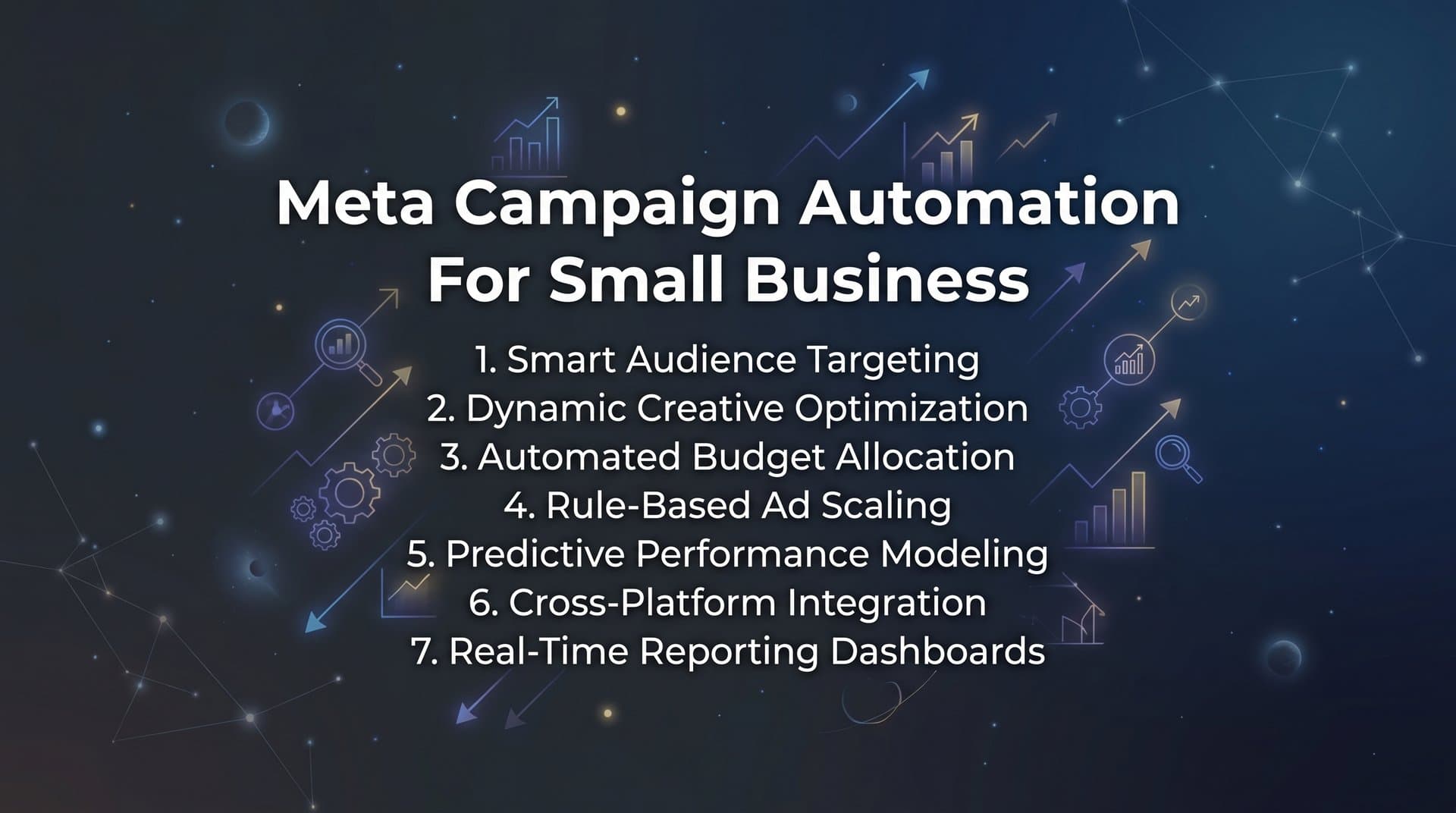
This guide covers seven automation strategies specifically designed for small business realities: limited budgets, lean teams, and the need for every ad dollar to work harder. These are not generic tips but practical approaches you can implement this week to reclaim your time while improving campaign performance.
1. Automate Creative Generation
The Challenge It Solves
Creating fresh ad creatives is the biggest time drain for small businesses. Hiring designers is expensive, learning design software takes weeks, and sourcing video content requires equipment and editing skills most teams don't have. Meanwhile, your competitors are launching new ads daily while you're stuck on Canva tutorials at midnight.
The creative bottleneck kills momentum. By the time you finally get an ad designed, the promotion you planned has already passed or your competitor has saturated the market with similar messaging.
The Strategy Explained
AI-powered creative generation tools can now produce scroll-stopping image ads, video ads, and UGC-style content directly from your product URL. These platforms analyze your product, understand your value proposition, and generate multiple creative variations in minutes.
Think of it like having a creative team on standby 24/7. You provide the product link, the AI generates the visuals and suggests copy angles, and you refine anything that needs adjustment through simple chat-based editing. No design degree required.
The best part? You can generate dozens of creative variations to test different angles, styles, and messaging without multiplying your workload. What used to take a week now takes twenty minutes. This is why AI marketing automation for Meta ads has become essential for lean teams.
Implementation Steps
1. Choose a platform that generates multiple ad formats from a single input (image ads, video ads, UGC-style content).
2. Input your product URL or upload product images along with key selling points you want emphasized.
3. Review the AI-generated options and use chat-based editing to refine headlines, adjust visual elements, or modify the messaging angle.
4. Generate variations with different hooks and visual styles to test what resonates with your audience.
5. Download or directly connect to Meta to launch your creatives without switching platforms.
Pro Tips
Generate creative batches around specific themes or promotions rather than one-off ads. This builds a library you can pull from quickly. Also, clone competitor ads from the Meta Ad Library to analyze what's working in your industry and generate similar styles with your own products.
2. AI-Powered Campaign Building
The Challenge It Solves
Setting up a Meta campaign from scratch involves dozens of decisions: which audiences to target, what headlines to test, how to structure ad sets, which placements to use. For small businesses without dedicated media buyers, these decisions feel like educated guesses at best.
You spend hours researching best practices, second-guessing your choices, and wondering if you're leaving performance on the table because you missed some optimization trick the experts know.
The Strategy Explained
Modern AI campaign builders for Meta ads analyze your historical performance data to understand what has worked for your business specifically. They identify your top-performing creatives, headlines, audiences, and copy, then use that intelligence to build complete campaign structures optimized for your goals.
The difference between this and generic automation is personalization. The AI learns from your actual results, not industry averages. If your audience responds better to benefit-focused headlines than curiosity-driven ones, the AI picks up on that pattern and prioritizes accordingly.
Every decision comes with transparent reasoning so you understand the strategy, not just blindly trust the output. You maintain control while eliminating the research paralysis that slows down campaign launches.
Implementation Steps
1. Connect your Meta Ads account to an AI campaign builder that can access your historical performance data.
2. Set your campaign objective and target metrics (ROAS, CPA, conversion volume, etc.).
3. Let the AI analyze your past campaigns to identify top-performing elements across creatives, audiences, headlines, and copy.
4. Review the AI-generated campaign structure including recommended audiences, budget allocation, and creative pairings.
5. Make any strategic adjustments based on your business knowledge, then launch directly to Meta.
Pro Tips
The AI gets smarter with every campaign you run. Start with smaller tests to build performance history, then scale up as the system learns your audience preferences. Pay attention to the AI's reasoning for each decision to build your own strategic understanding over time.
3. Bulk Ad Launching
The Challenge It Solves
Testing is how you find winners, but manually creating every combination of creative, headline, audience, and copy is soul-crushing work. If you want to test 5 creatives with 3 headlines across 4 audiences, that's 60 individual ads to set up manually in Meta Ads Manager.
Most small businesses skip proper testing because the setup time isn't worth it. You launch one or two variations, hope for the best, and never discover the combination that could have tripled your conversion rate.
The Strategy Explained
Bulk ad launching tools automatically generate every combination of your selected elements and push them to Meta in minutes. You select which creatives, headlines, audiences, and copy variations you want to test, and the system creates all possible combinations at both the ad set and ad level.
This transforms testing from a luxury into standard practice. Instead of choosing between thorough testing and actually launching your campaign this month, you can do both. The right Meta ads software for small business handles the tedious multiplication work while you focus on selecting the elements worth testing.
What used to take hours of copying, pasting, and clicking now happens with a few selections and one launch button.
Implementation Steps
1. Prepare your testing elements: gather 3-5 creatives, 3-4 headline variations, 2-4 audience segments, and 2-3 copy angles you want to test.
2. Use a bulk launching platform to upload or select these elements from your library.
3. Define your combination structure (test creatives within each audience, or test audiences with each creative, etc.).
4. Set budget allocation across the variations (equal split or weighted based on confidence).
5. Review the generated ad count and launch all variations to Meta simultaneously.
Pro Tips
Start with smaller combination sets to avoid overwhelming your budget with too many simultaneous tests. As you identify patterns in what works, you can scale up your bulk launches with more confidence in the elements you're testing.
4. Automated Performance Tracking with Goal-Based Scoring
The Challenge It Solves
Checking Meta Ads Manager daily to spot performance trends is time-consuming and reactive. By the time you notice an ad is underperforming, you've already wasted budget. Worse, when you have dozens of ads running, it's nearly impossible to identify patterns across creatives, audiences, and copy manually.
You need a system that watches performance for you and surfaces insights proactively rather than making you hunt for them in spreadsheets and dashboards.
The Strategy Explained
Goal-based scoring systems automatically rank every element of your campaigns against your target metrics. Set your ideal ROAS, CPA, or CTR, and the system scores each creative, headline, audience, and landing page based on how it performs against those benchmarks.
Instead of staring at raw numbers trying to determine what's "good," you get instant clarity on what's winning and what's losing. Leaderboards show you at a glance which creatives are crushing it and which audiences are draining budget without returns. Understanding the full benefits of Meta campaign automation helps you appreciate why this tracking matters.
This shifts you from reactive monitoring to proactive optimization. You spend your time analyzing why winners work and how to replicate that success, not hunting through data to figure out what's happening.
Implementation Steps
1. Define your success metrics based on business goals (target ROAS, maximum CPA, minimum conversion rate, etc.).
2. Set up automated tracking that scores every campaign element against these benchmarks in real-time.
3. Create leaderboards for different elements: top creatives, top audiences, top headlines, top copy variations.
4. Set up daily or weekly reports that surface the highest and lowest performers automatically.
5. Use the scoring data to make optimization decisions quickly without manual analysis.
Pro Tips
Adjust your scoring benchmarks as your campaigns mature. What's "good" performance in week one might be average by week four. Keep raising the bar as your automation learns and improves.
5. Build a Winners Hub
The Challenge It Solves
You finally find a creative that converts like crazy, then three months later you can't remember which campaign it was in or what the exact audience settings were. Your winning elements are scattered across past campaigns with no organized way to reuse them.
Every new campaign starts from scratch instead of building on proven winners. You reinvent the wheel repeatedly, wasting time testing things you've already validated while your best-performing assets collect dust in old campaign folders.
The Strategy Explained
A Winners Hub centralizes all your top-performing elements in one searchable library with attached performance data. Every creative, headline, audience, and copy variation that hits your success benchmarks automatically gets added with its real metrics visible.
When you're building your next campaign, you start by browsing proven winners rather than brainstorming from zero. Effective Meta ad management tools for small business make this organization seamless and searchable.
This creates a compounding advantage. Each campaign adds more proven elements to your library, making future campaigns faster to build and more likely to succeed because you're starting with validated components.
Implementation Steps
1. Set performance thresholds that qualify elements as "winners" (example: ROAS above 3x, CPA below $20, CTR above 2%).
2. Automatically tag and save any creative, headline, audience, or copy that meets these thresholds to your Winners Hub.
3. Attach performance metrics to each saved element so you can see not just what won, but how well it won.
4. Organize winners by category, product line, or campaign type for easy retrieval.
5. When building new campaigns, browse your Winners Hub first and select proven elements to test against new variations.
Pro Tips
Review your Winners Hub monthly to identify patterns. If certain visual styles consistently outperform, double down on that approach. If specific audience segments always deliver, prioritize them in future campaigns.
6. Implement Budget Protection Rules
The Challenge It Solves
Budget waste happens when underperforming ads keep running because you didn't check the dashboard in time. A campaign that looked promising on day one can spiral into negative ROI by day three while you're focused on actually running your business.
Manual monitoring requires constant attention that small business owners simply don't have. You need guardrails that protect your budget automatically without requiring you to babysit every campaign.
The Strategy Explained
Automated budget protection rules pause underperforming ads and reallocate spend to top performers based on triggers you define. Set rules like "pause any ad with CPA above $50 after spending $100" or "reduce budget by 50% if ROAS drops below 2x for three consecutive days."
The system watches performance continuously and takes action when thresholds are crossed. Your budget flows automatically toward what's working and away from what's not, even when you're not logged in. This is a core feature of comprehensive Meta campaign automation solutions.
This doesn't mean you lose control. You set the rules based on your business economics and risk tolerance. The automation simply executes those rules consistently without the delays that come from manual checks.
Implementation Steps
1. Calculate your break-even CPA and minimum acceptable ROAS based on your product margins and business goals.
2. Create pause rules for ads that exceed your maximum CPA or fall below minimum ROAS after a set spend threshold.
3. Set up budget reallocation rules that automatically increase spend on ads performing above your targets.
4. Define the observation period before rules trigger (example: 3 days of data, $100 minimum spend) to avoid premature decisions.
5. Set up alerts so you're notified when rules trigger, allowing you to review the decision even though it executed automatically.
Pro Tips
Start with conservative rules and tighten them as you gain confidence. It's better to pause a few winners early than to waste significant budget on clear losers. You can always manually restart an ad if you believe it needs more time.
7. Create a Continuous Learning Loop
The Challenge It Solves
Most businesses treat each campaign as an isolated event. You launch ads, they perform well or poorly, then you start fresh next time without systematically applying the lessons learned. Valuable insights stay locked in your head rather than feeding into an improving system.
This means your tenth campaign isn't meaningfully better than your first because you're not capturing and applying learnings in a structured way. You repeat mistakes and rediscover best practices instead of building on past success.
The Strategy Explained
A continuous learning loop uses platforms that analyze every campaign to improve targeting, creative selection, and budget allocation over time. Each campaign feeds data into the system, which identifies patterns in what works for your specific audience and business.
The platform learns which creative styles resonate with which audience segments, which messaging angles drive conversions, and which combinations consistently outperform. Exploring the top Meta advertising automation platforms can help you find systems with robust learning capabilities.
Unlike static automation that follows the same rules regardless of results, learning systems adapt based on your unique performance patterns. What worked for your competitor might not work for you, and the system learns your specific success formula.
Implementation Steps
1. Choose automation platforms that explicitly improve recommendations based on historical performance data, not just industry best practices.
2. Run campaigns consistently rather than sporadically so the system has sufficient data to identify reliable patterns.
3. Review the AI's reasoning for its recommendations to understand what patterns it's detecting in your data.
4. Test the AI's suggestions even when they seem counterintuitive, the system may be seeing patterns you're missing.
5. Track how campaign performance improves over time as the learning system accumulates more data about your audience.
Pro Tips
The learning loop accelerates when you feed it diverse data. Don't just run the same campaign repeatedly. Test new audiences, creative styles, and messaging angles to give the system more patterns to learn from and more optimization opportunities to discover.
Putting It All Together
Meta campaign automation is not about removing yourself from the process entirely. It's about eliminating the repetitive, time-consuming tasks that prevent you from focusing on strategy and growth.
Start with the strategy that addresses your biggest bottleneck. For most small businesses, that means automating creative generation first. When you're no longer stuck creating visuals manually, you can actually launch campaigns frequently enough to test and learn.
From there, move to AI-powered campaign building and bulk launching. These strategies compound with creative automation because you can now test dozens of variations without multiplying your workload. What used to take weeks happens in hours.
As you implement performance tracking, Winners Hubs, and budget protection rules, your automation becomes smarter and your results compound. You're not just working faster, you're building a system that improves with every campaign.
The small businesses winning on Meta in 2026 are not the ones with the biggest budgets. They're the ones using automation to test faster, learn quicker, and scale what works without scaling their workload.
Ready to transform your advertising strategy? Start Free Trial With AdStellar and be among the first to launch and scale your ad campaigns 10× faster with our intelligent platform that automatically builds and tests winning ads based on real performance data.