Most Meta campaigns fail before they even launch. Not because the ads are bad or the targeting is wrong, but because there was no real plan to begin with. Advertisers jump straight into Ads Manager, pick an objective that sounds right, throw together some creatives, and hope for the best. Three weeks and several thousand dollars later, they're staring at disappointing metrics wondering what went wrong.
The difference between campaigns that scale profitably and those that drain budgets comes down to planning. A systematic meta campaign planning process gives you a blueprint for success before you spend a single dollar. It forces you to think through your objectives, understand your audience deeply, develop diverse creatives, structure campaigns logically, and set up proper measurement systems.
This isn't about adding more steps or slowing down your launch timeline. It's about making strategic decisions upfront that save you from expensive mistakes later. When you plan properly, your campaigns launch with clarity, test with purpose, and optimize based on real data rather than guesswork.
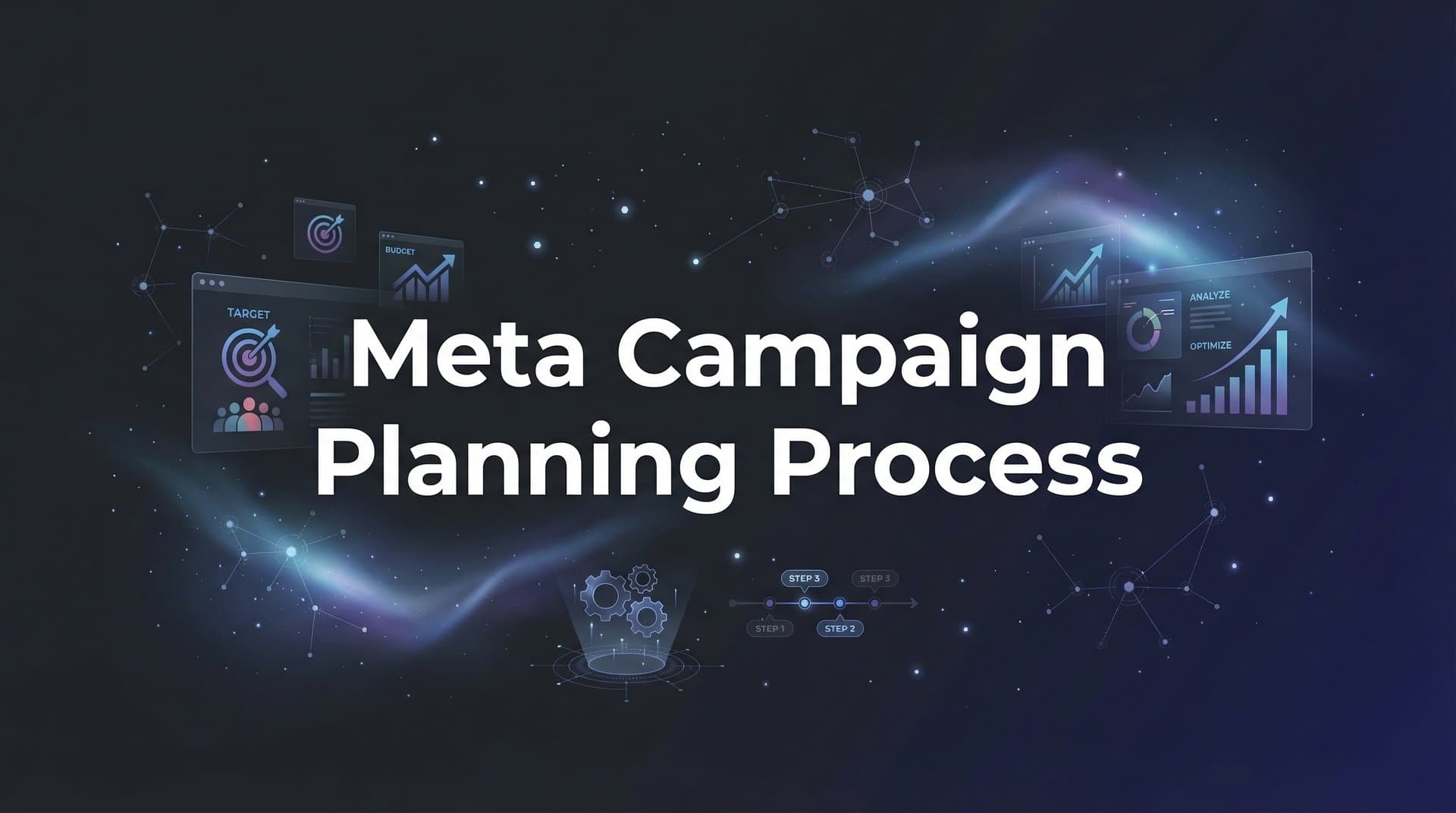
This guide walks you through each phase of the meta campaign planning process, from defining success metrics to configuring tracking and launching with confidence. By the end, you'll have a repeatable framework that works whether you're launching your first Facebook ad or scaling an established advertising operation.
Step 1: Define Your Campaign Objective and Success Metrics
Every Meta campaign starts with a single decision that shapes everything else: what are you trying to accomplish? Meta offers objectives across three categories: awareness (brand awareness, reach), consideration (traffic, engagement, app installs, video views, lead generation, messages), and conversion (conversions, catalog sales, store traffic). Your choice here determines how Meta's algorithm optimizes your campaign and what results you can expect.
The key is aligning your objective with where your customers are in their buying journey. If you're introducing a new product to cold audiences, awareness objectives make sense. If you're nurturing people who visited your site but didn't purchase, conversion objectives are appropriate. Mismatched objectives waste budget by optimizing for the wrong outcome.
But choosing an objective isn't enough. You need specific, measurable success criteria before you build anything. What's your target cost per acquisition? What return on ad spend makes this campaign profitable? What click-through rate indicates your creative is resonating? Without these benchmarks, you have no objective way to evaluate performance. A comprehensive Meta ads campaign planning checklist can help ensure you don't miss critical metrics.
Document your success metrics clearly. If you're running a lead generation campaign, you might set targets like: cost per lead under $15, lead-to-customer conversion rate above 8%, and customer acquisition cost below $120. For an e-commerce conversion campaign, you might target: ROAS above 3.5x, cost per purchase under $25, and add-to-cart rate above 4%.
These numbers should come from your business economics, not arbitrary hopes. Calculate your profit margins, customer lifetime value, and acceptable acquisition costs. If you don't know these numbers yet, use industry benchmarks as starting points and refine them as you gather data.
Setting clear objectives and metrics upfront creates accountability. When results come in, you'll know immediately whether the campaign succeeded or needs adjustment. You'll also avoid the trap of moving goalposts after launch to make disappointing results look better than they are.
Step 2: Research and Build Your Target Audience
Your campaign objective tells Meta what to optimize for. Your audience definition tells Meta who to show your ads to. Get this wrong and even the best creatives won't save you.
Start by analyzing your existing customer data. Who are your best customers? What demographics, interests, and behaviors do they share? Look for patterns in age ranges, locations, device usage, and purchase behavior. If you're using tools like Google Analytics or your CRM, export customer segments and look for commonalities.
Create detailed audience profiles that go beyond basic demographics. What problems are they trying to solve? What stage of awareness are they at? Are they actively searching for solutions or do they need to be educated about the problem first? Understanding these psychographics helps you craft messaging that resonates.
Now decide on your audience strategy. Broad targeting lets Meta's algorithm find your customers using minimal constraints. This works well when you have strong conversion data and trust the algorithm to optimize. Lookalike audiences find people similar to your existing customers, making them ideal for scaling what already works. Custom audiences let you retarget people who've interacted with your business, perfect for moving prospects through your funnel.
Consider audience size carefully. Audiences that are too small (under 50,000 people) limit Meta's ability to optimize and can drive up costs. Audiences that are too broad waste budget on people unlikely to convert. Aim for audiences between 500,000 and 2 million people for most campaigns, adjusting based on your targeting specificity and budget. Understanding campaign structure best practices helps you organize audiences effectively.
Watch for audience overlap, especially if you're running multiple campaigns simultaneously. When audiences overlap significantly, your campaigns compete against each other in the auction, driving up costs and making performance analysis messy. Use Meta's Audience Overlap tool to check this before launching.
Plan to test multiple audiences from the start. You might test a broad interest-based audience against a lookalike audience and a custom retargeting audience. This parallel testing reveals which audience strategy performs best for your specific offer and objective.
Step 3: Develop Your Creative Strategy and Assets
Your creative is what stops the scroll. Even perfect targeting and campaign structure can't overcome mediocre ads. The meta campaign planning process must include a deliberate creative strategy that accounts for format diversity, testing variations, and platform best practices.
Start by mapping creative formats to your objective and audience preferences. Video ads often work well for storytelling and demonstrating products in action. Static image ads can be highly effective for simple, benefit-focused messages. UGC-style creatives (user-generated content that looks native to the platform) typically generate higher engagement because they feel less like ads.
Plan multiple creative variations from the start, not as an afterthought. You might develop three different hooks, four different visual styles, and two different calls-to-action. This gives you 24 potential combinations to test. The goal isn't to test everything at once, but to have options ready so you can quickly pivot when ad fatigue sets in.
Your ad copy should speak directly to pain points and desired outcomes. What specific problem does your product solve? What transformation does it enable? What objection might prevent someone from taking action? Address these in your headlines, primary text, and calls-to-action.
Creating diverse, high-quality creatives used to require designers, video editors, and significant production time. AI tools like AdStellar have changed this equation entirely. You can generate scroll-stopping image ads, video ads, and UGC-style avatar content directly from a product URL. Even more powerful, you can clone competitor ads from the Meta Ad Library, identifying what's working in your space and creating your own variations in minutes. The campaign cloning process lets you replicate proven ad structures quickly.
The AI Creative Hub in AdStellar lets you refine any generated ad with chat-based editing, so you're not stuck with the first version. No designers, no video editors, no actors needed. This dramatically accelerates the creative development phase of your planning process.
When planning your creative strategy, think about the full customer journey. Someone seeing your brand for the first time needs different messaging than someone who visited your site but didn't purchase. Plan creative variations for each stage: awareness-focused creatives that introduce your solution, consideration-focused creatives that highlight benefits and social proof, and conversion-focused creatives that create urgency and remove friction.
Step 4: Structure Your Campaign Architecture
Meta's campaign structure follows a three-tier hierarchy: campaigns, ad sets, and ads. How you organize these levels directly impacts your ability to analyze performance, optimize effectively, and scale what works. Proper campaign architecture planning is essential for long-term success.
At the campaign level, you set your objective. Keep campaigns focused on a single objective and business goal. You might have separate campaigns for prospecting new customers versus retargeting existing site visitors. This separation makes budget allocation and performance analysis clearer.
At the ad set level, you define audiences, placements, budgets, and schedules. This is where your audience research from Step 2 comes into play. A common structure is one ad set per audience segment you're testing. If you're testing three audiences, you'd create three ad sets within your campaign.
At the ad level, your creatives and copy live. Each ad set should contain multiple ads with different creative variations. This lets Meta's algorithm test which creative performs best with each specific audience.
Now comes a critical decision: Campaign Budget Optimization (CBO) or ad set budgets? CBO gives Meta control to distribute your total campaign budget across ad sets automatically, favoring those that perform best. This works well when you trust the algorithm and want hands-off optimization. Ad set budgets give you more control, letting you allocate specific amounts to each audience or test. This is better when you want to ensure each test gets adequate spend regardless of early performance.
Plan your testing structure deliberately. Are you primarily testing creatives, audiences, or both? If you're testing creatives, use the same audience across multiple ad sets with different creative variations. If you're testing audiences, use the same creatives across multiple ad sets with different audience definitions. Testing both simultaneously makes it harder to isolate what's driving results.
Set naming conventions that make reporting and optimization easier. A clear naming structure might look like: [Objective]_[Audience]_[Creative Type]_[Date]. For example: "Conversions_LookalikeUS_VideoUGC_Mar2026". When you're managing multiple campaigns, consistent naming saves hours of confusion. Learn more about effective campaign naming conventions to keep your account organized.
Step 5: Set Your Budget and Bidding Strategy
Your budget determines how much data you'll collect and how quickly you'll reach statistical significance. Your bidding strategy tells Meta how aggressively to pursue your objective within that budget.
Calculate your budget based on audience size and objective. A general guideline: you need around 50 optimization events per ad set per week to exit the learning phase and achieve stable performance. If your target cost per conversion is $30 and you want 50 conversions per week, you need at least $1,500 weekly budget per ad set. Scale this across all your ad sets to determine your total campaign budget.
For upper-funnel objectives like awareness or traffic, you can often start with smaller budgets since optimization events (impressions or clicks) come more frequently. For conversion objectives with longer sales cycles or higher-priced products, budget accordingly for fewer but more valuable events. Running app install campaigns requires different budget considerations than standard conversion campaigns.
Choose your bidding strategy based on how much control you want. Lowest cost (now called "Highest Volume") lets Meta bid whatever it takes to get the most results within your budget. This works well when you're starting out and don't have enough data to set cost or bid caps. Cost cap lets you tell Meta your target cost per result, and the algorithm will optimize to achieve it. Bid cap gives you even more control by setting the maximum you'll bid in each auction, though this requires more expertise to set effectively.
Decide between daily budgets and lifetime budgets. Daily budgets spend roughly the same amount each day, giving you predictable pacing. Lifetime budgets let Meta spend more flexibly across your campaign duration, which can be more efficient but less predictable. For most campaigns, daily budgets offer better control.
Build in budget for the learning phase. When you launch a new campaign or make significant changes to an existing one, Meta enters a learning phase where performance can be volatile. Plan for at least one week of learning phase spend before expecting stable results. Resist the urge to make changes during this period unless performance is drastically off target.
Step 6: Configure Tracking and Attribution
You can't optimize what you can't measure. Proper tracking setup is non-negotiable in the meta campaign planning process, yet it's often rushed or overlooked entirely.
Verify that your Meta Pixel is properly installed on every page of your website. The Pixel tracks visitor actions and feeds this data back to Meta for optimization. Use Meta's Pixel Helper browser extension to confirm it's firing correctly on key pages: homepage, product pages, cart, and checkout.
Implement the Conversions API alongside your Pixel. The Conversions API sends conversion data directly from your server to Meta, making tracking more reliable as browser-based tracking becomes less accurate due to privacy changes. Together, Pixel and Conversions API create redundant tracking that captures more complete data. Understanding the complexity of campaign setup helps you avoid common tracking mistakes.
Set up custom conversions for specific actions that matter to your business. Standard events like "Purchase" and "Lead" are useful, but custom conversions let you track nuanced behaviors. You might create custom conversions for "High-Value Purchase" (orders over $200), "Repeat Purchase" (customers who've bought before), or "Quiz Completion" (engaged prospects). These custom conversions can become optimization goals for specific campaigns.
Choose your attribution window based on your sales cycle. Attribution windows determine how long after someone clicks or views your ad that a conversion gets credited to that ad. Shorter attribution windows (1-day click) are more conservative and credit only recent interactions. Longer windows (7-day click) capture more conversions but may include people who would have converted anyway. For products with longer consideration periods, longer attribution windows make sense. For impulse purchases, shorter windows are appropriate.
Plan how you'll track performance across the full funnel. Meta's reporting shows you campaign-level metrics, but you need to connect ad performance to downstream business outcomes. If you're generating leads, track how many leads become customers. If you're driving purchases, track customer lifetime value. Tools like Cometly can help connect ad spend to revenue across your entire funnel, giving you a complete picture of campaign profitability.
Step 7: Launch, Monitor, and Optimize
You've defined your objective, researched your audience, developed your creatives, structured your campaigns, set your budget, and configured tracking. Now it's time to launch, but not without a final review.
Use a pre-launch checklist to catch errors before they cost you money. Verify your campaign objective matches your goal. Confirm your audiences are correctly defined and don't overlap significantly. Check that your creatives follow Meta's ad policies and display correctly on mobile devices. Ensure your landing pages load quickly and your conversion tracking is firing. Review your budget and schedule settings. Double-check that your payment method is current.
Once you launch, allow adequate time for the learning phase before making changes. Meta needs to gather data and optimize delivery. Making frequent changes resets the learning phase, extending the time until you see stable performance. Unless something is drastically wrong (spending 10x your target CPA, for example), wait at least 3-5 days before adjusting. Leveraging AI-driven campaign planning can help you make smarter optimization decisions.
Monitor performance daily but optimize weekly. Check that your campaigns are spending as expected and that tracking is working correctly. Look for obvious issues like disapproved ads or technical errors. But resist the urge to make optimization decisions based on one or two days of data. Weekly reviews give you enough data to identify real patterns versus random variance.
Use leaderboards and performance rankings to identify winners quickly. Instead of manually comparing dozens of metrics across multiple ads, organize your data to surface top performers automatically. Which creatives have the lowest CPA? Which audiences generate the highest ROAS? Which headlines drive the best click-through rates? A campaign scoring system makes this analysis systematic.
AdStellar's AI Insights feature does this automatically with leaderboards that rank your creatives, headlines, copy, audiences, and landing pages by real metrics like ROAS, CPA, and CTR. Set your target goals and the AI scores everything against your benchmarks, so you can instantly spot winners and reuse them in future campaigns. The Winners Hub keeps your best-performing elements organized with real performance data, making it easy to build your next campaign around proven assets.
When you identify winning elements, scale them strategically. Increase budgets gradually (20-30% at a time) to avoid shocking the algorithm. Duplicate winning ad sets to new audiences. Create new creative variations that maintain the winning elements while testing new angles. The goal is to extract maximum value from what works while continuously testing new approaches.
Putting It All Together
A solid meta campaign planning process transforms advertising from guesswork into a repeatable system. When you define clear objectives, build targeted audiences, develop diverse creatives, structure campaigns logically, and set up proper tracking, you position every campaign for success before it even launches.
Use this checklist before your next campaign: objective and KPIs documented, audience research complete, creative variations ready, campaign structure mapped, budget and bidding decided, tracking verified, and launch checklist reviewed. Each item might seem small, but together they create the foundation for campaigns that scale profitably.
The difference between campaigns that work and those that don't usually comes down to planning. Advertisers who skip the planning phase end up spending more time troubleshooting problems that could have been prevented. They make changes based on hunches rather than data. They struggle to scale because they don't know what's actually working.
Advertisers who follow a systematic planning process launch with confidence, optimize with clarity, and scale with predictability. They know their numbers before they launch. They test with purpose. They can explain why a campaign succeeded or failed because they planned for measurement from the start.
Tools like AdStellar can accelerate this entire process by handling creative generation, campaign building, and performance analysis in one platform. The AI Creative Hub generates scroll-stopping ads from a product URL or by cloning competitor ads. The AI Campaign Builder analyzes your past campaigns, ranks every creative, headline, and audience by performance, and builds complete Meta campaigns in minutes with full transparency about every decision. Bulk ad launching creates hundreds of variations instantly. AI Insights surface your top performers automatically with goal-based scoring.
Instead of spending hours in Ads Manager manually building campaigns, you focus on strategy while AI handles execution. Instead of guessing which creatives will work, you clone proven winners from the Meta Ad Library. Instead of manually analyzing performance across dozens of metrics, leaderboards show you exactly what's working and what's not.
Ready to transform your advertising strategy? Start Free Trial With AdStellar and be among the first to launch and scale your ad campaigns 10× faster with our intelligent platform that automatically builds and tests winning ads based on real performance data.
Start planning your next Meta campaign with this framework and watch your results become more predictable and scalable. The meta campaign planning process isn't about adding complexity. It's about making strategic decisions upfront that save you from expensive mistakes later. Plan deliberately, launch confidently, and optimize systematically. That's how you turn Meta advertising into a reliable growth channel.