Managing paid social campaigns in 2026 means juggling more variables than ever before. On any given day, a performance marketer might be pulling reports from Ads Manager, briefing a designer on three new creative concepts, manually pausing underperforming ad sets, adjusting budgets across a dozen campaigns, and still finding time to analyze which audiences are actually converting. That is a lot of moving parts, and most of it is execution work, not strategy.
This is the environment that paid social AI automation was built for. Not as a buzzword or a promise of hands-free advertising, but as a practical shift in how the operational layer of campaign management gets handled. When AI takes on the repetitive, data-heavy tasks, marketers get back the time and headspace to focus on what actually moves the needle.
This article breaks down what paid social AI automation actually covers, how it works across each stage of the campaign lifecycle, and what a genuinely connected automated workflow looks like in practice. If you have been wondering whether automation is just rules-based triggers dressed up in new language, or something fundamentally more capable, that distinction gets addressed here too.
The Real Cost of Running Paid Social Without Automation
Let's be specific about where the time actually goes. In a typical paid social workflow, a meaningful portion of the day gets absorbed by tasks that are necessary but not strategic. Pulling performance reports and formatting them for review. Checking which ad sets have drifted above target CPA and manually pausing them. Building out campaign structures one ad set at a time, duplicating audiences, swapping in new creatives, and making sure naming conventions are consistent. Writing briefs for designers, waiting on revisions, uploading assets, and then doing it all again for the next test.
None of this requires deep expertise. It requires attention and time, and it crowds out the work that does require expertise: identifying strategic opportunities, understanding why certain creative angles resonate, deciding which markets to expand into, and building a testing framework that actually generates learning.
The compounding cost here is worth understanding clearly. Paid social performance data moves fast. An ad set that is burning budget inefficiently at 9 AM might not get reviewed until a human checks the dashboard at 2 PM. By then, significant spend has already gone toward a poor performer. On the flip side, a creative that is outperforming benchmarks might sit at the same budget for days before anyone notices and scales it. Slow decision-making does not just waste money in isolation. It creates a pattern where underperformers run too long and winners get starved of spend.
This is the core tension that automation is designed to resolve: as campaigns scale, the number of decisions required grows faster than any team can manually handle. You can either hire more people to manage the volume, accept that some decisions will be slow, or introduce automation that handles execution at the speed the data demands.
For marketers managing multiple clients or product lines, the burden compounds further. The same manual process has to run in parallel across every account, and the cognitive load of context-switching between them adds another layer of inefficiency. Automation does not eliminate judgment. It eliminates the work that does not require judgment in the first place.
What Paid Social AI Automation Actually Does
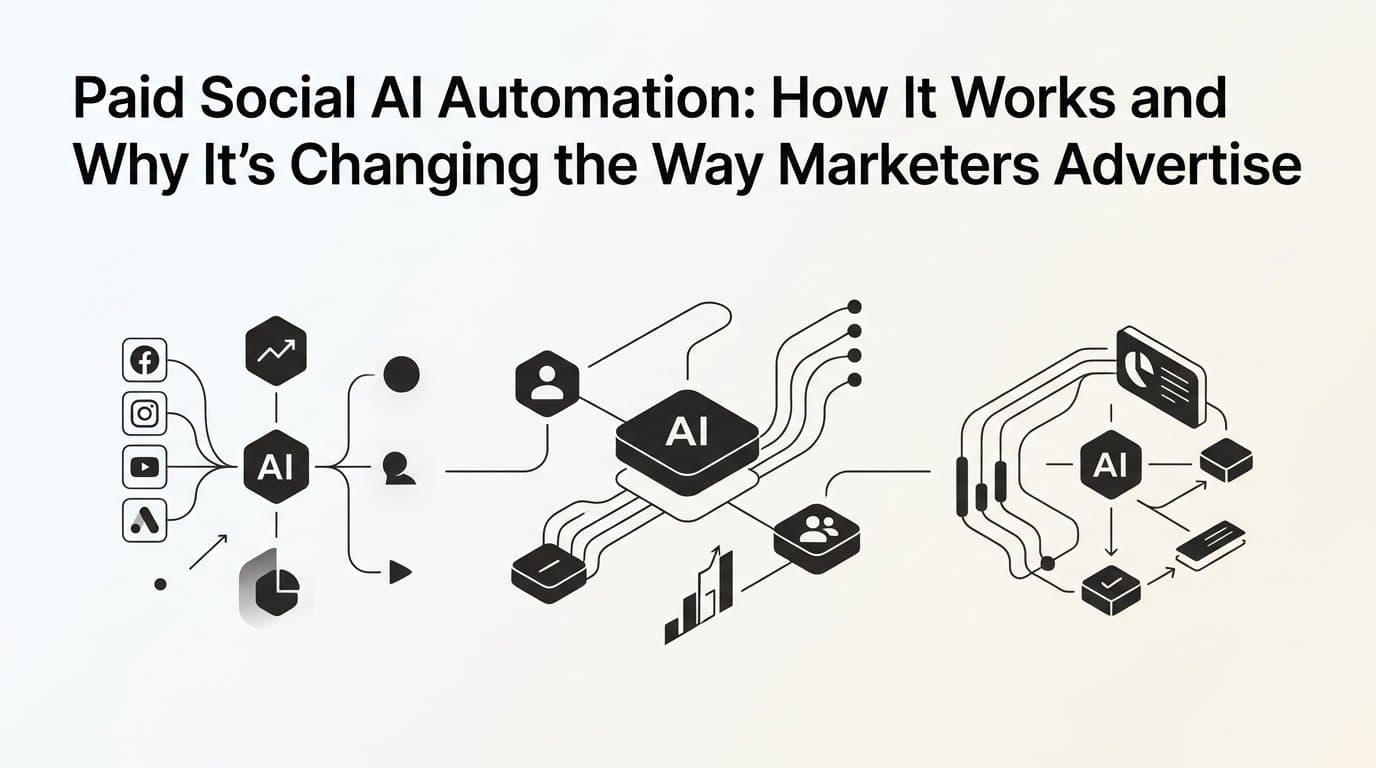
It helps to think about paid social AI automation in three distinct layers, because conflating them leads to confusion about what a given tool actually does.
Creative generation is the first layer. This covers producing the actual ad assets: images, videos, and UGC-style content. Historically, this required a creative team with designers, video editors, and sometimes actors or on-camera talent. AI creative tools can now generate these assets from a product URL, a brief, or even by analyzing competitor ads, removing the production bottleneck entirely.
Campaign management is the second layer. This covers building the campaign structure itself: selecting audiences, writing headlines and ad copy, organizing ad sets, and setting budgets. AI campaign builders can analyze historical performance data to inform these decisions before a campaign even launches, rather than starting from scratch each time.
Performance optimization is the third layer. This is the ongoing work of monitoring live campaigns, identifying what is converting, shifting budget toward winners, pausing waste, and surfacing insights. This is where the speed advantage of AI is most pronounced, because it operates continuously rather than waiting for a scheduled review.
Now, there is an important distinction between rules-based automation and AI-driven automation, and it matters for understanding what modern platforms actually deliver. Rules-based automation works on if-then logic: if CPA exceeds a threshold, pause the ad set. This is useful, but it is reactive and static. It can only respond to conditions you anticipated when you set the rule.
AI-driven automation goes further. It learns from patterns across campaigns, recognizes which combinations of creative, audience, and copy tend to perform together, and makes predictive decisions before significant budget is spent on a poor performer. It does not just respond to what already happened. It informs what should happen next based on accumulated learning.
The practical implication is that modern AI automation can handle tasks that previously required multiple specialists working in coordination. A creative team, a media buyer, and an analyst can each be partially replaced, or at minimum significantly augmented, by a connected AI system that handles all three layers. That is a meaningful operational shift, not just an incremental improvement.
Creative Automation: From Brief to Launch-Ready Ad
Creative is often the biggest bottleneck in paid social, and it is also the area where AI automation delivers some of the most immediate value. The traditional path from idea to live ad involves a brief, a design round, revisions, approval, asset formatting for different placements, and upload. That process can take days, and it limits how many creative hypotheses you can test at any given time.
AI creative generation collapses that timeline. Starting from a product URL, a brand description, or even just a category, AI can produce image ads, video ads, and UGC-style avatar content without requiring a designer, video editor, or on-camera talent. The output is not a rough draft that needs significant rework. It is launch-ready creative that can be refined through chat-based editing if adjustments are needed.
This matters most when you consider what effective creative testing actually requires. To get statistically meaningful signal on which creative angle, hook, or visual style resonates with your audience, you need volume. Testing two or three variations gives you limited learning. Testing twenty or thirty variations across different formats and approaches gives you real data to work with. The problem is that producing twenty or thirty variations manually is expensive and slow, so most teams compromise on testing volume and end up with less learning than they need.
Bulk creative generation changes this. With AI, you can produce hundreds of variations across different hooks, visual styles, and formats in the time it used to take to brief a single concept. Testing is no longer a phase that happens after creative production. It becomes built into the production process itself, because variation is generated automatically rather than requested one brief at a time.
Competitive intelligence adds another dimension. The Meta Ad Library is a publicly available database of active ads running across Meta platforms. AI tools that can analyze and clone structures from this library give marketers a starting point informed by what is already working in their competitive landscape, rather than starting from a blank page. This is not about copying competitors. It is about understanding which creative formats, messaging angles, and visual approaches are getting traction in your category, and using that intelligence to inform your own testing strategy.
AdStellar's AI Ad Creative feature covers all of this: generating image ads, video ads, and UGC-style content from a product URL, cloning competitor ad structures from the Meta Ad Library, and enabling chat-based refinement. No designers, no video editors, no production overhead.
Campaign Building and Audience Targeting at Scale
Once creatives exist, the next challenge is building campaigns that deploy them intelligently. This is where many marketers still spend an enormous amount of manual time, constructing ad sets one by one, selecting audiences based on intuition or past experience, and writing copy variations without a systematic framework for which combinations to test first.
AI campaign builders approach this differently. Rather than starting from a blank campaign structure, they analyze historical performance data to inform decisions before the campaign launches. Which audiences have driven the lowest CPA in past campaigns? Which headlines have consistently outperformed across different creative formats? Which combinations of copy and audience tend to work together? These are questions that a human analyst could answer given enough time and data, but an AI system can process them instantly and build recommendations into the campaign structure from the start.
The transparency element matters here, and it is worth being explicit about. AI-driven decisions are only useful if the marketer understands the reasoning behind them. A system that just outputs a campaign structure without explaining why it made those choices creates dependency without understanding. The better approach is a system that explains its decisions in plain language, so marketers can evaluate the strategy, push back where they disagree, and build their own understanding of what the AI is learning over time.
Bulk ad launch capabilities extend this further. Instead of building each ad set individually, marketers can define a set of creatives, headlines, audiences, and copy variations, and let the system generate every possible combination automatically. What used to take hours of manual construction in Ads Manager can be completed in minutes, with every combination launched to Meta simultaneously. This is how you run meaningful tests at scale without multiplying the operational burden on your team.
AdStellar's AI Campaign Builder and Bulk Ad Launch features handle exactly this workflow: analyzing past campaigns to rank every creative, headline, and audience by performance, building complete campaign structures with full transparency into the reasoning, and generating hundreds of ad combinations for launch in clicks rather than hours.
Performance Optimization: How AI Finds and Scales Winners
Launching campaigns is only the beginning. The ongoing work of performance optimization is where most of the budget decisions actually happen, and it is also where the speed gap between human review and AI monitoring is most consequential.
AI insights work by continuously evaluating every element of your campaigns against the metrics that matter to your business. ROAS, CPA, and CTR are the primary benchmarks performance marketers use to judge paid social effectiveness. An AI insights system ranks your creatives, headlines, audiences, and landing pages against these metrics in real time, rather than waiting for a weekly report to surface what is working and what is not.
The practical difference is significant. When you set target benchmarks for your campaigns, AI can score every asset against those benchmarks continuously. A creative that is delivering strong ROAS gets flagged as a winner. An audience that is driving CPA above your target gets flagged for review or paused automatically. This is not periodic analysis. It is continuous evaluation that responds to performance signals as they emerge, not hours or days after the fact.
The concept of a Winners Hub takes this a step further. Rather than having top-performing assets scattered across different campaigns and ad accounts, a centralized Winners Hub surfaces your best-performing creatives, headlines, audiences, and other elements in one place, with actual performance data attached. When you are building a new campaign, you are not starting from scratch or relying on memory about what worked last quarter. You can see exactly which assets have performed against your benchmarks and add them to your next campaign directly.
This creates a compounding advantage over time. Each campaign generates learning that informs the next one. Winners get reused and iterated on. Underperformers get identified faster and paused before they consume significant budget. The system gets smarter with each cycle, and the marketer's institutional knowledge is captured in the platform rather than living in a spreadsheet or someone's head.
Continuous optimization also means the gap between identifying a winner and scaling it closes dramatically. In a manual workflow, a creative might outperform for several days before a human notices and increases its budget. In an AI-driven workflow, that signal is detected immediately and budget can shift toward the winner without waiting for a scheduled review. Over the course of a campaign, that responsiveness adds up to meaningfully more efficient spend.
AdStellar's AI Insights and Winners Hub features handle this layer: leaderboards that rank every asset by ROAS, CPA, and CTR against your defined benchmarks, and a centralized hub where top performers are stored with real data so they can be deployed in future campaigns without starting from zero.
Building a Fully Automated Paid Social Workflow
The real power of paid social AI automation is not in any single feature. It is in what happens when all three layers connect into a single workflow. When creative generation, campaign building, bulk launch, live optimization, and winner identification all operate within the same system, the handoffs between them become seamless and the learning compounds across every stage.
Here is what that looks like in practice. You start with a product URL or brief. AI generates a library of launch-ready creatives across image, video, and UGC formats. The campaign builder analyzes your historical data and recommends audiences, headlines, and copy based on what has performed before. Bulk launch generates every combination and deploys them to Meta simultaneously. AI insights monitor performance in real time, pausing waste and flagging winners. Those winners get captured in the Winners Hub and become the starting point for your next campaign.
This is a fundamentally different operational model than the one most marketers are running today. The manual touchpoints that used to consume the majority of the workday are handled by the system. The marketer's role shifts toward setting goals, evaluating strategic direction, and making the judgment calls that actually require human expertise.
A common concern about automation is that it removes strategic control. The opposite is true when the system is designed well. Automation removes execution burden, not strategic authority. You define the goals, the benchmarks, and the direction. The AI handles the work of getting there as efficiently as possible. The best systems keep that distinction clear, explaining their decisions rather than hiding them, and keeping the marketer in the loop on what is working and why.
AdStellar is built to connect all of these layers in one platform. From AI ad creative through to the AI Campaign Builder, Bulk Ad Launch, AI Insights, and the Winners Hub, the entire workflow from creative to conversion runs without requiring designers, video editors, or manual data pulls. It is one platform that handles the full stack, so the operational overhead of running paid social at scale no longer scales linearly with the number of campaigns you are running.
The Bottom Line
Paid social AI automation is not about replacing marketers. It is about removing the layer of work that prevents marketers from doing what they are actually good at. The creative bottleneck, the slow budget decisions, the manual campaign construction, the delayed response to performance data: these are all solvable problems, and AI automation solves them at a speed and scale that manual workflows cannot match.
The three layers covered here, creative generation, campaign building, and performance optimization, each deliver standalone value. But the compounding benefit comes from connecting them. When the same system that generates your creatives also builds your campaigns, launches every combination, monitors performance in real time, and captures your winners for future use, the entire paid social workflow becomes faster, more efficient, and more responsive to what the data is actually telling you.
Faster decisions mean less wasted spend. Better creative testing means more signal on what actually resonates. Continuous optimization means winners scale sooner and underperformers get cut before they drain budget. That is the practical case for paid social AI automation, and it is available now, not at some future point when the technology matures.
If you are ready to see what this looks like in practice, Start Free Trial With AdStellar and be among the first to launch and scale your ad campaigns faster with a platform that automatically builds and tests winning ads based on real performance data. One platform, from creative to conversion.