Meta's advertising ecosystem has never been more complex. You're dealing with more placements, more audience signals, more creative formats, and more data than any manual process can reasonably handle. The marketers who are winning right now aren't working harder, they're working smarter by letting automation handle the decisions that don't require human judgment.
Think about how many micro-decisions go into a single Meta campaign. Which creative to run. Which audience to target. Which headline pairs best with which image. How to allocate budget across ad sets. When to pause underperformers and scale winners. Doing all of that manually, across multiple campaigns and clients, is a recipe for inefficiency and missed opportunity.
Performance marketing automation changes the equation entirely. When AI handles creative generation, audience selection, bid optimization, and performance analysis, you get two things back: time and precision. Your team stops spending hours on repetitive setup tasks and starts focusing on strategy, positioning, and growth.
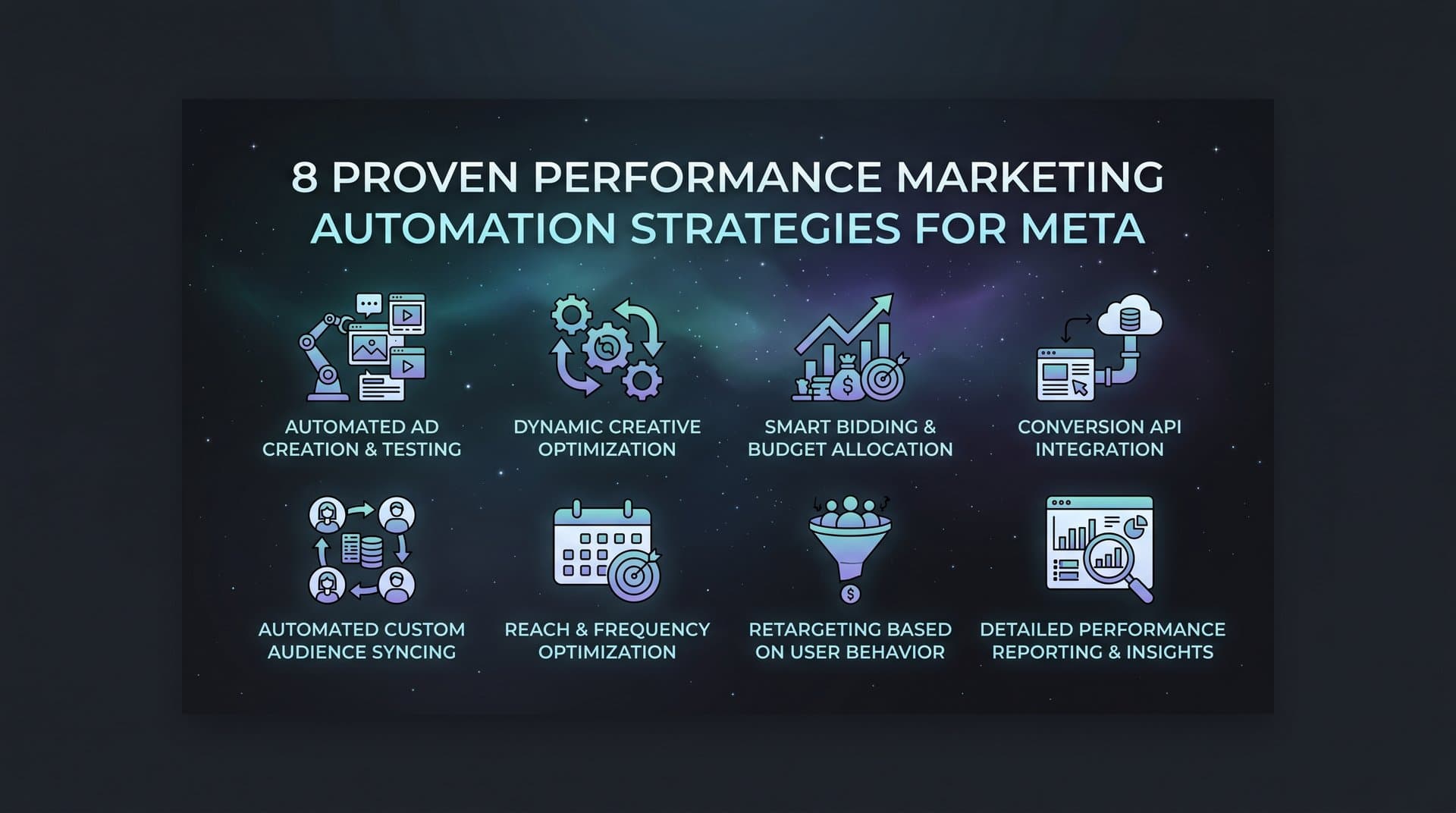
This article breaks down eight concrete strategies for building a more automated, data-driven Meta advertising operation. Whether you're running campaigns for a single brand or managing accounts across multiple clients, each strategy is designed to be immediately actionable. They're also designed to compound. The more of them you implement together, the more powerful your automation stack becomes.
By the end, you'll have a clear roadmap for moving from manual campaign management to a system that generates creatives, tests variations, identifies winners, and continuously improves with every campaign cycle. Let's get into it.
1. Automate Creative Production at Scale
The Challenge It Solves
Creative production is typically the biggest bottleneck in Meta advertising. Briefing designers, waiting on revisions, coordinating video shoots, and managing asset delivery all take time that most teams don't have in abundance. When creative output is slow, testing velocity suffers, and when testing velocity suffers, you find winners more slowly than your competitors do.
The Strategy Explained
AI-powered creative generation eliminates the designer dependency entirely. Instead of briefing a human to produce an ad, you feed a product URL or a short creative brief into an AI system and get image ads, video ads, and UGC-style avatar creatives back in minutes.
This isn't about sacrificing quality for speed. Modern AI creative tools for Meta ads produce scroll-stopping formats that match the visual standards Meta audiences expect. The real advantage is volume. When you can produce ten or twenty creative variations in the time it used to take to produce one, your testing surface area expands dramatically. More variations in the market means more chances to find the message that resonates.
Chat-based editing also means you can refine any creative without going back to a design queue. Adjust the copy, swap the background, change the call to action, and push a new version live, all without a single design ticket.
Implementation Steps
1. Start with your product URL or a clear creative brief that includes your core value proposition, target audience, and desired call to action.
2. Generate multiple creative formats simultaneously: static image ads, short-form video ads, and UGC-style avatar creatives to cover different placements and audience preferences.
3. Use chat-based editing to produce variations of each creative, adjusting headlines, visuals, and copy to create a diverse testing pool before launch.
Pro Tips
Don't just generate one version of each format. Aim for at least three to five variations per creative concept so you're testing messaging angles, not just aesthetics. The goal is to enter every campaign with enough creative diversity that the data can tell you something meaningful about what your audience responds to.
2. Build Campaigns with AI-Driven Historical Analysis
The Challenge It Solves
Most campaign builds start from assumptions. A marketer makes educated guesses about which audience to target, which headline to lead with, and which creative concept to prioritize. Those guesses might be informed by experience, but they're still guesses. Every campaign that launches without grounding in historical performance data is leaving efficiency on the table from day one.
The Strategy Explained
AI campaign builders solve this by analyzing your past campaign performance before a single new ad goes live. Rather than starting from a blank slate, the AI reviews your historical data, ranks every creative, headline, audience segment, and copy block by actual performance, and uses those rankings to inform the new campaign structure for Meta ads.
This approach means your campaign launches with the highest-probability elements already in place. You're not testing whether your audience responds to a certain type of messaging. You already know they do, because the data says so. The new campaign then tests refinements and extensions of what's already working, rather than testing from zero.
Full transparency matters here too. The best AI campaign builders don't just make decisions, they explain them. You should be able to see exactly why the AI selected a particular audience or headline, so you understand the strategy and can build on it over time.
Implementation Steps
1. Connect your historical campaign data to your AI platform so it has sufficient performance history to analyze, ideally covering multiple campaigns across different objectives.
2. Review the AI's rankings for creatives, headlines, and audiences before approving the campaign build, and use the explanations provided to understand the reasoning behind each selection.
3. Set clear campaign goals upfront so the AI optimizes toward the right metrics from the start, whether that's ROAS, CPA, or top-of-funnel volume.
Pro Tips
The more campaign history you feed into the system, the smarter the recommendations become. Treat every campaign you run as an investment in future campaign quality. The data you generate today directly improves the AI's decisions tomorrow.
3. Use Bulk Variation Testing to Find Winners Faster
The Challenge It Solves
Traditional A/B testing on Meta is painfully slow. You test one variation, wait for statistical significance, pick a winner, then test another variation. By the time you've worked through a meaningful number of combinations, weeks have passed and budget has been spent on a process that could have been compressed dramatically.
The Strategy Explained
Bulk variation testing replaces sequential testing with parallel testing. Instead of testing one combination at a time, you generate hundreds of ad variations across creatives, headlines, audiences, and copy simultaneously, and launch them all at once. The data comes back faster, the winners emerge sooner, and you spend less budget on the discovery process.
Think of it like this: if you're trying to find the best combination of four creatives, five headlines, three audience segments, and two copy blocks, sequential testing would take months. Parallel bulk testing surfaces the winners in a fraction of the time because you're running all combinations concurrently rather than one after another.
The practical result is a significant compression of your testing timeline. What used to take a full month of iterative testing can be accomplished in a single campaign cycle, freeing you to move faster toward scaling what works. Understanding Meta ads automation vs manual creation makes clear why this parallel approach consistently outperforms traditional methods.
Implementation Steps
1. Prepare your creative assets, headline variations, audience segments, and copy options before launch so you have a full library of components to mix and match.
2. Use a bulk ad launching tool to generate every combination automatically and push them all to Meta simultaneously, rather than building each ad set manually.
3. Monitor performance data across all variations in a unified view so you can identify winning combinations quickly and reallocate budget toward them without delay.
Pro Tips
Resist the urge to cut variations too early. Give each combination enough spend to generate meaningful signals before drawing conclusions. The goal of bulk testing is speed through breadth, not speed through impatience.
4. Implement AI-Powered Audience Targeting and Lookalike Scaling
The Challenge It Solves
Interest-based targeting on Meta has become increasingly crowded. Broad interest categories attract large, competitive audiences, and manual audience management can't keep pace with the volume of signals available. Many performance marketers find themselves cycling through the same audience configurations without meaningful improvement because the targeting approach itself hasn't evolved.
The Strategy Explained
AI-powered audience automation moves beyond basic interest targeting by analyzing your historical campaign data to identify which audience segments have actually driven results. Instead of guessing which interests correlate with your best customers, the AI surfaces the segments that have already proven themselves in your account.
From there, lookalike audience building becomes a systematic process rather than a manual one. By feeding your proven customer profiles into Meta's lookalike engine, guided by AI analysis of which customer attributes correlate most strongly with conversion, you can build audiences that mirror your best customers at scale. This is one of the core best practices for Meta ad automation that consistently separates high-performing accounts from average ones.
The key advantage is precision. You're not targeting people who might be interested in your product category. You're targeting people who statistically resemble the customers who have already bought from you, based on real performance data rather than demographic assumptions.
Implementation Steps
1. Analyze your historical campaign data to identify the audience segments that have delivered your best ROAS, lowest CPA, or highest conversion volume, depending on your primary goal.
2. Build lookalike audiences from your highest-value customer segments and layer AI-informed interest signals on top to create compound targeting that combines proven data with expansion potential.
3. Continuously feed new performance data back into your audience analysis so your targeting evolves with each campaign rather than staying static.
Pro Tips
Don't abandon broad testing entirely in favor of precision targeting. Maintain a portion of your budget for audience exploration so you're always discovering new segments while scaling what's already working.
5. Score Every Ad Element Against Your Performance Goals
The Challenge It Solves
When you're running dozens of creatives, headlines, and audience combinations simultaneously, identifying what's actually working becomes a data management challenge. Without a structured scoring system, performance analysis turns into a manual review process that takes hours and still leaves room for subjective interpretation.
The Strategy Explained
Goal-based scoring with AI-powered leaderboards solves this by automatically ranking every ad element against your specific benchmarks. You set your target ROAS, CPA, or CTR goals upfront, and the AI scores every creative, headline, copy block, audience segment, and landing page against those benchmarks in real time.
The leaderboard format makes the analysis instantly readable. Instead of digging through spreadsheets or platform dashboards, you see a ranked list of every element by performance, with the winners at the top and the underperformers clearly flagged. Connecting this to a Meta ads performance tracking dashboard means you know immediately where to reallocate budget and which elements to retire.
This approach also removes the subjectivity from performance decisions. The scoring is tied to your actual goals, not to which creative looks the most polished or which headline a team member prefers. Data drives the decision, and the decision is made in seconds rather than hours.
Implementation Steps
1. Define your performance benchmarks clearly before launching any campaign, including your target ROAS, maximum acceptable CPA, and minimum CTR threshold for each campaign objective.
2. Connect your AI insights tool to your live campaign data so scoring updates in real time as results come in, rather than requiring a manual data pull at the end of the week.
3. Review leaderboard rankings regularly and use the scores to drive budget reallocation decisions, scaling elements that exceed your benchmarks and pausing those that consistently fall short.
Pro Tips
Set different benchmark thresholds for different campaign objectives. A prospecting campaign targeting cold audiences will naturally have different ROAS expectations than a retargeting campaign. Scoring everything against the same benchmark regardless of objective will produce misleading rankings.
6. Build a Winners Hub to Systematize What Works
The Challenge It Solves
One of the most common inefficiencies in Meta advertising is institutional amnesia. A creative performs exceptionally well in one campaign, but when the next campaign launches, the team starts from scratch again because there's no organized system for capturing and reusing proven winners. Valuable performance data gets buried in old campaign reports that nobody revisits.
The Strategy Explained
A centralized Winners Hub solves this by collecting all top-performing creatives, headlines, audiences, and copy in a single organized location, with real performance data attached to each element. Every time an ad element clears your performance benchmarks, it gets added to the hub automatically so it's available for future campaigns.
The practical impact is significant. Instead of starting every new campaign from zero, you start from a foundation of what has already worked. Your best creative concepts, your highest-converting headlines, your most responsive audience segments, all of them are one click away when you're building the next campaign. Teams using Meta ads campaign automation software with built-in winner tracking report dramatically faster time-to-scale on new campaigns.
This compounds over time. The longer you run campaigns, the richer your Winners Hub becomes, and the stronger your starting point for every new campaign. It's the difference between building on a foundation and perpetually laying new groundwork.
Implementation Steps
1. Establish clear performance thresholds that qualify an ad element as a "winner" worth adding to your hub, based on your goal benchmarks from the scoring system described in Strategy 5.
2. Organize your Winners Hub by element type, separating creatives, headlines, audiences, and copy so you can quickly find the right component when building a new campaign.
3. When launching a new campaign, always start by reviewing your Winners Hub first and incorporate proven elements before introducing new untested variations.
Pro Tips
Don't let your Winners Hub become a static archive. Review it periodically to retire elements that may have worked historically but are showing signs of fatigue in more recent campaigns. A good winner from twelve months ago may not be a good winner today.
7. Automate Campaign Launch to Eliminate Manual Setup Time
The Challenge It Solves
Manual campaign setup is one of the most time-consuming parts of Meta advertising, and also one of the least strategic. Configuring ad sets, uploading creatives, assigning audiences, writing copy variations, setting bids, and reviewing everything before launch can take hours per campaign. That time adds up quickly, especially for agencies managing multiple accounts.
The Strategy Explained
Bulk ad launching automates the entire setup process by taking your creative assets, headlines, audiences, and copy and generating every combination automatically, then deploying them all to Meta in a single action. What used to take hours of manual configuration happens in minutes.
The efficiency gain here is twofold. First, you save the direct time that would have been spent on manual setup. Second, you eliminate the human error that inevitably creeps into repetitive manual processes. Mismatched audiences, incorrect bid settings, forgotten ad variations, all of these common mistakes disappear when the setup process is automated.
For agencies, this is particularly transformative. The ability to launch hundreds of ad variations across multiple client accounts without proportionally increasing setup time means you can scale your client base without scaling your operational overhead at the same rate. This is precisely why Meta ads automation for agencies has become a competitive necessity rather than a nice-to-have.
Implementation Steps
1. Prepare all campaign components in advance, including your creative library, headline variations, audience segments, and copy blocks, so the bulk launcher has everything it needs to generate combinations.
2. Define your campaign structure parameters upfront, including budget allocation, bidding strategy, placement preferences, and scheduling, so the automated launch reflects your strategic intent.
3. Review the generated combinations before final launch to confirm the mix aligns with your testing strategy, then deploy everything to Meta simultaneously.
Pro Tips
Use the time you save on manual setup to invest in the strategic decisions that automation can't make for you. Positioning, messaging strategy, offer development, and creative concept ideation are areas where human judgment still drives the most value.
8. Close the Loop with Attribution and Continuous Optimization
The Challenge It Solves
Platform-native reporting on Meta has well-documented limitations. Attribution windows, view-through conversions, and cross-device journeys all create gaps between what Meta reports and what's actually driving revenue. Without accurate attribution, your optimization decisions are based on incomplete data, which means you're scaling some campaigns that look good in-platform but aren't actually generating return.
The Strategy Explained
Connecting third-party attribution tracking to your Meta campaigns ties ad spend to actual revenue outcomes rather than platform-reported conversions. When you can see which campaigns, creatives, and audiences are genuinely driving purchases and revenue, your optimization decisions become significantly more accurate.
The real power comes when you feed that attribution data back into your AI optimization loop. Each campaign cycle produces performance data. That data informs the AI's decisions for the next campaign. The next campaign produces better results, which produces better data, which informs even smarter decisions in the cycle after that. Over time, this continuous learning loop creates a compounding performance advantage that manual optimization simply cannot replicate. Tracking the right performance marketing metrics throughout this cycle is what separates accounts that improve steadily from those that plateau.
Integrating attribution data with platforms like AdStellar's Cometly integration gives you a closed-loop system where every dollar spent is accountable and every insight feeds directly back into campaign strategy.
Implementation Steps
1. Implement a third-party attribution tool that tracks the full customer journey across Meta placements and connects ad interactions to downstream revenue events, not just platform-reported conversions.
2. Connect your attribution data to your AI campaign platform so performance insights from completed campaigns automatically inform the analysis and recommendations for future campaigns.
3. Review attribution data at the campaign level, the ad set level, and the individual creative level to identify where in the funnel each element is contributing, and use those insights to refine your next campaign structure.
Pro Tips
Pay particular attention to discrepancies between Meta's reported conversions and your attribution tool's data. Those gaps often reveal which campaigns are genuinely driving revenue versus which ones are benefiting from attribution overlap. Optimizing toward the attribution tool's data tends to produce more reliable real-world results.
Your Implementation Roadmap
Eight strategies is a lot to absorb, so here's how to think about sequencing the implementation. Start with the foundation: automate creative production and build your first AI-driven campaign. These two strategies alone will change how much you can produce and how confidently you can launch. Get comfortable with the output before adding more layers.
Next, layer in bulk variation testing and audience automation. Once you have a steady flow of AI-generated creatives and data-informed campaign structures, parallel testing and precision audience targeting will dramatically accelerate your path to finding winners.
From there, systematize everything. Implement goal-based scoring to identify what's working, build your Winners Hub to preserve those wins, and automate your launch process to eliminate the manual overhead that slows everything down. By this stage, your operation should feel fundamentally different from where it started.
Finally, close the loop with attribution. Connect your ad spend to real revenue outcomes and feed that data back into the AI optimization cycle. This is where the compounding effect really kicks in. Each strategy reinforces the others, and the entire system gets smarter with every campaign you run.
The good news is that you don't have to build this infrastructure piece by piece from multiple disconnected tools. Start Free Trial With AdStellar and bring all eight strategies together in one platform, from AI creative generation and campaign building to bulk launching, performance scoring, Winners Hub, and attribution integration. One platform, from creative to conversion, with a 7-day free trial to see what automated Meta advertising actually looks like in practice.