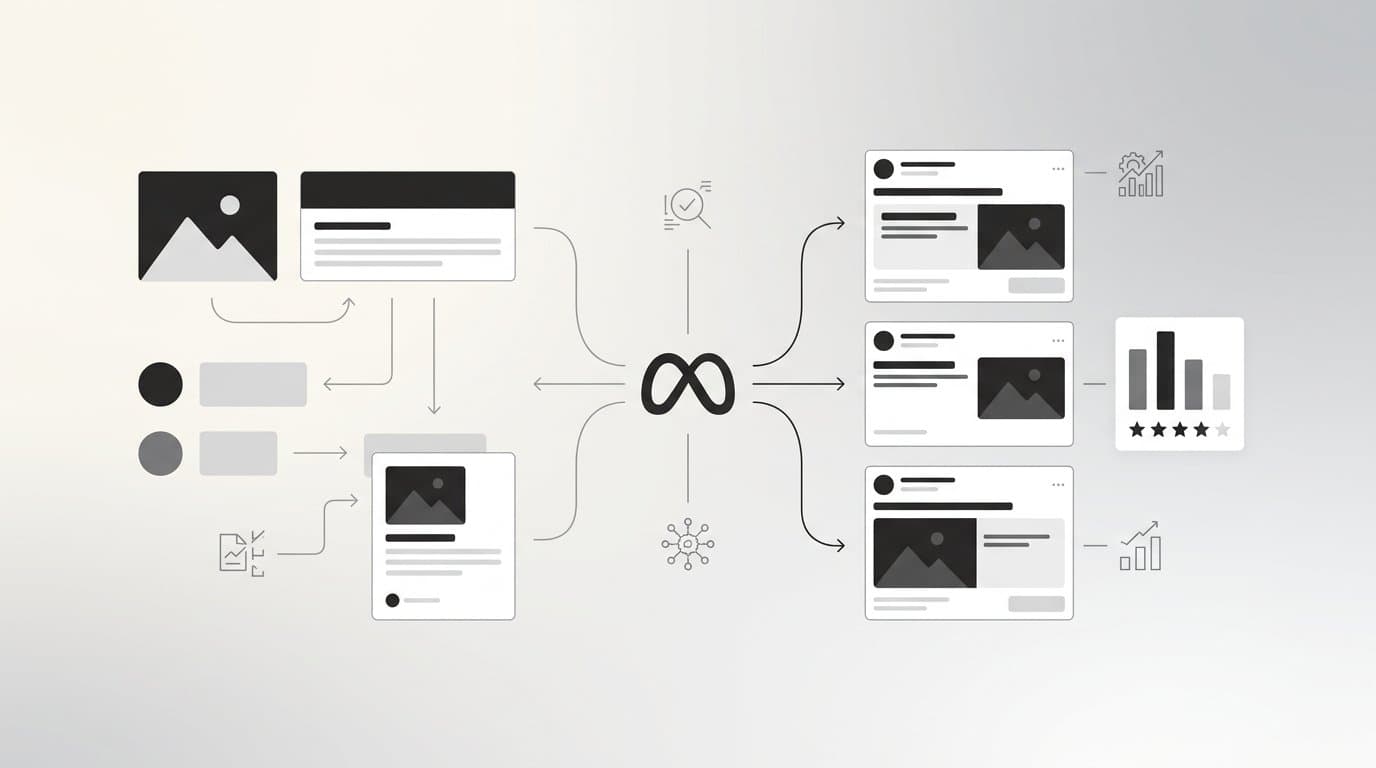
The average digital marketer toggles between five different tools just to create a single ad campaign. Design software for visuals. Spreadsheets for tracking variations. The Meta Ads Manager for setup. Analytics platforms for performance data. Then back to design software to resize everything for different placements.
This fragmented workflow creates a hidden tax on your time and creative energy. Every campaign requires the same tedious steps: resize images, rewrite headlines for character limits, manually configure audience settings, copy-paste ad copy across variations. These repetitive ad creation tasks don't just slow you down, they create bottlenecks that limit how many campaigns you can launch and how quickly you can test new ideas.
The marketers scaling their campaigns most effectively have stopped doing this manual work. They've implemented systems and tools that automate the repetitive parts of ad creation, freeing them to focus on strategy, creative direction, and optimization. The difference isn't working harder, it's eliminating the tasks that shouldn't require human effort in the first place.
This guide breaks down seven proven strategies to automate, streamline, and eliminate the repetitive work that's holding back your ad creation process. Each approach tackles a specific bottleneck in the workflow, from visual creation to campaign setup to performance analysis. Implement these systematically, and you'll transform how quickly you can move from concept to live campaign.
1. Implement AI-Powered Creative Generation
The Challenge It Solves
Creating ad visuals is one of the most time-intensive parts of campaign development. Traditional workflows require hiring designers, briefing them on requirements, waiting for drafts, providing feedback, and going through multiple revision cycles. Even with in-house design resources, producing variations for testing means repeating this process for every concept you want to explore.
Video content adds another layer of complexity. Producing even simple video ads traditionally requires videographers, editors, actors, and production coordination. For UGC-style content that performs well on Meta platforms, you need authentic-looking footage that feels native to the feed, which is difficult and expensive to produce at scale.
The Strategy Explained
AI-powered creative generation tools can produce image ads, video ads, and UGC-style content directly from product information. Instead of briefing a designer, you provide a product URL or description, and the AI generates scroll-stopping creatives that match your brand and campaign objectives.
The technology has advanced to where AI can create multiple visual variations in minutes, handling everything from product photography styling to video transitions to UGC avatar content. This doesn't replace human creativity for your overall strategy and direction, but it eliminates the repetitive execution work of producing individual assets. Many marketers find that AI ad creation vs traditional methods comparison reveals significant time savings.
Modern platforms like AdStellar take this further by letting you clone competitor ads directly from the Meta Ad Library and adapt them to your products. If you see a competitor's ad structure performing well, you can use that framework as a starting point rather than building from scratch.
Implementation Steps
1. Start with your best-performing product or offer and use AI creative generation to produce 5-10 visual variations exploring different angles, layouts, and styles.
2. Test these AI-generated creatives alongside your traditional design process to benchmark performance and identify which types of AI-generated assets work best for your audience.
3. Build a workflow where AI handles the bulk creative production while your design team focuses on high-level creative direction and refining the top performers.
4. Use chat-based editing features to refine AI-generated creatives without going back to design software, enabling rapid iteration based on performance data.
Pro Tips
Don't try to replace your entire creative process overnight. Start by using AI generation for testing new concepts and scaling winning approaches. The biggest efficiency gain comes when you combine AI speed with human strategic direction. Let AI produce the variations, and focus your creative energy on identifying which angles and messages resonate most with your audience.
2. Build a Reusable Creative Asset Library
The Challenge It Solves
Most marketers recreate the wheel with every new campaign. You've run hundreds of ads, but when launching a new campaign, you start from scratch because your winning elements are scattered across old campaigns, buried in folders, or lost in the Meta Ads Manager interface. This means repeatedly creating variations of headlines that already worked, rebuilding audiences you've tested before, and searching through past campaigns to remember which creative approaches performed best.
The institutional knowledge of what works lives in your head or in disconnected spreadsheets rather than in a system that makes it easy to reuse proven elements. This creates unnecessary work and means you're not compounding your learning over time.
The Strategy Explained
A centralized creative asset library organizes all your winning elements in one place with actual performance data attached. Instead of remembering which headlines worked or guessing which audiences to test, you have a searchable repository of proven creatives, copy, audiences, and campaign structures that you can instantly add to new campaigns.
The key is connecting this library to real performance metrics. A creative that drove a 4% conversion rate is worth reusing. A headline that achieved a 2.8% CTR deserves to be tested again. When your library shows which elements actually performed, you can make data-driven decisions about what to reuse rather than relying on intuition. Understanding ad creation bottleneck solutions helps you build more effective systems.
Implementation Steps
1. Audit your last 10 campaigns and identify the top 3 performers in each category: creatives, headlines, primary text, audiences, and landing pages.
2. Create a centralized system where these winning elements are organized with their performance metrics (ROAS, CPA, CTR, conversion rate) clearly visible.
3. Establish a workflow where every campaign's top performers automatically get added to your winners library so it grows over time without manual effort.
4. When building new campaigns, start by reviewing your winners library and selecting proven elements before creating anything new from scratch.
Pro Tips
The most effective winners libraries include context beyond just the numbers. Tag each winning element with the campaign objective, target audience, and time period so you understand when and why it worked. This helps you identify which winners are likely to perform in similar contexts versus which were one-time successes tied to specific circumstances.
3. Use Bulk Variation Tools for Testing at Scale
The Challenge It Solves
Proper ad testing requires creating multiple variations to identify what resonates with your audience. But if you're manually building each variation in Meta Ads Manager, the math becomes prohibitive. Testing 3 creatives with 4 headlines and 3 audiences means creating 36 individual ads. If you want to test variations at both the ad set and ad level, that number multiplies further.
This manual setup process takes hours and introduces errors. You might accidentally use the wrong headline with a creative, forget to update audience settings on one variation, or simply run out of time and test fewer combinations than you should. The result is incomplete testing that leaves winning combinations undiscovered. Many advertisers struggle because manual ad creation is time consuming and prone to mistakes.
The Strategy Explained
Bulk variation tools let you select multiple creatives, headlines, audiences, and copy variations, then automatically generate every possible combination. Instead of manually creating 36 ads, you select your elements and the tool builds all variations in minutes, ensuring every combination gets tested without gaps or errors.
This approach transforms testing from a tedious manual process into a systematic exploration of your creative and targeting options. You can confidently test more variations because the execution work is automated, and you can launch comprehensive tests that would be impractical to build manually.
Platforms like AdStellar enable this bulk ad creation for Facebook at both the ad set and ad level, giving you granular control over how variations are structured while eliminating the repetitive setup work.
Implementation Steps
1. Identify the elements you want to test in your next campaign: select 3-5 creatives, 3-4 headline variations, 2-3 primary text options, and 2-3 audience segments.
2. Use a bulk variation tool to automatically generate all combinations, ensuring each creative gets paired with every headline, text, and audience option.
3. Launch all variations simultaneously with the same budget allocation to get clean performance data on which combinations work best.
4. After 3-5 days of data collection, analyze which combinations are winning and create additional variations of those specific elements to further optimize.
Pro Tips
Start with a manageable number of variations in your first bulk test, around 20-30 ads. This gives you enough data to identify patterns without overwhelming your analysis. As you get comfortable with bulk testing workflows, you can scale up to testing hundreds of variations. The key is maintaining enough budget per variation to reach statistical significance in your results.
4. Clone and Adapt Competitor Ad Frameworks
The Challenge It Solves
Creating effective ad structures from scratch requires guesswork about what will resonate with your audience. You might spend hours developing a creative concept, writing copy, and designing visuals, only to discover the approach doesn't perform. Meanwhile, your competitors have already invested in testing and have proven ad frameworks running successfully.
The Meta Ad Library makes all active ads publicly visible, giving you a window into what's working for competitors in your space. But most marketers don't systematically analyze this resource or have an efficient way to adapt successful frameworks to their own products.

The Strategy Explained
Instead of reinventing ad structures, you can analyze competitor ads that have been running for extended periods (a signal they're performing well) and adapt their proven frameworks to your products. This doesn't mean copying ads directly, but rather understanding the structural elements that make them effective: the hook pattern, the benefit presentation, the visual style, the CTA approach.
Modern tools enable you to clone competitor ad frameworks and automatically adapt them to your products. You can take a successful ad structure from the Meta Ad Library and generate your own version that maintains the effective elements while featuring your product and brand.
This approach dramatically reduces the risk in creative development. You're starting from frameworks that have already been validated in the market rather than testing completely unproven concepts. For teams looking to streamline this process, exploring AI ad creation tools for Meta can accelerate adaptation workflows.
Implementation Steps
1. Search the Meta Ad Library for competitors and brands in adjacent markets, filtering for ads that have been running for 30+ days (indicating sustained performance).
2. Analyze the structural patterns in successful ads: how they open, how they present benefits, what visual elements they emphasize, how they structure their CTA.
3. Use ad cloning tools to adapt these frameworks to your products, maintaining the proven structure while customizing the specific messaging and visuals to your brand.
4. Test these adapted frameworks alongside your original creative concepts to benchmark performance and identify which approaches resonate most with your audience.
Pro Tips
Look beyond your direct competitors to brands selling to similar audiences in different categories. A skincare brand might find successful ad frameworks from supplement companies targeting the same demographic. The key is identifying structural patterns that work for your target audience, regardless of the specific product being advertised. Focus on long-running ads from established brands, as these are most likely to represent proven performers rather than experimental tests.
5. Automate Campaign Structure and Setup
The Challenge It Solves
Configuring campaign settings in Meta Ads Manager is repetitive and error-prone. Every campaign requires selecting objectives, configuring budget settings, choosing optimization events, setting bid strategies, defining audience parameters, and dozens of other decisions. If you're launching multiple campaigns, you're repeating these same configuration steps over and over.

Even experienced marketers make mistakes in this process. You might forget to exclude a customer list, select the wrong optimization event, or use yesterday's budget allocation instead of the updated strategy. These small errors can waste significant budget before you catch them. The reality is that too many manual tasks in Facebook ads create opportunities for costly mistakes.
Beyond the mechanical setup, there's the strategic question of which settings to use. Should you use cost cap or bid cap? Which placements should you include? What audience size is optimal? Making these decisions from scratch every time slows down campaign launches and introduces inconsistency.
The Strategy Explained
AI campaign builders analyze your historical campaign performance to identify which settings, structures, and configurations have worked best for your account. Instead of manually configuring every setting, the AI recommends optimal campaign structures based on what's actually performed well in your past campaigns.
These tools can build complete Meta ad campaigns in minutes, handling everything from audience selection to bid strategy to placement optimization. The key advantage is transparency: the AI explains why it's recommending each setting based on your performance data, so you understand the strategy rather than just accepting black-box automation.
As you run more campaigns, the AI gets smarter, continuously learning which approaches work best for your specific products, audiences, and objectives. This creates a compounding advantage where campaign setup becomes faster and more accurate over time.
Implementation Steps
1. Connect an AI campaign builder to your Meta Ads account so it can analyze your historical campaign performance and identify patterns in what's worked.
2. For your next campaign, use the AI builder to generate a complete campaign structure and review the recommendations to understand the strategic rationale behind each setting.
3. Launch the AI-built campaign alongside a manually configured control campaign to benchmark performance and build confidence in the automation.
4. Gradually shift more campaign setup to the AI builder as you validate its recommendations, focusing your time on creative strategy and optimization rather than mechanical configuration.
Pro Tips
The biggest value from AI campaign builders comes from the strategic insights, not just the time savings. Pay attention to which settings the AI consistently recommends based on your data. You'll often discover patterns you hadn't noticed manually, like certain audience sizes that consistently outperform or specific placement combinations that drive better results. Use these insights to inform your overall advertising strategy, even for campaigns you build manually.
6. Create Template Systems for Ad Copy
The Challenge It Solves
Writing ad copy from scratch for every campaign is time-consuming and leads to inconsistent quality. Some days you nail the messaging, other days you struggle to articulate the value proposition clearly. You end up rewriting similar concepts repeatedly because you don't have a systematic way to capture and reuse effective copy patterns.
The challenge is particularly acute when you need multiple variations for testing. Writing 5-10 headline variations that are genuinely different but equally compelling requires significant creative effort. Most marketers either spend too much time on this or settle for superficial variations that don't actually test different angles. Learning Facebook ad creation time reduction strategies can help address this bottleneck.
The Strategy Explained
Modular copy frameworks break ad copy into swappable components: hooks, benefit statements, social proof elements, and CTAs. Instead of writing complete ads from scratch, you mix and match proven components to create variations that test different angles while maintaining quality.
Think of it like building blocks. You might have five proven hooks (question-based, problem-focused, benefit-led, curiosity-driven, urgency-based), four benefit frameworks (transformation, time-saving, cost-saving, status), three social proof formats (testimonials, statistics, authority), and three CTA approaches (direct, soft, question-based).
By combining these components systematically, you can generate dozens of quality variations without starting from a blank page each time. The framework ensures you're testing genuinely different approaches rather than superficial word swaps.
Implementation Steps
1. Analyze your 20 best-performing ads and identify the structural patterns: what types of hooks did they use, how did they present benefits, what social proof elements appeared, how was the CTA framed.
2. Create a component library organized by category (hooks, benefits, social proof, CTAs) with 5-10 variations in each category based on proven performers.
3. When creating new ad copy, select one component from each category and combine them into complete ads, ensuring you test different combinations to identify which patterns work best together.
4. As you launch campaigns, add new high-performing copy components to your library so it grows more effective over time.
Pro Tips
The most effective copy templates include guidance on when to use each component. Tag your hooks with context like "works best for cold audiences" or "effective for retargeting" based on where they've performed well. This helps you select appropriate components for different campaign objectives rather than randomly mixing elements. Also maintain character count variations of each component so you can quickly adapt to different placement requirements without rewriting from scratch.
7. Leverage Performance Data to Prioritize Winners
The Challenge It Solves
After running multiple campaigns, you have valuable performance data scattered across Meta Ads Manager, analytics platforms, and spreadsheets. But extracting actionable insights from this data requires manually comparing metrics, calculating performance across different time periods, and trying to identify patterns in what's working.
Most marketers end up making decisions based on incomplete information because thorough analysis takes too long. You might remember that a certain creative performed well, but you can't quickly compare it against all your other creatives to confirm it's actually your top performer. This leads to repeating mediocre approaches while your best-performing elements sit unused in old campaigns. When manual ad creation inefficient processes dominate your workflow, optimization suffers.
The Strategy Explained
AI-powered performance tracking automatically ranks every element of your campaigns (creatives, headlines, copy, audiences, landing pages) by the metrics that matter to your business. Instead of manually analyzing data, you get leaderboards that instantly show which creatives have the highest ROAS, which headlines drive the best CTR, which audiences convert most efficiently.
The key is goal-based scoring that benchmarks everything against your specific targets. If your goal is a $30 CPA, the system shows which elements are beating that target and by how much. This makes it immediately clear which elements deserve more investment and which should be retired.
AdStellar's AI Insights feature provides exactly this type of intelligent performance analysis, ranking every campaign element by real metrics and scoring them against your goals so you can instantly identify winners worth scaling.
Implementation Steps
1. Define your key performance goals for different campaign types: target ROAS for prospecting campaigns, acceptable CPA for conversion campaigns, minimum CTR for awareness campaigns.
2. Implement performance tracking that automatically scores all campaign elements against these goals and surfaces top performers in ranked leaderboards.
3. Review your performance leaderboards weekly to identify winning elements and create a systematic process for incorporating top performers into new campaigns.
4. Use performance data to guide creative production priorities: if video ads consistently outrank image ads in your leaderboards, shift more resources to video creation.
Pro Tips
Don't just look at overall performance rankings. Segment your leaderboards by audience type, campaign objective, and time period to understand which elements work best in specific contexts. A creative that's your overall top performer might actually underperform for cold audiences while dominating with warm traffic. These nuanced insights help you deploy winning elements in the right contexts rather than assuming top performers work everywhere.
Putting It All Together
Eliminating repetitive ad creation tasks isn't about cutting corners. It's about recognizing which parts of your workflow require human creativity and strategic thinking, and which parts are mechanical execution that technology can handle better and faster.
The strategies in this guide work together as a system. AI-powered creative generation handles the visual production work. A winners library ensures you're building on proven success rather than starting from scratch. Bulk variation tools let you test comprehensively without manual setup. Competitor analysis reduces creative risk by starting from validated frameworks. Automated campaign builders handle the mechanical configuration. Copy templates maintain quality while speeding up variation creation. Performance tracking focuses your energy on what's actually working.
Start with the strategy that addresses your biggest bottleneck. If creative production is slowing you down, implement AI-powered generation first. If you're recreating the same campaign structures repeatedly, automate your setup process. If you're struggling to identify what's working, prioritize performance tracking and leaderboards.
The marketers scaling their campaigns most effectively have stopped doing repetitive work. They've built systems that compound their efforts over time. Every campaign adds winning elements to their library. Every test provides data that makes their AI smarter. Every automation frees up time for higher-level strategy and optimization.
Pick one strategy from this list and implement it this week. Measure how much time you save and how it impacts your campaign performance. Then add the next strategy. Within a month, you'll have transformed your workflow from manual execution to strategic orchestration.
Ready to transform your advertising strategy? Start Free Trial With AdStellar and be among the first to launch and scale your ad campaigns 10× faster with our intelligent platform that automatically builds and tests winning ads based on real performance data.