Scalable Marketing Automation: Why Your "Automated" Campaigns Still Require Manual Work
You've automated your email sequences, set up your CRM workflows, and scheduled your social posts. So why does launching a new campaign still take your team three days?
This is the paradox facing marketing teams in 2025. You've invested in automation tools. Your stack is connected. Your workflows are optimized. Yet when it's time to scale—when you need to launch 50 ad variations instead of 5, or test new audiences across multiple campaigns—you're still stuck in the same manual grind.
The problem isn't that your automation doesn't work. It's that you've automated tasks, not systems.
Your tools make individual actions faster. But they haven't changed the fundamental relationship between effort and output. When you double your campaign volume, you still need double the time. When you 10x your testing, you need 10x the manual work. You've built a faster assembly line, but you're still working on the assembly line.
Here's what makes this urgent: Meta's Andromeda update in 2024 fundamentally changed the rules. The algorithm now rewards advertisers who can feed it more variation data, faster. Testing 10-15 ad variations used to be thorough. Today, competitive advertisers are testing 50-100+ variations because the platform's learning systems optimize better with volume.
This isn't about working harder. It's about having infrastructure that scales exponentially instead of linearly. The difference between task automation and truly scalable systems determines whether you're competing with 2023's playbook or 2025's reality.
The Task Automation Trap: Why Your Current Tools Hit A Scaling Ceiling
Most marketing teams have implemented what they call "automation." They've connected their tools. They've built workflows. They've eliminated some repetitive tasks. But when campaign volume increases, they discover their automation doesn't actually scale.
Task automation optimizes individual actions. It makes sending an email faster. It streamlines posting to social media. It simplifies creating a single ad. These improvements feel significant when you're working on one campaign at a time.
The limitation becomes visible when you need to execute at volume. If you're using best ad automation platforms that focus on task-level efficiency, launching 50 ad variations still requires 50 separate setup processes—just faster ones.
This is the fundamental difference between task automation and scalable marketing automation. Task automation reduces the time per action. Scalable automation eliminates the linear relationship between volume and effort entirely.
Consider what happens when you need to launch a new campaign across multiple audience segments. With task automation, you create the first ad set, then duplicate and modify it for each segment. You've automated parts of the process, but you're still manually managing each variation.
With scalable automation, you define your strategy once—your targeting parameters, your creative variations, your budget allocation rules—and the system generates and launches all variations simultaneously. The effort required doesn't increase with volume.
This distinction matters more in 2025 than ever before because advertising platforms have fundamentally changed how they reward advertisers. Meta's algorithm, Google's Performance Max, TikTok's creative optimization—all of these systems now prioritize advertisers who can feed them more variation data.
The platforms want to see 50+ ad variations testing different creative approaches, messaging angles, and audience segments. They want continuous testing and optimization. They want volume. And they reward it with better performance and lower costs.
If your automation infrastructure requires linear effort increases to generate linear output increases, you're competing with one hand tied behind your back. Your competitors using ppc automation tools that actually scale are testing 10x more variations in the same time frame.
The Three Bottlenecks That Prevent True Scalability
When marketing teams hit scaling walls, they typically blame resources. "We need more people." "We need bigger budgets." "We need more time." But the real constraints are structural, not resource-based.
The first bottleneck is creative production. Generating ad variations at scale requires either massive creative teams or systems that can produce campaign-ready assets programmatically. Most teams have neither.
Traditional creative processes involve briefing designers, waiting for drafts, reviewing iterations, and requesting revisions. This workflow works fine for producing 5-10 high-quality ads. It completely breaks down when you need 50-100 variations testing different value propositions, visual approaches, and messaging angles.
The second bottleneck is campaign structure complexity. As you add more audience segments, creative variations, and testing parameters, the number of possible combinations explodes exponentially. Managing this complexity manually becomes impossible.
A campaign testing 5 creative variations across 10 audience segments with 3 different bidding strategies creates 150 unique ad sets. Setting these up manually, even with task automation tools, requires hours of repetitive work. And that's before you consider ongoing optimization and iteration.
The third bottleneck is decision-making speed. When you're running high-volume testing, you generate massive amounts of performance data. Analyzing this data, identifying patterns, and making optimization decisions quickly enough to capitalize on insights requires either large analytics teams or intelligent automation.
Most teams fall into a reactive pattern. They launch campaigns, wait several days to accumulate data, schedule analysis meetings, debate decisions, and finally implement changes. By the time they act on insights, market conditions have shifted and the insights are stale.
These bottlenecks compound each other. Slow creative production limits testing volume. Limited testing volume reduces learning speed. Slow learning speed means you can't iterate quickly enough to stay competitive. You end up in a cycle where your operational constraints prevent you from executing the strategies you know would work.
Understanding challenges faced by advertisers in scaling operations helps identify where your infrastructure needs upgrading. The solution isn't working harder within these constraints. It's building systems that eliminate the constraints entirely.
What Scalable Marketing Automation Actually Looks Like
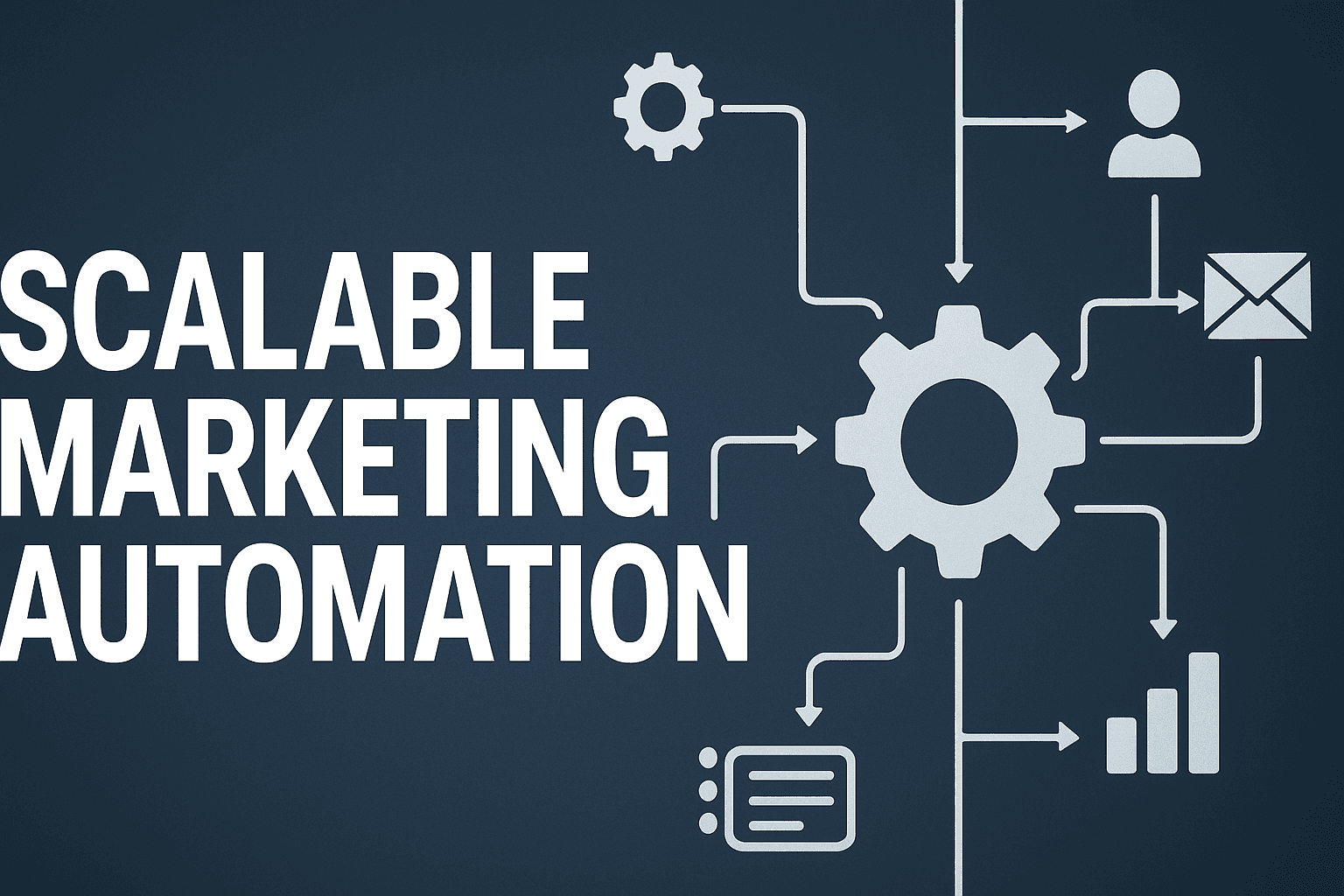
Scalable marketing automation fundamentally changes the relationship between input and output. Instead of optimizing how quickly you can complete tasks, it eliminates entire categories of manual work.
The core principle is strategy-to-execution automation. You define your strategic parameters once—your targeting criteria, your creative approach, your budget allocation rules, your optimization thresholds—and the system handles all implementation details.
This means you can launch 100 ad variations as easily as you launch 10. The effort required doesn't scale linearly with output volume. You're not duplicating and modifying campaigns manually. You're not copying and pasting targeting parameters. You're not individually uploading creative assets.
Instead, you specify what you want to test. The system generates all variations, structures campaigns optimally, and launches everything simultaneously. What used to take hours or days now happens in minutes.
But scalable automation goes beyond just launch efficiency. It extends to ongoing optimization and iteration. The system continuously monitors performance, identifies patterns, and makes adjustments based on your predefined rules.
When a particular creative variation underperforms, budget automatically shifts to better performers. When an audience segment shows strong engagement, the system expands testing in that direction. When performance thresholds are met, campaigns scale automatically. When they're not met, campaigns pause before burning budget.
This creates a fundamentally different operational model. Instead of spending time on execution and reactive optimization, your team focuses on strategy, creative direction, and analyzing patterns to inform the next iteration.
The practical impact shows up in campaign velocity. Teams using truly scalable automation can test more variations in a week than traditional teams test in a quarter. They can iterate daily instead of monthly. They can respond to market changes in hours instead of days.
This velocity advantage compounds over time. More testing generates more learning. More learning enables better strategy. Better strategy drives better results. Better results justify more investment. More investment enables more testing. The cycle accelerates.
Understanding why use automated ad platforms that offer true scalability helps clarify the strategic advantage. It's not just about efficiency. It's about fundamentally changing what's possible with your existing resources.
The Infrastructure Requirements For Exponential Scaling
Building scalable marketing automation requires specific infrastructure components working together as an integrated system. Individual tools, no matter how sophisticated, can't deliver exponential scaling if they don't connect properly.
The first requirement is programmatic creative generation. You need systems that can produce campaign-ready ad variations at scale without manual design work. This doesn't mean sacrificing quality—it means using templates, dynamic content, and AI assistance to maintain quality while increasing volume.
Effective creative generation systems allow you to define your brand guidelines, visual style, and messaging framework once. Then they generate variations testing different value propositions, visual approaches, and calls-to-action automatically. Each variation is campaign-ready, properly formatted, and on-brand.
The second requirement is intelligent campaign structuring. When you're launching dozens or hundreds of ad variations, manual campaign organization becomes impossible. You need systems that automatically structure campaigns for optimal learning and performance.
This means understanding platform-specific best practices. Meta's campaign budget optimization works differently than Google's Performance Max. TikTok's creative testing has different requirements than LinkedIn's audience targeting. Scalable systems handle these platform nuances automatically.
The third requirement is unified data integration. Scalable automation depends on having complete, accurate performance data flowing from all platforms into a central system. Without this, you can't make intelligent optimization decisions or identify cross-platform patterns.
Most marketing teams have data scattered across multiple platforms, dashboards, and spreadsheets. Consolidating this data manually for analysis takes hours. By the time you have insights, they're outdated. Scalable systems integrate data automatically and continuously.
The fourth requirement is rule-based optimization logic. You need to codify your optimization strategies into automated rules that execute without manual intervention. This doesn't mean removing human judgment—it means encoding that judgment into systems that can act instantly on new data.
For example, you might define rules like: "If an ad variation's CTR is 50% below campaign average after 1,000 impressions, pause it and reallocate budget to top performers." Or: "If an audience segment's CPA is 30% better than target after 50 conversions, increase budget by 25%."
These rules execute continuously, making hundreds of small optimization decisions that would be impossible to manage manually. The cumulative impact of these micro-optimizations compounds into significant performance improvements.
The fifth requirement is feedback loops that enable continuous learning. Every campaign should generate insights that inform the next iteration. Scalable systems capture these insights automatically and make them actionable.
This means tracking not just what performed well, but why. Which creative elements drove engagement? Which audience characteristics predicted conversion? Which messaging angles resonated? These insights feed back into creative generation and targeting strategy for the next campaign cycle.
Learning how to achieve ROI in advertising with scalable systems requires understanding these infrastructure components and how they work together. The goal isn't just efficiency—it's creating a system that gets smarter and more effective with every campaign you run.
How To Transition From Task Automation To Scalable Systems
Moving from task automation to scalable marketing automation isn't about replacing your entire stack overnight. It's about strategically upgrading components to eliminate scaling bottlenecks.
Start by auditing your current workflow to identify where manual work scales linearly with output. Map out every step from campaign strategy to launch to optimization. For each step, ask: "If we 10x our campaign volume, does this step require 10x more time?"
Any step that requires linear effort increases is a scaling bottleneck. These are your upgrade priorities. Focus on the bottlenecks that consume the most time or create the biggest delays in your current process.
For most teams, creative production is the first bottleneck to address. If generating ad variations requires manual design work for each variation, you'll never achieve true scalability. Look for systems that enable template-based creation, dynamic content generation, or AI-assisted design.
The goal isn't to eliminate human creativity—it's to separate strategic creative direction from execution. Your team should define the creative strategy, messaging framework, and visual approach. Systems should handle generating the variations.
The second common bottleneck is campaign setup and structure. If launching campaigns requires manually creating ad sets, uploading creatives, and configuring targeting for each variation, you're stuck in task automation mode.
Upgrade to systems that can generate campaign structures programmatically. You should be able to define your testing matrix once—audiences, creatives, budgets, bidding strategies—and have the system create all necessary campaigns and ad sets automatically.
The third bottleneck is typically optimization and iteration. If making campaign adjustments requires manually reviewing dashboards, exporting data to spreadsheets, and implementing changes one by one, you can't optimize at scale.
Implement rule-based optimization that executes automatically based on performance data. Start with simple rules—pause underperformers, scale winners, reallocate budgets—and gradually add sophistication as you learn what works.
As you upgrade each component, focus on integration. The power of scalable automation comes from components working together seamlessly. Your creative generation should feed directly into campaign launch. Your performance data should automatically inform optimization rules. Your insights should flow back into creative strategy.
This transition doesn't happen instantly. Plan for a phased approach where you upgrade one bottleneck at a time, validate the improvement, then move to the next. Each upgrade should demonstrably increase your capacity to execute at higher volume without proportional effort increases.
Comparing AI advertising tools comparison helps identify which platforms offer true scalability versus just task automation. Look for systems that emphasize strategy-to-execution automation, not just faster manual processes.
Ready to transform your advertising strategy? Get Started With AdStellar AI and be among the first to launch and scale your ad campaigns 10× faster with our intelligent platform that automatically builds and tests winning ads based on real performance data.