You're spending $50,000 monthly on Facebook ads, but your in-house team is drowning. Campaign performance has plateaued at a 2.8x ROAS that felt great six months ago but now barely covers costs. Creative testing has slowed to a crawl—your team launched three new ad variations last month when they should be testing three per day. The metrics tell a clear story: you need help. But how do you find a social media marketing agency for Facebook ads that won't just take your budget and deliver mediocre results?
The stakes are higher than most businesses realize. Choosing the wrong agency doesn't just waste the monthly retainer—it burns 3-6 months of opportunity cost while your competitors scale. Your team's morale takes a hit as they watch campaigns underperform. Worst of all, you lose momentum in a market where standing still means falling behind.
Here's the problem: most businesses approach agency selection like hiring a contractor. They review portfolios, check references, sit through polished sales presentations, and hope for the best. This vendor-selection mindset fails because Facebook ads agencies aren't service providers—they're performance partners who directly impact your revenue. The difference between a mediocre agency and an exceptional one isn't 10% better results. It's the difference between treading water and scaling profitably.
This guide provides a systematic framework for finding, vetting, and selecting agencies that actually move metrics. You'll learn exactly where to search beyond generic Google results, which specific questions reveal true expertise versus sales talk, and how to structure partnerships that align incentives with outcomes. By the end, you'll have a repeatable process for evaluating agencies based on capabilities, not promises.
Let's break down exactly how to find the right partner, step by step.
Step 1: Define Your Requirements Before You Start Searching
Most businesses start their agency search by Googling "Facebook ads agency" and reviewing the first five results. This approach wastes everyone's time because you haven't defined what you actually need. Without clear requirements, you'll end up in discovery calls that go nowhere, evaluating agencies against vague criteria like "they seem nice" or "their portfolio looks good."
Here's the reality: agency selection fails when businesses don't know what they're looking for. You need a requirements document before your first discovery call—not a 20-page RFP, but a clear one-pager that defines your objectives, budget parameters, and internal capability gaps. This framework prevents mismatched partnerships and gives you objective evaluation criteria.
Clarify Your Campaign Objectives
Different agencies excel at different objectives, and this specialization matters more than most businesses realize. A lead generation agency operates fundamentally differently than an e-commerce scaling specialist. Lead gen agencies focus on cost-per-lead optimization, CRM integration, and lead quality scoring. E-commerce agencies prioritize ROAS, product catalog management, and dynamic creative optimization. Brand awareness specialists emphasize reach, frequency, and engagement metrics.
Your primary objective determines which agency specialization you need. If you're a B2B SaaS company generating leads, you need an agency experienced with longer sales cycles, multi-touch attribution, and lead nurturing sequences. An e-commerce specialist won't understand your 90-day sales cycle or complex attribution models—they're optimized for immediate conversions and product-level ROAS.
Write down your primary campaign objective before searching. This becomes your first filter for agency candidates. Be specific: "Generate 500 qualified B2B leads monthly at $80 CPL" is actionable. "Increase brand awareness" is not.
Determine Your Budget Parameters
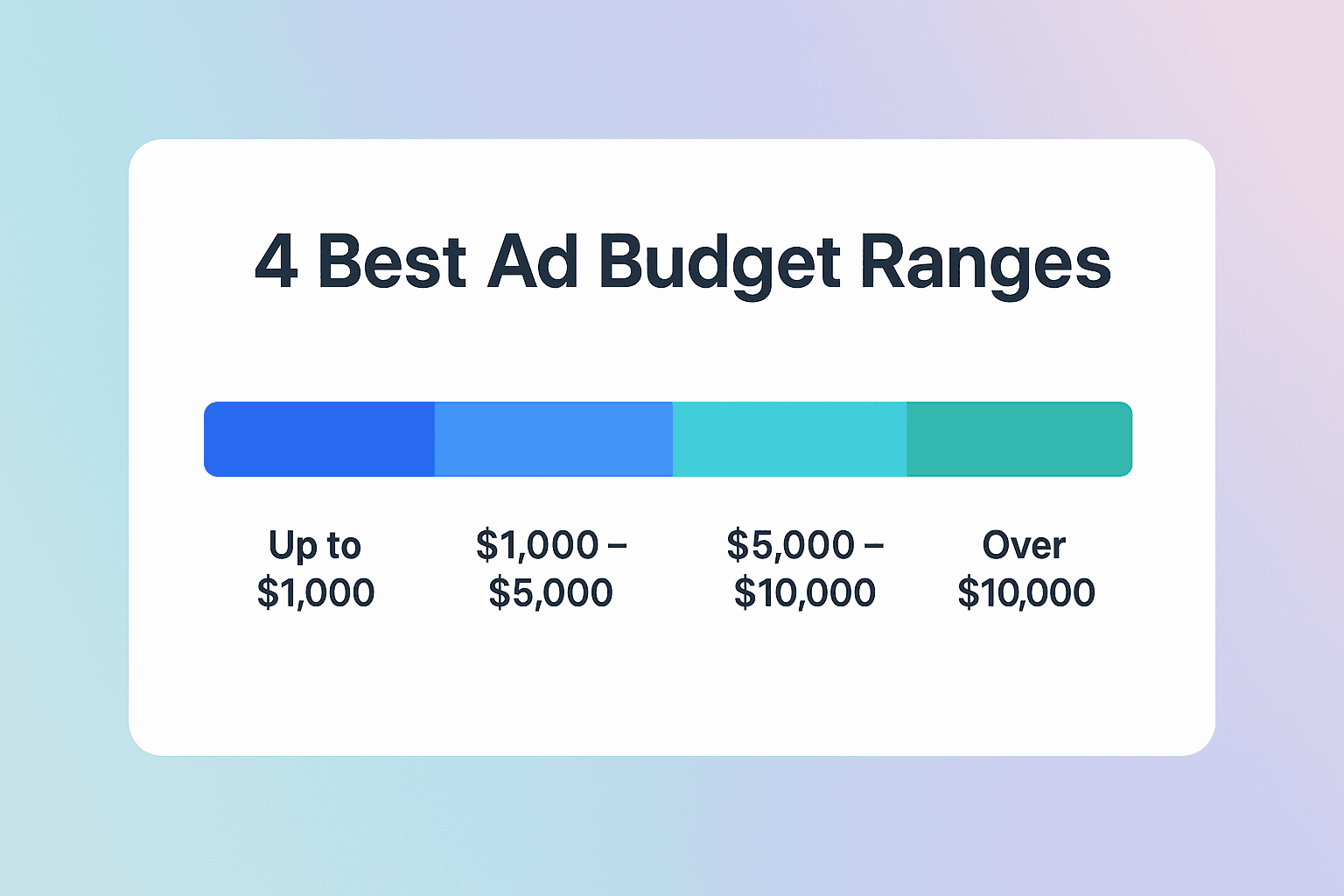
Understanding your total cost structure prevents sticker shock during negotiations and eliminates agencies outside your range immediately. Agency fees typically follow two models: percentage of ad spend (10-20%) or flat monthly retainers ($3,000-$15,000+). Many agencies also have minimum spend requirements—$10,000+ monthly ad spend is common for established agencies.
Calculate your all-in budget: ad spend + agency fees + creative production costs. If you're spending $20,000 monthly on ads, expect agency fees of $2,000-$4,000 under a percentage model or $5,000-$8,000 for a retainer model. Creative production often costs extra unless explicitly included in the retainer.
Your budget determines which agency tier you can access. Boutique specialists typically require $5,000+ monthly retainers. Mid-tier agencies work with $10,000-$50,000 monthly ad spends. Enterprise agencies often have $100,000+ minimums. Know your range before starting conversations—it saves everyone time.
Assess Your Internal Capabilities
Identifying your specific internal gaps determines what services you actually need from an agency. Do you need full-service support (strategy + creative + execution) or execution-only help? Can your team handle creative production, or do you need agency creative services? Do you have analytics infrastructure, or do you need the agency's reporting systems?
Some businesses have strong creative teams but lack Facebook ads execution expertise. Others have solid campaign management skills but struggle with how to create effective ad strategies that align with broader business objectives. Understanding exactly where your team needs support ensures you're not paying for services you can handle internally or leaving critical gaps unfilled.
Step 2: Know Where To Search For Qualified Agencies
Now that you know exactly what you need, let's talk about where to actually find qualified agencies. Here's the problem: most businesses start with Google searches like "Facebook ads agency" or "social media marketing agency." This approach surfaces agencies that are good at SEO and paid advertising—not necessarily good at managing your Facebook ads. The best agencies often aren't the most visible ones.
You need a multi-channel search strategy that goes beyond the first page of Google. The agencies delivering exceptional results for clients are often too busy scaling campaigns to invest heavily in their own marketing. They grow through referrals, industry reputation, and proven case studies—not aggressive outbound sales.
Meta Business Partner Directory
Start with Meta's official partner directory at facebook.com/business/partner-directory. This is the most underutilized resource in agency selection, and it's completely free.
Meta Business Partners meet specific performance and certification requirements that regular agencies don't. They've demonstrated platform expertise, maintained client satisfaction scores, and proven they can manage significant ad spend effectively. The partnership isn't just a badge—it comes with early access to new features, direct Meta support channels, and ongoing training that keeps them ahead of platform changes.
The directory lets you filter by specialization (lead generation, e-commerce, app installs), industry focus (B2B, retail, healthcare), and location. Pay attention to badge levels: Partner, Established, and Premier. Premier Partners have managed over $1 million in annual ad spend and maintained the highest performance standards. That doesn't guarantee they're right for your business, but it eliminates agencies without proven scale.
Here's how to use it effectively: filter for your specific campaign objective and industry, then review case studies on each agency's profile. Look for results that match your business model—if you're a B2B SaaS company, case studies from e-commerce brands aren't relevant. Download your top 10 candidates and move to deeper research.
Industry-Specific Networks And Communities
Peer recommendations from your specific industry are more valuable than any review site. The challenge is knowing where to find them.
Reddit communities like r/PPC and r/marketing offer brutally honest agency reviews. Search for "Facebook ads agency recommendation" and you'll find threads where marketers share real experiences—including what went wrong. LinkedIn groups for your industry (search "[your industry] marketing professionals") have similar discussions. The key is looking for patterns: when the same agency name appears multiple times across different conversations, that's a signal worth investigating.
Slack communities are goldmines for unfiltered feedback. Communities like Superpath (for content marketers), Demand Curve (for growth marketers), and industry-specific groups have dedicated agency recommendation channels. Join these communities, search the #agency-recommendations or similar channels, and read through past discussions. Don't just ask "Does anyone recommend an agency?"—be specific: "Who manages your Facebook lead generation campaigns for B2B SaaS?"
The advantage of community recommendations is context. You'll learn not just which agencies people use, but why they chose them, what results they've achieved, and what challenges they've faced. This qualitative insight is impossible to get from agency websites or sales calls.
Referrals And Case Study Research
The best agencies are often behind the scenes, quietly delivering results for clients who become their biggest advocates. Direct referrals from businesses similar to yours carry more weight than any marketing material because they come with real performance data and operational insights.
When researching potential agencies, pay close attention to how they discuss what are the benefits of programmatic ads and automation capabilities—this reveals whether they're leveraging modern advertising technology or still relying on purely manual processes. Agencies that understand programmatic buying, automated bidding strategies, and AI-powered optimization demonstrate they're keeping pace with platform evolution rather than stuck in outdated methodologies.
Step 3: Create Your Agency Vetting Framework
You've identified 5-10 potential agencies through Meta's partner directory, community recommendations, and case study research. Now comes the make-or-break moment: separating agencies who deliver polished sales presentations from those who actually drive results. Most businesses fail here because they ask generic questions that any agency can answer convincingly. "What's your approach to Facebook ads?" gets you rehearsed talking points. "Walk me through how you'd structure campaigns for our $30,000 monthly budget targeting B2B decision-makers" reveals actual expertise.
The difference between these questions determines whether you waste six months with the wrong partner. You need a vetting framework built on specific technical questions with clear green flag and red flag indicators. Think of this like performance marketing: you're testing hypotheses about agency capabilities using data points that can't be faked.
Technical Capability Assessment
Start with questions that expose platform mastery versus surface-level knowledge. When you ask "What's your creative testing methodology?" strong agencies respond with frameworks: "We test 3-5 creative variations per week, measuring statistical significance after 500 impressions per variant, then scale winners while iterating on losers." Weak agencies give vague answers: "We test different images and see what works."
The specificity gap reveals everything. Agencies with deep expertise naturally discuss testing cadences, significance thresholds, and iteration processes because that's how they actually work. Generic answers signal they're winging it.
Ask about campaign architecture next: "How would you structure our account?" Green flag responses discuss Campaign Budget Optimization versus Ad Set Budget Optimization trade-offs, explain audience segmentation logic, and mention testing frameworks. Red flag responses stay surface-level: "We'd create campaigns for different products." No strategic depth, no methodology, no framework.
When evaluating agency sophistication, pay close attention to how they discuss advanced targeting strategies like facebook ads custom audiences implementation—this separates strategic agencies from basic execution shops. Agencies that can articulate specific custom audience strategies (website visitor segmentation, engagement-based audiences, customer list matching) demonstrate platform mastery. Those who default to "we'll use Facebook's automatic targeting" are essentially admitting they add minimal strategic value.
Push on audience expansion methodology: "How do you scale beyond initial audiences?" Strong agencies explain lookalike audience layering strategies, interest stacking methodologies, and behavioral targeting approaches. They discuss how they balance audience size with targeting precision, when to expand versus when to optimize existing audiences, and how they prevent audience fatigue.
The ultimate test of agency competence is their ability to optimize ad spend efficiency—ask for specific examples of how they've reduced wasted spend while maintaining or improving results. Agencies should provide concrete examples with metrics, not vague promises about "continuous optimization." Look for stories about identifying underperforming placements, adjusting bid strategies based on conversion data, or restructuring campaigns to eliminate budget waste.
Process And Communication Evaluation
Technical skill matters, but operational compatibility determines whether the partnership actually works. Misaligned processes create friction that undermines even the strongest strategic capabilities. Start by clarifying reporting expectations: "What does your typical reporting cadence look like, and what metrics do you prioritize?"
Strong agencies provide structured reporting frameworks with clear KPI hierarchies. They distinguish between vanity metrics and business-critical indicators, explaining how they track performance analytics for ads across multiple dimensions—creative performance, audience efficiency, placement optimization, and conversion path analysis. Weak agencies offer generic dashboard access without interpretation or strategic recommendations.
Ask about their approach to addressing the challenges faced by advertisers in today's privacy-focused environment. Agencies should articulate specific strategies for iOS 14+ attribution challenges, first-party data collection, and conversion API implementation. Those who haven't adapted to privacy changes will struggle to deliver results in 2025 and beyond.
Communication cadence matters as much as reporting quality. Clarify expectations upfront: weekly check-ins, monthly strategy reviews, or quarterly business reviews. Understand their escalation process for underperforming campaigns and their typical response time for urgent issues. The best agencies proactively communicate when metrics shift, not just during scheduled calls.
Results Verification And Reference Checks
Case studies look impressive, but reference calls reveal operational reality. When agencies provide references, ask specific questions that expose both strengths and weaknesses: "What's one thing you wish they did differently?" and "How do they handle underperforming campaigns?" These questions bypass rehearsed testimonials and surface genuine insights.
Pay attention to how agencies discuss how to achieve ROI in advertising during reference conversations. Strong agencies have clear frameworks for measuring return, attributing revenue to campaigns, and optimizing toward profitability rather than vanity metrics. They should discuss incrementality testing, contribution margin analysis, and customer lifetime value optimization—not just ROAS and CPA.
Verify their experience with businesses at your scale and stage. An agency crushing it for enterprise brands with $500,000 monthly budgets might struggle with your $20,000 budget constraints. Conversely, an agency specializing in small business accounts might lack the sophistication needed for complex attribution models and multi-channel strategies.
Ask references about the agency's use of technology and automation. Modern advertising increasingly requires leveraging best AI ad platforms and automation tools to achieve the testing velocity and optimization speed that competitive markets demand. Agencies still relying purely on manual optimization will struggle to keep pace with competitors using intelligent automation.
Making the Right Choice
Finding the right social media marketing agency for Facebook ads isn't about choosing the cheapest option or the one with the flashiest portfolio. It's about systematic evaluation using the framework we've covered: defining your requirements before you search, knowing where to find qualified candidates beyond Google's first page, creating a vetting process that reveals true capabilities, and structuring discovery calls that expose red flags early.
The agencies that deserve your business will welcome tough questions about creative testing methodology, campaign architecture, and optimization frequency. They'll provide specific answers with frameworks and metrics, not vague promises about "driving results." They'll discuss their technology stack, explain their reporting cadence, and articulate clear success metrics before you ask. Most importantly, they'll treat your budget like their own—because exceptional agencies understand that your success directly determines their reputation.
Remember: the right agency relationship transforms your advertising from a cost center into a revenue driver. But even the best agency can't solve every challenge alone. Modern performance marketing increasingly requires combining human strategic thinking with AI-powered automation to achieve the testing velocity and optimization speed that competitive markets demand.
That's where platforms like AdStellar AI complement agency partnerships—handling the repetitive optimization tasks and creative testing at scale while your agency focuses on strategic direction and high-level decision-making. Whether you're working with an agency or building in-house capabilities, the future of Facebook advertising belongs to teams that blend human expertise with intelligent automation.
Ready to see how AI-powered campaign optimization can accelerate your Facebook ads performance? Get Started With AdStellar AI and discover how automation transforms your advertising efficiency.