Manual ad variation testing is one of the biggest time sinks in performance marketing. And the math alone should be enough to make you stop and rethink your approach: five headlines, five images, and three CTAs gives you 75 possible combinations. Add another variable and that number explodes. Build those out one by one in Ads Manager, and you have just signed up for days of repetitive work before a single data point comes in.
The problem is not testing itself. Testing is how you find winners. The problem is that doing it manually does not scale, creates messy data, and burns through budget before you land on a combination that actually performs. When you are testing too many ad variations manually, you end up with fragmented results, creative fatigue across your audiences, and a workflow that pulls you away from actual strategy.
The good news is that there is a better way to approach this. Structured frameworks, smarter tools, and AI-powered automation can transform ad testing from a chaotic grind into a repeatable system that surfaces top performers faster and with far less wasted spend.
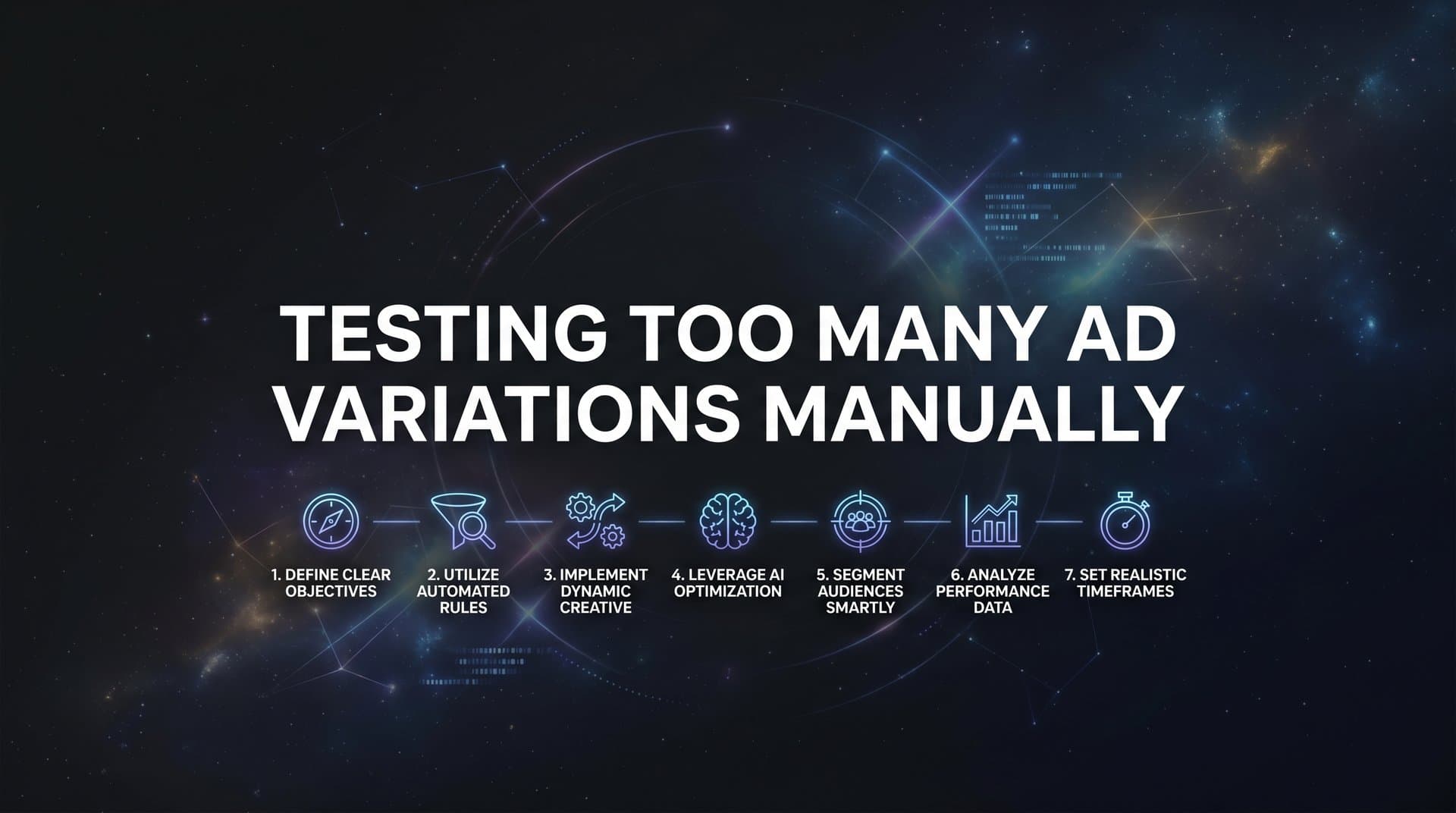
This article covers seven practical strategies to help you make that shift. Whether you are a solo marketer managing a handful of campaigns or an agency running multiple client accounts, these approaches will help you test smarter, move faster, and stop leaving performance on the table.
1. Replace Guesswork with Structured Testing Frameworks
The Challenge It Solves
Most manual testing problems start before a single ad goes live. Without a clear system, marketers test whatever feels right in the moment: a new headline here, a different image there, a copy tweak because a competitor's ad caught their eye. The result is a pile of data that is nearly impossible to interpret because too many variables changed at once.
The Strategy Explained
A structured testing framework forces you to slow down before you scale up. The ICE scoring method, which stands for Impact, Confidence, and Ease, is a well-known prioritization approach used in growth marketing. Before testing any variation, you score it across those three dimensions. High-impact, high-confidence, easy-to-execute tests go first. Low-priority ideas go to the backlog.
Equally important is the principle of isolating one variable at a time. If you change both the headline and the image in the same test, you cannot know which change drove the result. A structured testing calendar helps you sequence experiments logically, so each test builds on the last rather than muddying the data pool.
Implementation Steps
1. List every variable you want to test (headlines, images, CTAs, copy, audiences) and score each using the ICE framework before adding it to your testing queue.
2. Create a simple testing calendar that assigns one variable per testing cycle, with clear start dates and minimum spend thresholds before drawing conclusions.
3. Document your hypothesis before each test: what you expect to happen and why. This keeps your analysis honest and helps you learn from tests that do not go as expected.
Pro Tips
Keep your testing backlog visible and shared across your team. When new ideas come in during a campaign, add them to the backlog rather than launching them immediately. This prevents mid-flight changes that corrupt your current test data and ensures every idea gets evaluated on merit rather than urgency.
2. Use Multivariate Testing Instead of Sequential A/B Tests
The Challenge It Solves
Traditional A/B testing is sequential: you test one thing, wait for results, then move to the next. When you have dozens of variables to evaluate, this approach can take weeks or months to produce actionable insights. Meanwhile, your budget is running, your audience is seeing the same creative repeatedly, and your competitors are iterating faster.
The Strategy Explained
Multivariate testing allows you to test multiple variables simultaneously and evaluate how different combinations interact with each other. Rather than learning that headline A beats headline B in isolation, you learn that headline A paired with image C and CTA two is the highest-performing combination overall. This is statistically more efficient when you have sufficient traffic, because you are capturing interaction effects that sequential A/B testing misses entirely.
The key requirement is volume. Multivariate testing needs enough impressions and conversions to reach statistical significance across multiple cells. If your budget is limited, focus multivariate approaches on your highest-traffic campaigns and use structured A/B testing for lower-volume ad sets.
Implementation Steps
1. Identify the two or three variables with the highest potential impact on your primary KPI, then define two to three options for each variable to keep the test matrix manageable.
2. Set up your campaign structure so that each combination receives an equal budget allocation and runs under identical conditions (same audience, placement, and schedule).
3. Define your success metric and minimum sample size before launching, so you know exactly when you have enough data to make a confident decision.
Pro Tips
Resist the urge to call winners early. Multivariate tests need time to account for day-of-week performance fluctuations and audience learning periods. Set a minimum runtime before reviewing results, and stick to it even when early numbers look compelling.
3. Leverage Dynamic Creative Optimization to Automate Combinations
The Challenge It Solves
Building every ad variation manually is repetitive, error-prone, and slow. If you have five headlines, four images, and three body copy options, that is 60 individual ads to set up by hand. Most teams simply do not have the bandwidth, so they test a fraction of the possible combinations and miss high-performing pairings they never thought to try.
The Strategy Explained
Meta's Dynamic Creative Optimization (DCO) and Advantage+ creative features allow you to upload individual assets and let Meta automatically mix and match them to find the best-performing combinations for each user. Instead of you deciding which headline pairs with which image, Meta's delivery system tests combinations at scale and optimizes toward your campaign objective in real time.
This is particularly effective for top-of-funnel prospecting campaigns where you want broad reach and are still learning which creative angles resonate with different audience segments. You provide the raw ingredients and the platform handles the assembly and ad testing automation.
Implementation Steps
1. Prepare a diverse set of assets: at least three to five headlines, three to five images or videos, and two to three body copy variations that represent meaningfully different creative angles, not just minor wording tweaks.
2. Enable Dynamic Creative at the ad level in Meta Ads Manager and upload your assets, ensuring each element can stand alone and does not rely on a specific pairing to make sense.
3. After a sufficient learning period, review the asset-level breakdown report to identify which individual elements Meta favored, then use those insights to inform your next round of creative production.
Pro Tips
DCO works best when your assets represent genuinely different creative approaches. Uploading five headlines that all say essentially the same thing in slightly different words will not generate useful data. Push for real variety in message, tone, and value proposition across your asset set.
4. Bulk Launch Variations and Let Data Pick the Winners
The Challenge It Solves
Even when you have a clear testing plan and strong creative assets, the mechanical work of building campaigns in Ads Manager is a bottleneck. Duplicating ad sets, swapping creatives, adjusting audiences, and publishing one variation at a time is time-consuming work that adds no strategic value. It is the kind of task that keeps performance marketers busy without making them better.
The Strategy Explained
Bulk launching flips this dynamic entirely. Instead of building variations one by one, you define your testing matrix upfront and let a tool generate and deploy every combination simultaneously. This means you can go from creative assets to a live multi-variation campaign in minutes rather than hours, and your budget starts working immediately instead of waiting for manual setup to finish.
Tools like AdStellar's Bulk Ad Launch let you mix multiple creatives, headlines, audiences, and copy at both the ad set and ad level. AdStellar generates every combination and pushes them to Meta in clicks. You shift from being the person who builds the campaign to the person who reviews the results and scales the winners.
Implementation Steps
1. Define your testing matrix before touching any tool: list your creative assets, headline options, audience segments, and copy variations in a simple grid so you know exactly what combinations you want to test.
2. Use a bulk ad launch tool to input your matrix and generate all combinations automatically, reviewing the output before publishing to catch any mismatches or errors.
3. Set automated rules or budget caps at the ad set level so underperformers are paused automatically and budget shifts toward the combinations that are already showing strong early signals.
Pro Tips
When bulk launching, resist the temptation to test everything at once. A focused matrix of your highest-priority variables will produce cleaner data than an exhaustive test of every possible combination. Start with your top creative angles and your two or three most important audience segments, then expand from there.
5. Build a Winners Library to Stop Re-Testing Proven Elements
The Challenge It Solves
One of the most frustrating forms of wasted effort in ad testing is re-testing things you have already proven. It happens more often than most teams realize. A headline that drove strong results three months ago gets forgotten. A creative angle that worked for one campaign never gets applied to another. Without a centralized record of what works, teams repeat the same experiments and spend budget rediscovering insights they already paid to learn.
The Strategy Explained
A winners library is a curated, searchable repository of your best-performing creative elements backed by real performance data. Not a folder of old ads, but a structured system where every entry includes the asset itself, the campaign context, and the key metrics that made it a winner. When you are planning a new campaign, you start by pulling from proven elements rather than starting from scratch.
AdStellar's Winners Hub does exactly this. Your best-performing creatives, headlines, audiences, and more are all organized in one place with real performance data attached. When you are ready to launch a new campaign, you can select proven winners directly and add them instantly, skipping the discovery phase entirely for elements you have already validated.
Implementation Steps
1. Define your threshold for what qualifies as a winner: a minimum spend level, a ROAS target, a CPA benchmark, or a CTR threshold. Be specific so the library stays curated rather than becoming a dumping ground.
2. After every campaign cycle, review your top performers and add qualifying elements to the library with their performance data, campaign context, and any notes about why they worked.
3. Make the winners library the first stop in every new campaign brief. Require that anyone building a new campaign check the library before proposing new creative elements, so proven assets get reused and extended before new ones are commissioned.
Pro Tips
Tag your winners by objective, audience type, and creative format. A winning video ad for a retargeting campaign may not be the right starting point for a cold prospecting campaign, but a winning direct-response headline might transfer perfectly. Good tagging makes the library genuinely useful rather than just a historical archive.
6. Use AI-Powered Insights to Score and Rank Every Element
The Challenge It Solves
When you are running dozens of ad variations, manual performance analysis becomes its own bottleneck. You are pulling reports, building spreadsheets, sorting by ROAS, cross-referencing CTR, trying to figure out whether a creative underperformed because of the image, the headline, or the audience. This kind of analysis takes hours and still leaves room for human bias to influence which results you focus on.
The Strategy Explained
AI-powered insights replace that manual analysis with automated scoring and ranking. Instead of you combing through data to find patterns, the system evaluates every element against your target goals and surfaces what is working and what is not. You get a clear leaderboard rather than a spreadsheet full of numbers to interpret. This is one of the key advantages of AI tools for campaign management.
AdStellar's AI Insights feature ranks your creatives, headlines, copy, audiences, and landing pages by real metrics including ROAS, CPA, and CTR. You set your target goals and the AI scores everything against your benchmarks, so you can instantly see which elements are above the line and which ones to cut. This turns performance review from a half-day task into a five-minute decision.
Implementation Steps
1. Define your goal benchmarks clearly before launching any campaign: your target ROAS, maximum CPA, and minimum CTR. These benchmarks become the scoring criteria that make AI-powered ranking meaningful.
2. After your campaigns have gathered sufficient data, review the AI leaderboards to identify top-performing elements across each dimension. Look for patterns, not just individual winners.
3. Use the rankings to make systematic decisions: pause everything below your benchmark, scale everything above it, and add top performers to your winners library for future campaigns.
Pro Tips
Pay attention to which elements consistently appear in top-performing combinations rather than just which individual assets score highest in isolation. An image that ranks well on its own might underperform when paired with certain headlines. AI insights that show combination-level data give you a more accurate picture of what is actually driving results.
7. Generate Creatives with AI to Eliminate the Production Bottleneck
The Challenge It Solves
Many teams over-test stale creative not because they want to, but because producing fresh creative is slow and expensive. Briefing a designer, waiting for revisions, sourcing video footage, coordinating with copywriters: the production cycle can take days or weeks. So instead of testing new angles, teams keep running the same tired ads and wonder why performance is declining. Creative fatigue is a real phenomenon in digital advertising, where audiences become less responsive to ads they have seen repeatedly.
The Strategy Explained
AI creative generation removes the production bottleneck entirely. Instead of waiting on a design team, you can generate image ads, video ads, and UGC-style content in minutes, test multiple creative angles simultaneously, and refresh your ad library continuously without a growing production budget. The gap between AI ad tools and manual creation continues to widen as these platforms mature.
AdStellar's AI Ad Creative feature lets you generate scroll-stopping creatives from a product URL, clone competitor ads directly from the Meta Ad Library, or build from scratch with AI. You can create image ads, video ads, and UGC-style avatar content without designers, video editors, or actors. Chat-based editing lets you refine any ad in real time. The result is a creative pipeline that keeps pace with your testing velocity instead of constraining it.
Implementation Steps
1. Start by generating creatives across three to five distinct angles: different value propositions, emotional tones, or visual styles. Variety at this stage gives your testing more signal to work with.
2. Use the Meta Ad Library to research which creative formats and messaging approaches are running in your category, then use AI to generate your own versions that match your brand voice and positioning.
3. Build a regular creative refresh cycle into your workflow. Set a cadence, whether weekly or bi-weekly, for generating new creative variations so your ad library is always evolving and you are never forced to keep running exhausted assets.
Pro Tips
When generating UGC-style creatives with AI, focus on authenticity of message rather than just format. UGC works because it feels genuine and specific. Make sure your AI-generated UGC content includes concrete details about your product, real use cases, and language that mirrors how actual customers talk about the problem you solve.
Your Implementation Roadmap
The shift from manual testing chaos to a structured, scalable system does not happen all at once. But it does not have to be complicated either. The key is sequencing your changes so each one builds on the last.
Start with Strategy 1: get a structured framework and testing calendar in place before you change anything else. Without structure, more tools just create more chaos. Then move to Strategy 7 and remove the creative production bottleneck with AI generation. Fresh creative is the fuel that makes everything else work. Once you have a steady creative pipeline, apply Strategy 4 to bulk launch your variations and Strategy 6 to let AI insights score and rank every element automatically. From there, Strategy 5 ensures your winners are captured and reused rather than forgotten.
The goal is not to test less. It is to test smarter. More signal, less noise, faster decisions, and a workflow that compounds over time rather than burning out your team.
AdStellar brings all of this into one platform. AI creative generation, an intelligent campaign builder, bulk ad launching, and performance leaderboards work together so you can go from creative idea to winning campaign without juggling five different tools. Every decision comes with full AI transparency so you understand the strategy, not just the output.
If you are ready to stop testing manually and start testing at scale, Start Free Trial With AdStellar and see how fast you can surface your next winning campaign.