Running Facebook ads at scale used to mean hiring a full creative team, spending weeks on production, and hoping something would stick. That model is broken. The brands winning on Meta today are not producing more ads manually. They are automating the entire creative pipeline, from generation to testing to optimization, and letting data decide what runs.
Facebook creative automation is the practice of using AI and systematic workflows to produce, test, and optimize ad creatives without relying on manual design cycles. When done right, it compresses weeks of work into hours, surfaces winning creatives faster, and eliminates the guesswork that drains ad budgets.
This guide covers seven proven strategies for implementing top Facebook creative automation in your campaigns. Whether you are a solo performance marketer, an agency managing multiple clients, or an in-house team trying to scale without adding headcount, these strategies will help you build a creative system that compounds over time. Each strategy is actionable, grounded in how modern Meta advertising actually works, and designed to fit into a real workflow.
1. Build a Modular Creative System Before You Automate
The Challenge It Solves
Automation tools are only as good as the inputs you feed them. If you hand an AI system a handful of generic visuals and vague copy, it will scale mediocre creative faster than you can pull the plug. The root problem for most advertisers is not a lack of tools. It is a lack of structure in how creative assets are organized and produced.
The Strategy Explained
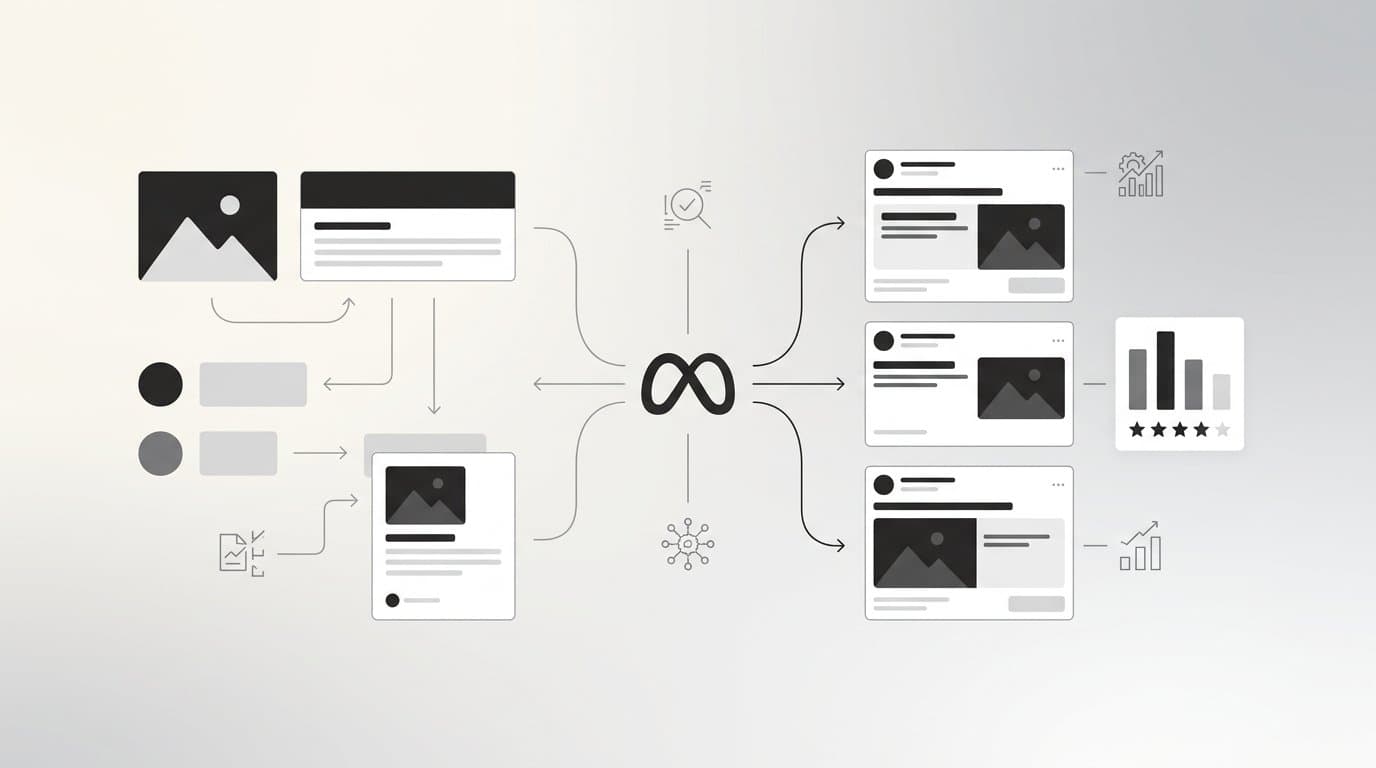
A modular creative system breaks every ad into interchangeable components: the hook (the first frame or opening line that stops the scroll), the visual or video body, the supporting copy, and the call to action. Each component is treated as a standalone asset that can be swapped in and out independently.
This structure matters because it gives automation something meaningful to work with. When your hooks, visuals, and CTAs are distinct and well-crafted, dynamic creative optimization and AI generation tools can combine them intelligently rather than just remixing noise. Think of it like building with LEGO bricks instead of wet clay. The cleaner your components, the more useful combinations you can generate.
You do not need dozens of each element to start. Even three strong hooks, four visuals, and two CTAs give you meaningful variation to test. Quality of inputs always beats quantity.
Implementation Steps
1. Audit your existing creative assets and tag each element by type: hook, visual, copy, CTA.
2. Identify gaps. If all your hooks sound the same, write five distinct versions targeting different emotional angles, such as curiosity, urgency, social proof, and problem-awareness.
3. Build a shared asset library in a tool your whole team can access, organized by component type and performance tier.
4. Establish a naming convention so automation tools and team members can identify components quickly.
Pro Tips
Label your top-performing components from past campaigns clearly. When AI tools or bulk launchers pull from your library, you want them prioritizing assets with a proven track record. A modular system also makes creative reviews faster because you can evaluate one component at a time rather than judging entire ads as monolithic units. Pair this with ad creation software that supports component-level organization from the start.
2. Use AI to Generate Creative Variations at Volume
The Challenge It Solves
Creative fatigue is one of the most persistent problems in Meta advertising. Meta's own advertising documentation acknowledges that ad creative is a primary lever for campaign performance, and audiences stop responding to the same ad over time. The traditional solution, hiring designers and video editors to produce more content, is expensive and slow. By the time new creative is ready, the campaign window has often passed.
The Strategy Explained
AI creative generation tools can produce image ads, video ads, and UGC-style content from a product URL or a brief description, without a design team, video editor, or on-camera talent. The key is treating AI generation as a creative accelerator rather than a replacement for creative thinking.
Start with your product URL or core offer and let the AI produce an initial batch of variations. Then use chat-based refinement to steer the output toward your brand voice, adjust visual tone, or test a completely different angle. This iterative loop keeps quality high while dramatically compressing production time. Platforms like AI ad creation tools allow you to generate image ads, video ads, and UGC avatar creatives in one place, then refine any element through conversation rather than a full redesign cycle.
Implementation Steps
1. Start with your product URL or a clear brief describing your offer, target audience, and key benefit.
2. Generate an initial batch of variations across formats: static image, short video, and UGC-style content.
3. Review the output and use chat-based editing to refine tone, visuals, or messaging rather than starting over.
4. Build a habit of generating new creative batches on a regular cadence, not just when performance drops.
Pro Tips
Do not wait for creative fatigue to hit before generating new variations. Build a production rhythm that keeps fresh creative in reserve. When you have a winning concept, use AI to produce five or six variations of that same angle with different visuals or hooks. This extends the life of a proven idea without repeating the same ad. Understanding common Facebook ad creative testing challenges will help you anticipate where your variation strategy needs the most reinforcement.
3. Automate Bulk Ad Launching Across Multiple Variations
The Challenge It Solves
Manually setting up individual ads in Meta Ads Manager is one of the biggest time sinks in performance marketing. When you are testing multiple creatives against multiple audiences with different copy variations, the setup alone can take hours. And the longer setup takes, the fewer variations actually get tested, which slows down your ability to find winners.
The Strategy Explained
Bulk launching allows you to mix creatives, headlines, audiences, and copy at both the ad set and ad level, then generate every possible combination and push them live in minutes rather than hours. The goal is not just adding volume for its own sake. It is collecting performance signal efficiently across a wide surface area so you can identify what works faster.
The key to effective bulk launching is intentional structure. Rather than launching every possible permutation randomly, organize your launch around specific hypotheses. For example, test three different hooks against two audience segments, or test two price-point CTAs against a benefit-focused CTA. Each launch should have a clear question it is designed to answer. Tools built for bulk Facebook ad creation make this process systematic rather than chaotic.
Implementation Steps
1. Define the variables you want to test in each launch: creatives, headlines, copy, and audiences.
2. Set a minimum budget per variation that gives each combination enough spend to generate meaningful signal.
3. Use a bulk ad launcher to generate all combinations and push them to Meta simultaneously.
4. Set a review cadence, typically 48 to 72 hours after launch, to evaluate early performance data before scaling winners.
Pro Tips
Resist the urge to pause underperformers too early. Give each variation enough runway to collect statistically meaningful data before making decisions. The value of bulk launching is in the breadth of signal it collects, but that signal only becomes useful if you let it accumulate before acting on it. Reviewing how Facebook ad testing automation works end-to-end will help you set smarter review cadences from the start.
4. Let AI Analyze Historical Data to Build Smarter Campaigns
The Challenge It Solves
Most advertisers build new campaigns from scratch, even when they have months or years of performance data sitting in their ad account. That historical data contains the most reliable signals available for predicting future performance: which creatives drove the lowest CPA, which audiences converted at the highest rate, which headlines generated the most clicks. Ignoring it means repeating avoidable mistakes.
The Strategy Explained
AI campaign builders can analyze your historical campaign data, rank every past creative, headline, and audience element by real performance metrics, and use those rankings to construct complete new campaigns automatically. The difference between this and a human reviewing past data is speed and scope. An AI agent can process hundreds of past ad variations and surface patterns that would take a human analyst days to identify.
What makes this approach particularly valuable is transparency. The best implementations explain the rationale behind every decision, so you understand why a particular audience or headline was selected, not just that it was. This is how AI-assisted ad launching moves beyond black-box automation into a system you can actually trust and learn from. Over time, the AI gets smarter with each campaign because it has more data to draw from.
Implementation Steps
1. Ensure your historical campaign data is clean and accessible, with consistent naming conventions that make it easy to identify creative and audience variables.
2. Connect your ad account to an AI campaign builder that can ingest and analyze past performance data.
3. Review the AI's campaign recommendations alongside its reasoning before launching, not just the output.
4. After each campaign, feed the new performance data back into the system to improve future recommendations.
Pro Tips
The quality of AI campaign analysis depends heavily on the quality of your historical data. If your past campaigns used inconsistent naming or mixed too many variables at once, the AI has less to work with. Cleaning up your data hygiene now pays compounding dividends as your campaign history grows. Explore AI marketing automation for Facebook that supports this kind of historical analysis natively.
5. Implement Goal-Based Scoring to Surface Winners Fast
The Challenge It Solves
Not every metric is equally relevant to your specific goal. An ad with a strong CTR but poor ROAS is not a winner for an e-commerce brand optimizing for revenue. An ad with a high CPA but strong brand recall might be exactly right for a top-of-funnel awareness campaign. Without a clear scoring framework tied to your actual goal, you end up optimizing for the wrong things.
The Strategy Explained
Goal-based scoring aligns your optimization framework to the outcomes that actually matter for your campaign objective. Instead of reviewing every metric equally, you set benchmarks for your primary KPI, whether that is ROAS, CPA, CTR, or another metric, and let a leaderboard system rank every creative, headline, audience, and landing page against those benchmarks automatically.
This approach makes winner identification fast and objective. Rather than spending hours in spreadsheets comparing ad performance, you have a ranked list that tells you exactly which elements are performing above your goal threshold and which are not. Performance analytics for ads built around goal-based scoring eliminate the subjectivity that often leads to keeping underperformers running too long.
Implementation Steps
1. Define your primary campaign goal and the specific metric that best represents success for that goal.
2. Set a benchmark threshold for that metric, the minimum performance level a creative or audience must hit to be considered a winner.
3. Connect your performance data to a leaderboard system that ranks all elements against your benchmark automatically.
4. Review the leaderboard on a regular cadence and move top-ranked elements into your Winners Hub for reuse in future campaigns.
Pro Tips
Set separate benchmarks for different campaign types. Your ROAS threshold for a retargeting campaign should be higher than for a cold audience prospecting campaign, because the conversion conditions are different. Applying the same benchmark across all campaign types will cause you to mislabel winners and losers. Use Facebook ad targeting automation that supports goal-specific scoring to keep your framework precise across audience segments.
6. Clone and Iterate on Competitor Creatives Strategically
The Challenge It Solves
Coming up with fresh creative angles is one of the hardest parts of running ads at scale. Creative blocks slow down production, and producing variations of the same angle over and over leads to audience fatigue. Meanwhile, your competitors are actively testing what resonates with the same audience you are targeting, and that intelligence is publicly available.
The Strategy Explained
The Meta Ad Library gives advertisers direct visibility into what competitors are currently running, including ad format, creative style, and messaging approach. The strategic use of this tool is not imitation. It is informed iteration. When you see a competitor running a particular ad format or angle consistently over weeks or months, that is a signal that it is performing well enough to keep running. That signal is worth building on.
The goal is to take a competitor's concept and produce a differentiated version that speaks more directly to your specific audience, highlights your unique advantages, or uses a stronger hook. AI tools that can clone competitor ads directly from the Meta Ad Library and generate variations make this process fast and systematic. The result is creative that is grounded in market-validated concepts but distinct enough to stand on its own.
Implementation Steps
1. Identify two or three direct competitors running active Meta campaigns and review their ad libraries regularly.
2. Note which ad formats and creative angles they are running consistently over time, as consistency is a proxy for performance.
3. Use an AI creative tool to generate your own version of the concept, adjusting the hook, visual style, and messaging to reflect your brand and offer.
4. Test your variation alongside your original creative to see whether the market-validated concept outperforms your existing approach.
Pro Tips
Do not copy competitor ads directly. The goal is to understand what creative approaches are resonating with your shared audience and then produce something better. Think of competitor research as a creative brief, not a template. The most effective iterations take a proven concept and sharpen it with a stronger offer, a more specific audience insight, or a more compelling visual. Explore how Facebook advertising automation compares to manual methods when it comes to speed of iteration at this stage.
7. Close the Loop with Attribution and Continuous Learning
The Challenge It Solves
Creative automation without accurate attribution is like navigating with a broken compass. You are making optimization decisions based on incomplete or misleading data. This problem became more acute after iOS privacy changes shifted how conversion events are tracked, making it harder to connect specific ad creatives to downstream purchase behavior. If your attribution is off, your best-looking ads in Meta's dashboard may not be your actual revenue drivers.
The Strategy Explained
Closing the attribution loop means connecting ad creative performance to real downstream conversion events, not just platform-reported metrics. This requires an attribution solution that can track the full customer journey from ad impression to conversion, even across devices and privacy restrictions.
When creative performance data is connected to accurate conversion data, every optimization decision improves. You can see which specific creatives, not just which campaigns, are driving purchases, sign-ups, or other goal completions. This data then feeds back into your AI campaign builder, your goal-based scoring system, and your modular creative library, making each subsequent campaign smarter than the last. AdStellar integrates with Cometly for attribution tracking, which connects ad-level creative data to real conversion events. Find out more about Meta Events Manager and how it fits into this attribution framework, and explore where to find ad performance data that goes beyond what Meta's native dashboard shows.
Implementation Steps
1. Audit your current attribution setup to identify gaps between Meta-reported conversions and actual revenue or conversion events in your CRM or analytics platform.
2. Connect an attribution tool that can track post-click behavior and match conversions back to specific ad creatives.
3. Set up creative-level reporting so you can see which specific assets, not just which campaigns, are driving conversions.
4. Feed accurate conversion data back into your AI campaign builder and scoring system to improve future recommendations.
Pro Tips
Do not rely solely on Meta's reported attribution window. Cross-reference your Meta data with your attribution tool regularly, especially for high-spend campaigns. Discrepancies between the two are normal, but large gaps often indicate a tracking issue worth investigating before you make major budget or creative decisions based on flawed data.
Putting It All Together
Facebook creative automation is not a single tactic. It is a system. The seven strategies covered here are designed to build on each other: a modular creative library feeds AI generation, bulk launching collects signal at scale, historical data informs smarter campaigns, goal-based scoring surfaces winners quickly, competitive intelligence accelerates iteration, and attribution closes the feedback loop.
The compounding effect of running all seven strategies together is significant. Each campaign makes the next one smarter. Each winning creative gets reused faster. Each dollar spent generates more useful data.
If you are just getting started, prioritize the modular creative system and AI generation first. Once you have volume, layer in bulk launching and AI campaign analysis. Then connect attribution to ensure your optimization decisions are based on real conversion data rather than platform-reported approximations.
The brands scaling efficiently on Meta right now are not working harder. They are working within systems that do the heavy lifting for them. Building that system is the competitive advantage that compounds over time.
AdStellar handles the full stack from creative generation to campaign launch to winner identification in one platform. Start Free Trial With AdStellar and see how quickly your creative pipeline can scale when AI handles the production, the testing, and the optimization automatically.