Authentic-looking video ads consistently outperform polished brand creative in Meta feeds. Most performance marketers know this. The problem is that producing real UGC at scale requires actors, scripts, shoots, revision cycles, usage rights negotiations, and budgets that most teams simply don't have sitting around.
The result is a frustrating gap: you know what works creatively, but the logistics of executing it at volume make it impractical. A single batch of UGC creatives can take weeks to produce and cost more per deliverable than most teams can justify when they need to be testing dozens of angles simultaneously.
That's exactly the problem a UGC avatar ad generator is built to solve. By combining AI-generated digital avatars with voice synthesis and automated video rendering, these tools let you produce authentic-feeling, spokesperson-style video ads without a single camera, actor, or production call. This article breaks down what the technology actually is, how it works under the hood, which ad formats it supports, how to fit it into a real Meta campaign workflow, and what to look for when evaluating platforms.
Why Authentic Creative Outperforms Polished Brand Content
Spend any time analyzing Meta feed behavior and a clear pattern emerges: content that looks like it belongs in the feed gets watched, while content that looks like an ad gets scrolled past. This isn't a new insight, but it's one that traditional brand creative consistently struggles to act on.
UGC-style ads work because they mimic the visual language of organic content. A person talking directly to the camera in a casual setting triggers a different cognitive response than a professionally lit product shot with brand overlays. It feels like a recommendation from someone you might actually know, which reduces the instinctive resistance most users have developed toward advertising.
The trust factor matters too. When someone who looks like a real person describes a problem and explains how a product solved it, the message lands differently than the same claim delivered through brand copy. This is the core reason UGC-style ads tend to outperform polished creative in feed environments, not just on engagement metrics but at the conversion stage as well.
The traditional path to capturing that authenticity involves finding creators who match your target audience, negotiating rates, briefing them on your product, waiting for drafts, managing revisions, and then handling usage rights before you can actually run anything. By the time a single round of UGC is ready to launch, the campaign window may have shifted entirely. Understanding UGC creator costs for ads makes it clear why so many teams are looking for alternatives.
Scaling that process is even harder. If you want to test five different hooks with three different personas across two audience segments, you're looking at coordinating a significant number of individual creator relationships, each with their own timelines and deliverables. Most performance marketing teams don't have the bandwidth or budget to run that kind of creative operation continuously.
The gap, then, is not a lack of understanding about what works. It's a production bottleneck that prevents teams from executing at the speed and volume that modern Meta advertising demands. Avatar-based UGC generators exist specifically to close that gap: they deliver the feel of authentic creator content without the logistics, cost, and timeline of producing it through traditional means.
The Mechanics Behind AI Avatar Video Generation
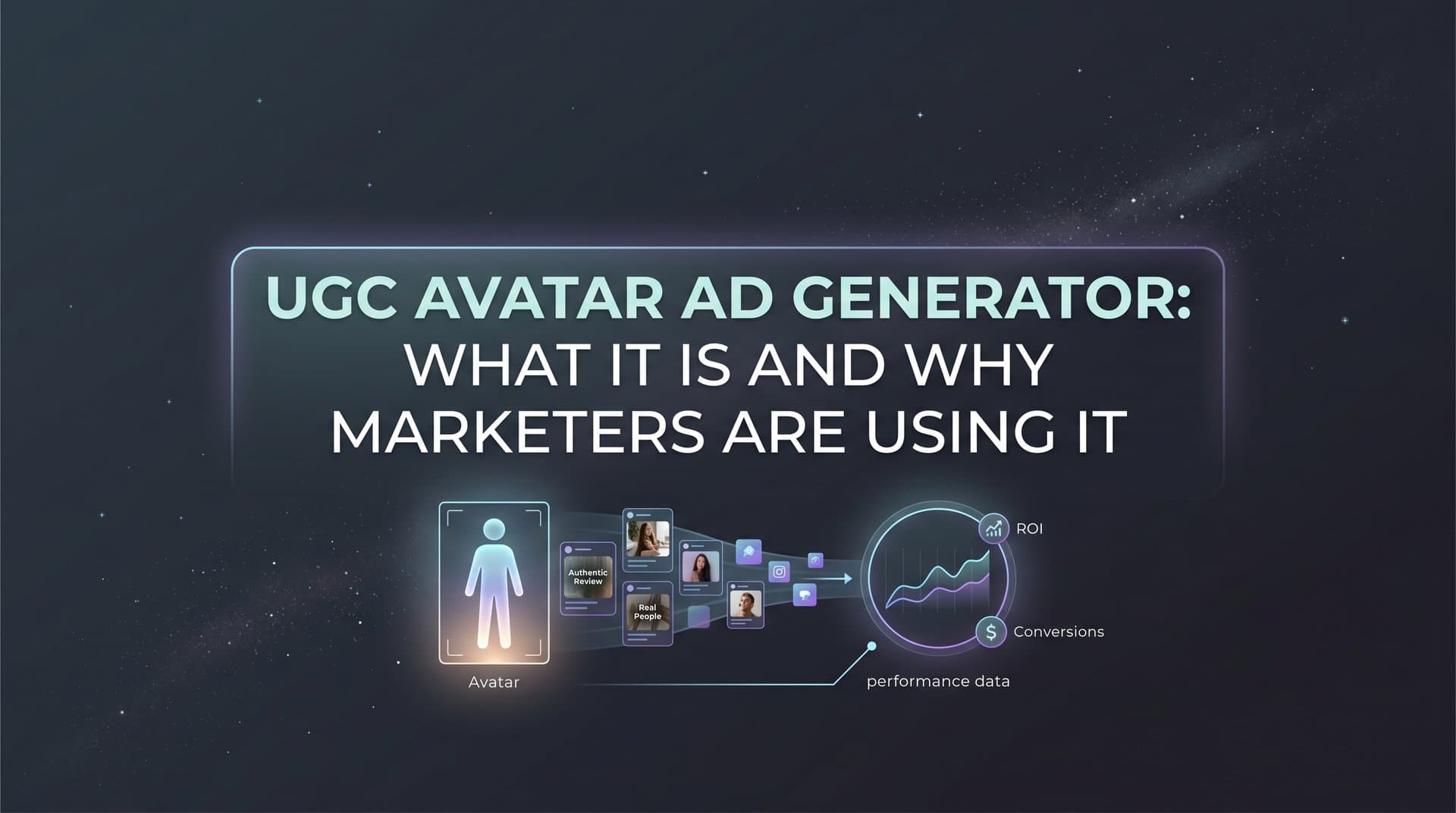
At its core, a UGC avatar ad generator combines three underlying technologies: AI-generated digital avatars that realistically mimic human presenters, voice synthesis or text-to-speech systems that deliver scripted content in a natural, conversational tone, and automated video rendering that assembles the avatar, audio, and any brand assets into a finished ad format.
The input side of the process is deliberately simple. Most purpose-built tools accept a product URL, a script or a set of talking points, and basic brand details. The system then generates a video featuring a realistic avatar delivering that message in a style that reads as organic rather than produced. You're not building anything manually; you're directing the output through the inputs you provide.
What separates an ad-specific avatar generator from a generic video creation tool is the layer of advertising-specific functionality built on top of the core technology. Generic tools produce video files. Ad-specific generators produce video in the formats Meta actually requires: vertical for Reels and Stories, square for feed placements, and story-length durations optimized for completion rates. That distinction matters because reformatting a generic video for Meta placements adds friction and often degrades quality. The best AI UGC video ads are built with these placement requirements baked in from the start.
Integration depth is the other major differentiator. A tool that exports a file and stops there forces you to manually upload creatives, build ad sets, write copy, and configure targeting in a separate workflow. A platform that connects avatar generation directly to campaign building eliminates that handoff entirely. You generate the creative and move it into a live campaign without leaving the platform.
The ability to generate multiple avatar variations is also specific to ad use cases. In a creative testing context, you don't want one avatar; you want several, with different demographics, visual styles, and delivery tones, so you can match personas to audience segments and identify which combination resonates. Generic video tools don't think in terms of variation sets. Ad-specific generators do.
AdStellar's AI Ad Creative hub includes UGC-style avatar content generation as part of its core offering. You can generate avatar ads directly from a product URL, choose from a range of AI personas, and move those creatives into the AI Campaign Builder without switching tools or reformatting files. The entire loop from creative generation to campaign launch happens inside one platform.
Creative Formats and When to Deploy Each
Not every avatar ad serves the same purpose, and understanding the format options helps you match creative to funnel stage rather than defaulting to one style for everything.
Avatar Spokesperson Ads: These feature an AI avatar delivering a direct-to-camera message, typically explaining a product, walking through a use case, or presenting a testimonial-style narrative. They work well for product explanations where the value proposition needs unpacking and for audiences who are already problem-aware but haven't encountered your brand. The conversational delivery style makes complex information easier to absorb than text-heavy static ads.
UGC-Style Review Videos: These are designed to mimic the look and feel of organic creator reviews. The avatar speaks casually, often in a less polished visual environment, and frames the product through personal experience language. This format is particularly effective at the awareness stage because it blends into feed content and doesn't trigger the visual cues users associate with advertising. The goal is to stop the scroll before the viewer has consciously identified the content as an ad. Platforms built around synthetic UGC for ads are specifically designed to nail this organic look.
Hybrid Formats: These combine avatar voiceover or on-screen presence with product footage, static visuals, or screen recordings. The avatar provides the human element and narrative structure while product visuals handle demonstration. This format works well for conversion-stage campaigns where you need to both build trust through a relatable presenter and show the product in action.
Mapping these formats to funnel stages makes creative planning more systematic. At the awareness stage, lead with relatable avatar personas and problem-focused scripts. The hook should surface a pain point the target audience recognizes immediately, and the avatar should look and sound like someone that audience would trust. At the consideration stage, shift to feature-focused scripts that explain what makes your product the right solution. At the conversion stage, deploy direct-response scripts with clear CTAs, specific offers, and confident avatar delivery.
The practical advantage of avatar generation is that producing multiple angle variations costs almost nothing additional once the core setup is in place. You can run a problem-agitation version, a social proof framing version, and a feature highlight version of the same ad with different avatars and scripts, all generated in a single session. That kind of creative variety is foundational to effective ad variant testing, and it's simply not achievable at comparable speed through traditional UGC production.
Building Avatar Ads Into a Real Meta Campaign Workflow
Generating a great avatar ad is only half the equation. The other half is deploying it in a way that produces actionable performance data quickly enough to inform your next creative decisions.
A practical workflow starts with generating several avatar ad variations that differ in meaningful ways: different hooks, different script angles, different avatar personas. The goal is not to produce minor tweaks of the same ad but to test genuinely different creative hypotheses. Does a problem-focused hook outperform a social proof hook for this audience? Does a younger avatar persona outperform an older one for this product category? These are questions you can only answer with data, and you can only get that data by running variations simultaneously.
Those avatar variations should be launched alongside image ads and standard video creatives inside the same campaign structure. This gives you a complete picture of how avatar-style content performs relative to other formats for your specific audience, rather than evaluating it in isolation. The comparison is what generates insight. Knowing when to scale ad campaigns based on that data is what separates systematic growth from guesswork.
Here's where bulk launching changes the economics of creative testing entirely. Because avatar ads can be generated quickly, combining them with a bulk ad launcher lets you mix multiple creatives, headlines, audiences, and copy variations at both the ad set and ad level, then launch every combination to Meta in minutes rather than hours. AdStellar's Bulk Ad Launch feature does exactly this: you generate the combinations and the platform handles the build and launch, eliminating the manual ad construction that typically makes large-scale testing impractical.
The feedback loop is where the real compounding value lives. Once performance data starts coming in, you're not just identifying which ad won. You're identifying which script angle, which avatar persona, and which hook structure drove results with which audience segment. That information feeds directly into your next round of creative generation. The scripts and personas that surface as winners in AdStellar's Winners Hub become the starting point for the next batch of avatar ads, and the AI Campaign Builder uses historical performance data to inform how those new creatives get deployed.
Over time, this creates a system where each campaign cycle produces better creative inputs for the next one. The testing is not random; it's structured learning that compounds with every round.
Evaluating a UGC Avatar Ad Generator: What Actually Matters
The category has grown quickly, and not every tool that calls itself a UGC avatar generator is built with advertising use cases in mind. Here's what to evaluate when choosing a platform.
Avatar Realism and Diversity: The avatars need to be convincing enough to pass as real presenters in a fast-moving feed environment. Beyond realism, diversity matters practically: if you're targeting multiple audience segments, you need avatar personas that reflect those audiences. A platform with a limited avatar library forces you to run the same face across different segments, which undermines the personalization that makes UGC-style content effective. Reviewing the best UGC ad generation software options side by side reveals significant differences in avatar library depth.
Script Flexibility: The ability to customize tone, pacing, length, and CTA structure is non-negotiable for performance advertising. A tool that constrains you to templates limits your ability to test different script approaches. Look for platforms that let you write custom scripts, adjust delivery style, and iterate quickly without rebuilding from scratch each time.
Output Quality for Meta Placements: Verify that the output formats match actual Meta ad specifications, including aspect ratios, resolution, and duration guidelines for each placement type. Poor output quality will hurt performance regardless of how good the script is.
Integration Depth: A standalone video export tool is useful. A platform that connects avatar generation to campaign building, bulk launching, and performance tracking is transformative. The handoff between creative production and campaign management is where most teams lose time and data fidelity. Eliminating that handoff through a unified platform is a genuine competitive advantage.
AI Scoring and Insights: Platforms that score creatives against your actual goals, whether that's ROAS, CPA, or CTR, let you move beyond subjective judgment and identify what's actually working. AdStellar's AI Insights feature ranks creatives, headlines, copy, audiences, and landing pages against your benchmarks, so you can see exactly which avatar ad elements are driving results and replicate them systematically. You can also analyze ad performance against competitor UGC-style ads via the Meta Ad Library and even clone competitor ad formats directly into your own creative workflow.
The Bottom Line on Avatar-Driven Creative
The shift toward UGC-style content on Meta is not a trend to chase and abandon. It reflects something durable about how people consume content in feed environments and how trust is built in digital advertising. The challenge has always been execution: producing authentic-feeling video content at the volume and speed that performance marketing requires is genuinely difficult with traditional production methods.
A UGC avatar ad generator removes that production barrier. It gives you the ability to generate realistic, spokesperson-style video ads from a product URL, test multiple personas and script angles simultaneously, and feed the results back into your next campaign cycle, all without designers, actors, or production overhead.
The real strategic advantage is not creating one good avatar ad. It's building a testing-and-learning system where avatar creatives, image ads, and video ads are continuously generated, launched, scored, and refined inside a single workflow. That system compounds over time: every campaign produces better inputs for the next one, and your creative library gets stronger with each cycle.
AdStellar is built to run that full loop. From UGC avatar generation in the AI Creative Hub to bulk campaign launching, AI-powered performance scoring, and a Winners Hub that preserves your best-performing creatives for reuse, everything connects inside one platform. No tool-switching, no manual handoffs, no guesswork about what's actually working.
If you're ready to move from knowing what works to actually executing it at scale, Start Free Trial With AdStellar and see how fast your creative testing cycle can move when production is no longer the bottleneck.