Authentic-looking video content is one of the most effective formats running on Facebook right now. Brands and performance marketers know this. The problem is that producing real user-generated content (UGC) is slow, expensive, and deeply unpredictable. You need to find the right creators, negotiate rates, write briefs, wait on revisions, manage usage rights, and hope the final output actually converts. By the time you have three usable videos, a competitor has already tested thirty.
That gap between what works and what's practical to produce is exactly where UGC avatar ads come in. These are AI-generated video ads that replicate the look, feel, and delivery style of creator content without requiring a single camera, actor, or studio. They use realistic digital avatars and synthetic voice to produce direct-to-camera spokesperson content at a fraction of the time and cost of traditional production.
This article covers everything you need to understand about UGC avatar ads for Facebook: what they are, how the technology works, why they perform well in the feed, and how to build, launch, and test them at scale without a production team behind you.
The Rise of Creator-Style Content in Facebook Advertising
Facebook's feed has changed dramatically over the past several years. Users are scrolling past hundreds of pieces of content daily, and their tolerance for obvious brand advertising has dropped. Polished, high-production ads often signal "commercial" immediately, triggering a scroll reflex before the message even registers. Creator-style content, the kind that looks like someone just picked up their phone and started talking, tends to survive that scroll because it blends in.
This isn't just a user preference. Facebook's algorithm rewards content that generates genuine engagement, and authentic-looking video consistently outperforms heavily branded creative in terms of watch time, saves, and click-through rates. The platform has evolved to favor content that feels native to the feed, and direct-to-camera video is about as native as it gets.
The traditional UGC model works because of this dynamic. When a real person talks about a product on camera, the audience perceives it as a recommendation rather than an advertisement. Trust increases, skepticism drops, and conversion rates often follow. Brands that figured this out early started building creator networks, running gifting programs, and paying UGC specialists to produce content at volume.
But the operational reality of that model is messy. Finding creators who match your brand, audience, and aesthetic takes time. Briefing them well enough to get usable content takes more. Revisions happen. Licensing and usage rights add legal complexity. Turnaround times stretch from days into weeks. And when a creative stops performing, the whole process starts over.
For DTC brands running aggressive testing cycles, or agencies managing creative across multiple client accounts, this bottleneck is a real constraint on performance. You can't test your way to winning creatives if you can only produce a handful of videos per month. The demand for authentic content is high, but the traditional supply chain is slow and expensive. That mismatch created a clear opening for a more scalable approach.
What UGC Avatar Ads Actually Are
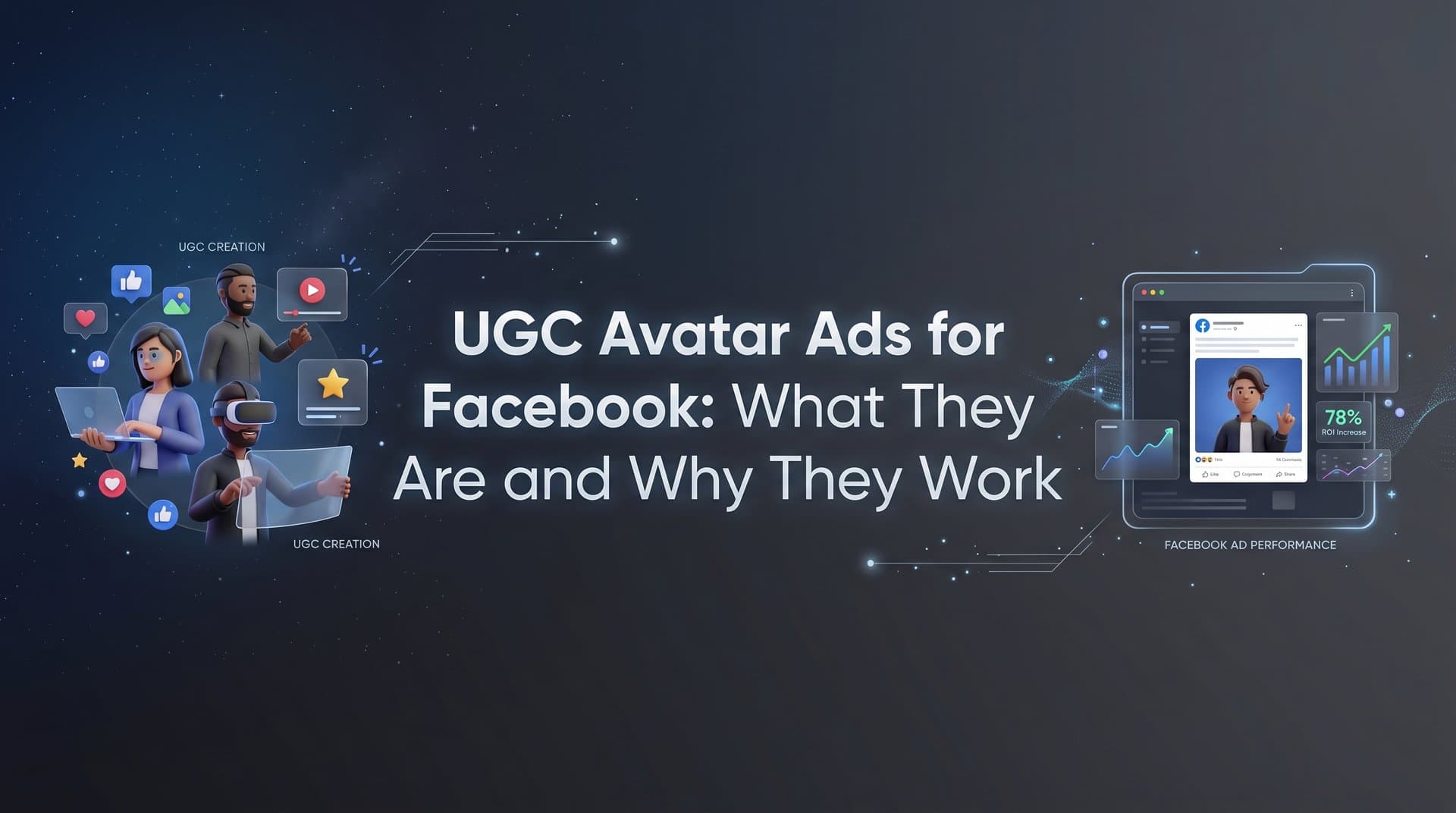
UGC avatar ads are AI-generated video ads designed to replicate the format and feel of creator-made content. At their core, they use a realistic digital avatar, a synthetic human presenter, to deliver a script directly to camera. The framing is casual, the delivery is conversational, and the visual style mirrors what you'd expect to see from an organic creator post rather than a brand commercial.
The technology behind them combines a few components working together. AI avatar systems generate a realistic human presenter that can be customized in appearance, including factors like age, style, and presentation tone. Text-to-speech synthesis converts a written script into natural-sounding spoken audio that syncs with the avatar's mouth and facial expressions. The result is a video that looks and sounds like a person recorded it, even though no one was ever on camera.
This is different from what most people think of when they hear "AI video." It's not animated graphics or motion design. It's not stock footage with a voiceover layered on top. It's a photorealistic presenter delivering your message in the same direct-to-camera format that defines high-performing UGC content. The distinction matters because the format itself is a big part of why UGC works. People respond to seeing a face and hearing a voice. Avatar ads preserve that dynamic while removing the production dependency.
It's also worth distinguishing UGC avatar ads from traditional video ads in terms of production logic. A traditional video ad is built around a fixed shoot: one concept, one execution, one outcome. If it doesn't perform, you go back to production. UGC avatar ads are built around variation and iteration. Because the "production" is generative, you can produce multiple scripts, multiple avatar styles, and multiple creative angles in the same time it would take to plan a single shoot.
The script carries most of the persuasive weight in this format. Since the visual presentation is relatively consistent across avatar variations, the spoken word becomes the primary variable. A strong hook in the first three seconds, a clear value proposition, and a direct call to action are the building blocks of a high-performing avatar ad script. The technology handles the delivery; your job is to give it something worth saying. AI copywriting for Facebook ads can help you develop and refine those scripts faster than starting from scratch.
Avatar selection also plays a role in performance. Matching the presenter style to your target audience, whether that means age, presentation energy, or visual tone, helps the ad feel relevant rather than generic. The best UGC avatar ads don't feel like AI-generated content. They feel like someone who looks like your customer is talking to your customer.
Why UGC Avatar Ads Perform on Facebook and Instagram
The core performance advantage of UGC avatar ads comes down to one word: native. Content that looks like it belongs in the feed gets more attention than content that looks like it was placed there. When an avatar ad matches the visual language of organic creator content, it reduces the immediate "this is an ad" signal that causes users to scroll past.
Ad fatigue is a real problem on Facebook and Instagram. Audiences see the same brands running the same creative for weeks at a time, and performance degrades as a result. Fresh creative is one of the most reliable antidotes to fatigue, and UGC avatar ads make it practical to keep your creative library rotating. Instead of waiting weeks for new video content, you can generate new variations quickly and keep the feed experience feeling fresh for your audience. If your Facebook ads are not performing well, stale creative is often one of the first culprits to investigate.
The testing advantage is equally significant. Facebook's ad auction rewards advertisers who identify winning creatives quickly and concentrate budget on them. The faster you can test, the faster you can find what resonates. Traditional video production limits how many creative concepts you can test in a given period. UGC avatar ads remove that constraint. A team can generate dozens of script and avatar variations in the time it would take to coordinate a single creator shoot, which means more data, faster learning, and better allocation of ad spend.
Audience alignment is another dimension where avatar ads create real leverage. Different audience segments respond to different tones, messaging angles, and presenter styles. With traditional production, creating tailored versions of a video for different segments is expensive and time-consuming. With AI-generated avatar ads, you can produce audience-specific variations without reshooting anything. A younger audience might respond better to a casual, energetic delivery. An older, higher-intent audience might prefer a more measured, informative tone. Avatar ads let you serve both without doubling your production budget.
It's worth being clear that avatar ads work best as part of a diverse creative mix, not as a replacement for every other format. Image ads, standard video, and other creative types each have their place in a well-structured campaign. The value of UGC avatar ads is that they fill a specific gap: the authentic, person-to-camera video format that drives strong engagement, produced at a volume and speed that traditional methods can't match.
How to Build UGC Avatar Ads Without a Production Team
The production workflow for UGC avatar ads has become significantly more accessible with AI-powered platforms. The general process starts with a brief or product URL. From that input, AI can generate a script that captures the key value propositions of the product in a conversational, direct-to-camera format. You then select an avatar style that fits your audience and brand context, refine the script using chat-based editing if needed, and output a ready-to-use video creative.
That entire sequence, from brief to finished creative, can happen in minutes rather than weeks. There's no coordination with creators, no waiting on revisions, no back-and-forth over licensing. The creative exists when you need it, in the format you need it, ready to go into a campaign.
Script refinement is where most of the creative judgment happens. AI can generate a strong starting point, but the best-performing avatar ads usually involve some iteration on the hook, the value proposition framing, and the call to action. Chat-based editing tools let you adjust tone, rewrite specific lines, or test different angles without starting over from scratch. Think of it as having a creative collaborator who executes instantly rather than a production team that needs days to turn around a revision.
Pairing UGC avatar ads with other creative formats inside the same campaign is a smart structural move. Image ads are fast to produce and highly testable at the headline and visual level. Standard video ads can carry more complex messaging. UGC avatar ads fill the authentic, conversational video slot. Running all three formats together gives the algorithm more material to work with and gives you more data to learn from. A robust Facebook ads creative management platform makes it easier to organize and deploy this kind of multi-format strategy.
AdStellar's AI Creative Hub handles this entire production workflow in one place. You can generate UGC avatar ads from a product URL, select avatar styles, refine scripts with chat-based editing, and output creatives ready to launch to Meta, all without designers, video editors, or actors. The platform also lets you clone competitor ad styles directly from the Meta Ad Library, so you can study what's working in your category and build variations that match those proven formats. For teams that need to move quickly across multiple products or client accounts, having creative generation and campaign management in a single platform removes a significant amount of operational friction.
Launching and Testing UGC Avatar Ads at Scale
Generating great UGC avatar ads is only half the equation. How you launch and test them determines whether that creative investment actually translates into performance data you can act on.
Bulk launching is the strategy that makes scale testing practical. Instead of launching one ad at a time, you mix multiple UGC avatar creatives with different headlines, audience segments, and ad copy variations to generate a large set of ad combinations. AdStellar's Bulk Ad Launch feature handles this automatically, generating every combination and pushing them to Meta in minutes rather than hours. The result is a much larger test surface, which means faster identification of winning combinations and better budget allocation from the start. Understanding how to launch Facebook ads at scale is essential for getting the most out of this approach.
Once your ads are running, the next priority is reading performance data at the creative level. Aggregate campaign metrics tell you whether your spend is working, but they don't tell you which specific avatar script, headline, or audience combination is driving results. AI Insights leaderboards rank your creatives, headlines, copy, and audiences by real metrics like ROAS, CPA, and CTR. You set your target goals and the AI scores everything against those benchmarks, so you can see at a glance which avatar ads are winning and which ones to cut.
Winners Hub takes that a step further by collecting your best-performing creatives, headlines, and audiences in one place with full performance data attached. When you're building your next campaign, you're not starting from zero. You're pulling from a library of proven elements and combining them with new variations. That compounding effect is one of the biggest advantages of a systematic testing approach over ad-hoc creative production.
There are a few common mistakes worth avoiding. Running too few variations is the most frequent one. With UGC avatar ads, the production cost of generating more variations is low, so there's no good reason to limit yourself to two or three scripts. More variations mean more data and a higher chance of finding a breakout creative. Neglecting script quality is the other common pitfall. The avatar handles the visual delivery, but the words are still doing the persuasive work. A weak hook or a vague value proposition will underperform regardless of how good the avatar looks. Finally, make sure your creative performance data connects back to attribution. Integrating with an attribution tool like Cometly helps you understand which avatar ads are driving actual conversions, not just clicks.
Putting It All Together: From Avatar Ad to Winning Campaign
The full loop looks like this: generate UGC avatar creatives with AI, launch them at scale with varied headlines and audiences, surface winners using performance data and leaderboard rankings, and feed those insights back into the next creative cycle. Each iteration makes the system smarter because you're building on real performance data rather than starting fresh every time.
This approach benefits a few types of advertisers in particular. DTC brands running high-volume campaigns need a steady stream of fresh creative to avoid ad fatigue and keep testing cycles moving. Agencies managing multiple client accounts need to produce quality creative at volume without proportionally increasing headcount. Performance marketers focused on ROAS and CPA need the kind of creative testing infrastructure that surfaces winners quickly and eliminates waste. UGC avatar ads, paired with a systematic launch and testing workflow, address all three needs.
The broader point is that UGC avatar ads are not a shortcut around quality. They're a smarter production model that lets you meet Facebook's demand for authentic, person-to-camera content at a pace and scale that traditional methods simply can't match. The creative quality still depends on the script, the avatar selection, and the strategic thinking behind the campaign. What changes is how quickly and affordably you can produce, test, and iterate.
If you're ready to see how this works in practice, Start Free Trial With AdStellar and generate your first UGC avatar ads directly inside the platform. You can build creatives from a product URL, launch them to Meta with AI-optimized audiences and copy, and start surfacing winners within days, not weeks. The 7-day free trial gives you full access to the AI Creative Hub, Bulk Ad Launch, AI Insights, and Winners Hub so you can experience the full workflow before committing.