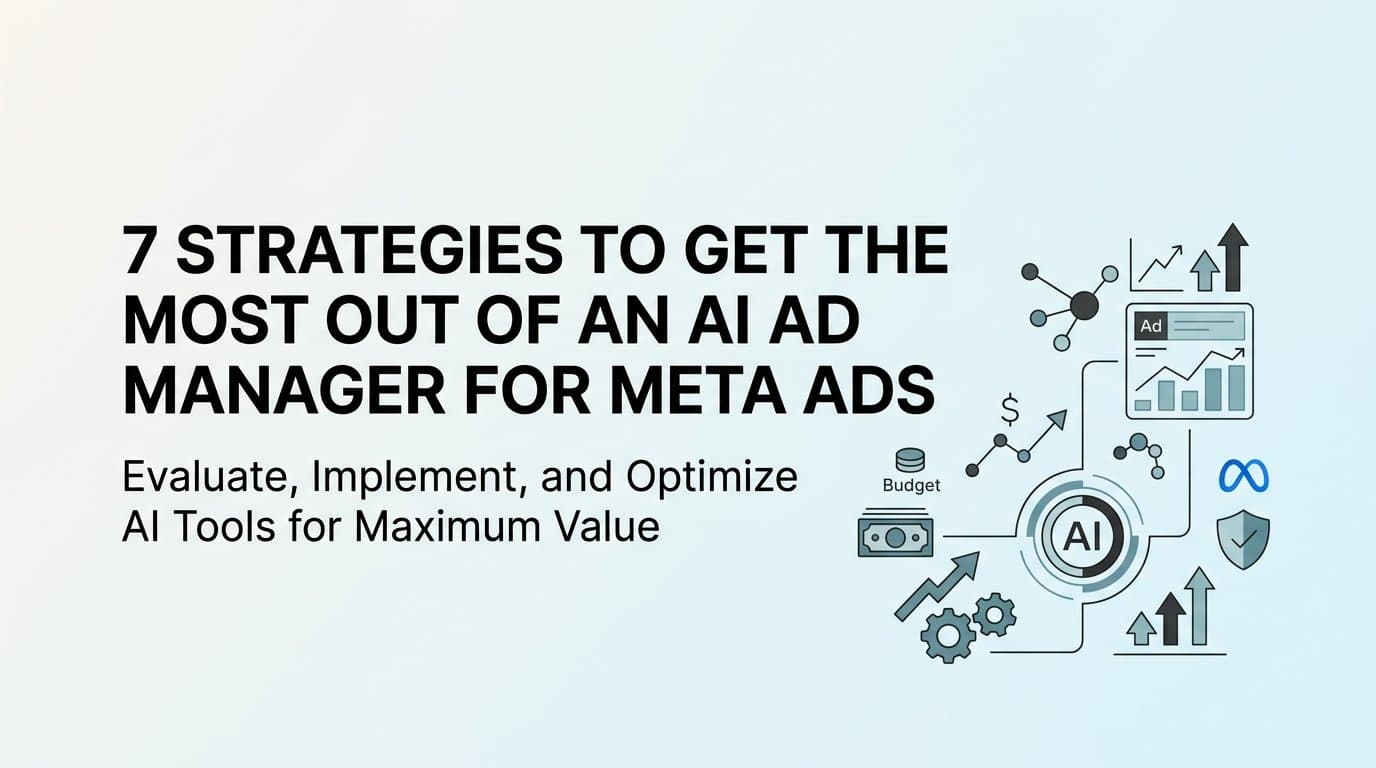
Running Meta ads without the right system in place is exhausting. You are toggling between Ads Manager, spreadsheets, creative briefs, and performance reports, all while trying to make fast decisions with incomplete information. AI ad managers promise to change that, but not every platform delivers on that promise equally.
The question most marketers are really asking is not just what is the best AI ad manager for Meta ads, but what does a great one actually do, and how do you use it to its full potential? If you are newer to the paid media world, it helps to understand the broader context of performance marketing before diving into the tactical layer.
This article breaks down the strategies that separate teams who get real results from AI-powered Meta advertising from those who just add another tool to their stack. Whether you are a solo media buyer or managing campaigns for multiple clients, these approaches will help you evaluate, implement, and extract maximum value from an AI ad manager. From creative generation to budget optimization to scaling winners, each strategy addresses a specific gap that traditional manual campaign management leaves open.
1. Use AI to Generate and Test Creatives at Scale
The Challenge It Solves
Creative is the biggest performance variable in Meta ads. Industry practitioners and Meta's own marketing science guidance consistently emphasize that the creative asset accounts for a significant portion of campaign outcome variance. Yet most teams are bottlenecked by production: waiting on designers, briefing video editors, and iterating slowly when something does not perform.
The result is that you end up running the same few creatives for too long, which leads directly to creative fatigue. Understanding when to change ad creative is critical, but knowing when to change it only helps if you can actually produce replacements quickly.
The Strategy Explained
AI creative generation removes the production bottleneck entirely. Instead of waiting days for a designer to deliver variations, you can generate image ads, video ads, and UGC-style content from a product URL in minutes. The real power comes from combining AI generation with bulk variation testing.
Rather than running a single ad against one alternative, you test many combinations simultaneously. This approach, often called multivariate testing, produces faster learning than sequential A/B tests because you are gathering signal across multiple variables at once. Teams that systematically test creative variations often discover winning angles they would never have prioritized manually.
Implementation Steps
1. Input your product URL or brief into your AI creative tool and generate a range of formats including static images, short-form video, and UGC-style avatar content.
2. Create multiple headline and copy variations to pair with each creative format, so you are testing the full combination, not just the visual.
3. Use bulk launch capabilities to push all variations live simultaneously, then let performance data identify which combinations earn the most attention and conversions.
4. Establish a refresh cadence so that as fatigue signals emerge, new creative variations are already in the pipeline ready to rotate in.
Pro Tips
Do not just test different visuals. Test different angles, hooks, and value propositions. Sometimes the same product image with a completely different headline outperforms an entirely new creative. AI tools that allow chat-based editing let you iterate on a winner without starting from scratch, which accelerates your learning loop considerably.
2. Let AI Build Campaigns Based on Your Historical Performance
The Challenge It Solves
Starting every campaign from scratch ignores the data you already have. Most media buyers carry institutional knowledge in their heads about which audiences respond, which headlines convert, and which creative formats tend to work for their product category. But that knowledge rarely gets systematically applied when building new campaigns, especially under time pressure.
Clean conversion tracking is a prerequisite for any of this to work. If your Meta Pixel is not firing correctly or your attribution is unreliable, the AI is working with flawed inputs and its recommendations will reflect that.
The Strategy Explained
AI campaign builders that analyze your historical account data can rank every creative, headline, and audience segment by actual performance metrics. Instead of building a campaign based on assumptions, you are building it on evidence. The AI surfaces what has worked, explains why it is making each recommendation, and constructs the campaign structure around proven inputs.
This is meaningfully different from using a template or following best practice guidelines. It is your specific account data informing the decisions, which means the recommendations get more accurate over time as the AI processes more campaign history.
Implementation Steps
1. Audit your Meta Pixel setup and confirm conversion events are firing accurately before connecting your account to an AI campaign builder.
2. Allow the AI to ingest your historical campaign data, including past creatives, audience performance, and conversion outcomes.
3. Review the AI's ranked recommendations for creatives, headlines, and audiences before launching, so you understand the rationale behind each decision.
4. Use the AI's transparency layer to build your own understanding of what drives performance in your account, not just to accept outputs blindly.
Pro Tips
The more campaign history you have, the better the AI's recommendations become. If you are starting with a newer account, prioritize running structured tests early so you build a meaningful data foundation. Even a few months of consistent campaign data gives an AI campaign builder significantly more to work with than a blank slate.
3. Automate Budget Shifting Toward What Is Already Converting
The Challenge It Solves
Manual budget reallocation is slow and reactive. By the time you notice that one ad set is outperforming another, review the data, and make a manual adjustment, the performance window may have already shifted. Meta ads automation addresses this by enabling real-time budget decisions that no human can match in speed or consistency.
The risk of manual management is not just missed opportunity. It is also overspending on underperformers while winners are starved of budget simply because you have not had time to look at the dashboard yet.
The Strategy Explained
AI tools that monitor performance signals continuously can detect when an ad set starts converting at a strong rate and shift budget toward it before the momentum fades. At the same time, guardrails prevent runaway spending on a single ad set that might be benefiting from a temporary spike rather than a genuine performance improvement.
Understanding your target ROAS is essential here. When you give the AI a clear performance benchmark, it can make budget decisions that are aligned with your actual profitability goals rather than optimizing for surface-level metrics like click volume.
Implementation Steps
1. Define your target ROAS and CPA thresholds before enabling automated budget shifting, so the AI has clear guardrails to work within.
2. Set minimum and maximum budget limits at the ad set level to prevent any single ad set from consuming a disproportionate share of your daily budget.
3. Review automated budget decisions daily at first to build confidence in the system and catch any patterns that conflict with your broader campaign strategy.
4. Gradually expand the AI's budget authority as you validate that its decisions align with your performance goals over time.
Pro Tips
Automated budget shifting works best when you have enough ad sets running simultaneously to give the AI meaningful choices. If you are only running two or three ad sets, the optimization potential is limited. Use bulk launch capabilities to get more variations live so the AI has a larger pool of options to work with.
4. Build a Systematic Process for Killing Underperformers Early
The Challenge It Solves
Letting losing ads run drains budget and can hurt overall account performance. Many media buyers hold onto underperforming ads longer than they should, either hoping for a turnaround or simply because they have not had time to review the account. If you have ever wondered why your Facebook ads are not converting, the answer is often sitting in your account data, but it requires a systematic review process to surface it.
The Strategy Explained
AI platforms that score ads against your own benchmarks make it easier to pull the plug on underperformers based on data rather than instinct. Instead of manually reviewing every ad set and comparing performance against a mental benchmark, you get a scored view of every creative, headline, and audience ranked against your actual goals.
The key is acting on that data early. Creative fatigue compounds over time, and an ad that is underperforming in its first week rarely recovers. Knowing when to change ad creative is not just about protecting budget, it is about maintaining account health and keeping your overall performance metrics strong.
Implementation Steps
1. Set clear performance thresholds for each metric you care about, including CPA, CTR, and ROAS, so the AI has defined benchmarks to score against.
2. Review AI-generated performance scores at a consistent cadence, whether daily or every few days, and commit to pausing any ad that falls below your minimum threshold.
3. Document why underperformers failed before pausing them, whether it was the audience, the creative angle, or the offer, so you carry that learning into future campaigns.
4. Build a replacement pipeline so that when you pause an underperformer, a new variation is ready to take its place without a gap in coverage.
Pro Tips
Resist the temptation to give underperformers "more time to optimize." Meta's algorithm does need a learning period, but an ad that shows no positive signal after meaningful spend has usually told you what you need to know. Trust your benchmarks over your intuition when the data is clear.
5. Use AI Insights to Understand What Elements Actually Drive Results
The Challenge It Solves
Aggregate campaign data hides the truth. A campaign-level ROAS number tells you whether the overall effort is working, but it does not tell you which specific headline, creative format, or audience segment is responsible for the performance. Without that granularity, you cannot replicate success or diagnose failure at the element level.
The Strategy Explained
Creative leaderboards that break down performance by individual element reveal the specific combinations that move your metrics. When you can see that a particular headline consistently outperforms others across multiple ad sets, or that one creative format drives a lower CPA regardless of audience, you have actionable intelligence rather than just aggregate numbers.
Understanding return on ad spend at the element level, rather than just the campaign level, transforms performance data into a repeatable creative strategy. You stop guessing what to test next and start building on what you know works.
Implementation Steps
1. Set up your AI insights dashboard with your target metrics, including ROAS, CPA, and CTR, so that every element is scored against the outcomes that matter to your business.
2. Review creative leaderboards after each campaign to identify which individual elements, headlines, visuals, and audiences, contributed most to performance.
3. Cross-reference element-level data across multiple campaigns to identify patterns that hold up over time rather than one-off results from a single campaign.
4. Use element-level insights to brief your next round of creative generation, so you are iterating on proven angles rather than starting from zero.
Pro Tips
Look for patterns that cut across campaigns and audiences. If a specific type of headline structure consistently outperforms regardless of the audience it is shown to, that is a signal worth building a creative framework around. Element-level data is most valuable when you look for cross-campaign consistency, not just single-campaign wins.
6. Centralize Your Winners So Every New Campaign Starts Ahead
The Challenge It Solves
Most teams lose institutional knowledge between campaigns. A creative that performed exceptionally well three months ago gets buried in Ads Manager, and the next campaign starts from scratch without any reference to what already worked. This is one of the most common and costly inefficiencies in Meta advertising, and it compounds over time as your team grows or campaigns multiply.
Building a winning ad elements library is the structural solution to this problem. When your best-performing creatives, headlines, and audiences are stored in one place with real performance data attached, every new campaign launch starts with a meaningful head start.
The Strategy Explained
A centralized winners hub creates compounding returns. The first campaign you run with AI might produce five strong performers. The second campaign starts with those five as a foundation and adds more. By the time you are running your tenth campaign, you have a library of validated creative elements, proven audience segments, and high-performing copy that dramatically accelerates the build process.
This is the concept behind a winning ad elements database: a living repository that gets more valuable with every campaign you run. Instead of institutional knowledge living in someone's head or buried in a spreadsheet, it is organized, searchable, and immediately actionable.
Implementation Steps
1. After each campaign, tag your top-performing creatives, headlines, audiences, and copy with their actual performance metrics before archiving anything.
2. Organize your winners hub by performance metric so you can quickly pull the best CPA performers for conversion-focused campaigns or the best CTR performers for awareness objectives.
3. When building a new campaign, start by reviewing your winners library before generating new creative, and use proven elements as the baseline that new variations are tested against.
4. Establish a minimum performance threshold for something to enter the winners hub, so the library maintains quality and does not become a dumping ground for average performers.
Pro Tips
Treat your winners hub as a strategic asset, not just a filing system. The teams that get the most value from it are the ones that actively reference it at the start of every campaign build, not just when they are out of ideas. The goal is to make your historical performance data the starting point for every new campaign, not an afterthought.
7. Evaluate AI Ad Managers on Full-Funnel Capability, Not Just One Feature
The Challenge It Solves
Point solutions that handle only creative or only optimization create integration gaps and data silos. You end up with a creative tool that does not talk to your campaign builder, an optimization platform that does not understand your creative performance, and a reporting dashboard that aggregates data from multiple disconnected sources. Each handoff between tools introduces friction, delays, and the risk of context loss.
Understanding why to use automated ad platforms comes down to this: the value is not in any single feature, it is in the connected workflow that eliminates the gaps between creative, campaign management, and performance analysis.
The Strategy Explained
The best AI ad manager for Meta ads handles creative generation, campaign building, launching, and performance analysis in a single connected environment. When these capabilities share the same data layer, the AI can make decisions that account for the full picture. A creative that performs well in one audience segment informs the campaign builder's next recommendation. Budget decisions are informed by creative-level performance data, not just ad set aggregates.
As of 2026, the AI-powered advertising tool category generally falls into three groups: creative-only tools, optimization-only tools, and full-funnel platforms that handle the entire workflow. Evaluating which category a tool belongs to before committing is one of the most important decisions you will make in your AI ad stack.
Implementation Steps
1. Map your current workflow from creative briefing to campaign launch to performance review and identify every handoff point where data or context is lost between tools.
2. Evaluate AI ad managers against your full workflow map, not just the feature that initially attracted you to the platform.
3. Test whether the platform's performance data feeds back into its creative and campaign recommendations, which is the defining characteristic of a genuinely connected full-funnel system.
4. Prioritize platforms that offer transparency into their AI decisions so you can build understanding alongside automation, rather than becoming dependent on a black box.
Pro Tips
Ask any AI ad manager vendor a simple question: how does creative performance data influence your campaign building recommendations? If the answer is vague or involves manual exports, you are looking at a point solution dressed up as a full-funnel platform. The integration between creative intelligence and campaign decisions is what separates genuinely capable platforms from feature collections.
Putting It All Together
The best AI ad manager for Meta ads is not the one with the longest feature list. It is the one that removes friction across the entire workflow, from generating creatives to launching campaigns to surfacing what is working and feeding those insights back into the next campaign build.
Start with creative scale and historical data learning. Those two strategies alone will change how quickly you find winning combinations. Then layer in automated budget management and a systematic process for cutting underperformers early. Over time, your winners library becomes a strategic asset that makes every new campaign launch faster, smarter, and more grounded in evidence than the one before it.
The compounding effect is real. Teams that build these systems consistently find that their campaigns improve not just from optimization within a single campaign, but from the accumulated intelligence that carries forward from every campaign they have ever run.
AdStellar is built to handle all of this in one place. Generate image ads, video ads, and UGC-style creatives from a product URL. Build and launch full Meta campaigns with AI-optimized audiences and copy. Let the platform surface your top performers with real-time leaderboards. Then reuse your winners instantly with a single click. No designers, no video editors, no guesswork. One platform from creative to conversion.
If you are ready to stop managing ads manually and start scaling with AI, Start Free Trial With AdStellar and be among the first to launch and scale your ad campaigns faster with a platform that automatically builds and tests winning ads based on real performance data.