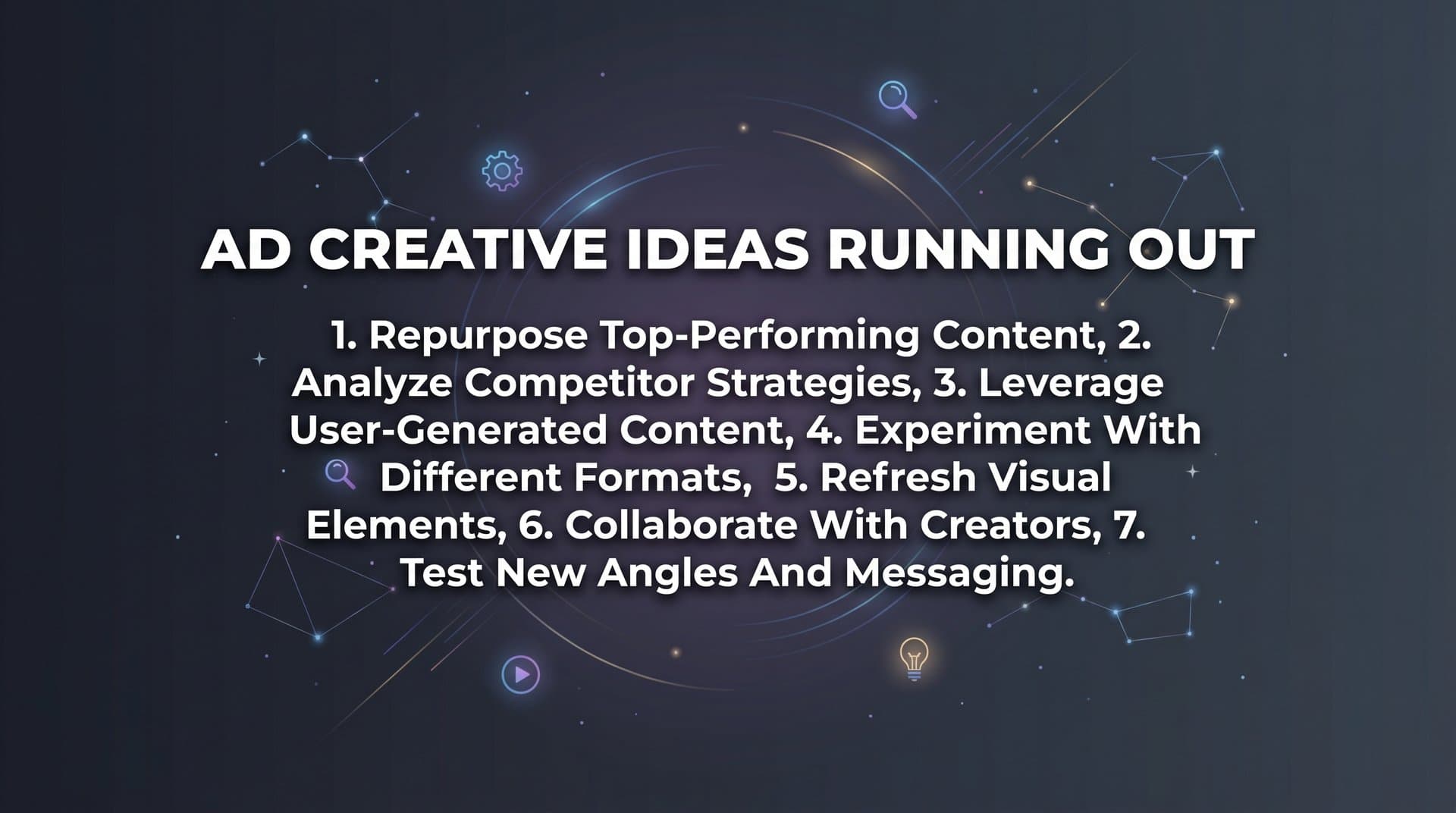
Every performance marketer hits the wall eventually. You have been running Meta campaigns for weeks or months, cycling through the same hooks, the same imagery, the same angles, and the results are flatlining.
Creative fatigue is real. When your ad creative ideas are running out, it does not just stall your brainstorming sessions. It tanks your ROAS, inflates your CPAs, and leaves your campaigns bleeding budget on stale assets.
The problem is rarely a lack of effort. Most marketers are working hard. The problem is a lack of systems for generating fresh creative at scale. When you rely solely on manual brainstorming, designer availability, or your own inspiration, the pipeline dries up fast.
This guide breaks down seven actionable strategies to refill your creative pipeline, from mining competitor insights and leveraging AI generation tools to building systematic testing frameworks that keep your ad account flush with fresh, high-performing creatives. Whether you manage ads for a single brand or run campaigns across dozens of clients, these approaches will help you break through creative blocks and keep your Meta campaigns performing.
1. Mine the Meta Ad Library for Competitor Inspiration
The Challenge It Solves
Starting from a blank canvas is one of the most draining parts of ad creative work. When you have no external reference points, brainstorming becomes circular. You end up revisiting the same angles, the same visual styles, and the same hooks you have already exhausted. The Meta Ad Library removes that blank canvas problem entirely.
The Strategy Explained
The Meta Ad Library is a free, publicly accessible tool that lets you view every active ad running on Meta platforms from any advertiser. Think of it as a window into your competitors' creative strategies, updated in real time.
The goal is not to copy. It is to identify patterns. When multiple competitors in your niche are running the same visual format or leading with a similar hook, that is a signal the market is responding to something. Your job is to understand what is working and then build your own version that fits your brand and offer.
Look for patterns in how long ads have been running. Ads that have stayed active for weeks or months are almost always profitable, because no advertiser keeps paying for creative that does not convert. Building a winning creative library from these observations gives you a powerful reference point for future campaigns.
Implementation Steps
1. Search the Meta Ad Library for your top three to five competitors and filter by active ads only.
2. Screenshot or save ads that have clearly been running for an extended period, noting their hook style, visual format, and call to action.
3. Identify recurring patterns across multiple advertisers, such as problem-focused hooks, before-and-after formats, or testimonial-style layouts.
4. Build a swipe file organized by pattern type and use these as frameworks for your own creative briefs.
Pro Tips
Do not limit your research to direct competitors. Search adjacent categories and industries that share your target audience. A fitness supplement brand can learn a lot from how wellness apps or meal delivery services are framing their creative. Fresh angles often come from outside your immediate niche.
2. Remix Your Own Winners Instead of Starting From Scratch
The Challenge It Solves
When creative ideas run dry, most marketers instinctively reach outward for new inspiration. But one of the richest sources of new creative is already sitting inside your ad account. Your top performers contain proven signals about what your audience responds to, and most teams fail to fully exploit them before moving on.
The Strategy Explained
Remixing winners means systematically deconstructing your best-performing ads into their component parts and then recombining those parts in new ways. A winning ad is not a single indivisible unit. It is a combination of a hook, a visual format, a headline, a body copy angle, and a call to action. Each of those elements can be isolated, tested independently, and combined with new variations.
This approach dramatically reduces creative risk. Instead of betting on entirely new concepts, you are building on a foundation that already has proof of performance. Addressing Facebook ad creative burnout starts with recognizing that iteration often outperforms invention.
Implementation Steps
1. Pull your top ten performing ads from the last 90 days and rank them by your primary KPI, whether that is ROAS, CPA, or CTR.
2. Break each ad into its individual elements: hook (first three seconds or first line), visual style, headline, body copy angle, and CTA.
3. Identify which elements appear consistently across your top performers. These are your proven building blocks.
4. Create a variation matrix: keep one element constant and change one other variable at a time to isolate what is actually driving performance.
Pro Tips
Tools like AdStellar's Winners Hub make this process systematic by surfacing your best-performing creatives, headlines, and audiences in one place with real performance data attached. Instead of manually digging through your ad account, you can see your winners at a glance and build new campaigns around them immediately.
3. Expand Into New Creative Formats You Have Not Tested
The Challenge It Solves
Static image dependency is one of the most common reasons creative fatigue sets in quickly. When your entire creative library consists of a handful of image formats, your audience's feed experience becomes predictable. Predictable means ignored. Expanding your format library is one of the fastest ways to re-engage an audience that has tuned out your ads.
The Strategy Explained
Different creative formats activate different psychological responses and perform differently depending on placement, audience, and objective. Video ads can demonstrate product use cases and build emotional connection in ways static images cannot. UGC-style content mimics organic posts, which reduces the "this is an ad" resistance that causes scroll-past behavior. Carousel formats let you tell a sequential story or showcase multiple product angles within a single ad unit.
If you have been running primarily static images, adding even one new format to your testing rotation can meaningfully refresh your creative pipeline without requiring entirely new concepts. Understanding the role of creatives in digital marketing helps you appreciate why format diversity matters so much for sustained performance.
Implementation Steps
1. Audit your current creative library and categorize every ad by format: static image, video, carousel, or UGC-style.
2. Identify the format you have tested least and prioritize it for your next creative sprint.
3. Take a proven concept from your existing winners and rebuild it in the new format rather than starting with a new angle simultaneously.
4. Run the new format against your existing best performer to measure the lift in engagement or conversion metrics.
Pro Tips
UGC-style avatar ads have become a practical option for brands that want authentic-feeling content without coordinating with creators. Platforms like AdStellar can generate UGC-style video creatives directly from a product URL, removing the production bottleneck entirely. No actors, no video editors, no scheduling delays.
4. Build a Swipe File System That Feeds Ideas Continuously
The Challenge It Solves
The problem with most creative inspiration processes is that they are reactive. You feel stuck, you go looking for ideas, you spend an hour scrolling through ads, and you walk away with a vague sense of direction but nothing concrete. A swipe file system flips this dynamic by making inspiration collection a continuous background habit rather than an emergency response.
The Strategy Explained
A swipe file is a curated collection of ads, hooks, visuals, and copy angles that you find compelling or effective, organized in a way that makes them searchable and useful when you need them. The key word is organized. A folder of random screenshots is not a swipe file. A structured library tagged by hook type, emotional angle, visual style, and industry is a swipe file.
When your ad creative ideas are running out, a well-maintained swipe file means you never start from zero. You start from a library of proven patterns that you can adapt, remix, and build on. Pairing this approach with the right creative management tools makes the entire process even more efficient.
Implementation Steps
1. Choose a tool for organizing your swipe file, such as Notion, Airtable, or a dedicated folder system with consistent naming conventions.
2. Define your tagging categories before you start collecting: hook type (problem, curiosity, social proof), visual style (lifestyle, product-only, text-heavy), emotional angle (fear, aspiration, humor), and industry.
3. Set a recurring habit of adding to your swipe file, even just five to ten minutes a few times per week while browsing your own feed or the Meta Ad Library.
4. Review your swipe file at the start of every creative sprint and pull three to five references that align with your current campaign goals.
Pro Tips
Do not limit your swipe file to ads. Strong direct response copywriting, compelling organic social posts, and even print advertising can all inform your creative direction. The underlying principles of what makes someone stop scrolling and take action translate across formats and channels.
5. Use AI to Generate Creatives at Scale
The Challenge It Solves
Even with great inspiration sources and a solid swipe file, manual creative production is a bottleneck. A designer can produce a limited number of variations per day. A copywriter can draft a finite number of hooks per week. When you need to test dozens of creative combinations to find winners, manual production simply cannot keep pace with what effective Meta advertising requires in 2026.
The Strategy Explained
AI creative generation tools can produce image ads, video ads, and UGC-style content from a product URL or a brief description in a fraction of the time manual production requires. This is not about replacing creative judgment. Exploring the best ad creative AI strategies shows how these tools remove the production bottleneck so your creative judgment can be applied at scale.
The real power of AI generation is volume with variation. Instead of producing three creatives and hoping one performs, you can produce thirty variations across different hooks, visual styles, and formats, test them simultaneously, and let performance data tell you which direction to scale. This is how creative velocity becomes a competitive advantage.
Implementation Steps
1. Start with a product URL or a clear description of your offer and let an AI creative tool generate an initial batch of image and video ad options.
2. Use chat-based editing to refine the outputs that show the most promise, adjusting visual style, copy angle, or format without starting over.
3. Clone competitor ads from the Meta Ad Library directly into your creative workflow to generate brand-adapted versions of proven frameworks.
4. Build out a batch of variations across at least three different hook types and two different visual formats before launching your next campaign.
Pro Tips
AdStellar's AI Creative Hub lets you generate image ads, video ads, and UGC-style avatar content from a product URL, clone competitor ads directly from the Meta Ad Library, and refine any output through chat-based editing. The entire creative generation process happens inside the same platform where you launch and track campaigns, which eliminates the handoff friction that slows most teams down.
6. Adopt a Structured Creative Testing Framework
The Challenge It Solves
Running lots of creative variations without a structured testing framework is like throwing darts in the dark. You might land on a winner occasionally, but you will not understand why it won, which means you cannot reliably replicate the result. Unstructured testing wastes budget and produces insights that are difficult to act on.
The Strategy Explained
A structured creative testing framework means testing one variable at a time so you can isolate what is actually driving performance differences. Building a solid Meta ads creative testing strategy ensures that when you change only the hook while keeping everything else constant, you learn something definitive.
The framework also requires a way to track and rank results systematically. Performance leaderboards that rank creatives, headlines, and audiences by real metrics like ROAS, CPA, and CTR give you a clear picture of what is working and what to cut. Over time, the patterns that emerge from structured testing become a proprietary playbook for your brand.
Implementation Steps
1. Define your primary testing variable for each creative sprint: hook, visual format, headline, or call to action. Test one at a time.
2. Set a minimum spend threshold before making decisions on any creative variation, so you are not cutting winners early due to insufficient data.
3. Use a leaderboard system to rank all active creatives by your primary KPI so top performers are immediately visible.
4. Document what you learn from each test in a running creative insights log that informs future briefs and hypotheses.
Pro Tips
AdStellar's AI Insights feature automatically ranks your creatives, headlines, copy, audiences, and landing pages by real metrics. You set your target goals and the AI scores everything against your benchmarks, so spotting winners and understanding which elements to carry forward becomes a matter of reading a leaderboard rather than manually analyzing spreadsheets.
7. Let AI Analyze Historical Data to Inform New Creative Directions
The Challenge It Solves
Most marketers have more performance data sitting in their ad accounts than they know what to do with. Manually reviewing months of campaign history to find patterns in what worked and why is time-consuming and prone to confirmation bias. The result is that valuable insights get buried and new creative directions get chosen based on gut feel rather than evidence.
The Strategy Explained
AI-powered campaign analysis can surface patterns in historical performance data that would take hours to find manually. Which headline structures consistently drove higher CTR? Which audience segments responded best to which visual styles? Leveraging Meta ads creative automation helps answer these questions by analyzing your data systematically rather than relying on manual review.
When AI analyzes your past campaigns and ranks every creative element by performance, it generates data-informed hypotheses for new creative directions. Instead of guessing what to test next, you have a prioritized list of angles that your own account history suggests are worth exploring. This turns your ad account into a continuously improving creative intelligence engine.
Implementation Steps
1. Pull at least 90 days of campaign data and segment performance by creative element: hook type, visual format, headline structure, and audience.
2. Identify the top-performing combination of elements and use it as your control creative for the next testing cycle.
3. Use AI analysis tools to generate hypotheses about underexplored angles based on partial performance signals in your data.
4. Brief new creative variations around those hypotheses and track whether the AI's predictions hold up in live testing.
Pro Tips
AdStellar's AI Campaign Builder analyzes your past campaigns, ranks every creative, headline, and audience by performance, and builds complete Meta Ad campaigns in minutes. Every decision comes with a full explanation so you understand the reasoning behind each recommendation. The system gets smarter with every campaign you run, which means the longer you use it, the more precise its creative direction becomes.
Putting It All Together
When your ad creative ideas are running out, the solution is not to push harder with the same approach. It is to build systems that make creative generation repeatable, scalable, and data-informed.
Start with the strategies that give you the fastest return. Mine the Meta Ad Library for competitive patterns and remix your existing winners before investing in entirely new concepts. These two approaches alone can refill your creative pipeline without requiring significant time or budget.
Then build the infrastructure that sustains your pipeline long term. A well-organized swipe file means you never start from zero. A structured testing framework means every dollar you spend on creative generates learnable insights. AI generation tools mean your production capacity is no longer the bottleneck.
Finally, close the loop with data. Let AI analyze what has already worked in your account and use those findings to inform where you go next. The marketers who consistently produce winning Meta ads are not more creative than you. They have better systems.
Platforms like AdStellar bring the entire workflow together, from AI creative generation to bulk launching to performance insights, so you spend less time stuck and more time scaling what works. Start Free Trial With AdStellar and see how quickly your creative pipeline refills when you have the right tools behind it.