Most performance marketers have been in this position: you run a campaign with three or four creatives, one clearly outperforms the rest, and you have absolutely no idea why. Was it the headline? The visual? The audience? The offer framing? You make your best guess, carry that assumption into the next campaign, and the cycle continues. This is not a skill problem. It is a data problem.
The tools most marketers use are built for execution. They help you build ads, set budgets, and track impressions. What they do not do is tell you which specific element of a creative drove a result. That gap between making ads and understanding them is exactly where creative performance stalls, budgets get wasted, and teams end up rebuilding from scratch every single time.
Ad creative intelligence is the answer to that gap. It is a category of marketing technology focused not just on running ads but on analyzing, scoring, and learning from creative performance at a granular level. Rather than treating an ad as a single indivisible unit, an ad creative intelligence platform breaks it down into its component parts and measures each one against your actual goals. The result is a compounding knowledge base that makes every campaign smarter than the last.
This article breaks down what these platforms actually do, how the intelligence layer works, and why Meta advertisers in particular have the most to gain from getting this right.
The Gap Between Making Ads and Understanding Them
Here is the core problem with most ad tools: they are excellent at telling you what happened and nearly useless at telling you why. You can see that one ad generated a 3.2x ROAS while another generated 1.1x. But the data stops there. Both ads ran to similar audiences, had similar budgets, and were live at the same time. The difference was somewhere in the creative itself, and most platforms have no mechanism to tell you where.
This distinction matters enormously. Raw performance data, clicks, impressions, cost per result, ROAS, tells you the outcome. Creative intelligence tells you the cause. Knowing that your campaign hit a 2.8x ROAS is useful. Knowing that every ad featuring a direct benefit headline outperformed every curiosity-style headline by a consistent margin across three separate campaigns is actionable. One gives you a number. The other gives you a principle you can build on.
The absence of this insight has historically pushed creative decisions into the realm of opinion. A designer prefers a certain visual style. A copywriter believes in a particular tone. A media buyer has a gut feeling about a specific format. These instincts are not worthless, but they are expensive to rely on exclusively. When every new campaign requires rediscovering what works through trial and error, you are paying for the same education repeatedly.
The trial-and-error cycle is particularly costly on Meta, where the ad auction rewards creative relevance and engagement. Small differences in how an ad is constructed can produce meaningfully different auction outcomes. A headline change, a shift from a static image to a UGC-style video, a different value proposition in the first line of copy: any of these can move performance in ways that are invisible without a system designed to track element-level impact. The Facebook ad intelligence tools that surface these patterns are what separate systematic learners from perpetual guessers.
The marketers who consistently outperform on Meta are not necessarily the ones with the largest budgets or the most creative talent. They are the ones who have built a system for learning faster than their competition. That system starts with understanding what is actually driving results, not just whether results happened.
What an Ad Creative Intelligence Platform Actually Does
The term gets used loosely, so it is worth being precise. An ad creative intelligence platform is a system that analyzes creative performance at the element level, scores individual components against defined goals, and uses that analysis to inform and improve future creative decisions. The emphasis is on granularity and learning, not just reporting.
The foundation of any intelligence platform is data ingestion. The platform pulls in historical campaign data, not just aggregate metrics but performance broken down by creative, headline, copy variation, audience segment, and landing page. This is the raw material that makes intelligence possible. Without sufficient historical data to analyze, the platform has nothing to learn from.
On top of that data layer sits the scoring and ranking engine. Rather than applying a generic performance standard, a well-built platform scores each creative element against the specific goals the marketer has defined. If your benchmark is CPA, every headline, visual, and audience combination gets evaluated through that lens. If your goal is CTR for a top-of-funnel awareness campaign, the scoring model adjusts accordingly. This goal-based approach ensures that the intelligence being generated is relevant to your actual business objectives, not a universal average.
The most sophisticated layer is where AI agents move beyond reporting into active decision-making. Rather than simply surfacing what worked in the past, these agents analyze patterns across campaigns and use that analysis to build new campaigns. They identify which creative elements, audience pairings, and copy structures have the highest probability of success given your goals, and they construct campaigns around those insights. Every new campaign benefits from everything the platform has learned across every previous campaign. This is precisely what distinguishes a true ad campaign intelligence platform from a standard reporting dashboard.
This is the compounding advantage that separates an intelligence platform from a dashboard. A dashboard shows you what happened. An intelligence platform applies what happened to what comes next. The AI gets smarter with every campaign it processes, which means the platform becomes more valuable the longer you use it. Early campaigns generate the training data. Later campaigns benefit from the accumulated knowledge.
The practical output of this process is a set of actionable recommendations with full transparency into the reasoning behind them. Not just "use this headline" but "use this headline because it has outperformed alternatives by a consistent margin across these specific audience segments at this goal benchmark." That transparency is what allows marketers to build genuine strategic understanding rather than simply following algorithmic instructions they cannot interrogate.
The Five Layers of Creative Intelligence
A true ad creative intelligence platform does not evaluate ads as single units. It evaluates the distinct dimensions that combine to make an ad work. There are five layers where this analysis matters most.
Creative Assets: This is the visual layer, covering static images, video formats, and UGC-style content. Each format performs differently depending on placement, audience, and objective. UGC-style content, in particular, has become a dominant format in Meta advertising because it blends naturally into native feed environments and tends to generate stronger engagement signals. An intelligence platform tracks which visual formats are generating results for your specific product and audience, rather than relying on general industry assumptions about what works.
Headlines: The headline is often the highest-leverage text element in a Meta ad. Small changes in framing, benefit emphasis, or tone can produce significant differences in performance. An intelligence platform tracks headline performance across campaigns, identifies patterns in what resonates with specific audience segments, and surfaces those patterns as actionable guidance for future creative development. Understanding these dynamics is one of the core top features of AI ad platforms that separate them from basic analytics tools.
Ad Copy: The body copy supports the headline and carries the conversion argument. Intelligence analysis at the copy level looks at factors like length, structure, offer framing, and call-to-action language. Patterns that emerge here often reveal something meaningful about how your audience processes information and what motivates them to act.
Audience Segments: Creative performance is never fully separable from audience context. A visual style that resonates with one segment may fall flat with another. An intelligence platform tracks the interaction between creative elements and audience characteristics, identifying which combinations produce the best outcomes. This audience-creative pairing insight is something that aggregate ROAS data completely obscures.
Landing Pages: The ad is only part of the conversion journey. An intelligence platform that extends its analysis to landing page performance can identify where the post-click experience is reinforcing or undermining the creative's promise. This matters especially when attribution data is integrated directly into the scoring model, allowing the platform to evaluate the full path from impression to conversion rather than stopping at the click.
Goal-based scoring ties these five layers together. Each element gets evaluated against the benchmark you have set, whether that is ROAS, CPA, CTR, or another metric. The result is a leaderboard view that ranks every element by real performance, removing ambiguity from optimization decisions. Instead of asking "which of these creatives should I scale?", you can see exactly which combinations are winning and why, and move forward with confidence rather than intuition.
From Intelligence to Action: How the Creative Loop Works
Understanding creative performance is only useful if it feeds directly back into what you create next. The real power of an ad creative intelligence platform is not in the analysis itself but in the closed loop between analysis and action.
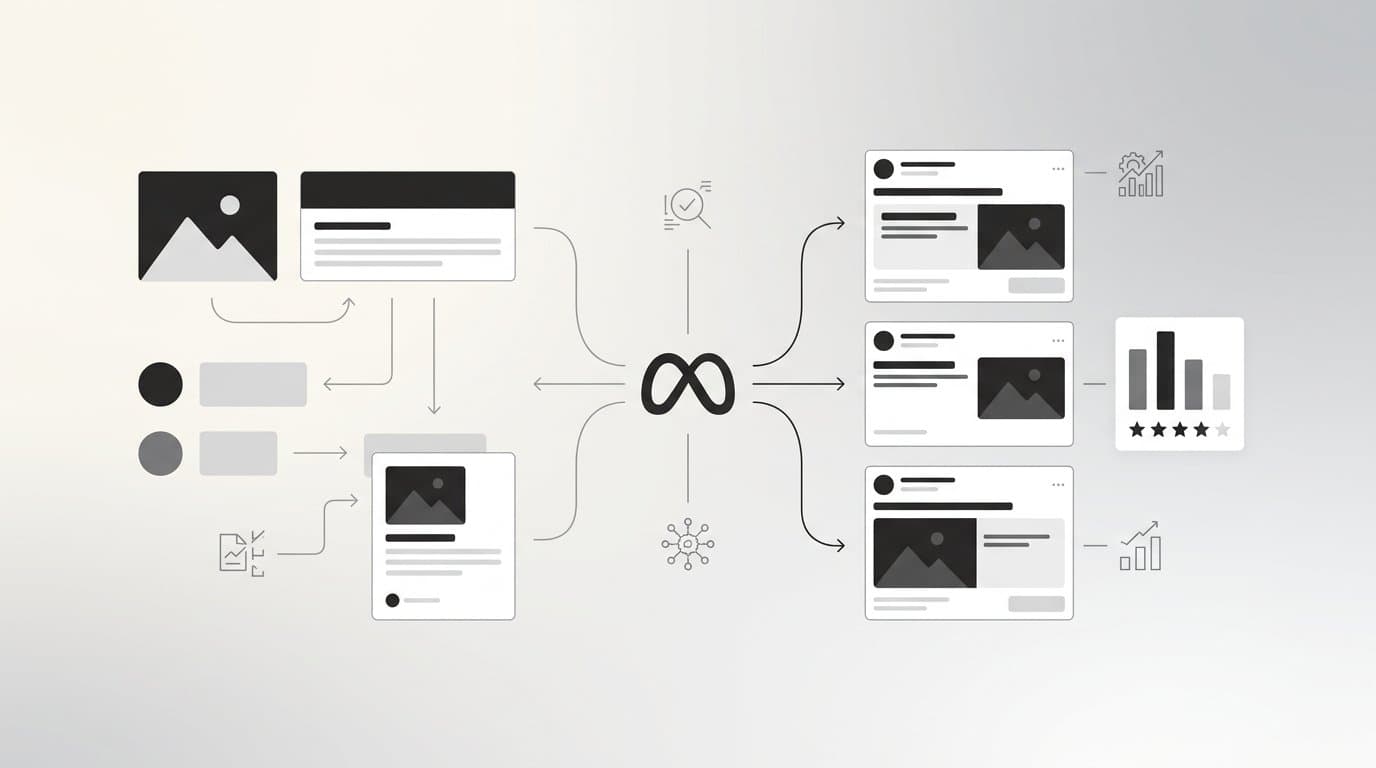
The loop works in four stages. First, you generate creative variations across multiple formats, headlines, copy structures, and audience pairings. Second, you launch those variations at scale, giving the platform enough data points to draw meaningful conclusions. Third, the platform measures performance and identifies which elements are driving results. Fourth, those findings feed directly into the next creative cycle, informing what gets built, what gets tested, and what gets retired.
The volume question is critical here. A platform cannot learn from too few data points. If you are running two creatives with modest budgets, the signal is too weak to produce reliable intelligence. Bulk ad launching solves this problem by making it operationally feasible to test at the volume intelligence requires. The ability to create hundreds of ad variations in minutes, mixing multiple creatives, headlines, audiences, and copy at both the ad set and ad level, means you can generate enough testing surface area for meaningful patterns to emerge without spending weeks on manual setup. This is where a dedicated Facebook ad creative testing platform delivers an advantage that manual workflows simply cannot match.
This is where the creative learning loop accelerates. The faster you can generate variations, launch them, identify winners, and apply those learnings to the next round, the faster your overall account performance compounds. Teams that can complete this cycle in days rather than weeks accumulate a meaningful advantage over time. Their creative knowledge base grows faster, their campaigns improve faster, and their cost per result trends downward as the platform gets better at predicting what will work.
The Winners Hub is the structural component that makes this loop sustainable. Rather than relying on team members to remember which creative performed well three campaigns ago, a Winners Hub maintains a living library of proven creatives, headlines, audiences, and copy. Every element is stored with its actual performance data, so when you are building the next campaign, you can pull directly from what has already been validated. This eliminates the common problem of rediscovering the same insights repeatedly and ensures that institutional creative knowledge is preserved and accessible rather than scattered across spreadsheets and memory.
The practical effect of this loop, when it is working well, is that each campaign starts from a higher baseline than the last. You are not reinventing your creative strategy every time. You are building on it.
Creative Intelligence vs. Standard Ad Automation
It is worth being clear about what creative intelligence is not, because the term "automation" gets applied to very different things in the ad tech space.
Standard ad automation handles execution. It manages scheduling, bidding strategies, placement optimization, and budget pacing. These are valuable capabilities, but they operate at the delivery layer. They answer the question of how to run your ads efficiently. They do not answer the question of what to create or why a particular creative approach is likely to succeed.
Creative intelligence operates at the strategic layer. It focuses on the content of what you are running, not just the mechanics of how it is delivered. The distinction matters because even perfectly optimized delivery cannot rescue a creative strategy built on guesswork. You can have flawless bidding and targeting and still waste significant budget on creatives that were never going to resonate with your audience. Understanding why automated ad platforms fall short without a creative intelligence layer is key to making the right infrastructure decisions.
The transparency requirement is another meaningful differentiator. Standard automation often functions as a black box. It makes decisions, but it does not explain them. A true creative intelligence platform shows its reasoning for every recommendation. When the platform suggests leading with a specific visual format or headline structure, it explains why, citing the performance patterns that support that recommendation. This transparency allows marketers to build genuine strategic understanding rather than becoming dependent on outputs they cannot interrogate or apply in other contexts.
The full-stack advantage extends this further. When creative generation, campaign building, and performance intelligence all exist within a single platform, the data flows cleanly between each stage. There is no manual export from an analytics tool, no interpretation step between insight and action, no version control problem when applying learnings to new campaigns. Platforms that combine these capabilities eliminate the data fragmentation that occurs when teams stitch together multiple disconnected tools, each with its own data model and reporting logic. A thorough AI ad platform vs traditional tools comparison makes this structural advantage immediately clear.
This integration is not just a convenience. It is a structural advantage. Every insight generated by the intelligence layer is immediately available to the creative generation layer. Every creative generated by the AI feeds directly into the campaign builder. The system compounds because the components reinforce each other.
Putting Creative Intelligence to Work for Meta Campaigns
Meta campaigns are a particularly strong fit for creative intelligence because of how Meta's ad auction actually works. Meta's algorithm rewards relevance and engagement at the creative level. Ads that generate strong early engagement signals get more favorable delivery. This means creative quality is not just a marketing consideration; it directly affects your cost per result at the auction level. Small creative differences can produce meaningfully different outcomes, which is exactly the environment where element-level intelligence creates the most value.
Meta also rewards creative volume and variation. The algorithm needs enough creative diversity to find the right combination for each user at the right moment. Running two or three creatives and hoping one sticks is a strategy that leaves significant performance on the table. The practical workflow for Meta campaigns built around creative intelligence starts with generating multiple creative formats from a single input, whether that is a product URL or a competitor ad identified in the Meta Ad Library. Teams using a Meta ads platform with AI capabilities can compress this ideation-to-launch timeline dramatically.
From a product URL, an AI creative system can generate image ads, video ads, and UGC-style avatar content, each representing a different format hypothesis. Cloning competitor ads from the Meta Ad Library accelerates the ideation phase by letting you analyze what is already working in your competitive landscape and iterate on those formats rather than starting from a blank canvas. Once you have a set of creative variations across formats and angles, bulk launching creates every combination of creative, headline, copy, and audience and sends them live to Meta in minutes rather than hours.
Attribution tracking is the final piece that makes this loop accurate. Understanding which specific ad drove a conversion is not straightforward on Meta, particularly for customer journeys that involve multiple touchpoints. When attribution data feeds directly into the platform's scoring model, the intelligence layer is working from accurate conversion data rather than last-click approximations. This matters because a creative that appears to underperform on click-through metrics might be driving a disproportionate share of actual conversions, and without clean attribution feeding the scoring model, that insight gets missed.
The result is a system where every Meta campaign generates knowledge that makes the next campaign more effective. The creative strategy improves continuously rather than resetting with each new campaign brief.
The Compounding Advantage of Knowing What Works
The shift from creative guesswork to creative intelligence is not just an efficiency gain. It is a competitive positioning decision. The performance marketers who consistently win on Meta are not the ones with the largest budgets. They are the ones who learn the fastest, accumulate creative knowledge the most systematically, and apply that knowledge most effectively to each new campaign.
An ad creative intelligence platform is the infrastructure that makes that learning systematic rather than accidental. It turns every campaign into a knowledge asset. It ensures that what you discover about your audience, your creative formats, and your messaging carries forward rather than disappearing when the campaign ends or when a team member moves on.
The practical starting point is straightforward. You do not need to overhaul your entire creative process at once. You need a platform that can ingest your historical data, start scoring your creative elements against your goals, and surface the patterns that are already present in your performance data but currently invisible to you.
If you are ready to stop guessing and start compounding your creative knowledge, Start Free Trial With AdStellar and be among the first to launch and scale your ad campaigns faster with an intelligent platform that automatically builds and tests winning ads based on real performance data. The 7-day free trial gives you direct access to the full stack: AI creative generation, campaign building, bulk launching, and the intelligence layer that ties it all together.