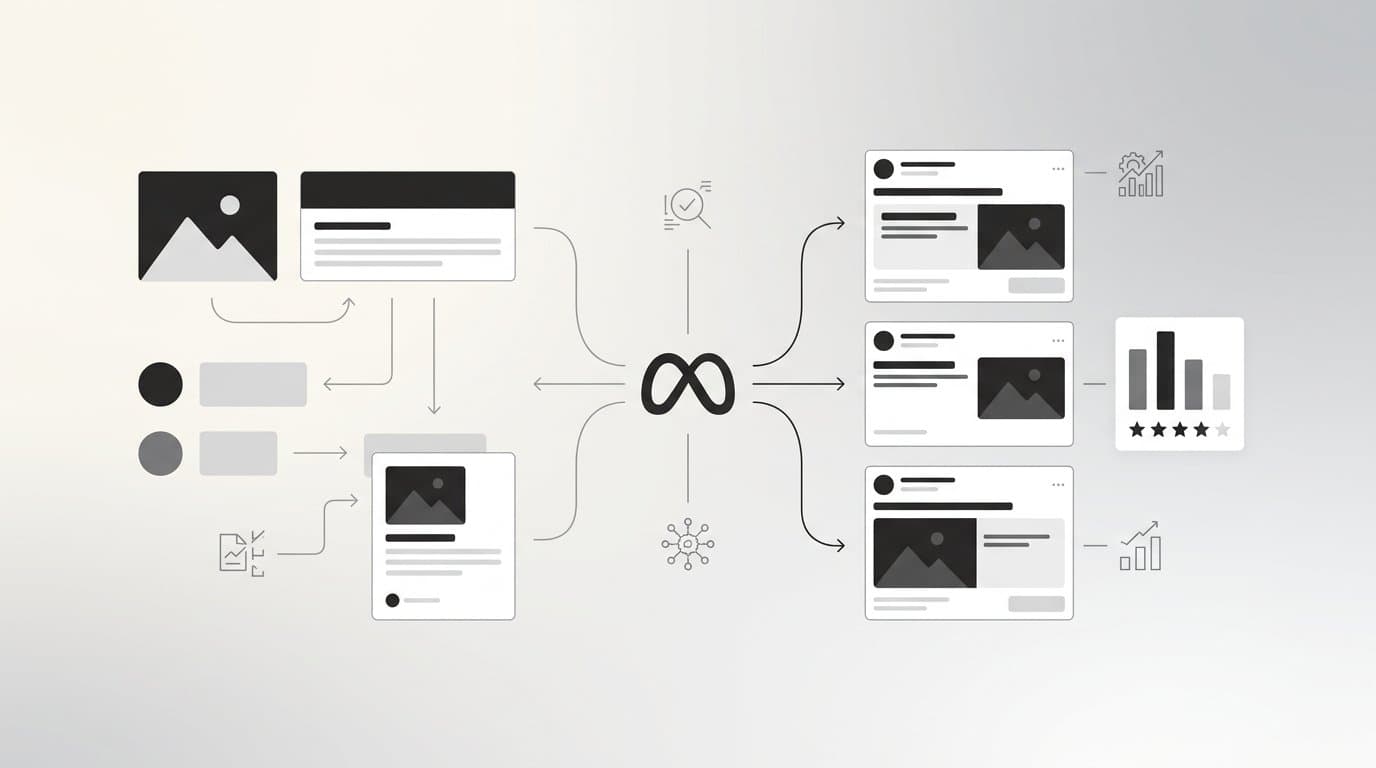
Your best-performing ad from last quarter is somewhere in your creative library. You know it exists. You remember the results. But finding it means scrolling through hundreds of files across three different folders, two platforms, and that one Google Drive someone created six months ago.
Meanwhile, your designer just spent two hours recreating an asset that already exists because nobody could find the original. Your campaign manager is launching new ads without checking if similar concepts already flopped. And your top-performing creative from Black Friday? Lost in a folder labeled "Final_FINAL_v3."
This is the hidden tax of poor ad creative library management. It doesn't show up in your ad spend reports, but it costs you time, money, and momentum every single day.
The teams that scale successfully treat their creative library as a strategic weapon, not a digital junk drawer. They can instantly pull up their top performers, understand exactly why they worked, and deploy proven winners across new campaigns in minutes instead of hours.
The difference isn't luck. It's systems.
These seven strategies will help you transform your creative chaos into a competitive advantage. You'll find winners faster, eliminate redundant work, and scale your advertising without losing control of your assets. Whether you're managing dozens of creatives or thousands, these approaches work.
1. Build a Performance-Based Tagging System
The Challenge It Solves
Most teams organize creatives by format, date, or campaign name. This tells you what something is, but not whether it works. When you need to find high-performing creatives for a new campaign, you're stuck manually checking performance data across multiple dashboards.
Generic tags like "summer campaign" or "product launch" create noise without insight. You end up with hundreds of tagged assets but no quick way to filter for actual winners.
The Strategy Explained
Performance-based tagging categorizes creatives by what actually matters: results. Instead of organizing by when you created something, you organize by how it performed against your goals.
This means tagging creatives with ROAS tiers, conversion rate brackets, engagement levels, and audience performance. A single creative might carry tags like "ROAS_5x_plus," "audience_retargeting," "format_UGC," and "hook_problem_agitation."
The power comes from multi-dimensional filtering. Need high-ROAS UGC creatives that worked for cold audiences? Your tagging system surfaces them instantly. Looking for scroll-stopping hooks that drove engagement? They're one filter away. Implementing a robust Facebook ads creative library management system makes this filtering seamless.
Implementation Steps
1. Define your performance tiers based on actual campaign goals (for example: ROAS brackets of 2-3x, 3-5x, 5x+, or CPA ranges that align with your targets).
2. Create tag categories for creative elements (hook type, visual style, offer angle), audience segments (cold, warm, retargeting), and performance metrics (engagement tier, conversion tier, ROAS tier).
3. Establish a tagging workflow where every creative gets performance tags added after it has sufficient data, typically after spending at least your minimum test budget.
4. Build saved filter combinations for common searches like "top performers for cold audiences" or "high-engagement video creatives."
Pro Tips
Start with three core tag categories: performance tier, audience type, and creative format. You can always add more granular tags later. Avoid tag proliferation by establishing clear definitions for each tag before you start. If your team debates whether something qualifies as "high-performing," your criteria aren't specific enough.
2. Establish a Winners Archive with Context
The Challenge It Solves
You know which ads drove results, but six months later, you can't remember why they worked. Was it the audience? The timing? The specific offer? Without context, even your best performers become guesswork when you try to replicate their success.
Creative files alone don't tell the full story. You need the strategic context that made them winners.
The Strategy Explained
A winners archive captures both the creative asset and the complete performance context. For each top performer, you document not just what the ad looked like, but the audience it targeted, the campaign objective, the offer details, seasonal timing, and the specific metrics that made it successful.
This creates a knowledge base that helps you understand patterns across your winners. Maybe your highest-ROAS creatives all share a specific hook structure. Maybe your best cold audience ads follow a consistent visual pattern. Building a Meta ads winning creative library helps these insights emerge naturally.
Implementation Steps
1. Create a dedicated folder or database for creatives that meet your "winner" threshold (typically top 10-20% performers by your primary metric).
2. Build a standard template that captures the creative file, target audience details, campaign objective, key metrics (ROAS, CPA, CTR, conversion rate), offer or promotion details, run dates and seasonal context, and what you believe made it successful.
3. Schedule quarterly reviews where you add new winners and update context for existing ones based on fresh insights.
4. Cross-reference winners to identify patterns in creative elements, audience combinations, or timing that consistently drive results.
Pro Tips
Don't wait until you have perfect documentation systems to start. Begin with a simple spreadsheet that links to creative files and captures basic context. The act of documenting forces you to think critically about why things worked. Tools like AdStellar's Winners Hub automatically organize your best-performing creatives with real performance data attached, eliminating manual tracking.
3. Implement Version Control for Creative Iterations
The Challenge It Solves
You test a creative variation that tanks. Two weeks later, someone launches essentially the same variation because they didn't know it already failed. Or worse, you have five versions of the same creative with filenames like "ad_v2_final_REAL_final" and nobody knows which one actually performed.
Without clear version tracking, you waste budget retesting failed approaches and lose the ability to understand which specific changes improved or hurt performance.
The Strategy Explained
Version control treats creative iterations like software development treats code changes. Every variation gets documented with clear lineage showing what changed from the previous version and why.
This creates a learning trail that shows which specific modifications moved the needle. When you change a headline, swap an image, or adjust the CTA, you track that change and its performance impact. Over time, you build a database of what types of iterations actually improve results. Proper Meta ad creative testing methods depend on this systematic approach.
Implementation Steps
1. Establish a naming convention that includes version numbers and change indicators (for example: "ProductName_ImageAd_v1.2_HeadlineTest" where the decimal indicates a minor variation).
2. Create a change log document or field that captures what changed between versions (for example: "v1.1 to v1.2: Changed headline from benefit-focused to curiosity-driven, kept all other elements identical").
3. Link each version to its performance data and the previous version's performance for direct comparison.
4. Tag versions with test type (headline test, image test, CTA test) to enable filtering by what element you're optimizing.
Pro Tips
Limit variables between versions. If you change the headline AND the image AND the CTA, you can't know which change drove the performance difference. Test one element at a time and document it clearly. When a variation significantly outperforms, make it your new baseline and start the next round of iterations from there.
4. Create Asset Component Libraries
The Challenge It Solves
Every new campaign means starting from scratch, even though you have dozens of proven headlines, images, and CTAs scattered across past creatives. Your team recreates assets that already exist because there's no systematic way to access individual components.
This approach treats every creative as a monolithic unit instead of recognizing that the best new ads often combine proven elements in fresh ways.
The Strategy Explained
Component libraries break down your creatives into reusable building blocks. Instead of storing complete ads, you maintain separate libraries for headlines, images, video clips, CTAs, body copy angles, and other elements.
Each component gets tagged with performance data from every creative where it appeared. A headline that drove strong results across three different campaigns gets marked as a proven winner. An image that consistently improved CTR becomes a go-to visual asset.
When you need to create new variations, you assemble them from your component library like building with proven blocks. This dramatically speeds up creative production while maintaining quality. The right Facebook ad creative management tools can automate much of this component tracking.
Implementation Steps
1. Audit your top-performing creatives and extract their individual components into separate libraries organized by type (headlines, primary images, background videos, CTAs, opening hooks, body copy frameworks).
2. Tag each component with its performance history, including which creatives it appeared in and the results it contributed to.
3. Create mix-and-match templates that let you quickly combine components into new creative variations without starting from blank files.
4. Establish a workflow where new high-performing components automatically get added to your libraries for future use.
Pro Tips
Start with your highest-impact components first. Headlines and opening hooks typically drive the most performance variation, so begin there. Create a simple rating system for components based on how consistently they perform across different creatives. A headline that works in multiple contexts is more valuable than one that only succeeded once.
5. Set Up Competitive Intelligence Folders
The Challenge It Solves
You save competitor ads sporadically when something catches your eye, but they end up scattered across screenshots, browser bookmarks, and random folders. When you need creative inspiration or want to understand what's working in your industry, you can't find your saved examples.
Competitive research becomes a wasted effort because you have no system for capturing insights or making them accessible when you need them.
The Strategy Explained
Systematic competitive intelligence folders organize competitor ads by strategic value rather than random collection. You categorize ads by creative approach, industry trend, platform, and what makes them noteworthy.
This transforms competitive research from inspiration hoarding into strategic intelligence. Instead of a pile of random screenshots, you build a searchable database of creative approaches, messaging angles, and visual styles that work in your market. Pairing this with a Facebook ads library management tool streamlines the entire process.
Implementation Steps
1. Create category folders for different creative approaches (problem-agitation-solution, social proof-heavy, UGC style, comparison ads, educational content) and industry trends you're tracking.
2. Add context notes to each saved ad explaining why you saved it, what makes it effective, and potential applications for your brand.
3. Schedule weekly competitive research sessions where you systematically review competitor ads from sources like Meta Ad Library and organize them into your folders.
4. Tag competitor ads with elements you might want to test (specific hooks, visual styles, offer structures) to enable quick filtering when planning new campaigns.
Pro Tips
Don't just save ads from direct competitors. Look at successful brands in adjacent industries or companies targeting similar audiences with different products. The best creative inspiration often comes from outside your immediate competitive set. Focus on understanding why an ad works, not just collecting examples.
6. Automate Creative Performance Scoring
The Challenge It Solves
Manually tracking which creatives hit your performance goals means constantly jumping between your ad platform, spreadsheets, and creative files. By the time you identify winners, the opportunity to scale them has often passed.
Without automated scoring, you rely on gut feel or outdated performance snapshots instead of real-time data about what's actually working right now. This is why Facebook ad creative testing becomes inefficient for many teams.
The Strategy Explained
Automated performance scoring creates a system that continuously evaluates every creative against your benchmarks and assigns scores based on how they perform against your goals. Instead of manually checking if a creative hit your target CPA or ROAS, the system automatically flags winners and losers.
This enables instant identification of top performers and quick decisions about what to scale, what to pause, and what to iterate on. You spend less time analyzing data and more time acting on insights.
Implementation Steps
1. Define clear performance benchmarks for your key metrics (target ROAS, acceptable CPA range, minimum CTR, conversion rate goals).
2. Set up automated scoring rules that assign grades or scores based on how creatives perform against these benchmarks (for example: A-grade for 5x+ ROAS, B-grade for 3-5x ROAS, C-grade for 2-3x ROAS, F-grade for below 2x ROAS).
3. Create dashboards or reports that automatically surface your highest-scoring creatives and flag underperformers that need attention.
4. Build alerts for when creatives cross important thresholds, like moving from B-grade to A-grade performance or dropping below your minimum acceptable metrics.
Pro Tips
Different campaign objectives need different scoring criteria. Your ROAS benchmarks for cold prospecting should differ from retargeting campaigns. Create separate scoring systems for different funnel stages. Platforms like AdStellar automatically score every ad element based on your goals with leaderboards that rank creatives, headlines, copy, audiences, and landing pages by real metrics like ROAS, CPA, and CTR.
7. Build Workflows for Creative Reactivation
The Challenge It Solves
Your library is full of past winners that could drive results again, but they're effectively dead because you have no system for identifying when to bring them back. Seasonal creatives sit unused until someone randomly remembers them. Strong performers from six months ago never get retested despite changing market conditions.
Without reactivation workflows, you constantly create new creatives while proven winners gather dust.
The Strategy Explained
Creative reactivation workflows systematically identify opportunities to revive dormant winners. This includes seasonal calendars that trigger reviews of past seasonal creatives, performance-based triggers that flag when current ads underperform compared to past winners, and refresh cycles that test whether older high-performers still resonate with evolved audiences.
The goal is turning your creative library from a historical archive into an active asset that continuously feeds your campaigns. Following Facebook campaign management best practices includes building these systematic reactivation processes.
Implementation Steps
1. Create a seasonal calendar that flags when to review and potentially reactivate creatives from previous years (for example: review last year's Black Friday winners in October, check summer campaign performers in April).
2. Set performance triggers that prompt creative reviews when current campaigns underperform, automatically surfacing past winners that might work better.
3. Establish refresh testing cycles where you periodically retest top performers from 6-12 months ago to see if they still drive results or need updates.
4. Document reactivation results to understand which types of creatives age well and which need significant updates to remain effective.
Pro Tips
Not every winner deserves reactivation. Focus on creatives that drove strong results over extended periods rather than flash-in-the-pan performers. When reactivating older creatives, consider minor updates to keep them feeling fresh, like updated stats, current testimonials, or refreshed visuals, while maintaining the core elements that made them successful.
Putting It All Together
Effective ad creative library management isn't about achieving perfect organization for its own sake. It's about building systems that help you find winners faster, eliminate wasted effort, and scale without chaos.
Start with the strategy that addresses your biggest pain point. If you're constantly recreating assets, build your component library first. If winners keep getting buried, establish your performance-based tagging system. If you're struggling to identify what actually works, implement automated performance scoring.
The most successful advertising teams treat their creative library as a strategic asset, not a dumping ground. When every creative is tagged, scored, and searchable, scaling becomes a matter of deploying proven winners rather than starting from scratch every time.
You don't need to implement all seven strategies at once. Pick one, get it working, then add the next. The compound effect of systematic creative management reveals itself over time as your team spends less time searching and more time scaling what works.
The difference between teams that scale efficiently and those that struggle often comes down to how well they leverage what they've already learned. Your creative library contains those lessons. The question is whether you can access them when you need them.
Ready to transform your advertising strategy? Start Free Trial With AdStellar and be among the first to launch and scale your ad campaigns 10× faster with our intelligent platform that automatically builds and tests winning ads based on real performance data.