For most Meta advertisers, ad creative production is the biggest bottleneck between strategy and results. You have a campaign idea, a budget, and a target audience ready to go, but you are still waiting on a designer, hunting down copy revisions, or manually building out ad variations one by one. By the time everything is ready, the opportunity window has narrowed.
A well-structured ad creative production workflow changes that. Instead of treating each campaign as a one-off scramble, a repeatable workflow turns creative production into a system: faster to execute, easier to scale, and built to surface winners without burning out your team.
This article breaks down seven practical strategies for building that system, whether you are a solo performance marketer, an in-house team, or an agency managing multiple client accounts. Each strategy addresses a specific friction point in the production process, from how you brief creatives and structure testing to how you recycle top performers and use AI to accelerate every stage.
If you are running Facebook and Instagram campaigns and want to spend less time producing ads and more time optimizing them, these strategies will help you get there.
1. Build a Brief Template That Eliminates Creative Guesswork
The Challenge It Solves
Most creative production delays do not happen in design or copywriting. They happen before any work even starts, when the brief is vague, incomplete, or missing entirely. When a designer does not know the target audience or a copywriter is unclear on the hook angle, the result is a revision cycle that can stretch days into weeks. Ambiguity at the briefing stage is one of the most consistent sources of friction in the entire production process.
The Strategy Explained
A standardized brief template forces every creative request to answer the same core questions before production begins. Think of it as a pre-flight checklist: nothing moves forward until every field is filled in. A solid brief template should capture the campaign goal, primary audience, the specific hook or angle, ad format, call-to-action, and a performance benchmark from previous campaigns. That last element is often overlooked, but it matters. When the person writing copy or designing visuals knows what a winning ad looked like before, they have a concrete target to aim for rather than a blank canvas.
Implementation Steps
1. List every decision that currently gets made mid-production and build those decisions into the brief upfront. Common examples include format choice, tone of voice, and audience pain point.
2. Add a required "benchmark" field that links to a top-performing ad from a previous campaign. This anchors new work to proven creative signals rather than assumptions.
3. Create a short approval step where the brief is reviewed before production starts, not after the first draft comes back. One checkpoint at the start eliminates three checkpoints in the middle.
Pro Tips
Keep the template short enough that filling it out takes under ten minutes. If it becomes a lengthy document, people will skip fields or avoid using it altogether. A focused brief with six to eight fields consistently used beats a comprehensive one that gets ignored. Store your templates in a shared workspace so every team member and collaborator is working from the same version. Teams dealing with Meta advertising workflow bottlenecks often find that a standardized brief is the single highest-leverage fix they can make.
2. Structure Your Creative Testing in Batches, Not One-Offs
The Challenge It Solves
Launching a single ad to see how it performs is one of the most common habits in Meta advertising, and one of the most limiting. When you test one creative at a time, you end up with isolated data points that are difficult to interpret. Did it underperform because of the visual, the headline, the audience, or the offer? You cannot know. One-off testing keeps your production effort high and your learning rate low.
The Strategy Explained
Batch testing organizes your production around structured groups of creatives that isolate specific variables. Instead of launching one ad and waiting, you produce a set of variations that each test a single element: format, hook style, visual approach, or CTA. This generates cleaner data because the differences between ads are intentional and controlled. Each production cycle becomes a learning opportunity rather than just another campaign launch. Over time, you build an evidence base about what works for your specific audience, which makes every future brief more informed.
Implementation Steps
1. Choose one variable to test per batch. Common starting points include hook style (question vs. statement vs. bold claim) or format (static image vs. video vs. UGC-style).
2. Produce three to five variations per batch, keeping everything else as consistent as possible. The goal is to isolate the variable so the data is readable.
3. Define your evaluation criteria before launch. Know which metric you are optimizing for, whether that is CTR, CPA, or ROAS, and set a minimum spend threshold before drawing conclusions.
Pro Tips
Document your batch results in a simple log that captures the variable tested, the winner, and the insight it generated. This log becomes a reference point for future briefs and prevents your team from retesting things that have already been answered. Over several campaign cycles, this habit compounds into a significant competitive advantage. If you want a deeper look at how to structure this process, the guide on Facebook ad creative testing challenges covers the most common pitfalls teams run into when moving from one-off to batch testing.
3. Use AI to Generate and Iterate Creatives at Scale
The Challenge It Solves
Traditional creative production depends on a chain of specialists: a designer for visuals, a video editor for motion content, a copywriter for messaging. Each handoff adds time, and each revision request restarts the clock. For teams running continuous Meta campaigns, this dependency creates a production ceiling that limits how many creatives can realistically be tested. Creative fatigue is a well-documented reality in Meta advertising: ads lose effectiveness as audiences see them repeatedly, which means the demand for fresh creative is constant.
The Strategy Explained
AI creative generation removes the specialist dependency from the production loop. Platforms like AdStellar can generate image ads, video ads, and UGC-style avatar content directly from a product URL, without requiring a designer, video editor, or actor. You can also clone competitor ads directly from the Meta Ad Library to use as creative research and starting points. Chat-based editing then lets you refine any generated creative through a conversation rather than a revision brief, which compresses the iteration cycle from days to minutes.
Implementation Steps
1. Start with your product URL or a top-performing existing ad as the input. Let the AI generate an initial set of variations across formats including static, video, and UGC-style.
2. Use the Meta Ad Library to identify competitor creatives that are running consistently. These are signals of what is working in your category. Clone them as inspiration and let AI help you build variations informed by those patterns.
3. Use chat-based editing to iterate on generated creatives. Instead of writing a new brief, describe the change you want in plain language: "Make the hook more direct" or "Change the background to something lifestyle-oriented."
Pro Tips
Treat AI generation as a volume tool, not a replacement for creative judgment. Generate a wide range of options, then apply your own strategic filter to select the most promising variations for testing. The goal is to expand your automated Facebook creative production output without expanding your team headcount or production timeline.
4. Systematize Bulk Ad Variation Creation Before Launch
The Challenge It Solves
Even after creatives are approved, the pre-launch setup process in Meta Ads Manager is notoriously manual. Building individual ad sets, assigning creatives, writing headline variations, and configuring audiences one by one is a time sink that can take hours for a moderately sized campaign. This manual assembly work is low-value and high-friction, and it often introduces errors that require fixes after launch.
The Strategy Explained
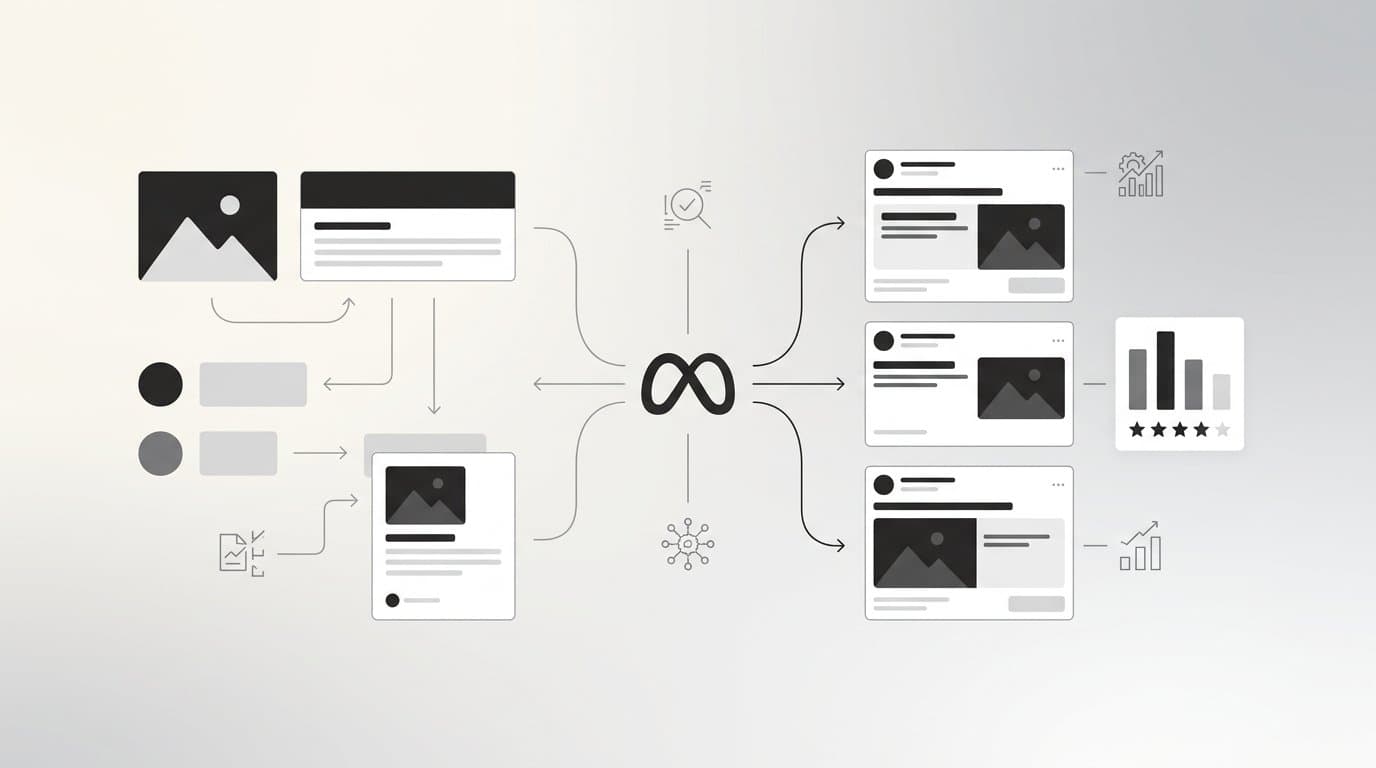
Bulk ad variation creation replaces manual assembly with an automated mixing process. Instead of building each ad individually, you input your creative assets, headline options, copy variants, and audience segments, and let a bulk creation tool generate every possible combination automatically. What previously took hours of Ads Manager workflow optimization can be compressed into minutes. AdStellar's bulk launch feature, for example, mixes creatives, headlines, audiences, and copy at both the ad set and ad level, then launches every combination to Meta in a few clicks. This approach also ensures you are testing more combinations than you would realistically build by hand, which improves the quality of your performance data.
Implementation Steps
1. Before launch, compile all approved assets into a single organized set: creatives, headline options (aim for at least three to five), copy variants, and audience segments.
2. Use a bulk creation tool to generate combinations. Review the output to confirm the combinations make logical sense before sending them live.
3. Set clear naming conventions for every ad variation so performance data is easy to read in reporting. Consistent naming prevents confusion when you are analyzing results across dozens of variations.
Pro Tips
Bulk creation works best when your inputs are already high quality. Garbage in, garbage out applies here. A strong brief process and AI-generated creatives that have already been reviewed give bulk creation the right raw material to work with. Think of bulk creation as the final production step, not a shortcut around earlier ones.
5. Centralize Performance Data to Inform Every New Creative
The Challenge It Solves
One of the most persistent problems in ad creative production is the gap between the people producing creatives and the data generated by those creatives. Designers and copywriters often work without direct access to performance metrics, which means each new brief starts from intuition rather than evidence. This disconnect is especially common in agencies where creative and media buying functions sit in different teams or tools.
The Strategy Explained
Centralizing performance data into a format that directly informs creative decisions closes this loop. Leaderboard-style rankings that score creatives, headlines, copy, and audiences against actual campaign goals give everyone involved in production a shared reference point. When you can see that a specific hook style consistently outperforms others on CPA, or that a particular visual format drives stronger CTR, that insight shapes the next brief before any work begins. AdStellar's AI Insights feature surfaces exactly this kind of ranked, goal-scored data across every element of your campaigns, from individual creatives to landing pages, using real metrics like ROAS, CPA, and CTR.
Implementation Steps
1. Define the metrics that matter most for your campaigns and set them as benchmarks. Every creative element should be scored against these specific goals, not generic platform averages.
2. Review leaderboard rankings before writing each new brief. The top performers across creatives, headlines, and copy should be referenced explicitly in the brief template.
3. Share performance data with everyone involved in production, not just the media buyer. When a designer can see which visual approaches are driving results, their next round of work is immediately more targeted.
Pro Tips
Integrate attribution data wherever possible. Surface-level metrics like CTR can be misleading if they do not connect to downstream conversion data. Pairing campaign performance with attribution tracking, such as AdStellar's integration with Cometly, gives you a more complete picture of which creatives are actually driving revenue rather than just clicks. For agencies managing multiple accounts, the guide on agency workflow for Meta advertising outlines how to structure this data sharing across client teams effectively.
6. Build a Winners Library to Accelerate Future Production
The Challenge It Solves
Most performance marketing teams start every new campaign from a near-blank slate. Even when strong creatives exist from previous campaigns, they are often buried in Ads Manager, scattered across shared drives, or simply forgotten. This means teams repeatedly do the work of discovery when they could be building on what already works. Starting from scratch every campaign cycle is one of the most avoidable inefficiencies in ad creative production.
The Strategy Explained
A winners library is a curated collection of your best-performing creatives, headlines, audiences, and copy, organized with their actual performance data attached. The key word is "organized." A folder of random assets is not a winners library. A structured, searchable collection where every item is tagged with its performance context, the campaign it ran in, the audience it reached, and the metrics it achieved, is a genuine production accelerator. AdStellar's Winners Hub does exactly this, pulling your top performers into one place with real performance data so you can select any winner and immediately add it to your next campaign without rebuilding from scratch. The concept of a Meta ads winning creative library is one of the highest-leverage systems a performance team can build.
Implementation Steps
1. After each campaign cycle, identify the top performers across every element: creatives, headlines, copy, and audiences. Use your performance leaderboard to make this selection objective rather than subjective.
2. Tag each winner with context: the audience it ran to, the campaign goal it was optimized for, and the key metric it excelled on. This context is what makes the library useful rather than just a storage archive.
3. Make the winners library the first stop at the start of every new brief. Before generating new ideas, check whether an existing winner can be adapted or directly reused.
Pro Tips
Winners libraries compound in value over time. The longer you maintain one, the more reference points you have for any new campaign scenario. Teams that build this habit consistently find that their production speed increases with each campaign cycle because they are spending less time on discovery and more time on refinement and adaptation.
7. Automate Campaign Assembly So Production Ends at Creative Approval
The Challenge It Solves
Even when creatives are ready, the work is not done. Selecting audiences, writing campaign-level copy, choosing bidding strategies, and assembling the full campaign structure in Meta Ads Manager is a substantial task that requires both strategic judgment and technical execution. For teams running multiple campaigns simultaneously, this assembly work can become a bottleneck in its own right, delaying launch even after all the creative work is complete.
The Strategy Explained
AI campaign builders analyze your historical performance data to make the strategic decisions that previously required manual input. Rather than choosing audiences, headlines, and copy from scratch, the AI ranks every element by past performance and builds a complete campaign structure around your approved creatives. AdStellar's AI Campaign Builder works this way: it analyzes past campaigns, ranks every creative, headline, and audience by performance, and assembles a complete Meta ad campaign in minutes. Every decision is explained with full transparency so you understand the rationale, not just the output. The AI also learns from each campaign, meaning its recommendations improve over time.
Implementation Steps
1. Ensure your historical campaign data is accessible to the AI campaign builder. The more data it has to work with, the more accurate its recommendations will be. Connect your Meta account and allow sufficient campaign history to accumulate.
2. Review the AI-assembled campaign before launch rather than building it from scratch. Your role shifts from builder to reviewer, which is a much faster and lower-effort position to be in.
3. Use the transparency features to understand why specific audiences, headlines, and copy were selected. This understanding helps you catch any misalignments and also builds your own strategic intuition over time.
Pro Tips
Automated campaign assembly works best as the final step in a structured workflow, not a standalone shortcut. When it is fed with AI-generated creatives, bulk variations, and performance-informed briefs, the output quality is significantly higher than when it is used in isolation. Teams looking to reduce manual Facebook ad workflow overhead consistently find that automated assembly is where the largest time savings are realized. Think of it as the closing mechanism that makes everything upstream move faster.
Putting It All Together
A strong ad creative production workflow is not about producing more ads. It is about producing the right ads faster, learning from them systematically, and reusing what works. The seven strategies above address every major friction point in that process: unclear briefs, slow iteration, manual variation building, disconnected performance data, and the constant pressure to start from scratch.
The most effective approach is to tackle these in sequence. Start by standardizing your brief process so every creative starts with clear direction. Then build a batch testing structure so your production efforts generate real learning. From there, use AI to accelerate generation and iteration, bulk creation to scale variations, and performance data to make every new brief smarter than the last.
A winners library and automated campaign assembly then close the loop, turning your best work into a reusable system rather than a one-time result. Each strategy reinforces the others, and the compounding effect across a few campaign cycles is meaningful.
If you want to see how this entire workflow can run inside a single platform, AdStellar handles everything from AI creative generation to campaign launch and performance tracking. Start Free Trial With AdStellar and be among the first to launch and scale your ad campaigns faster with an intelligent platform that automatically builds and tests winning ads based on real performance data.