Most performance marketers know the feeling. A campaign that was crushing it two weeks ago has quietly flatlined. The creative is the same, the budget is the same, the audience is the same. But the results? Nowhere near what they used to be. The culprit is almost always creative fatigue, and the fix is almost always the same: new assets, and fast.
Here's the problem. "Fast" in a traditional creative workflow means days at best, weeks at worst. By the time fresh assets are briefed, designed, revised, approved, and uploaded, the campaign has already burned through budget with diminishing returns. This is the cycle that quietly kills performance marketing efficiency.
The marketers who consistently outperform their competitors have figured something out: ad creative production at scale is not a headcount problem. It's a systems problem. Hiring another designer or briefing another freelancer doesn't solve the structural issue. It just adds more people to a broken process.
The real shift happens when teams stop thinking about creative production as a series of one-off tasks and start treating it as a continuous pipeline, built on repeatable systems and supported by the right technology. When that happens, the relationship between creative quality and creative volume stops being a tradeoff. You can have both.
This article breaks down exactly how modern marketers are making that shift: why creative volume is now a genuine competitive advantage, where traditional production models fall apart, what scaled production actually looks like in practice, and how AI is compressing timelines that used to take days into something closer to minutes.
Why Creative Volume Is Now a Competitive Advantage
Meta's ad delivery system is, at its core, a relevance engine. It rewards ads that generate strong engagement signals, and it deprioritizes ads that audiences have already tuned out. This has a direct structural implication for how teams should think about creative production: more variations means more opportunities to find what resonates, and more opportunities to stay relevant as audience fatigue sets in.
The creative fatigue cycle is well-documented among performance marketers. An ad launches with strong engagement. Frequency climbs as the same users see it repeatedly. Click-through rates drop. Cost per result creeps up. The team scrambles to produce replacement assets, but they're already behind. By the time new creatives are ready, the campaign has already overspent on a degraded audience experience.
This reactive loop is the default state for teams that treat creative production as something that happens when performance drops, rather than something that runs continuously in the background. The difference between those two approaches compounds over time. Teams in reactive mode are always catching up. Teams with a proactive creative pipeline are always ahead of fatigue.
Think of it like inventory management. A retailer that only restocks shelves when they're empty is going to have gaps. A retailer with a continuous replenishment system keeps shelves full without the scramble. Creative production works the same way. The goal is to have a library of fresh, untested variations ready to rotate in before the current batch burns out.
The teams that produce more creative variations also have a structural testing advantage. Meta's algorithm needs signal to optimize. When you give it five ad variations, it has five data points to work with. When you give it fifty, it has ten times the signal to identify what's working and allocate spend accordingly. More creative volume doesn't just fight fatigue. It actively accelerates the algorithm's ability to find your best performers.
This is why creative volume has become a genuine competitive moat. It's not about flooding the platform with mediocre content. It's about building the infrastructure to consistently generate, test, and refresh quality variations at a pace that keeps both the algorithm and the audience engaged. Teams that have built that infrastructure have a structural edge that teams relying on one-off production simply can't match.
The Traditional Production Model and Where It Breaks Down
Walk through a typical creative workflow and you'll see the same pattern: a strategist writes a brief, hands it to a copywriter, who hands it to a designer, who produces an initial concept, which goes back for revisions, then to an approver, then gets formatted for different placements, then uploaded to Ads Manager. Each handoff adds time. Each revision loop adds more.
For a single ad concept, this process can easily take a week or longer. For a team that needs to test multiple angles across multiple audiences and formats, the math gets painful quickly. The production timeline doesn't just slow things down. It actively limits how much testing the team can run, which directly caps how much learning they accumulate.
There are three bottlenecks that consistently break this model at scale.
Creative talent availability: Designers and video editors are finite resources. When a campaign needs fresh assets urgently, it competes with every other project in the queue. Teams either wait or pay a premium for rush work. Neither option scales well, and both create unpredictable timelines that make proactive creative planning nearly impossible.
Revision loops: Creative work rarely ships on the first attempt. A headline needs adjusting. The visual hierarchy is off. The CTA doesn't match the audience. Each round of revisions adds days to the cycle, and the more stakeholders involved in the approval process, the more rounds there tend to be. This isn't a people problem. It's a structural feature of collaborative creative work that doesn't disappear just because the team gets bigger.
Manual variation building: Even after a single ad concept is approved, producing variations for different audiences, formats, and placements is largely manual work. Resizing for Stories vs. Feed, swapping headlines for different audience segments, adjusting copy for different offers. These tasks are time-consuming, repetitive, and don't require creative judgment. They're the definition of work that should be automated, but in most traditional workflows, they aren't.
The deeper issue is what this bottleneck costs in terms of learning velocity. Performance marketing is fundamentally an empirical discipline. The more variations you test, the faster you identify what works. The faster you identify what works, the faster you can scale it. A production model that limits teams to testing a handful of concepts per month is also limiting how quickly those teams can improve their results.
Teams that recognize this often try to solve it by hiring more people. But adding headcount to a broken process doesn't fix the process. It just means more people are moving slowly through the same bottlenecks. The real solution isn't more people. It's a different model entirely.
What Scaled Creative Production Actually Looks Like
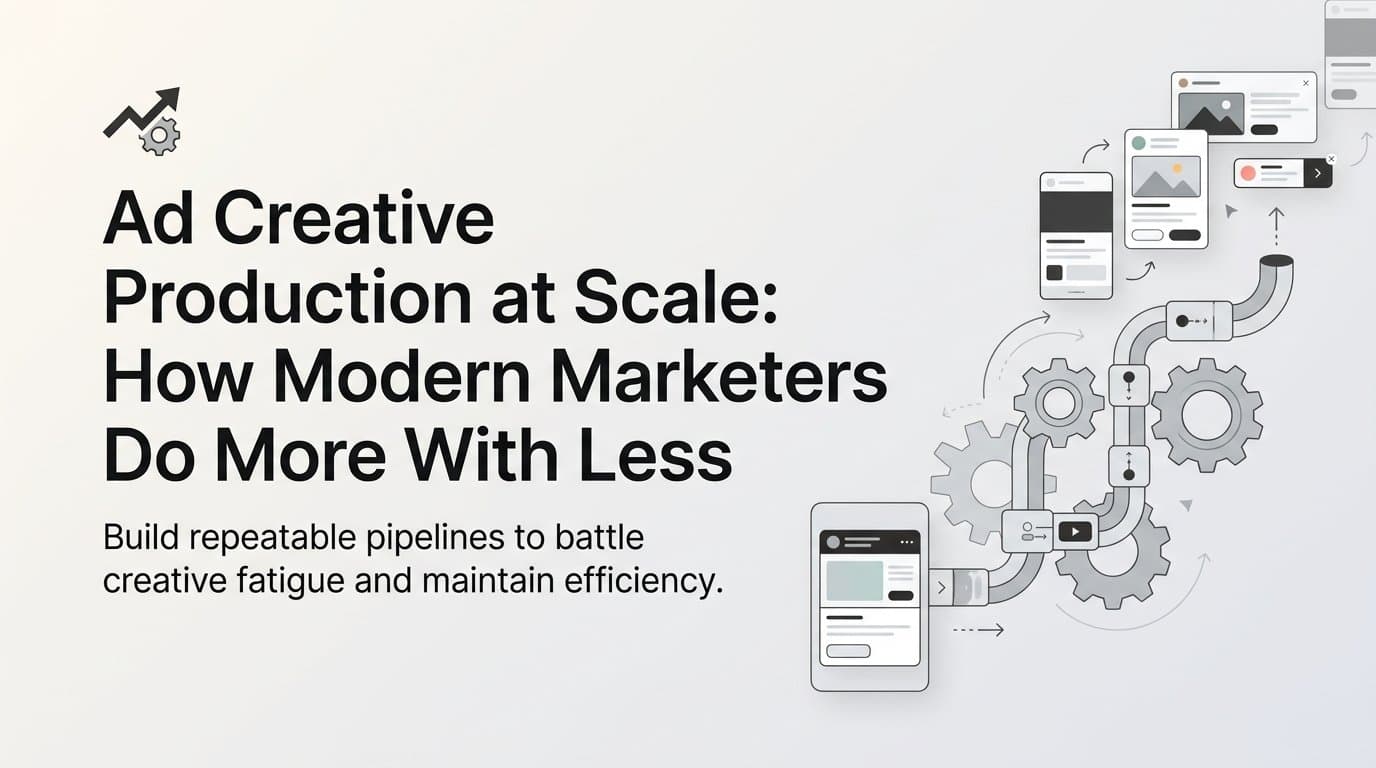
When practitioners talk about ad creative production at scale, they're describing something specific: the ability to generate multiple image, video, and copy variations from a single brief or product input and launch them simultaneously, without the production timeline multiplying proportionally with the volume.
The key concept that makes this possible is modular creative thinking. Instead of treating each ad as a bespoke piece of work built from scratch, modular production treats creative elements as interchangeable components. A hook is a hook. A headline is a headline. A visual is a visual. A CTA is a CTA. When you build a library of these components, you can mix and match them to produce dozens of unique ad combinations from a relatively small set of raw inputs.
Here's what that looks like in practice. Imagine you have four hooks, three visuals, five headlines, and two CTAs. In a traditional workflow, producing those elements is the end of the process. You pick one combination and run it. In a modular system, those same elements can generate over a hundred unique ad combinations. The creative work that used to produce one ad now produces many.
This changes the testing math fundamentally. Instead of running three to five variations and waiting weeks for statistically meaningful signal, teams can test fifty or more combinations simultaneously. The path to a winning creative compresses dramatically. You're not waiting for sequential tests to play out one at a time. You're running a parallel experiment across many combinations and letting performance data surface the winners.
Volume also changes how teams think about risk. When producing a single ad takes significant time and resources, there's pressure to make it perfect before it goes live. That pressure leads to longer approval cycles and more conservative creative choices. When production volume is high, any single ad represents a smaller portion of the total investment. Teams can afford to take more creative risks, test more unconventional angles, and let the data decide what works rather than relying on internal consensus.
Scaled production also means thinking about format coverage from the start. A single creative concept should be able to generate assets for Feed, Stories, Reels, and any other placement in the mix. In a manual workflow, each format is a separate production task. In a scaled system, format variation is built into the production process, not added as an afterthought.
The result is a creative library that's always stocked, always fresh, and always generating signal. That's what separates teams running at scale from teams that are perpetually playing catch-up.
How AI Changes the Creative Production Equation
The most significant shift in creative production over the past few years isn't a new strategy or framework. It's the arrival of AI tools that can actually do the work, not just assist with it. The difference matters enormously for teams trying to close the gap between how fast they need creatives and how fast they can produce them.
AI can now generate image ads, video ads, and UGC-style creatives from a product URL or a simple text prompt. What used to require a designer, a video editor, and potentially an actor or spokesperson can now happen in minutes. The production timeline collapses from days to something closer to the time it takes to write a brief. This isn't speculative. It's the current state of tools built specifically for performance marketing workflows.
Platforms like AdStellar take this further by handling not just creative generation but the entire workflow that follows. You can generate scroll-stopping image ads, video ads, and UGC-style avatar content from a product URL, clone competitor ads from the Meta Ad Library, or let AI build creatives from scratch. Refine any ad with chat-based editing. No designers, no video editors, no actors needed.
The AI Campaign Builder component addresses a different bottleneck: the gap between having creative assets and having a fully optimized campaign ready to launch. AI analyzes past campaign performance, ranks every creative, headline, and audience by actual results, and assembles complete Meta campaigns in minutes. Critically, every decision comes with explained reasoning. You understand why the AI made the choices it did, which means you're building strategic knowledge with every campaign, not just outsourcing decisions to a black box.
Competitive intelligence is another area where AI changes the workflow in meaningful ways. The Meta Ad Library is publicly available and shows active ads from any advertiser. Analyzing competitor creative approaches manually is time-consuming but valuable. AI tools that can accelerate this analysis, identify patterns in what competitors are running, and help teams build on proven angles provide a real shortcut. Instead of starting from scratch on every new campaign, teams can begin with a baseline understanding of what's already working in their category and iterate from there.
The cumulative effect of these capabilities is a production environment where the constraint is no longer time or talent. A small team with the right AI tools can operate with the creative output of a much larger operation. The strategic work, understanding your audience, identifying compelling angles, setting performance goals, remains human. The execution work, generating assets, building variations, formatting for placements, assembling campaigns, shifts to AI.
This is the practical definition of doing more with less. Not cutting corners, but removing the friction between having a good idea and having it live in market, tested, and generating data.
Turning Production Volume Into Performance Insight
Producing a high volume of creatives only creates value if there's a system to identify which ones are actually working. Without that system, volume becomes noise. With it, volume becomes a compounding advantage.
The key tool here is creative leaderboards: ranking systems that score every creative, headline, copy variation, audience, and landing page by actual performance metrics like ROAS, CPA, and CTR, measured against benchmarks that the team defines upfront. This is a meaningful upgrade over raw data dashboards, which require manual analysis to extract insight. A leaderboard makes the ranking explicit and actionable. You can see at a glance which assets are above benchmark, which are below, and where to focus attention.
AdStellar's AI Insights feature works exactly this way. Set your target goals and AI scores everything against your benchmarks so you can instantly spot winners and reuse them. The leaderboard surfaces what's working across every dimension of the campaign, not just which ad has the highest CTR, but which headlines, which audiences, which landing pages are contributing to results.
The Winners Hub concept takes this a step further. Rather than having winning creative elements scattered across past campaigns where they're difficult to find and easy to forget, a Winners Hub consolidates your best-performing creatives, headlines, audiences, and more in one place with real performance data attached. When you're building the next campaign, you're not starting cold. You're starting with a curated library of proven elements that you can deploy immediately.
This addresses one of the most underappreciated costs in performance marketing: the cold-start problem. Every new campaign that begins without reference to past performance is leaving learning on the table. Teams that have a systematic way to capture and reuse winning elements start every campaign with an advantage over teams that don't.
The compounding effect is where this becomes genuinely powerful. Each campaign cycle generates performance data. That data informs the next round of creative decisions. Better creative decisions produce stronger performance. Stronger performance generates richer data. Over time, the system gets smarter with every iteration. What starts as a production efficiency play becomes a self-improving creative intelligence system.
Teams that build this loop early accumulate a significant knowledge advantage over competitors who are still treating each campaign as a standalone effort. The gap widens with every cycle.
Building Your Scaled Creative System: Where to Start
The concept of scaled creative production can feel abstract until you're looking at your own workflow and trying to figure out where to begin. The practical starting point is simpler than it might seem: audit what you're currently producing and identify where the biggest constraint actually lives.
Most teams find their bottleneck in one of three places. Either they can't produce enough creative assets fast enough (a production bottleneck), they can produce assets but struggle to get them live efficiently (a launching bottleneck), or they can launch campaigns but can't quickly identify what's working (an analysis bottleneck). Each of these requires a different solution, and trying to fix all three simultaneously without prioritizing the biggest constraint tends to produce incremental improvement at best.
Once you've identified your primary bottleneck, the next step is building a creative testing framework around it. This means defining success metrics before a campaign launches, not after. What ROAS threshold constitutes a winner? What CPA is acceptable? What minimum spend level do you need before drawing conclusions? Without these benchmarks set in advance, analysis becomes subjective and inconsistent.
Establish a rotation cadence as well. Decide how frequently you'll introduce new creative variations into active campaigns, whether that's weekly, bi-weekly, or tied to specific frequency thresholds. Having a cadence prevents both creative fatigue from setting in and the opposite problem: rotating creatives so frequently that campaigns never accumulate enough data to optimize properly.
Tool selection is where many teams make the process harder than it needs to be. The instinct is often to stitch together specialized tools for each part of the workflow: one tool for creative generation, another for campaign building, another for performance reporting. The problem with this approach is that data and context get fragmented across platforms. Insights from the reporting tool don't automatically inform decisions in the creative tool. The workflow becomes a series of manual handoffs between disconnected systems.
What to look for instead is a platform that handles the full workflow in a single environment: creative generation through launch through performance analysis. When all of that lives in one place, the feedback loop between performance data and creative decisions becomes tight and continuous rather than slow and manual. The system can actually improve itself over time rather than requiring constant manual intervention to connect the dots.
AdStellar is built around exactly this principle. From generating image and video ads to bulk launching hundreds of variations to surfacing winners through AI Insights and the Winners Hub, the entire workflow runs in one platform. The AI gets smarter with every campaign, and every campaign starts with the accumulated intelligence of everything that came before it.
The Bottom Line on Creative Scale
Scaled ad creative production is not about working harder, hiring more designers, or throwing more budget at the problem. It's about building a system where creative generation, campaign launching, and performance analysis operate as a continuous, connected loop rather than a series of disconnected tasks.
The shift from reactive to proactive creative strategy is the real unlock. Teams that wait for performance to drop before producing new creatives are always behind. Teams with a continuous creative pipeline are always ahead, always testing, always learning, and always compounding the insights from previous campaigns into better decisions on the next ones.
The technology to build this system exists right now. AI tools can generate scroll-stopping image ads, video ads, and UGC-style content in minutes. AI campaign builders can analyze past performance and assemble optimized campaigns with full transparency. Bulk launch tools can put hundreds of variations into market simultaneously. Creative leaderboards can surface winners automatically. And Winners Hubs can make sure those winning elements get reused rather than forgotten.
The question isn't whether this approach is possible. It's whether you're set up to take advantage of it.
If you're ready to stop patching a broken production process and start building a system that scales, Start Free Trial With AdStellar and be among the first to launch and scale your ad campaigns faster with an intelligent platform that automatically builds and tests winning ads based on real performance data.