Traditional split testing feels like watching paint dry while your ad budget evaporates. You launch two ad variations, wait three weeks for statistical significance, discover the winner by a marginal 2% improvement, then start the entire process over with your next hypothesis. Meanwhile, your competitors are already three iterations ahead.
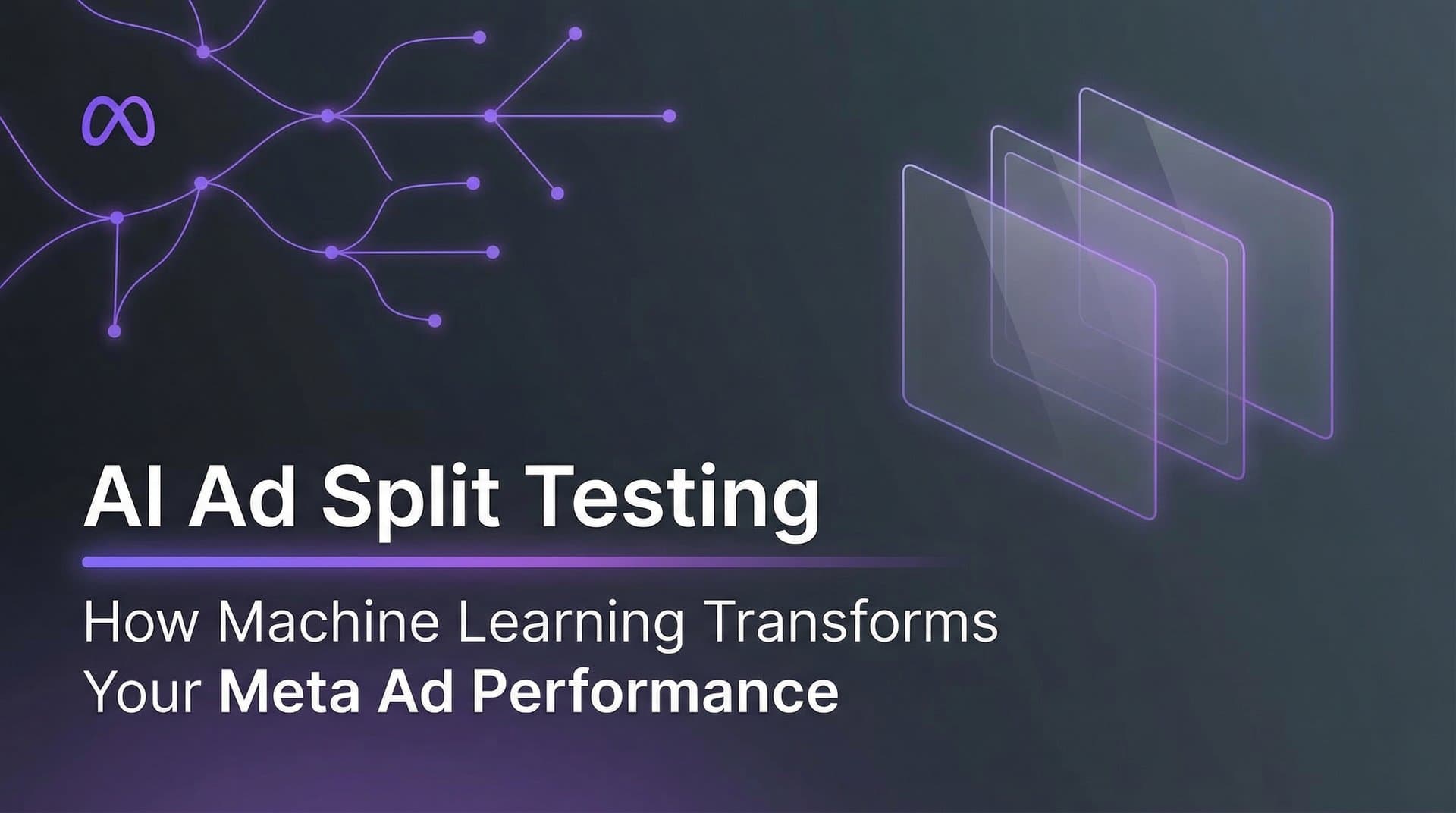
AI ad split testing flips this entire paradigm. Instead of testing one variable at a time over weeks, machine learning systems generate and test hundreds of variations simultaneously, identify winning patterns in days instead of weeks, and continuously optimize your campaigns without manual intervention. The technology doesn't just speed up traditional testing—it fundamentally transforms how advertisers discover what works.
This guide breaks down exactly how AI-powered split testing works for Meta advertisers, what it tests that humans can't, and how to build a testing strategy that compounds your advantages with every campaign you run.
From Linear Testing to Parallel Intelligence
Traditional A/B testing follows a rigid, linear path. You form a hypothesis (perhaps red buttons outperform blue ones), create two variations, split your audience, wait for enough data to achieve statistical significance, declare a winner, then move to your next hypothesis. This methodical approach made sense when creating ad variations required designers, copywriters, and weeks of production time.
The fundamental limitation isn't the methodology itself. It's the constraint of human capacity. You can only test what you think to test. Your hypotheses are limited by your experience, your team's creativity, and your ability to spot patterns in performance analytics for ads. If you've never considered testing UGC-style creatives against polished product shots, you'll never discover which performs better for your audience. Tools like an AI UGC ad generator have made this type of creative experimentation more accessible, but the testing bottleneck often remains.
AI ad split testing operates on a completely different principle. Instead of testing one hypothesis at a time, machine learning systems test dozens or hundreds of variations simultaneously across multiple variables. The AI doesn't need to form hypotheses about what might work. It tests everything and lets the data reveal the patterns. This represents one of the core differences when comparing AI vs traditional advertising methods.
This shift from sequential to parallel testing creates exponentially more learning opportunities. Where traditional testing might evaluate 8-10 variations per month, AI systems can test hundreds of combinations in the same timeframe. Each test generates data that feeds back into the system, making subsequent tests smarter and more targeted.
The real transformation happens at the multivariate level. Traditional split testing typically isolates single variables because testing multiple variables simultaneously creates complexity that humans struggle to analyze. Did the red button win because of the color, or because it appeared with headline variation B and audience segment 3? Untangling these interactions manually becomes mathematically prohibitive.
Machine learning thrives in this complexity. AI systems naturally analyze interactions between variables—how certain headlines perform better with specific images, how audience segments respond differently to various calls to action, how time of day affects creative performance. These multi-dimensional patterns are invisible to traditional testing but obvious to properly trained algorithms. Understanding what is multivariate testing helps explain why AI excels at this type of analysis.
The statistical significance challenge also transforms under AI testing. Traditional methods require large sample sizes and extended time periods to confidently declare winners. AI systems use predictive modeling to identify likely winners earlier in the testing cycle, then shift budget toward top performers while continuing to monitor for changes. This dynamic approach reduces the budget wasted on underperformers while maintaining statistical rigor.
The Mechanics of Intelligent Testing Systems
AI ad split testing begins with creative generation at scale. Instead of manually creating each variation, the system generates dozens or hundreds of creative options automatically. For image ads, this might mean testing different product angles, background colors, text overlays, and visual styles. For video ads, it could involve varying opening hooks, pacing, music choices, and end screens. The AI creates these variations based on learned patterns about what typically performs well in your industry and for your specific goals.
Once variations exist, the AI builds a comprehensive testing matrix. This isn't just creative A versus creative B—it's creative variations 1-50 combined with headline variations 1-20, paired with audience segments 1-15, distributed across placement options. A traditional marketer might test 5 combinations manually. The AI tests 500 simultaneously.
Budget allocation happens dynamically based on early performance signals. Rather than splitting budget evenly across all variations until statistical significance is reached, machine learning models predict which combinations are likely to perform best based on initial data. If a particular creative-headline-audience combination shows strong early signals, the AI increases its budget allocation while continuing to test other variations at lower spend levels.
This predictive allocation prevents the common split testing problem where you spend 50% of your budget on a clear loser just to reach statistical confidence. The AI identifies patterns faster because it's analyzing performance across hundreds of data points simultaneously, not just comparing two isolated variations.
Real-time optimization creates a continuous feedback loop. As performance data flows in, the AI adjusts budget allocation, pauses underperformers, and scales winners—all without human intervention. This happens at a speed and scale that manual optimization can't match. While a human media buyer might check campaign performance twice daily and make adjustments, AI systems monitor and optimize continuously. This is why ad creative testing automation has become essential for competitive advertisers.
The learning component distinguishes AI testing from simple automation. Machine learning models don't just follow rules—they identify patterns and improve their predictions over time. If the AI notices that UGC-style creatives consistently outperform polished product shots for your brand, it weights future creative generation toward that style. If certain headline structures drive better conversion rates, those patterns influence future copy variations.
Performance analysis extends beyond surface metrics. AI systems analyze why certain combinations win, not just which ones perform best. They identify that videos with hooks in the first three seconds outperform slow builds, or that specific color palettes resonate with particular audience segments, or that certain emotional angles drive action while others generate clicks without conversions.
This deep analysis creates actionable insights that inform creative strategy. Instead of simply knowing that Ad Set 47 performed best, you understand that conversational headlines paired with authentic lifestyle imagery and targeted to warm audiences between 25-34 consistently drive your lowest cost per acquisition. That's strategic intelligence, not just optimization data.
The Testing Matrix: What AI Evaluates Simultaneously
Creative elements form the most visible testing layer. AI systems evaluate image composition, color psychology, visual hierarchy, and design styles across hundreds of variations. For product-focused brands, this means testing different product angles, lifestyle contexts, close-ups versus full shots, and packaging presentations. For service businesses, it involves testing conceptual imagery, benefit-focused visuals, and social proof elements.
Video creative testing goes deeper into temporal elements that static split testing can't address. The AI evaluates opening hooks, pacing variations, music choices, voiceover styles, and end screen calls to action. It identifies which video lengths perform best for different campaign objectives—perhaps 15-second videos drive awareness while 45-second versions convert better for consideration campaigns.
UGC-style content represents another testing dimension that AI handles particularly well. The system can generate variations with different avatar styles, speaking patterns, background settings, and authenticity levels. It tests which UGC approaches resonate with your audience without requiring actual user-generated content or hiring multiple creators. Exploring Facebook ad variations reveals how many creative dimensions can be tested simultaneously.
Copy variations multiply the testing possibilities exponentially. AI systems test headline structures, emotional angles, benefit-focused versus feature-focused messaging, and calls to action. They evaluate how copy length affects performance, whether questions outperform statements, and which power words drive action in your specific market.
Primary text testing goes beyond simple word swapping. The AI evaluates narrative structures, pain point positioning, solution framing, and urgency creation. It tests whether your audience responds better to problem-agitation-solution frameworks or benefit-led approaches. It identifies which objection handling strategies work best in ad copy versus landing pages.
Call to action variations seem simple but significantly impact conversion rates. AI testing reveals whether your audience responds better to direct commands like "Shop Now" versus softer invitations like "Explore Options." It identifies whether urgency-driven CTAs outperform curiosity-based ones, and how CTA positioning affects click-through rates.
Audience and placement combinations create the most complex testing matrix. AI systems evaluate how different creative variations perform across audience segments—cold traffic versus retargeting, lookalike audiences versus interest-based targeting, broad audiences versus narrow demographics. They identify which placements work best for specific creative formats and campaign objectives.
These audience-creative interactions often reveal surprising insights. A creative that crushes with cold traffic might underperform with warm audiences who need different messaging. An image that works brilliantly in feed placement might fail in Stories format. AI testing surfaces these nuanced patterns that manual testing typically misses because testing every combination manually is prohibitively expensive.
Building Your AI Testing Framework
Goal definition forms the foundation of effective AI testing. Before launching any test, establish clear KPIs that align with your business objectives. Are you optimizing for return on ad spend, cost per acquisition, click-through rate, or conversion rate? Different goals require different testing strategies and success metrics.
Setting specific benchmarks gives the AI clear optimization targets. Instead of vague goals like "improve performance," define precise targets: achieve $4 ROAS, reduce CPA below $25, or increase CTR above 2.5%. These concrete benchmarks allow the AI to score every variation against your actual business needs rather than optimizing for generic engagement metrics.
Creating sufficient variation volume provides the AI with meaningful data to analyze. While traditional testing might evaluate 3-5 variations per campaign, AI systems need dozens or hundreds to identify patterns. This doesn't mean manually creating hundreds of ads—it means using AI creative generation to build comprehensive testing matrices quickly. A solid Facebook ad testing framework ensures you're generating enough variations to unlock AI's full potential.
The variation volume requirement might seem daunting, but it's the key to unlocking AI's advantages. With only a handful of variations, you're essentially running traditional split tests with automated reporting. With hundreds of variations across multiple variables, you're generating the data density that allows machine learning to identify winning patterns.
Establishing feedback loops ensures that insights from current tests inform future campaigns. When the AI identifies that certain creative styles, headline structures, or audience combinations consistently outperform others, those winning elements should become the foundation for your next testing cycle. This creates a compounding advantage where each campaign makes subsequent campaigns smarter.
Building a winners library operationalizes this feedback loop. Instead of treating each campaign as isolated, maintain a repository of proven performers—top creatives, winning headlines, effective CTAs, and high-converting audiences. Reference this library when generating new variations, ensuring that future tests build on proven foundations rather than starting from scratch.
Time horizons for AI testing differ from traditional approaches. While conventional split tests might run for 2-4 weeks before declaring winners, AI systems can identify strong performers within days because they're analyzing patterns across hundreds of variations simultaneously. However, letting tests run longer allows the AI to identify more subtle patterns and optimize for different contexts like day-parting or weekly cycles. If you're experiencing delays, understanding why Facebook ad testing takes too long can help you optimize your approach.
Budget allocation strategy matters significantly for AI testing. Spread your budget across enough variations to generate meaningful data, but concentrate enough spend on individual variations to reach minimum viable traffic thresholds. Many AI systems handle this balance automatically, but understanding the principle helps you set appropriate campaign budgets.
Decoding Performance: Beyond Surface Metrics
Goal-based scoring transforms how you evaluate ad performance. Instead of ranking ads by a single metric like CTR or cost per click, AI systems score every element against your specific objectives. If your goal is $5 ROAS, every creative, headline, and audience gets scored on how well it achieves that target, not on proxy metrics that may or may not correlate with revenue.
This goal-oriented approach prevents the common pitfall of optimizing for engagement metrics that don't drive business results. High click-through rates mean nothing if those clicks don't convert. Low cost per click is irrelevant if the traffic doesn't generate revenue. Goal-based scoring keeps optimization focused on what actually matters for your business.
Leaderboards provide intuitive visualization of what's working across your campaigns. Rather than drowning in spreadsheets of performance data, AI systems rank your creatives, headlines, copy variations, audiences, and landing pages by actual performance against your goals. This immediate visibility makes it obvious which elements deserve more budget and which need replacement. The right ad testing software makes this analysis intuitive rather than overwhelming.
The leaderboard approach also reveals patterns across elements. You might notice that your top five performing ads all use UGC-style creatives, or that your best headlines all incorporate specific benefit language, or that certain audience segments consistently deliver better ROAS regardless of creative. These pattern insights inform strategic creative direction.
Multi-dimensional analysis uncovers interactions that single-metric evaluation misses. AI systems can show you that Creative A performs best with Headline B and Audience C, but underperforms with other combinations. These interaction effects are invisible in traditional reporting but crucial for optimization. Understanding not just what works, but what works together, dramatically improves campaign efficiency.
Cohort analysis over time reveals how performance evolves. AI systems track whether certain creatives experience fatigue, whether specific audiences become more or less responsive, and how seasonal factors affect different campaign elements. This temporal dimension prevents you from scaling ads that are already declining or pausing winners that are experiencing temporary dips.
Attribution insights become more sophisticated with AI analysis. The system can identify which touchpoints in your funnel contribute most to conversions, how different ad elements perform at various customer journey stages, and which combinations drive both immediate conversions and long-term customer value. This comprehensive view of performance beats focusing on last-click attribution alone.
Building your winners library with performance data attached creates a strategic asset that compounds over time. Each proven creative, headline, and audience becomes a building block for future campaigns. As this library grows, your baseline performance improves because you're starting new tests from a foundation of proven winners rather than educated guesses.
From Theory to Execution: Making AI Testing Work
Starting with bulk variation creation gives AI systems the data volume they need to identify patterns. Rather than launching campaigns with 3-5 manually created ads, use AI creative generation to build 50-100 variations that test different visual styles, messaging angles, and format options. This initial volume investment pays dividends through faster pattern identification and more confident optimization decisions. Implementing Facebook ad creative testing at scale requires this bulk approach from the start.
The bulk approach might feel wasteful if you're accustomed to carefully crafting each ad, but it's essential for AI optimization. The system needs enough variation diversity to test hypotheses you haven't even considered. Some variations will fail immediately, but those failures teach the AI what doesn't work, making future creative generation more targeted.
Letting AI handle complexity frees you to focus on strategic creative direction. Instead of spending hours in Ads Manager manually adjusting budgets and pausing underperformers, you define the creative strategy, set the goals, and let the AI execute the tactical optimization. Your time shifts from campaign management to creative strategy and insight analysis. This is the core benefit of automating ad testing for efficiency.
This division of labor leverages both human creativity and machine efficiency. You bring strategic thinking, brand understanding, and creative vision. The AI brings tireless optimization, pattern recognition across massive datasets, and the ability to test hundreds of combinations simultaneously. Together, these capabilities create results neither could achieve alone.
The compounding effect becomes visible after running multiple campaigns through AI testing. Your first campaign generates insights about what works. Your second campaign starts from those proven foundations and discovers new winning combinations. Your third campaign builds on accumulated knowledge from both previous tests. Each cycle makes the AI smarter and your baseline performance higher.
This compounding advantage creates significant competitive moat over time. Competitors starting from scratch face the same learning curve you've already climbed. Your accumulated winners library, proven audience insights, and refined creative patterns give you a substantial head start that grows with each campaign.
Continuous improvement becomes automatic rather than aspirational. Traditional optimization requires dedicated time for performance analysis, hypothesis formation, and manual adjustments. AI systems handle this optimization loop continuously, testing new variations while scaling winners and pausing losers. Improvement happens automatically as a byproduct of the system's operation, not as a separate initiative requiring dedicated resources.
The New Standard for Meta Advertising
AI ad split testing represents more than an incremental improvement in campaign optimization. It's a fundamental shift in how successful advertisers approach Meta campaigns. The technology transforms testing from a time-consuming, hypothesis-limited process into an automated campaign testing system that learns and improves with every campaign you run.
The time savings alone justify adoption. Hours spent manually creating ad variations, adjusting budgets, and digging through dashboards become minutes spent reviewing AI-generated insights and making strategic creative decisions. If you've ever struggled with how to analyze ad performance efficiently, you'll appreciate how AI consolidates complex data into actionable recommendations.
But the real advantage isn't just efficiency. It's the ability to test combinations and identify patterns that manual optimization would never discover. Human testers are limited by the hypotheses they think to test. AI systems explore the full landscape of possibilities, surfacing winning combinations that wouldn't occur to even experienced media buyers.
The compounding benefits create lasting competitive advantages. Each campaign builds on insights from previous tests, creating a winners library and knowledge base that makes future campaigns more effective. Over time, this accumulated intelligence becomes a strategic asset that competitors can't easily replicate, giving you a structural edge in Meta ads optimization that grows stronger with every dollar you spend.
Staying competitive in Meta advertising increasingly requires AI-powered tools. As more advertisers adopt intelligent testing systems, the baseline performance standards rise. Manual optimization becomes progressively less viable as AI-powered competitors test more variations, optimize faster, and learn continuously. The question isn't whether to adopt AI testing, but how quickly you can implement it before the competitive gap widens.
Ready to transform your advertising strategy? Start Free Trial With AdStellar and be among the first to launch and scale your ad campaigns 10× faster with our intelligent platform that automatically builds and tests winning ads based on real performance data.