Most Meta advertisers are running four tools at once and still falling behind. Ads Manager is open in one tab, a creative brief is sitting in a Google Doc, a performance spreadsheet is pulling numbers from last week, and somewhere in the background, Meta's algorithm is already making decisions faster than any weekly review cycle can catch. The gap between the speed at which the platform moves and the speed at which humans can respond is not a workflow problem. It is a structural one.
This is the problem that AI agents for Meta ads are designed to solve. Not by giving you a better dashboard or a smarter notification, but by shifting the fundamental model: from a human using tools to an autonomous agent that perceives performance data, reasons about it, and takes action without waiting for someone to click a button.
The term "AI agent" gets used loosely, so this article is going to be specific. We will cover what actually separates an AI agent from a basic automation rule, the four core jobs these agents handle inside a Meta account, how they generate and test creative at scale, and where human judgment still matters. If you are running Meta ads and wondering whether this technology is real or just rebranded automation, this is the explanation you have been looking for.
Automation Rules vs. True AI Agents: A Distinction Worth Understanding
Here is a question worth sitting with: if you already have automation rules set up in Ads Manager, what would an AI agent actually add? The answer starts with understanding how differently these two things work.
An automation rule is essentially an if-then statement. If CPA exceeds $40, pause the ad set. If CTR drops below 1%, send an alert. The rule fires when a single condition is met, and it executes a predetermined action. It does not consider context. It does not ask why CPA is rising. It does not look at whether the audience is saturated, whether a competing ad set is cannibalizing spend, or whether a creative swap might fix the problem. It just triggers.
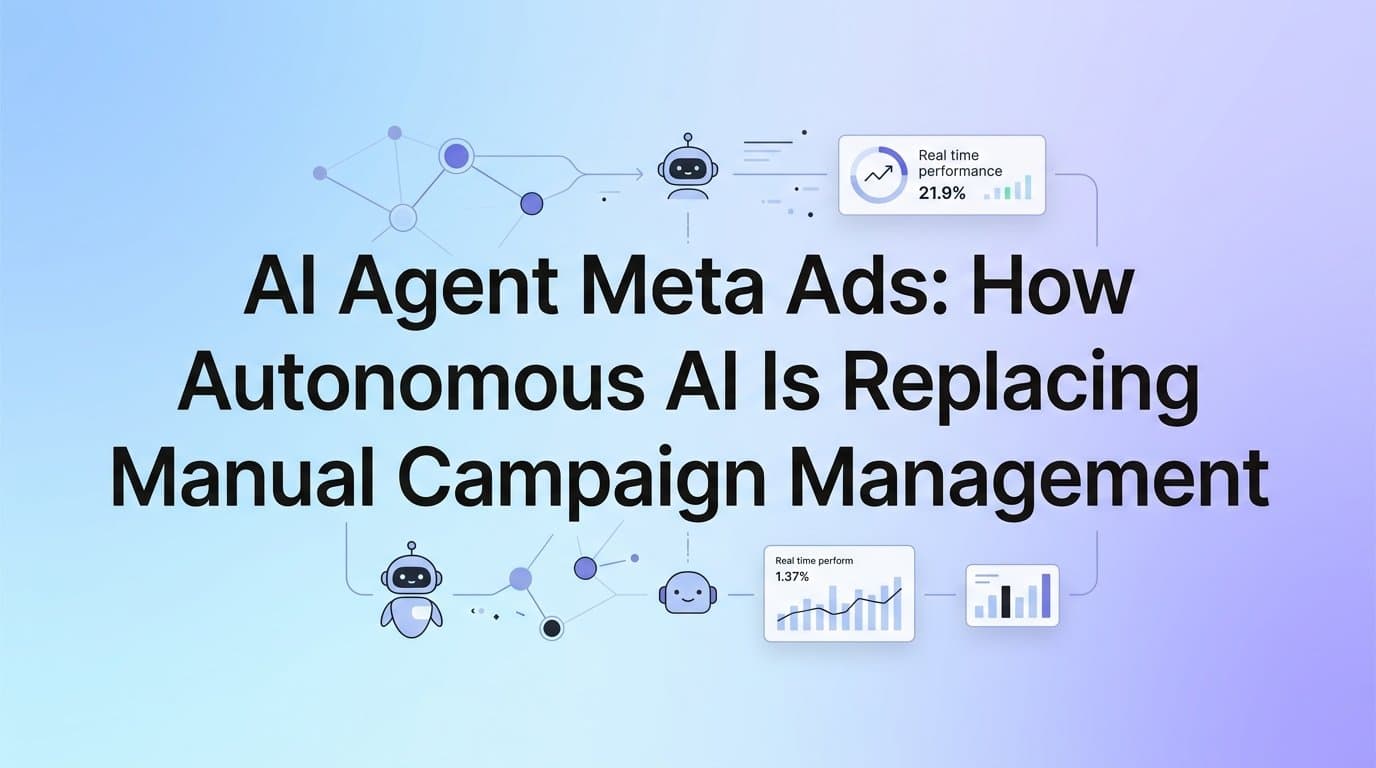
An AI agent operates through a fundamentally different loop. It perceives incoming data across multiple dimensions simultaneously, reasons about patterns and anomalies within that data, decides on an action based on that reasoning, executes the action, and then learns from the outcome. This is sometimes called the perceive-reason-act loop, and it is what separates an agent from a script.
In practical terms for Meta advertising, this distinction matters enormously. Consider a scenario where your CPA is rising on a particular ad set. An automation rule pauses it. An AI agent asks a different set of questions: Which audience segment is driving the cost increase? Is the creative fatigued, or is the offer losing relevance? Is there a competing ad set pulling from the same audience? What has historically worked in this account when similar patterns appeared?
The agent is not just reacting to a threshold. It is interpreting a situation. And because it is continuously running this loop across every campaign, ad set, and creative in your account simultaneously, it is doing something no individual advertiser can replicate manually: maintaining full-account awareness at all times.
This is why the distinction matters practically. A rule gives you a guardrail. An agent gives you a decision-maker that operates at the speed and scale the Meta platform actually demands.
The Four Core Jobs an AI Agent Handles in Your Meta Account
Once you understand what an AI agent actually is, the next question is what it does. In the context of Meta advertising, agent capabilities cluster into four distinct functions, each of which traditionally requires either significant human time or a separate specialized tool.
Creative Generation: The agent produces image ads, video ads, and UGC-style content from a product URL or a basic brief. This removes the designer and video editor from the workflow entirely. Rather than waiting for creative assets to be produced, reviewed, and revised over days, the agent generates ready-to-launch variations in minutes. Chat-based refinement means advertisers can request specific changes in plain language and the agent applies them, keeping humans in a directional role without pulling them into execution.
Campaign Building and Launch: The agent does not just generate creatives and hand them off. It analyzes historical campaign data from your account, ranks creatives and audiences by past performance, constructs complete campaign structures with optimized headlines and copy, and publishes directly to Meta. Every decision in that build process is explained, so you understand why a particular audience or headline was prioritized, not just what was chosen.
Budget and Bid Management: This is where the speed advantage becomes most visible. The agent continuously monitors ROAS, CPA, and CTR across every ad set, reallocating spend toward converting combinations and pausing waste in real time. Compare that to a weekly review cycle where underperforming spend runs unchecked for days. The agent is making those calls on an ongoing basis, not on a schedule that suits a human calendar.
Performance Analysis and Reporting: Rather than exporting data into a spreadsheet and manually sorting for insights, the agent surfaces winners through ranked leaderboards across creatives, audiences, headlines, and landing pages. Everything is scored against advertiser-defined benchmarks, so the next campaign does not start from scratch. It starts from a documented understanding of what has already worked in your specific account.
Taken together, these four functions represent the full campaign lifecycle. Creation, launch, optimization, and learning. Previously, each of these required either dedicated headcount or significant manual time. An AI agent handles all four in a continuous loop.
How AI Agents Generate and Test Ad Creatives at Scale
Creative is the primary performance lever in Meta advertising right now. As Meta's algorithm has become increasingly capable of finding audiences on its own, the quality and variety of your creatives has become the dominant variable separating campaigns that scale from campaigns that stall. This makes creative generation and testing one of the highest-value functions an AI agent can take on.
Here is where it gets interesting. The challenge with creative testing has never been knowing that you should test more variations. Everyone knows that. The challenge is the production bottleneck. Briefing a designer, waiting for concepts, reviewing rounds, getting final files, setting up ad sets manually. By the time you have launched five variations, a week has passed. An AI agent collapses that timeline by generating hundreds of variations across creatives, headlines, audiences, and copy combinations at both the ad set and ad level, then launching every combination in minutes rather than hours.
This approach is sometimes called combinatorial testing. Instead of running a clean A/B test between two options, you are launching a matrix of combinations and letting real performance data identify the winners. The agent interprets results across all variables simultaneously, which is something a human reviewing isolated tests simply cannot do at the same scale.
Competitive intelligence feeds into this process as well. Agents can analyze competitor ads from the Meta Ad Library, identify patterns in what is running and what appears to be performing, and use those patterns to inform new creative directions. This is not copying. It is informed creative strategy, the same thing a skilled media buyer does manually when they research the competitive landscape, but done systematically and at speed.
The chat-based refinement layer is worth highlighting specifically. Once a creative is generated, an advertiser can request changes in plain language: adjust the headline tone, swap the background, make the CTA more direct. The agent applies those changes without requiring a design file or a new brief. This keeps the human in a strategic, directional role while the agent handles all execution. It is a meaningful shift in how creative collaboration works.
From Launch to Optimization: The Continuous Decision Loop
Launching a campaign used to be the end of the setup phase and the beginning of the waiting phase. You would publish, let it run for a few days, pull the data, make some adjustments, and repeat. The problem with that cycle is that Meta's auction environment does not pause while you are reviewing last week's numbers. Budget is being spent, audiences are being reached, and the window for catching underperformers early is often missed.
An AI agent changes the post-launch dynamic entirely. Once a campaign goes live, the agent begins monitoring performance signals in real time. It identifies which creative and audience combinations are converting, and it starts shifting budget toward those winners without waiting for a scheduled review. Underperformers do not get a week of runway. They get evaluated against multiple signals simultaneously.
This multi-signal evaluation is important. A basic automation rule might pause an ad set when CPA exceeds a threshold, but that single metric does not always tell the full story. An agent considers ROAS, CPA, CTR, audience overlap, creative fatigue signals, and spend velocity together before making a call. An ad set with a temporarily elevated CPA but strong ROAS and a growing audience might be worth keeping. One with declining CTR, rising CPA, and high frequency might be signaling creative exhaustion. The agent reads the combination, not just the individual number.
The compounding advantage is where this gets particularly powerful over time. Every campaign an AI agent runs adds to its understanding of what works for that specific account. Early campaigns generate signal. Later campaigns use that signal to start with better creative choices, more relevant audiences, and smarter budget allocation from day one. The agent is not treating each campaign as a fresh start. It is building on accumulated account intelligence.
This is a meaningful differentiator compared to tools that reset with every campaign or that apply generic best practices without accounting for what has actually worked in your specific account history. The agent that learns your account is more valuable the longer it runs, and that compounding effect is one of the strongest arguments for adopting agent-driven advertising early.
Where Human Judgment Still Belongs in the Process
An honest assessment of AI agents for Meta ads has to include the limits, because they are real and they matter for how you structure your workflow.
AI agents excel at execution and pattern recognition. They are not equipped to make brand judgment calls. Decisions about brand positioning, tone of voice, whether a campaign aligns with a product launch strategy, or how to respond to a cultural moment still require a human. The agent can produce a hundred creative variations efficiently, but it cannot tell you whether a particular message is right for where your brand is right now. That is a strategic judgment that lives outside the performance data.
Data quality and account history also shape what an agent can do. A new account with limited campaign history gives the agent less signal to work with. In those early stages, human guidance on audience targeting and offer framing matters more, because the agent has not yet accumulated enough account-specific data to make confident decisions. This does not make the agent less useful. It just means the human contribution is higher at the start and decreases as the account history builds.
The transparency requirement is worth calling out specifically. A good AI agent explains its decisions. When it shifts budget, you should be able to see which signals drove that decision. When it pauses an ad set, you should understand why. This transparency is not just a nice feature. It is what separates an agent that builds your capability as an advertiser from one that creates dependency on outputs you cannot interpret or verify.
If the agent is a black box, you are outsourcing your judgment entirely. If the agent explains its reasoning, you are developing a better understanding of your account while the agent handles the execution. The second model is significantly more valuable long-term.
Getting Started: How to Work Alongside an AI Agent for Meta Ads
The practical question is how to actually begin. The transition to agent-driven advertising does not require abandoning everything you already know. It requires restructuring where your attention goes.
Start with the fundamentals. Connect your Meta ad account and feed the agent your product information and any existing campaign data. Define your performance benchmarks clearly before the first campaign launches: your target CPA, your minimum acceptable ROAS, the audience segments you want to prioritize. These inputs shape how the agent makes decisions, so being specific here pays off immediately.
From there, the division of responsibility becomes clearer. Your role is strategy, offer, and brand direction. The agent's role is creative production, combinatorial testing, budget management, and performance analysis. You are not removed from the process. You are elevated within it, spending time on decisions that actually require human judgment rather than on execution tasks that an agent handles faster and at greater scale.
AdStellar is built around exactly this model. The platform brings together AI ad creative generation, an AI campaign builder that analyzes your past performance and constructs complete Meta campaigns, bulk ad launch that creates and deploys hundreds of variations in minutes, AI insights that rank every creative and audience against your benchmarks, and a Winners Hub that keeps your best performers accessible for every new campaign. The entire workflow from creative generation through campaign launch to performance surfacing runs in one place, without requiring designers, video editors, or manual spreadsheet analysis.
The goal is not to remove the advertiser from the equation. It is to make sure the advertiser's time and judgment are applied where they actually create value, while the agent handles everything else.
The Bottom Line on AI Agent Meta Ads
The shift from manual campaign management to agent-driven advertising is not about replacing marketing expertise. It is about redirecting it. The busywork of creative production, campaign setup, bid adjustments, and performance review has always consumed the majority of a media buyer's time. An AI agent takes that work off the plate entirely, running a continuous loop of creation, launch, optimization, and learning that no individual can match at scale.
What remains, and what matters most, is the strategic layer: the brand judgment, the offer development, the understanding of your customer that no algorithm can replicate. An AI agent amplifies that judgment by making sure it is applied consistently and at speed, across every campaign, every creative, and every budget decision.
The advertisers who will benefit most from this shift are the ones who engage with it clearly: understanding what the agent does well, staying involved in the decisions that require human context, and using the transparency the agent provides to keep building their own expertise rather than outsourcing it.
If you are running Meta ads and spending most of your time on execution rather than strategy, that is the problem an AI agent is built to solve. Start Free Trial With AdStellar and see how an AI agent handles your Meta campaigns from creative to conversion, so you can focus on the work that actually moves the needle.