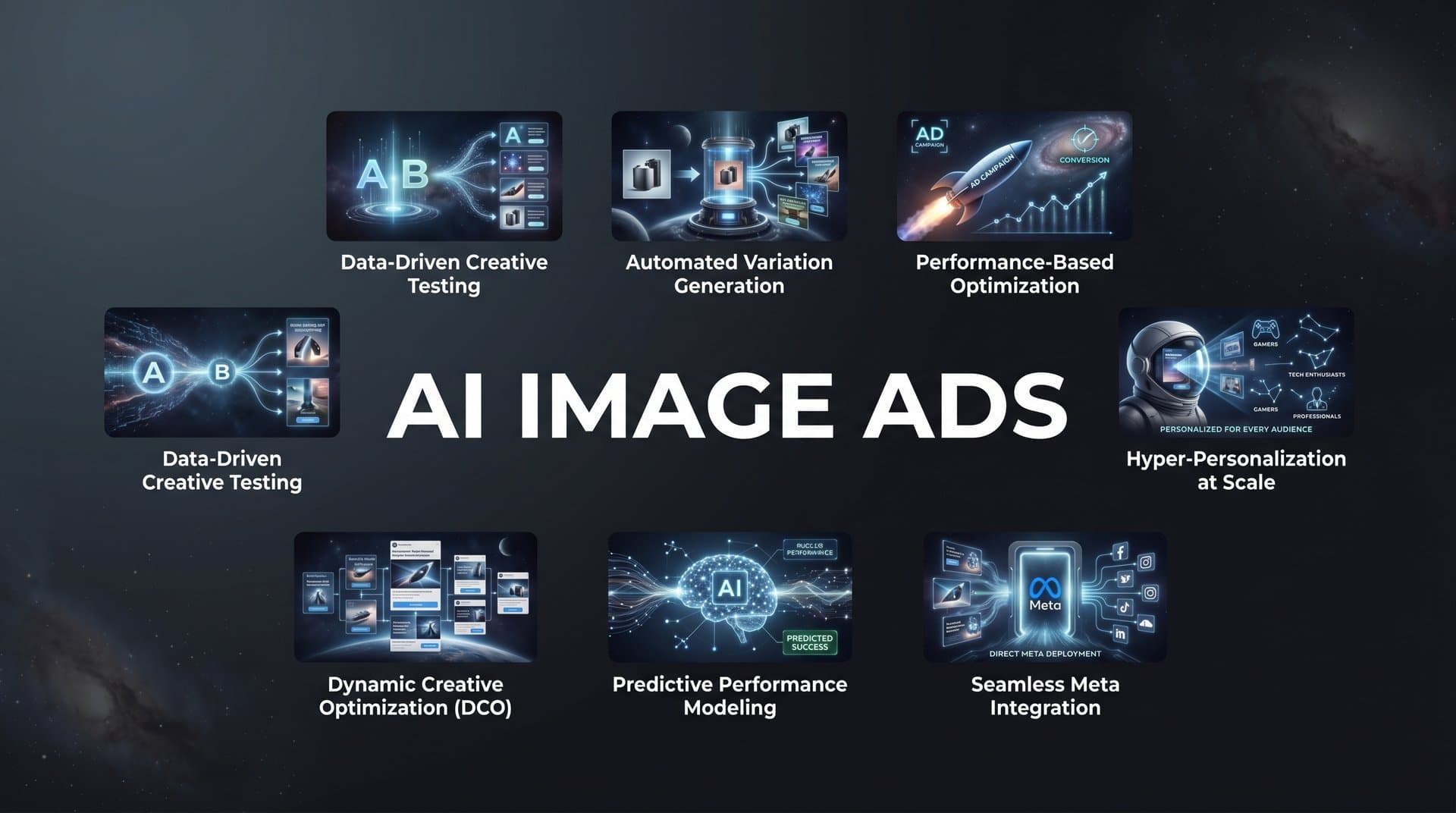
The era of spending hours in Photoshop crafting a single ad creative is fading fast. AI image ads have transformed how performance marketers approach creative production, enabling teams to generate, test, and scale visual ad content at a pace that was unthinkable just a few years ago.
But generating AI images is only half the equation. The real competitive edge comes from how you use AI image ads strategically: choosing the right visual concepts, testing at volume, analyzing what resonates, and feeding those insights back into your next creative cycle.
Whether you are a solo marketer running Meta campaigns for an ecommerce brand or an agency managing dozens of ad accounts, these seven strategies will help you move beyond basic AI image generation and build a system that consistently produces scroll-stopping, high-converting ad creatives. Each strategy focuses on a different stage of the creative lifecycle, from initial concept development through scaling your winners.
1. Start With Your Product URL, Not a Blank Canvas
The Challenge It Solves
One of the biggest friction points in AI creative generation is producing images that actually look like your product and reflect your brand. Generic AI outputs can feel disconnected from what you are actually selling, which means extra rounds of editing and a slower path to launch. Starting from scratch every time is inefficient and inconsistent.
The Strategy Explained
Instead of building from a blank prompt, anchor your AI image ad generation in real product data. When you input your product URL, the AI pulls in actual product details, imagery, and context to generate creatives that are grounded in what you are selling from the very first draft.
This approach dramatically reduces the gap between the initial AI output and a publish-ready ad. Your creatives reflect real product colors, features, and positioning rather than generic visual concepts that need to be heavily modified. Think of it like giving the AI a proper creative brief instead of a vague idea.
With AdStellar, you can paste a product URL and let the AI generate image ads, video ads, and UGC-style creatives directly from that source. The platform extracts the relevant details and builds scroll-stopping creatives without requiring you to write complex prompts or manually upload assets.

Implementation Steps
1. Identify the specific product page URL you want to advertise, making sure the page has strong product imagery and clear copy.
2. Input the URL into AdStellar's AI Creative Hub and select your preferred ad format, whether image, video, or UGC-style.
3. Review the initial outputs and use the platform's chat-based editing to refine any elements that need adjustment before moving to the next stage.
Pro Tips
Make sure your product landing page is well-optimized before using it as a creative source. Strong product photography, clear headlines, and detailed descriptions give the AI better raw material to work with. The better your input, the stronger your first-draft outputs will be.
2. Clone and Improve Competitor Creatives From the Meta Ad Library
The Challenge It Solves
Knowing what visual formats and messaging angles are working in your market is incredibly valuable, but most marketers lack a systematic way to act on that competitive intelligence. Manually recreating competitor ad styles is time-consuming and often results in creatives that feel like weak imitations rather than genuine improvements.
The Strategy Explained
The Meta Ad Library is a publicly available resource that gives you direct visibility into what your competitors are actively running. Instead of just observing those ads, you can use AI to generate your own improved versions that incorporate proven visual formats while replacing their product and branding with yours.
This is not about copying. It is about understanding what formats resonate with your shared audience and then executing those formats better. If a competitor is running a high-contrast product-on-white background format and it has been live for weeks, that is a signal the format is performing. Your job is to take that insight and produce a superior version using AI for Meta ads campaigns to accelerate the process.
AdStellar lets you clone competitor ads directly from the Meta Ad Library and generate your own versions with AI. You get the structural and visual intelligence of what is already working in your niche, combined with your own product, messaging, and brand identity.
Implementation Steps
1. Browse the Meta Ad Library and filter by your competitors or relevant keywords to identify ads that have been running for an extended period, which typically signals strong performance.
2. Note the visual format, layout style, color palette, and messaging angle of the ads that stand out.
3. Use AdStellar's clone feature to generate your own AI image ads inspired by those formats, then refine the output to reflect your unique product positioning and brand voice.
Pro Tips
Focus on the structural elements of competitor ads rather than surface-level aesthetics. A bold headline placement, a specific type of lifestyle imagery, or a particular call-to-action format can all be adopted and improved upon without crossing into imitation territory.
3. Generate Variations at Scale With Bulk Creative Production
The Challenge It Solves
Creative fatigue is one of the most persistent problems in Meta advertising. Even strong ads lose effectiveness over time as audiences see them repeatedly. If you are manually producing creatives one at a time, you simply cannot refresh your creative library fast enough to stay ahead of fatigue and keep your campaigns performing.
The Strategy Explained
Bulk creative production flips the traditional model on its head. Instead of laboring over a single "perfect" ad, you generate many variations quickly and let real performance data tell you which ones win. Industry best practices in performance marketing consistently point to creative volume as a key driver of faster winner identification.
The key is mixing variables systematically. Combine different visual concepts with different headlines, different copy angles, and different audience segments. Each combination becomes a data point that teaches you something about what resonates with your market. Understanding Meta ads campaign structure best practices helps ensure your test matrix is organized for clean data.
AdStellar's Bulk Ad Launch feature is built exactly for this. You can mix multiple creatives, headlines, audiences, and copy at both the ad set and ad level. The platform generates every combination and launches them to Meta in minutes, not hours. What used to take a team of designers and media buyers days to execute can now happen before your morning coffee gets cold.
Implementation Steps
1. Prepare a set of AI-generated image ad creatives covering different visual concepts, such as product-focused, lifestyle, benefit-led, and social proof formats.
2. Write multiple headline and copy variations for each creative concept, aiming for at least three to five options per visual.
3. Use AdStellar's Bulk Ad Launch to combine your creatives, headlines, and audiences into a comprehensive test matrix and launch everything to Meta simultaneously.
Pro Tips
Treat bulk production as a scientific experiment. Change one variable at a time when possible so you can isolate what is actually driving performance differences. When you find a winning combination, you will know exactly which element to credit and replicate.
4. Use Chat-Based Editing to Refine AI Creatives Without a Designer
The Challenge It Solves
Even when AI generates a strong first draft, there are almost always elements you want to adjust. Traditionally, that means going back to a designer, waiting for revisions, and losing momentum in your creative cycle. For smaller teams or solo marketers, this bottleneck can slow everything down significantly.
The Strategy Explained
Chat-based editing removes the designer dependency entirely. Instead of opening design software or submitting a revision request, you describe what you want to change in plain language and the AI updates the creative accordingly. It is as close to having a designer on demand as most performance marketers will ever get.
This approach is particularly powerful for rapid iteration. You can test a version with a red background, then ask the AI to switch it to dark navy, then try a version with larger product imagery, all in the time it would take to write a single design brief. The speed of iteration directly translates to faster learning and better final creatives, which is why Meta ads efficiency has become such a critical focus for modern marketing teams.
AdStellar's chat-based editing lets you refine any AI-generated ad using natural language prompts. Adjust colors, layouts, text placement, visual emphasis, and more without ever touching design software. No designers, no video editors, no back-and-forth. Just describe what you want and see it reflected immediately.
Implementation Steps
1. Start with your best AI-generated draft and identify the specific elements you want to adjust, such as background color, font size, image crop, or headline placement.
2. Use natural language prompts to describe each change clearly. Be specific: "Make the product larger and move the headline to the top" works better than "change the layout."
3. Iterate through several versions quickly, saving each variation so you can compare them side by side before deciding which to launch.
Pro Tips
Think of chat-based editing as a conversation, not a single command. Start with broad adjustments and progressively narrow in on the details. The more specific your prompts, the more precisely the AI can execute your vision without requiring multiple rounds of correction.
5. Let AI Score and Rank Every Creative Against Your Goals
The Challenge It Solves
With large volumes of ad creatives running simultaneously, manually reviewing performance data across every creative, headline, audience, and landing page becomes overwhelming. Many marketers end up making decisions based on incomplete data or gut instinct, which leads to budget being allocated to mediocre performers while true winners get overlooked.
The Strategy Explained
AI-powered scoring transforms how you evaluate creative performance. Instead of manually sorting through spreadsheets, you set your target goals and let AI evaluate every element against those benchmarks automatically. The result is a clear, ranked view of what is working and what is not, organized around the metrics that actually matter for your business.
This is where goal-based scoring becomes a genuine competitive advantage. A creative that drives high CTR but poor ROAS might look good on the surface but is actually hurting your bottom line. Leveraging an AI marketing agent for ads that is calibrated to your specific KPIs cuts through vanity metrics and surfaces the ads that are genuinely moving the needle.
AdStellar's AI Insights feature uses leaderboard rankings to rank your creatives, headlines, copy, audiences, and landing pages by real metrics like ROAS, CPA, and CTR. Set your target goals and the AI scores everything against your benchmarks so you can instantly spot winners and reuse them in future campaigns.
Implementation Steps
1. Define your primary KPI for each campaign, whether that is ROAS, CPA, CTR, or another metric, and input those targets into AdStellar's goal-based scoring system.
2. Allow your campaigns to run long enough to accumulate meaningful data, then review the AI-generated leaderboard to identify top and bottom performers.
3. Use the rankings to make data-driven decisions about which creatives to scale, which to pause, and which elements to carry forward into your next creative cycle.
Pro Tips
Review your leaderboard rankings regularly rather than waiting until the end of a campaign. Early signals can tell you a lot about creative performance, and catching a strong performer early means you can reallocate budget toward it before significant spend has been wasted on weaker ads.
6. Build a Winners Library to Fuel Future Campaigns
The Challenge It Solves
Most performance marketing teams have experienced the frustration of rediscovering the same insights repeatedly. A creative format works brilliantly in Q4, but by Q2 of the following year, that knowledge has been lost and the team is starting from scratch again. Without a structured system for capturing winners, every campaign cycle begins with the same trial and error.
The Strategy Explained
A winners library is your institutional memory for creative performance. It catalogs your best-performing AI image ads alongside their actual performance data so you can reference, reuse, and remix winning elements in future campaigns rather than reinventing the wheel every time.
The value compounds over time. The longer you maintain a winners library, the richer your understanding of what visual formats, messaging angles, and creative structures resonate with your audience. New campaigns become faster to build because you are starting from a foundation of proven elements rather than untested ideas. This is especially valuable for agencies that need to manage Facebook ads for clients across multiple accounts simultaneously.
AdStellar's Winners Hub keeps your best-performing creatives, headlines, audiences, and more all in one place with real performance data attached. When you are ready to build a new campaign, you can select any winner and instantly add it to your next campaign. No digging through old ad accounts or trying to remember which version performed best.
Implementation Steps
1. Establish a clear performance threshold for what qualifies as a "winner" in your account, based on your primary KPIs, and consistently apply that standard across all campaigns.
2. After each campaign cycle, review your top performers and save them to AdStellar's Winners Hub with notes on the campaign context, such as the audience, objective, and time period.
3. Before launching any new campaign, review your Winners Hub first to identify elements that can be incorporated or remixed rather than building entirely from scratch.
Pro Tips
Tag your winners by category, such as product type, audience segment, or campaign objective, so you can quickly filter for relevant examples when building new campaigns. A well-organized winners library becomes one of your most valuable creative assets over time.
7. Close the Loop With AI Campaign Intelligence
The Challenge It Solves
Running individual campaigns in isolation means you are always starting from zero. Each new campaign requires the same manual analysis, the same guesswork about audiences and creative angles, and the same ramp-up period before you find what works. Without a system that learns from historical performance, you are perpetually in discovery mode rather than building on proven foundations.
The Strategy Explained
Closing the loop means creating a continuous improvement cycle where every campaign makes the next one smarter. AI campaign intelligence analyzes your historical performance data to identify patterns across creatives, audiences, headlines, and copy, then uses those patterns to inform and optimize future creative and campaign decisions automatically.
This is the difference between using AI as a one-time tool and building an AI-powered system. The former gives you a faster way to do what you were already doing. The latter fundamentally changes how your campaigns improve over time, with each cycle generating insights that feed directly into the next. Exploring AI marketing automation for Meta ads reveals just how much of this cycle can now run without manual intervention.
AdStellar's AI Campaign Builder is designed for exactly this. The AI analyzes your past campaigns, ranks every creative, headline, and audience by performance, and builds complete Meta Ad campaigns in minutes. Every decision comes with full transparency so you understand the strategy behind it, not just the output. And because the AI gets smarter with every campaign, your results compound over time rather than plateauing.
This is also where integration with attribution tools becomes critical. AdStellar integrates with Cometly for Meta ads attribution tracking, which means the performance data flowing back into your AI campaign intelligence is accurate and complete, not just last-click metrics that can mislead optimization decisions.
Implementation Steps
1. Ensure your attribution tracking is properly set up so the performance data feeding into your AI analysis is accurate and reflects true conversion paths.
2. After each campaign, allow AdStellar's AI to analyze the results and generate recommendations for your next campaign based on historical performance patterns.
3. Review the AI's rationale for each recommendation before launching, so you build an understanding of the patterns driving performance in your account over time.
Pro Tips
The more campaign data you accumulate in AdStellar, the more powerful the AI intelligence becomes. Treat early campaigns as an investment in the system's learning curve. Even campaigns that underperform are valuable because they give the AI contrast data that sharpens its future recommendations.
Putting It All Together: Your AI Image Ad Workflow
These seven strategies are not isolated tactics. They form a connected workflow that covers every stage of the creative lifecycle, and each stage feeds directly into the next.
It starts with generation. Strategies 1 and 2 give you a smarter starting point, whether that is grounding your creatives in real product data or drawing on competitive intelligence from the Meta Ad Library. From there, Strategy 3 takes those initial concepts and scales them into a comprehensive test matrix through bulk creative production.
Once you have volume, Strategies 4 and 5 help you refine and evaluate. Chat-based editing lets you iterate quickly without a designer, while AI scoring cuts through the noise to surface which creatives are genuinely driving your goals. Strategy 6 then captures those winners in a structured library so your best creative work is never lost or forgotten.
Finally, Strategy 7 closes the loop by feeding all of that accumulated performance intelligence back into your next campaign, creating a system that continuously learns and improves rather than resetting with each new launch.
The best AI image ad strategy is not about any single creative. It is about building a system that gets smarter over time, and that system works best when it operates on a single, integrated platform rather than a fragmented stack of disconnected tools.
AdStellar handles this entire lifecycle in one place: from generating image ads, video ads, and UGC-style creatives from your product URL, to launching campaigns directly to Meta, to surfacing your winners with real-time AI insights and leaderboard rankings. No designers, no video editors, no guesswork.
If you are ready to move from manual creative production to a fully integrated AI image ad workflow, Start Free Trial With AdStellar and experience the complete system firsthand. The 7-day free trial gives you access to the full platform so you can see exactly how each of these strategies works in practice, with your own products, your own campaigns, and your own performance data driving the results.