Meta advertising budgets have a way of disappearing faster than you can say "campaign optimization." You check your ad account Monday morning—everything looks fine. By Wednesday afternoon, three ad sets have burned through their weekly allocation while your best performer sits starved at $20 per day. You know something needs to change, but which lever do you pull? Increase the winner's budget and risk triggering Meta's learning phase reset? Cut the losers entirely and potentially miss a turnaround? Redistribute everything and start from scratch?
This is the budget allocation trap that keeps media buyers up at night. The decisions feel urgent, the data feels incomplete, and the consequences of getting it wrong compound daily. Meanwhile, your competitors might be running the exact same campaigns with better results simply because their budget distribution is smarter.
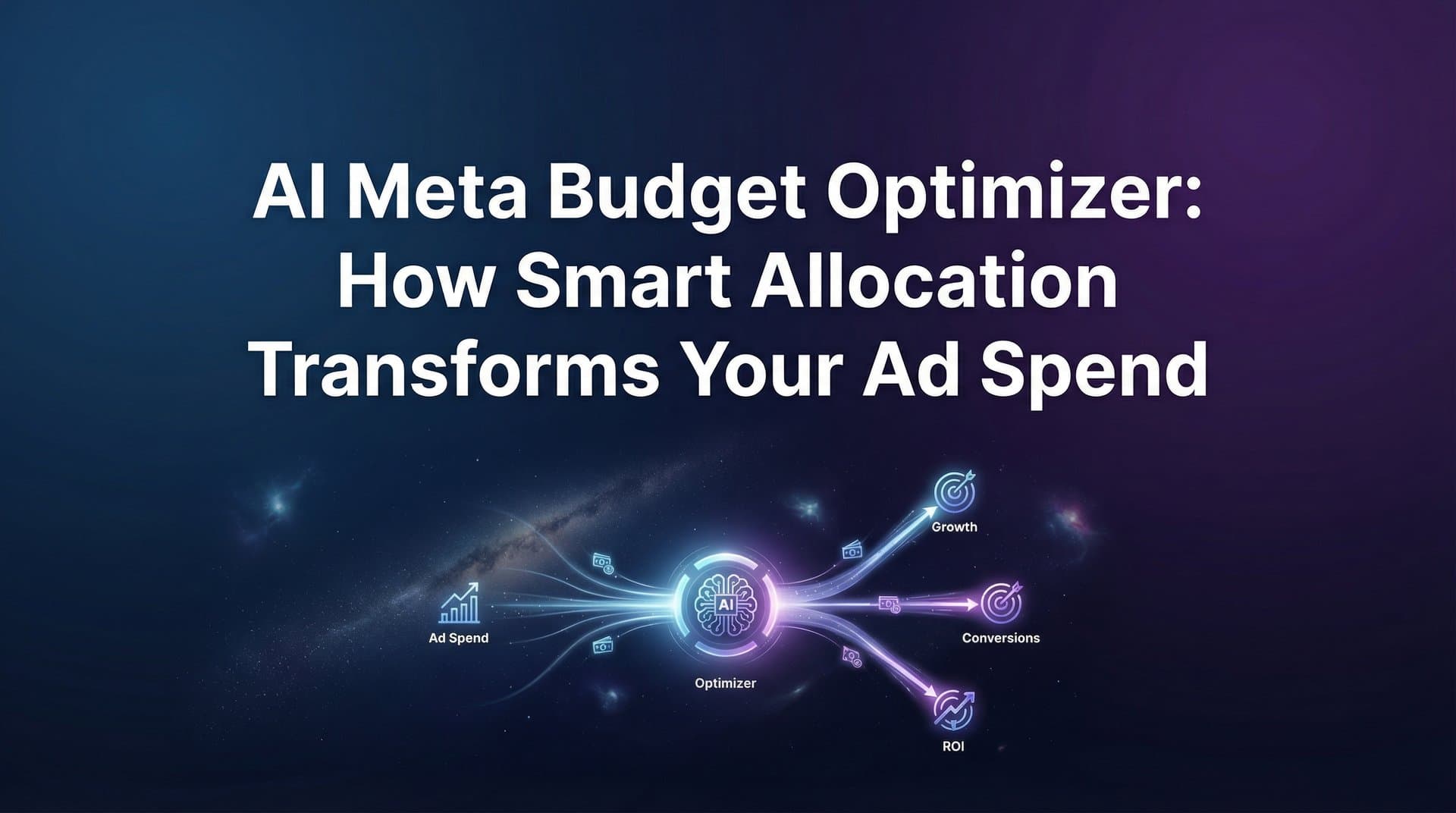
AI Meta budget optimizers promise a way out of this cycle. These systems use machine learning to make allocation decisions continuously—not just when you remember to check your dashboard. They process signals humans miss, adjust budgets in real-time, and theoretically eliminate the guesswork that leads to wasted spend. But understanding how they actually work, what they can realistically achieve, and how to set them up for success requires looking beyond the marketing promises and into the practical mechanics of intelligent budget allocation.
The Budget Allocation Problem Every Meta Advertiser Faces
Manual budget management operates on a fundamental limitation: you're making decisions based on yesterday's data to influence tomorrow's performance. By the time you notice an ad set underperforming, it may have already wasted hundreds of dollars. When you spot a winner and increase its budget, you're often catching the tail end of its peak performance rather than the beginning.
The challenge intensifies with scale. Managing five ad sets? You can probably keep tabs on performance and make reasonable allocation decisions weekly. Managing fifty ad sets across ten campaigns? The cognitive load becomes impossible. You start relying on shortcuts—checking only the top spenders, making changes based on the most dramatic swings, or worse, setting budgets once and hoping for the best.
Meta's own Campaign Budget Optimization (CBO) attempts to solve this by automatically distributing budget across ad sets within a campaign. But CBO operates with constraints that often frustrate experienced advertisers. It tends to concentrate spend heavily on one or two ad sets, sometimes abandoning promising variants before they exit the learning phase. It doesn't consider cross-campaign dynamics—your winning ad set in Campaign A might be cannibalizing performance in Campaign B, but CBO has no visibility into that relationship.
Traditional rules-based automation offers another approach: "If ROAS drops below X, decrease budget by Y%." These rules sound logical in theory but fail in practice because they lack contextual intelligence. A temporary ROAS dip might signal audience fatigue requiring creative refresh, or it might reflect normal weekend performance patterns, or it could indicate increased competition in the auction. A simple rule cannot distinguish between these scenarios, leading to budget cuts when you should be doubling down or budget increases when you should be pausing entirely. Understanding the full scope of Meta ads budget allocation problems helps clarify why traditional approaches fall short.
The emotional dimension compounds the technical challenge. When you've manually built a campaign, you develop attachment to it. You remember the hours spent crafting ad copy or the creative brief that took three rounds of revisions. This makes it psychologically difficult to cut budgets aggressively when data suggests you should. Conversely, fear of missing out can lead to over-funding experimental campaigns that lack sufficient signal to justify the spend.
How AI Budget Optimizers Actually Work
At their core, AI budget optimization systems are pattern recognition engines trained on your historical advertising data. They analyze thousands of data points across your campaigns—conversion rates by time of day, ROAS trends by audience segment, creative fatigue curves, seasonal performance variations—to identify patterns that correlate with success.
The machine learning models powering these systems don't just look at surface-level metrics like click-through rate or cost per acquisition. They examine the relationships between variables: how does increasing budget on this ad set affect performance in related campaigns? When this audience segment saturates, which alternative audiences tend to perform well? If creative engagement drops by X%, what's the probability of a conversion rate decline within the next 48 hours?
This is where AI diverges fundamentally from rules-based automation. A rule says "if this happens, do that." Machine learning says "based on 10,000 similar situations in your account history, here's the probability distribution of outcomes for different budget allocation strategies, weighted by your current optimization goal."
Real-time data processing enables these systems to make micro-adjustments continuously rather than waiting for your daily dashboard review. While you sleep, the AI might shift $200 from an ad set showing early fatigue signals to one demonstrating accelerating conversion velocity. By the time you check your account in the morning, the reallocation has already captured the high-performance window you would have missed entirely with manual management.
Predictive algorithms add another dimension by forecasting performance trajectories. Instead of reacting to what happened yesterday, the AI anticipates what's likely to happen tomorrow. It recognizes that an ad set currently showing modest ROAS has engagement patterns matching your historical top performers at the same stage of their lifecycle. The system increases budget proactively, capturing the upward trajectory before it becomes obvious in the dashboard metrics everyone else is watching.
The learning loop creates compounding improvements over time. Each budget allocation decision generates new performance data. The AI analyzes whether its predictions were accurate, adjusts its models accordingly, and applies those refinements to future decisions. Your account-specific patterns—the peculiarities of your audience, the seasonality of your product, the creative styles that resonate with your customers—become embedded in the optimization logic. This is the foundation of effective automated budget optimization for Meta ads.
Think of it like this: a human advertiser might remember "that campaign with the carousel ads worked really well last quarter." An AI system remembers the precise budget allocation sequence that maximized that campaign's performance, the leading indicators that signaled when to scale, the saturation point where returns diminished, and the audience overlap patterns that affected cross-campaign dynamics. It then applies those specific learnings to current campaigns with similar characteristics.
Key Capabilities That Drive Better Results
Cross-campaign budget fluidity represents one of the most powerful capabilities AI optimizers bring to Meta advertising. Traditional management treats each campaign as an isolated budget silo. You might allocate $1,000 to Campaign A and $500 to Campaign B, then manually adjust those allocations weekly based on performance. AI systems can move budget between campaigns continuously based on real-time opportunity cost.
When Campaign A's best ad set hits audience saturation while Campaign B discovers a high-performing audience segment, the AI can reallocate hundreds of dollars within hours. This fluidity captures performance windows that manual management simply cannot access. By the time you notice the shift in your weekly review, the opportunity may have passed. Implementing smart Meta ads budget allocation strategies requires this level of dynamic responsiveness.
Learning phase acceleration addresses one of Meta's most frustrating platform constraints. New ad sets need approximately 50 conversions within a 7-day window to exit the learning phase and stabilize performance. With manual budget management, you might cautiously allocate $50 per day to a new ad set, extending the learning phase unnecessarily. AI optimizers can concentrate budget strategically to reach the 50-conversion threshold faster when early signals suggest strong potential, then adjust allocation based on post-learning performance.
This capability becomes especially valuable when testing new creative concepts or audiences. Instead of spreading budget evenly across ten test ad sets—ensuring all of them languish in learning phase purgatory—the AI can identify the two or three showing the strongest early signals and concentrate budget to exit learning phase quickly. The clear winners and losers emerge faster, enabling more rapid iteration.
Dayparting and audience-timing optimization operate on a level of granularity that humans cannot monitor continuously. You might know conceptually that your audience converts better on weekday evenings than weekend mornings. But do you know that Thursday 7-9 PM converts at 40% higher ROAS than Thursday 9-11 PM? Or that your audience's engagement patterns shift by 20% during the first week of the month due to paycheck timing?
AI budget optimizers can detect these micro-patterns and adjust allocation hourly. During high-performance windows, budget increases automatically to capture maximum volume. During low-performance periods, spend decreases to minimize waste. These adjustments happen around the clock, including weekends and holidays when you're not actively managing campaigns.
Audience saturation detection prevents one of the most common budget allocation mistakes: continuing to pour money into an audience that's already seen your ads too many times. The AI recognizes the engagement decline patterns that precede conversion rate drops and reallocates budget before performance deteriorates noticeably. This is particularly valuable for smaller audience segments where saturation happens quickly but might not be obvious in daily metrics reviews. Pairing this with AI Meta targeting optimizer capabilities ensures you're always reaching fresh, responsive audiences.
Setting Up AI Budget Optimization for Success
Defining clear optimization goals forms the foundation of effective AI budget allocation. The system needs to understand what success looks like for your specific business. Are you optimizing for maximum return on ad spend regardless of volume? Minimum cost per acquisition with a volume floor? Conversion volume within a target CPA range? Each goal leads to fundamentally different budget allocation strategies.
The specificity of your goals matters enormously. "Maximize ROAS" is too vague—maximize at what volume threshold? A campaign generating 10 conversions at 8x ROAS might be "better" by pure ROAS metrics than one generating 1,000 conversions at 4x ROAS, but the latter probably serves your business objectives more effectively. Define your goals with enough nuance that the AI can make allocation decisions aligned with actual business value.
Many advertisers make the mistake of setting a single optimization goal across all campaigns. In reality, different campaigns often serve different strategic purposes. Your prospecting campaigns might optimize for efficient customer acquisition cost, while retargeting campaigns optimize for maximum conversion volume. Your brand awareness campaigns might optimize for engagement metrics rather than direct conversions. The AI needs distinct goals for each campaign type to allocate budgets appropriately. Understanding how to structure Meta ad campaigns helps you set these differentiated goals effectively.
Establishing appropriate guardrails prevents the AI from making technically optimal but strategically problematic decisions. Without guardrails, an AI optimizer might concentrate 90% of your budget on your single best-performing ad set—maximizing short-term ROAS but eliminating all testing and creating dangerous dependence on one creative-audience combination.
Budget floors ensure that strategic priorities receive minimum funding even when they're not the top performers. You might set a $100 daily floor for new audience testing regardless of immediate ROAS, recognizing that audience discovery is a long-term strategic investment. Similarly, budget ceilings prevent over-concentration that could trigger Meta's learning phase resets or exhaust audience segments too quickly.
The guardrails should reflect your specific risk tolerance and business model. An e-commerce business with high repeat purchase rates might allow more aggressive budget concentration because customer lifetime value extends beyond the first conversion. A lead generation business with longer sales cycles might require more conservative guardrails to ensure consistent lead flow rather than volatile spikes.
Creating effective feedback loops ensures the AI's allocation decisions continuously improve based on actual business outcomes. This goes beyond feeding conversion data back into the system—it requires connecting advertising performance to downstream metrics like customer quality, lifetime value, and revenue attribution.
If the AI optimizes purely for Meta-reported conversions without understanding that customers from Audience A have 3x higher lifetime value than those from Audience B, it will allocate budgets suboptimally. The feedback loop should incorporate your CRM data, revenue tracking, and customer behavior patterns so the AI learns which conversions are actually most valuable to your business.
Regular calibration sessions help align AI optimization with evolving business priorities. Your Q4 holiday campaign goals differ from Q1 customer retention goals. New product launches require different budget allocation strategies than steady-state catalog promotion. Schedule monthly reviews where you assess whether the AI's allocation patterns match current strategic priorities and adjust goals or guardrails accordingly.
Common Pitfalls and How to Avoid Them
Over-reliance on short-term metrics represents the most prevalent mistake in AI budget optimization. The algorithms optimize for the goals you give them, and if those goals emphasize immediate ROAS or next-day CPA, the system will starve campaigns that deliver long-term value through brand building or audience education.
This creates a particularly insidious problem because the AI's decisions appear correct based on the metrics you're tracking. A brand awareness campaign might show poor immediate conversion rates while significantly improving conversion rates in your retargeting campaigns weeks later. If the AI only sees the direct attribution, it will reallocate budget away from the brand campaign despite its actual positive impact on your overall funnel. Avoiding Meta advertising budget waste requires looking beyond surface-level metrics.
The solution requires incorporating longer attribution windows and multi-touch attribution models into your optimization goals. Instead of optimizing purely for 1-day click conversions, weight 7-day and 28-day view-through conversions appropriately. Consider view-through conversion data even though it's less precise, recognizing that brand exposure influences purchase decisions beyond direct clicks.
Insufficient data volume undermines AI optimization effectiveness more than most advertisers realize. Machine learning models need substantial data to identify reliable patterns and make confident predictions. If you're spending $500 per month across five campaigns, there simply isn't enough conversion volume for the AI to distinguish signal from noise.
As a general threshold, AI budget optimization works best when individual ad sets generate at least 50-100 conversions monthly. Below that volume, the statistical confidence in performance patterns is too low for reliable optimization. The AI might make budget allocation decisions based on random variance rather than true performance differences, potentially making results worse than simple even budget distribution.
If your account doesn't meet these volume thresholds, focus the AI on higher-level budget allocation decisions rather than ad set micro-optimization. Optimize budget distribution across campaigns rather than across dozens of ad sets. Consolidate similar audiences to increase conversion volume per segment. Or recognize that for low-volume accounts, simpler manual management might actually outperform AI optimization until scale increases.
Misaligned goals between AI settings and actual business objectives create optimization toward the wrong outcomes. This often happens when advertisers accept default optimization settings without considering their specific business model. Meta's platform defaults to optimizing for conversions, but your business might care more about conversion value, customer quality, or specific conversion events beyond the initial purchase.
The misalignment becomes particularly problematic when your conversion funnel includes multiple stages. If you optimize for email signups but actually care about customers who progress to paid plans, the AI will allocate budgets toward audiences that generate signups regardless of downstream conversion quality. You'll see improving signup metrics while revenue stagnates or declines.
Audit your optimization goals quarterly by tracing them back to revenue impact. For each goal you've set, ask: "If the AI perfectly optimizes this metric, will our revenue increase proportionally?" If the answer isn't clearly yes, the goal needs refinement. This might mean switching from conversion optimization to value optimization, adjusting your conversion event to reflect higher-funnel actions, or incorporating offline conversion data that captures the full customer journey.
Ignoring creative fatigue in budget allocation creates another common failure mode. The AI might identify an ad set performing exceptionally well and concentrate budget heavily on it. In the short term, this maximizes ROAS. But creative fatigue sets in as your audience sees the same ads repeatedly, engagement declines, and conversion rates drop. By the time the metrics deteriorate enough for the AI to reallocate budget, you've wasted significant spend on the declining tail of the performance curve. This contributes to inconsistent Meta ad results that frustrate advertisers.
Effective AI budget optimization incorporates creative refresh signals into allocation logic. The system should recognize engagement pattern changes that precede conversion rate declines and proactively shift budget toward fresh creative variants before performance degrades noticeably. This requires the AI to consider metrics beyond direct conversion data—frequency, engagement rate trends, and creative-specific fatigue patterns.
Measuring the Impact of AI-Driven Budget Allocation
Budget efficiency ratio provides one of the clearest metrics for quantifying AI optimization impact. Calculate the revenue or conversion value generated per dollar of ad spend, then compare this ratio before and after implementing AI budget allocation. The improvement reveals how much more efficiently your budget is being deployed.
Track this metric at multiple levels: overall account efficiency, campaign-level efficiency, and efficiency by audience segment or creative type. The granular view helps you understand where AI optimization delivers the most value. You might discover that AI budget allocation improves efficiency dramatically in prospecting campaigns but provides minimal benefit in retargeting where manual management already performed well. Using Meta ads dashboard software makes this multi-level tracking significantly easier.
Time saved on manual optimization represents substantial value even when performance improvements are modest. Calculate the hours you previously spent on weekly budget reviews, allocation adjustments, and performance analysis. Multiply by your hourly rate or the opportunity cost of that time spent on strategic work instead of tactical budget management.
For many media buyers and agencies, this time savings alone justifies AI budget optimization adoption. Instead of spending five hours weekly adjusting budgets across client accounts, you can invest that time in creative strategy, audience research, or landing page optimization—activities that often deliver higher returns than incremental budget reallocation.
A/B testing AI allocation against manual management provides the most rigorous performance assessment. Split your campaigns into two groups with similar characteristics—audience size, budget level, creative types. Manage one group with AI budget optimization and the other with your standard manual approach. Run the test for at least 30 days to account for weekly performance variations and learning phase effects.
Compare not just the top-line metrics like ROAS or CPA, but also consistency and volatility. AI optimization often delivers more stable day-to-day performance by smoothing out the manual management mistakes that create performance swings. A slightly lower average ROAS with much lower volatility might actually be preferable for business planning and cash flow management.
The test should account for the AI's learning curve. Performance in week one might not match week four as the system accumulates data and refines its models. Extend the test long enough to capture the AI's performance after it's had time to learn your account patterns rather than judging it purely on initial results.
Long-term tracking considerations matter because AI optimization compounds over time. The system's performance in month one provides a baseline, but month six performance should be noticeably better as the AI has accumulated more data about your specific account patterns, seasonal variations, and audience behaviors.
Track improvement velocity—how quickly does AI performance improve relative to your manual management baseline? Some systems show rapid initial gains that plateau, while others demonstrate steady compounding improvements over extended periods. Understanding your AI optimizer's improvement curve helps set realistic expectations and determines optimal evaluation timeframes.
Monitor the AI's decision patterns qualitatively, not just quantitatively. Review the budget allocation changes it makes weekly and ask whether they align with your strategic understanding of the account. If the AI consistently makes decisions that seem counterintuitive but deliver results, you're learning something valuable about your account that your manual management missed. If the decisions seem random or contradict proven patterns, the AI might lack sufficient data or have misaligned goals.
Making AI Budget Optimization Work for Your Business
AI Meta budget optimization fundamentally changes the advertiser's role from tactical executor to strategic director. Instead of spending your time adjusting campaign budgets and monitoring daily performance fluctuations, you focus on defining clear goals, establishing appropriate guardrails, and ensuring the AI has access to the data it needs to make intelligent decisions.
This shift requires trust but not blind faith. The most effective approach pairs AI automation with strategic oversight. Let the system handle the continuous micro-adjustments that humans cannot monitor around the clock, while you maintain responsibility for the strategic decisions that require business context the AI doesn't possess—creative direction, audience strategy, promotional calendar alignment, and competitive positioning. Learning best practices for Meta ad automation helps you strike this balance effectively.
The technology works best when you recognize both its strengths and limitations. AI excels at pattern recognition across large datasets, real-time optimization based on clear goals, and executing repetitive decisions with perfect consistency. It struggles with strategic context, understanding causation versus correlation, and adapting to unprecedented situations outside its training data.
Start testing AI budget optimization on a portion of your ad spend rather than converting your entire account immediately. Choose campaigns with sufficient conversion volume for the AI to learn effectively—typically your established performers rather than experimental tests. Monitor the results closely for the first month, adjusting goals and guardrails as you learn how the system interprets your optimization objectives.
As you gain confidence in the AI's decision-making patterns, gradually expand its scope. The learning curve applies to you as much as to the algorithm—understanding how to set effective goals, establish appropriate guardrails, and interpret the AI's allocation decisions takes time and experimentation.
Ready to transform your advertising strategy? Start Free Trial With AdStellar AI and be among the first to launch and scale your ad campaigns 10× faster with our intelligent platform that automatically builds and tests winning ads based on real performance data. Our AI agents don't just optimize budgets—they analyze your best-performing creatives, headlines, and audiences, then build and launch new campaign variations automatically, creating a continuous optimization loop that compounds results over time.