There's a creative paradox sitting at the heart of most Meta advertising strategies right now. The content that performs best, the kind that stops thumbs mid-scroll and actually converts, looks nothing like what most brands spend their budget producing. UGC-style content, raw, direct-to-camera, creator-made videos that feel like a recommendation from a friend rather than a pitch from a brand, consistently outperforms polished production. Yet producing that content at any meaningful scale is slow, expensive, and deeply unpredictable.
Real UGC production means finding creators, briefing them, waiting on drafts, managing revisions, and hoping the final output actually matches what you needed. Do that for five variations and you've spent weeks and a significant budget. Do it for fifty and the math simply doesn't work.
This is exactly the problem that AI powered UGC generation was built to solve. By using AI avatar technology, synthetic voiceovers, and dynamic scripting, modern platforms can produce content that carries all the authenticity signals of creator-made video without any of the production overhead. The result is a scalable creative engine that lets performance marketers test more angles, find winners faster, and keep their Meta campaigns fed with fresh, high-performing content.
This article breaks down how the technology works, why it performs, and how to build it into your Meta advertising strategy from creative generation all the way through to campaign optimization.
Why UGC-Style Content Has a Natural Edge on Meta
Meta's feeds, both Facebook and Instagram, are built around social content. People open these apps to see posts from friends, creators they follow, and communities they care about. The visual language of that environment is casual, direct, and personal. Polished brand advertising sits outside that language. Audiences can spot it instantly, and when they do, they scroll past.
UGC-style content works because it fits in. A direct-to-camera video with natural lighting, conversational delivery, and informal pacing looks like something a real person posted. It doesn't trigger the mental shortcut that says "this is an ad, skip it." Instead, it earns a second of attention, and in Meta advertising, that second is everything.
The performance signals that come with this attention are real. UGC-style ads tend to generate stronger engagement, higher click-through rates, and lower cost-per-acquisition compared to heavily produced brand creative, particularly at the top of the funnel where trust is still being established. Meta's own creative guidance has consistently pointed toward authentic, native-feeling content as a driver of ad performance.
The traditional production model, however, makes this advantage difficult to capture at scale. Sourcing creators through platforms or agencies, briefing them, reviewing multiple rounds of content, and managing delivery timelines can stretch a single creative from brief to final asset across days or weeks. For a team that needs to test dozens of variations simultaneously, that timeline kills the strategy before it starts.
The cost compounds the problem. Creator fees vary widely depending on tier and niche, and when you factor in revision rounds and the unpredictability of creative output, the cost per usable variation can be significant. Teams end up running fewer variations than they need, which means less data, slower learning, and a narrower shot at finding the angles that actually convert.
The core opportunity is straightforward: if you can produce content that carries the authenticity signals of real UGC without the production bottleneck, you unlock a creative advantage that scales with your ambition rather than against it. That's the premise behind AI powered UGC generation, and it's why performance marketers are paying close attention.
Breaking Down AI Powered UGC Generation
The term gets used loosely, so it's worth being precise. AI powered UGC generation refers to AI systems that produce video and image content specifically designed to look and feel like organic, creator-made content rather than polished brand advertising. The goal isn't just automation for its own sake. It's authenticity simulation at scale.
This distinguishes AI UGC from standard AI ad creative in an important way. Plenty of AI tools can generate visually clean image ads or produce copy variations automatically. That's automation. AI UGC generation is doing something more specific: it's replicating the visual and tonal signals that make content feel native to a social feed.
Those signals are well understood by performance marketers. Direct-to-camera presentation creates the feeling of a personal recommendation. Conversational scripting sounds like someone talking, not a brand writing copy. Natural lighting aesthetics and informal pacing remove the glossy production sheen that audiences associate with advertising. When these elements come together, the content reads as organic even when it isn't.
The key components that make this possible include several interconnected technologies working together. AI avatar technology generates realistic on-screen presenters, human-looking figures that can deliver a script without requiring a real actor, camera crew, or studio. Synthetic voiceover systems produce natural-sounding speech from written scripts, with control over tone, pace, and style. Dynamic script generation allows AI to create conversational copy tailored to a specific product, audience, or hook angle. And visual styling tools apply the aesthetic choices that make content feel creator-made rather than brand-produced.
The result is a video or image asset that a viewer scrolling their feed would reasonably interpret as content from a real person. That perception is the performance driver. It's not about deceiving anyone; it's about speaking the visual language of the platform where the ad is running.
Understanding this distinction matters when evaluating AI creative tools. The question isn't just whether a platform can generate content quickly. It's whether the output carries the specific signals that make UGC-style content perform. Speed without authenticity simulation just produces more generic ads faster.
From Product URL to Finished Creative: The Generation Process
One of the most practically useful aspects of modern AI UGC platforms is how little input they require to produce usable output. The process typically starts with something as simple as a product URL or a brief description of what you're advertising.
Here's how the generation workflow generally unfolds.
Step 1: Product Analysis. When you input a product URL, the AI analyzes the page to extract key information: what the product does, its main benefits, the tone of the brand, and any existing messaging. This gives the system enough context to generate relevant, accurate content without you writing a detailed brief from scratch.
Step 2: Script Generation. The AI produces a conversational script written in the style of a real creator talking about the product. This isn't marketing copy formatted for an ad; it's dialogue designed to sound like someone genuinely recommending something. Multiple script variations can be generated simultaneously, each taking a different hook angle, tone, or focus.
Step 3: Avatar Selection and Configuration. The platform offers a library of AI avatars, realistic synthetic presenters with different demographics, styles, and visual aesthetics. You select the avatar that best fits your target audience or the persona you want to project. More advanced systems allow for custom avatar generation. The avatar is then configured to deliver the script with appropriate pacing and expression.
Step 4: Voice and Lip Sync Rendering. Synthetic voice technology converts the script into natural-sounding speech, with control over tone, speed, and style. Lip sync technology maps the audio to the avatar's mouth movements, creating the visual coherence that makes the presenter feel real. This is where the technical sophistication of the platform matters most: poor lip sync or unnatural speech immediately breaks the authenticity effect.
Step 5: Visual Styling and Final Render. The platform applies the visual treatment that gives the content its UGC aesthetic: natural lighting simulation, appropriate framing, and the informal visual style that distinguishes creator content from brand production. The final asset is rendered and ready for review.
What happens after that initial render is where chat-based editing becomes valuable. Rather than starting over when something isn't quite right, marketers can refine specific elements through a conversational interface. Adjust the hook, change the call to action, shift the tone from enthusiastic to measured, or update the script to reflect a promotion. The iteration happens quickly, without rebuilding the creative from scratch. This is the practical difference between a tool that saves some time and one that genuinely changes the production workflow.
Creative Volume: The Strategic Advantage You Can't Get From Traditional Production
Meta's ad delivery system is built around learning. The algorithm identifies which creative resonates with which audience segments by running variations and observing where engagement and conversion happen. The more variations you give it to work with, the faster and more accurately it learns. Running a single ad against a broad audience is a slow, expensive way to gather data. Running twenty variations across multiple audiences is how you actually find what works.
This is why creative volume matters so much in performance marketing, and why the traditional UGC production model creates such a structural disadvantage. When each variation takes days to produce and costs meaningful budget, the number of angles you can test is severely limited. You end up making educated guesses about which hook or format will resonate, rather than letting data tell you.
AI powered UGC generation removes that constraint. Because scripts, avatars, hooks, and visual styles can be generated and combined programmatically, producing dozens of variations from a single brief becomes a matter of minutes rather than weeks. A single product can yield variations with different opening hooks, different presenter demographics, different tones, and different calls to action, all generated in a single session.
Platforms like AdStellar take this further with bulk ad launching capabilities. Rather than uploading and configuring each variation manually, the system mixes multiple creatives, headlines, audiences, and copy combinations and generates every possible variation automatically. Hundreds of ad combinations can be launched to Meta in the time it would previously take to set up a handful of campaigns by hand.
The strategic implication is significant. When you can test more angles simultaneously, you compress the learning timeline. Instead of running one concept for two weeks before iterating, you're running twenty concepts in parallel and identifying winners in days. That speed compounds over multiple campaigns: each round of testing produces insights that sharpen the next round, and the gap between your creative output and a competitor relying on traditional production widens with every cycle.
Creative volume also supports more sophisticated campaign structures. Different UGC variations can be assigned to different audience segments, placements, and objectives, matching the right tone and angle to the right context rather than running the same creative everywhere and hoping it lands.
From Performance Data to the Next Winning Creative
Generating a high volume of UGC-style creatives is only half the equation. The other half is understanding which ones are actually working and why, then using that knowledge to get better with every campaign.
AI insights tools make this practical by ranking creatives against real performance metrics. Rather than manually pulling data from Meta Ads Manager and building your own analysis, platforms like AdStellar surface leaderboards that rank your creatives, headlines, copy, audiences, and landing pages by metrics that actually matter: ROAS, CPA, and CTR. You set your target goals, and the AI scores everything against those benchmarks, so identifying winners and underperformers is immediate rather than buried in a spreadsheet.
This kind of visibility changes how you make creative decisions. Instead of relying on intuition about which hook style or avatar type performs best with your audience, you have data telling you directly. The avatar that drives lower CPA, the opening hook that generates higher CTR, the script tone that converts best for a specific product category, these patterns emerge from the performance data and inform every subsequent creative decision.
The learning loop this creates is genuinely compounding. Winning UGC creatives don't just get paused and forgotten when a campaign ends. They become the input for the next round of generation. The AI learns which styles, scripts, and visual approaches drive results for a specific product or audience, and that knowledge shapes what gets generated next. Each campaign makes the system smarter about what works for your specific context.
The Winners Hub concept formalizes this process. Rather than tracking top performers manually across multiple campaigns, a centralized hub collects your best-performing creatives, headlines, audiences, and other elements in one place with their actual performance data attached. When you're building the next campaign, you're not starting from zero. You're starting from a library of proven assets that have already demonstrated they work.
This is the structural difference between AI powered UGC generation as a one-time production shortcut and as a genuine performance marketing system. The value isn't just in the first batch of creatives you generate. It's in the continuous improvement loop that makes each subsequent campaign more efficient than the last.
Where AI UGC Fits in Your Meta Ad Strategy
AI powered UGC generation isn't a replacement for your entire creative strategy. It's a powerful component that performs best when it's deployed where authenticity has the highest impact and where creative volume creates the most leverage.
Top-of-funnel awareness campaigns are the natural home for UGC-style content. When you're reaching cold audiences who have no prior relationship with your brand, content that feels like a genuine recommendation from a real person lowers defenses and builds trust faster than anything with a polished brand aesthetic. This is where the authenticity simulation that AI UGC generation delivers is most directly valuable.
Retargeting scenarios are another strong fit. Audiences who have already visited your site or engaged with previous ads respond well to content that feels personal and direct. A UGC-style video that addresses a specific hesitation or reinforces a key benefit in a conversational tone can be more persuasive than a standard retargeting banner at this stage.
Product launches benefit from the volume and speed that AI UGC generation enables. When you need to build awareness quickly across multiple audience segments, the ability to generate dozens of creative variations in a single session and launch them immediately compresses the timeline from concept to live campaign significantly.
The most effective Meta strategies combine AI UGC with other creative formats rather than relying on it exclusively. Image ads serve different placements and audience contexts well. Standard video creative has its place for certain brand messages. Using AI UGC as part of a diversified creative mix means you're covering more surface area across placements, audiences, and funnel stages.
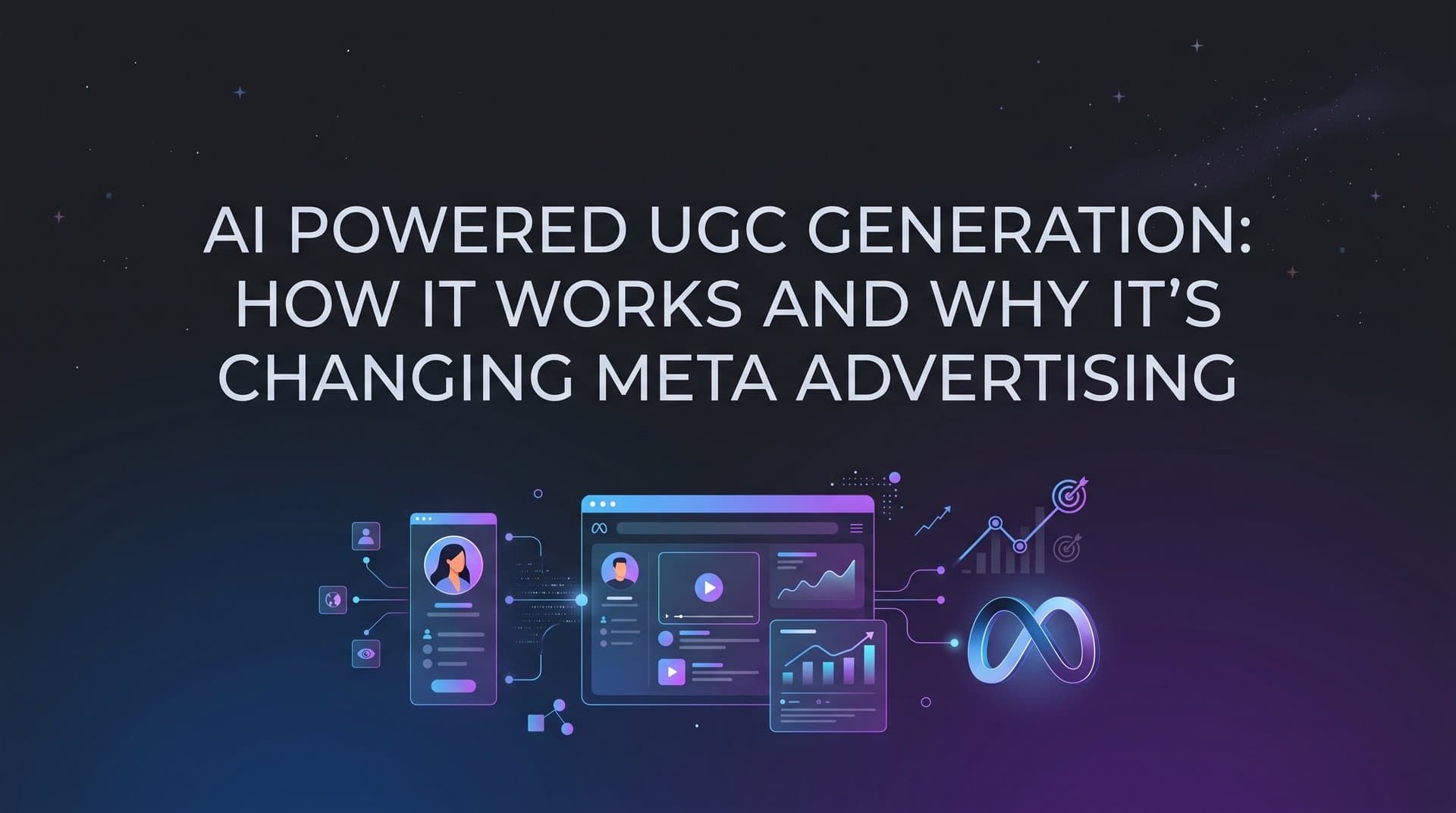
The end-to-end workflow that platforms like AdStellar enable brings this all together. Generate UGC-style avatar ads from a product URL in the AI Creative Hub. Use the AI Campaign Builder to analyze historical performance data, rank creative elements, and build complete campaigns with AI-optimized audiences and copy. Launch hundreds of variations through bulk ad launching. Track performance through AI Insights leaderboards. Pull winners into the Winners Hub for reuse. Then start the next cycle with everything you've learned.
That's not a collection of separate tools bolted together. It's a single system designed to move from creative generation to campaign performance to optimization without the gaps, delays, and manual work that fragment most advertising workflows.
The Bottom Line on AI Powered UGC Generation
The trade-off that has defined UGC advertising for years, authenticity on one side, scalability on the other, is no longer a fixed constraint. AI powered UGC generation shifts the equation by making it possible to produce content that carries the authenticity signals of creator-made video without the production overhead that made scale impractical.
The workflow is straightforward in principle. Input a product URL, generate scripts and avatar-based videos, refine through chat-based editing, launch multiple variations, analyze performance data, identify winners, and feed those insights back into the next round of generation. Each cycle produces better creative faster than the one before it.
For performance marketers running Meta campaigns, this changes the creative constraint from a bottleneck into a competitive advantage. More variations mean more data. More data means faster learning. Faster learning means better results compounding over time.
If you want to see how this works in practice, AdStellar's AI Creative Hub lets you generate UGC-style avatar ads directly from a product URL, with no designers, video editors, or actors required. Start Free Trial With AdStellar and generate your first UGC-style creatives, launch them to Meta, and start identifying winners with a 7-day free trial. The gap between teams that have adopted this approach and those still relying on traditional production is widening. Now is a good time to be on the right side of it.