UGC-style video ads have a fundamental advantage on Meta platforms: they look like content, not advertising. When someone scrolling through their feed encounters a polished, production-heavy brand video, their brain immediately categorizes it as an ad and keeps scrolling. But a conversational talking-head clip that feels like a friend sharing a recommendation? That gets watched.
The problem has always been scale. Sourcing real creators is expensive, slow, and unpredictable. Coordinating scripts, shoots, revisions, and usage rights for a handful of creatives can take weeks. For performance marketers who need dozens of ad variations to run meaningful tests, traditional UGC production simply cannot keep up.
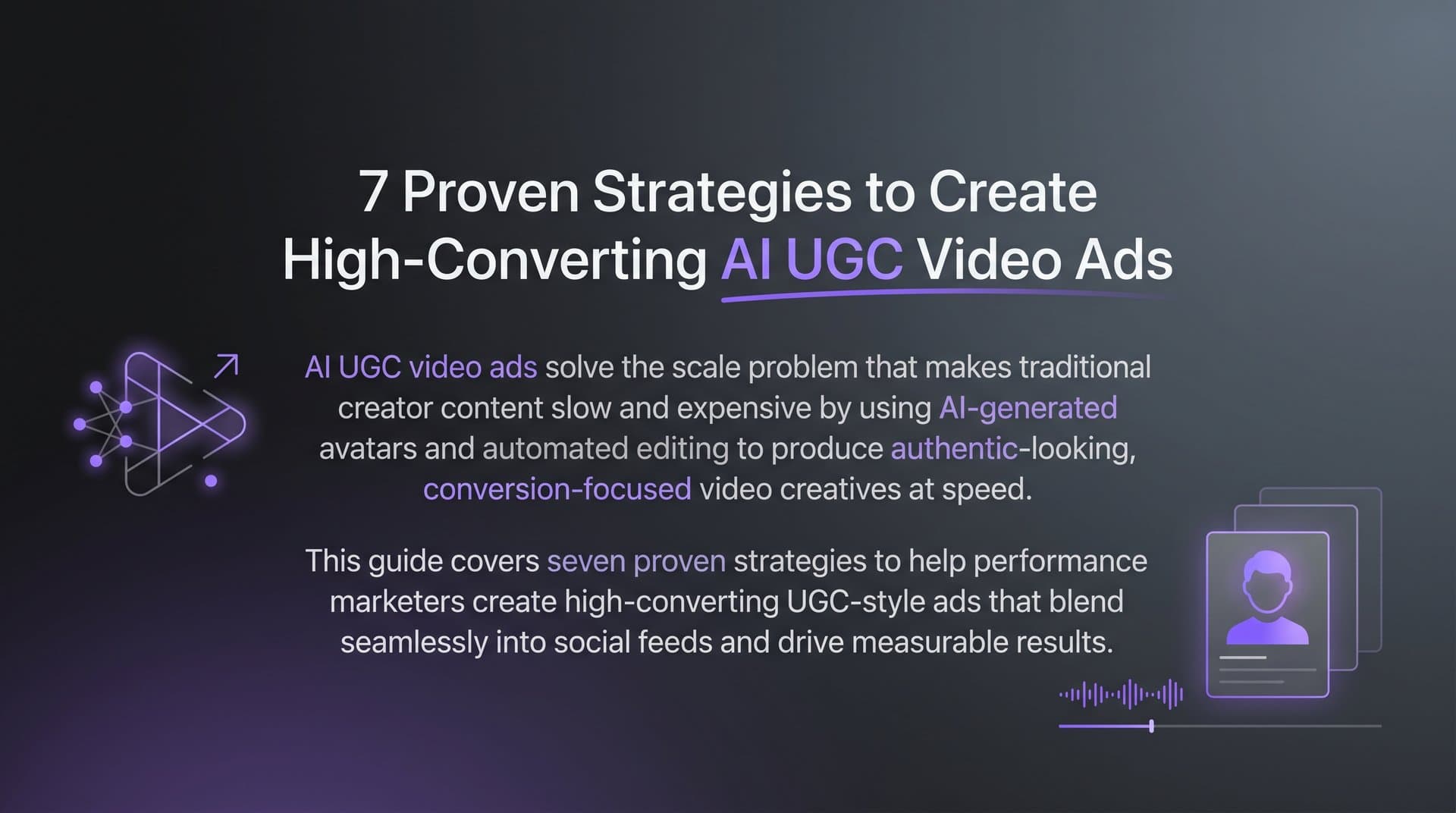
That is where AI UGC video ads change the equation entirely. With AI-generated avatars, script generation, and automated editing, teams can produce authentic-looking video creatives at a fraction of the cost and time. The format has matured significantly, and in 2026, AI-generated UGC is a serious creative strategy, not a shortcut.
But generating a clip and launching it is not enough. The brands seeing real results are applying deliberate strategy at every stage: how they write scripts, which avatars they choose, how they test, and how they learn from performance data. This guide covers seven proven strategies to help you build AI UGC video ads that actually convert, whether you are a solo media buyer or running creative at an agency.
1. Script for the Scroll-Stop, Not the Storyboard
The Challenge It Solves
Most marketers approach ad scripting the same way they would write a TV commercial: introduce the brand, build context, present the offer, close with a CTA. On social feeds, that structure fails immediately. By the time your avatar finishes the intro, your viewer has already scrolled past. The first two to three seconds of your AI UGC video ad determine whether anyone sees the rest of it.
The Strategy Explained
Native social content does not ease you into the point. It hits you with it immediately. Your AI UGC video script needs to open with a pattern interrupt: a statement, question, or claim that creates enough curiosity or tension to stop the thumb. Think "I stopped spending money on X and here's what happened" or "Nobody talks about this but it completely changed how I Y."
After the hook, deliver the value proposition in plain conversational language. Write the way people actually talk, not the way copywriters write. Avoid formal sentence structures, jargon, and anything that sounds like it was produced by a marketing department. The goal is to sound like a real person who genuinely discovered something worth sharing.
Front-load your key message. Do not save the best for last. If someone watches only five seconds, they should already understand what you are offering and why it matters to them. Getting the video size for Facebook ads right is equally critical to ensuring your content displays properly across placements.
Implementation Steps
1. Write three to five distinct hook variations for every script, each using a different emotional angle such as curiosity, social proof, problem agitation, or surprising contrast.
2. Read every script out loud before feeding it to your AI avatar. If it sounds stiff or scripted when you say it, it will sound worse when the avatar delivers it.
3. Keep total script length between 30 and 60 seconds. Respect that attention is your most limited resource.
4. End with a single, clear CTA that matches the emotional tone of the script rather than pivoting abruptly to a hard sell.
Pro Tips
Study the comment sections on organic UGC content in your niche to find the exact language your audience uses to describe their problems and desires. Those phrases, lifted directly from real conversations, make your AI avatar scripts feel genuinely human. Authenticity in word choice matters as much as authenticity in delivery.
2. Match Your AI Avatar to Your Buyer Persona
The Challenge It Solves
One of the most common mistakes with AI UGC video ads is treating avatar selection as an afterthought. Marketers pick whoever looks professional or appealing to them personally, rather than thinking about who their target customer would trust. When the person on screen does not feel like someone the viewer can relate to or aspire to be, the peer-recommendation effect that makes UGC so powerful disappears entirely.
The Strategy Explained
Your AI avatar is a casting decision, and it should be driven by your buyer persona, not your personal aesthetic preferences. Think carefully about the demographics, style, energy level, and presentation of the person your ideal customer would take advice from. A 45-year-old professional buying B2B software responds differently to a polished business-casual avatar than to a casual, energetic younger presenter. Neither is universally better; the right choice depends entirely on who is watching.
Consider testing multiple avatar types across different audience segments. An avatar that resonates with one demographic may underperform with another, and the only way to know is to test. Leveraging an AI targeting assistant can help you match the right audience segments to each avatar variation for more precise testing.
Also think about energy and pacing. Some products call for an enthusiastic, fast-talking presenter. Others benefit from a calm, authoritative tone. Match the avatar's delivery style to the emotional register your audience is in when they encounter your ad.
Implementation Steps
1. Document your buyer persona in detail, including age range, lifestyle signals, communication style, and the type of people they trust for recommendations.
2. Select two to three avatar options that represent meaningfully different demographic or stylistic profiles, not just superficial variations.
3. Run the same script with different avatars as a controlled test to isolate the impact of avatar selection on performance metrics.
4. Build an internal reference guide mapping avatar types to audience segments based on real performance data as your library grows.
Pro Tips
Do not overlook background and wardrobe cues in your AI avatar setup. A home office background signals something different than a minimalist studio. These environmental details contribute to the overall authenticity of the UGC feel and subtly reinforce whether the avatar matches your buyer's world.
3. Clone and Remix Competitor Winning Formats
The Challenge It Solves
Starting every creative from a blank page is inefficient and unnecessary. Your competitors have already spent real budget testing what works in your market. Their top-performing ads have survived the selection pressure of real audience data. Ignoring that signal means reinventing the wheel when the wheel already exists and is publicly visible in the Meta Ad Library.
The Strategy Explained
The Meta Ad Library is one of the most underutilized research tools available to performance marketers. Any advertiser can search by brand name or keyword and browse active ads, including how long they have been running. Ads that have been running for weeks or months without being paused are almost certainly generating positive results, because no one keeps spending on a losing creative.
When you find a competitor's AI UGC ad that has clearly been running for a while, analyze its structure: How does it open? What emotional angle does the hook use? How long is it? Where does the CTA appear? What editing style does it use? You are not copying the content; you are identifying a proven format that resonates with a shared audience.
Then use AI to generate your own version of that structure with your product, your messaging, and your brand voice. Platforms like AdStellar allow you to clone competitor ads directly from the Meta Ad Library and generate your own creative variations, dramatically compressing the research-to-production timeline. Understanding the broader landscape of Meta ads campaign tools helps you choose the right platform for this workflow.
Implementation Steps
1. Identify your top five to ten competitors and search each one in the Meta Ad Library, filtering for active video ads.
2. Document the structural patterns of their longest-running ads: hook format, script length, avatar type, editing style, and CTA placement.
3. Build a swipe file of proven formats organized by hook type, emotional angle, and product category.
4. Use AI creative tools to generate your own versions of the top two or three formats, substituting your product details and brand messaging throughout.
Pro Tips
Look beyond your direct competitors. Brands in adjacent categories that target a similar audience can reveal creative formats that your competitors have not yet discovered. Borrowing a hook structure from a different industry and applying it to your product can produce genuinely fresh-feeling ads that still carry the validation of proven performance.
4. Build a Bulk Testing Engine with Creative Variations
The Challenge It Solves
In performance marketing, you cannot know which creative will win before you test it. The challenge is that traditional production bottlenecks force marketers to test only a handful of variations at a time, which means the learning process is painfully slow. By the time you identify a winner, weeks have passed and budget has been spent on suboptimal ads. AI UGC removes the production constraint, but only if you build a systematic testing approach to take advantage of it.
The Strategy Explained
Think of your AI UGC creative assets as modular components rather than finished ads. You have hooks, avatars, body scripts, and CTAs, and each of those variables can be mixed and matched to generate a large matrix of distinct ad variations. The ability to launch multiple Meta ads at once makes testing this matrix simultaneously far more practical than sequential testing ever could.
The key is to isolate variables intentionally. If you change the hook and the avatar and the CTA all at once, you cannot determine which change drove the performance difference. Structure your testing matrix so you can draw clear conclusions about which elements are doing the work.
AdStellar's bulk ad launch capability was built exactly for this workflow. You can mix multiple creatives, hooks, audiences, and copy variations at both the ad set and ad level, generating every combination and launching them to Meta in minutes rather than hours. This turns creative testing from a manual grind into a systematic engine.
Implementation Steps
1. Define your testing variables: at minimum, three to five hook variations, two to three avatar options, and two CTA formats.
2. Build a simple creative matrix mapping every combination you want to test so nothing falls through the cracks.
3. Set clear performance thresholds before launching. Know in advance what ROAS, CPA, or CTR benchmark a creative needs to hit to be considered a winner.
4. Use bulk launch tools to deploy all variations simultaneously rather than staggering them, ensuring each variation gets comparable exposure and data.
5. Review performance at a consistent cadence, such as every 48 to 72 hours, and pause underperformers quickly to concentrate spend on emerging winners.
Pro Tips
Resist the temptation to over-engineer your first testing matrix. Start with a manageable number of variations, learn from the data, and expand the matrix as you develop clearer hypotheses about what drives performance in your specific market.
5. Layer Native-Feel Editing Cues into AI Creatives
The Challenge It Solves
Even a well-scripted AI UGC video can fail if it looks too polished. Ironically, production quality can work against you in a UGC format. If the video looks like it was professionally edited, it triggers ad blindness immediately. The editing style of your AI UGC ads is as important as the script and avatar in determining whether the content feels native to the feed.
The Strategy Explained
Organic UGC content has a recognizable visual language: burned-in captions, simple jump cuts, text overlays that emphasize key phrases, and an overall aesthetic that feels like someone shot it on their phone. These are not flaws; they are trust signals. They tell the viewer's brain that this is real content from a real person, not a produced advertisement.
When you are editing AI UGC video ads, deliberately incorporate these native-feel elements. Add captions directly onto the video rather than relying on platform-generated subtitles. Use text overlays to highlight your key benefit or hook phrase. Keep transitions simple and avoid anything that screams "motion graphics package." Teams that struggle with manual Facebook ads being too slow often find that AI-assisted editing workflows dramatically accelerate this process.
This matters especially because a large portion of social video is watched without sound. Burned-in captions ensure your message lands even in a silent scroll, and text overlays give you a second channel to communicate your value proposition beyond what the avatar is saying.
Implementation Steps
1. Add burned-in captions to every AI UGC video before launching. Make them readable at mobile screen size with high contrast against the background.
2. Use text overlays strategically at the hook moment and at the CTA to reinforce the two most critical points in your script.
3. Review your finished ad in your phone's social feed before launching. If it looks like an ad rather than organic content, simplify the editing.
4. Avoid branded lower-thirds, animated logos, and polished transitions during the first ten seconds of the video where the native-feel effect matters most.
Pro Tips
Study the editing style of top organic creators in your niche and use their aesthetic as a benchmark, not the editing style of other ads. The goal is to match organic content, and organic creators set that standard, not advertisers.
6. Use Performance Leaderboards to Build a Winners Playbook
The Challenge It Solves
Running creative tests generates data, but data without a system for capturing and applying insights is just noise. Many performance marketers run tests, identify a winner, launch the next campaign, and start from scratch again. This approach fails to compound the learning from previous campaigns, which means you are perpetually re-discovering the same insights rather than building a cumulative creative intelligence.
The Strategy Explained
A winners playbook is a living document that catalogs the creative elements, structures, and patterns that have proven to drive results in your specific market. It is built from real performance data, not assumptions, and it becomes more valuable with every campaign you run.
The foundation of a good winners playbook is systematic performance tracking at the element level, not just the ad level. You need to know not just which ad won, but which hook drove the most engagement, which avatar generated the lowest CPA, and which CTA format produced the highest conversion rate. Investing in Meta ads dashboard software makes this granular tracking far more manageable across campaigns.
AdStellar's AI Insights feature surfaces exactly this kind of data. Leaderboards rank your creatives, headlines, copy, audiences, and landing pages by real metrics like ROAS, CPA, and CTR. Set your performance goals and the platform scores every element against your benchmarks, making it easy to spot patterns across campaigns. The Winners Hub then keeps your best-performing assets organized and ready to pull into future campaigns without digging through old accounts.
Implementation Steps
1. Define which metrics matter most for your goals before you start tracking. ROAS for e-commerce, CPA for lead generation, and CTR for awareness campaigns each tell a different story.
2. After each campaign cycle, document the top-performing hook formats, avatar types, script structures, and CTA variations in a shared reference document.
3. Look for patterns across multiple campaigns rather than drawing conclusions from single data points. A hook format that wins three times across different campaigns is a genuine signal.
4. Use your winners playbook as the starting point for new campaigns, building on proven elements rather than starting fresh each time.
Pro Tips
Tag your creative assets with descriptive labels when you build them: hook type, emotional angle, avatar style, product focus. This makes it far easier to search for patterns in your performance data later and prevents your winners playbook from becoming a disorganized archive rather than a useful strategic resource.
7. Let AI Campaign Intelligence Close the Loop
The Challenge It Solves
The most sophisticated creative testing system still falls short if the campaign structure around it is not optimized. A winning AI UGC creative paired with the wrong audience, mismatched copy, or poorly set bidding will underperform its potential. The final strategy is about connecting creative intelligence to campaign intelligence so that your best ads are always paired with the conditions most likely to make them succeed.
The Strategy Explained
AI-powered campaign builders can analyze your historical performance data to identify which audience segments, headline combinations, and bidding strategies have worked best with specific creative types. Rather than manually assembling campaigns based on intuition, you are letting the data drive every structural decision in the campaign setup. Understanding campaign structure best practices gives you the foundation to evaluate and refine what the AI recommends.
This closes the loop between creative production and campaign management. Instead of treating them as separate workflows handled by different people or tools, you bring them together into a single connected system where insights from past campaigns automatically inform how the next campaign is built.
AdStellar's AI Campaign Builder does exactly this. It analyzes your past campaigns, ranks every creative, headline, and audience by performance, and builds complete Meta Ad campaigns in minutes. Every decision comes with a transparent explanation so you understand the strategy behind it, not just the output. And because the AI learns from each campaign, the recommendations improve over time as your performance history grows. Exploring how AI for Meta ads campaigns works at a broader level helps contextualize why this closed-loop approach is so effective.
When you combine this with AdStellar's integration with Cometly for attribution tracking, you get a complete picture from creative impression all the way through to conversion, giving the AI accurate signal to optimize against.
Implementation Steps
1. Ensure your historical campaign data is clean and properly tagged before feeding it into an AI campaign builder. Garbage in, garbage out applies here as much as anywhere.
2. Let the AI generate campaign structures based on your performance history, but review its rationale before launching to build your own understanding of what it is optimizing for.
3. Set up proper attribution tracking so the AI is optimizing against real conversion data, not just platform-reported metrics that may not reflect actual business outcomes.
4. Run AI-built campaigns alongside manually built campaigns initially to validate that the AI recommendations are improving results before fully committing to the automated workflow.
Pro Tips
Treat the AI's reasoning as a learning tool, not just an output. When the campaign builder explains why it selected a particular audience or headline, pay attention. Over time, those explanations will sharpen your own strategic instincts and make you a better performance marketer, not just a faster one.
Putting It All Together
Building AI UGC video ads that consistently convert is not about finding a single magic formula. It is about constructing a repeatable system where every stage, from scripting to testing to performance analysis, feeds into the next and compounds over time.
The seven strategies in this guide work best when they are connected. Scripts written for the scroll-stop perform better when delivered by an avatar matched to the buyer persona. Competitor research reveals proven formats that make your bulk testing more efficient. Native editing cues ensure your creatives survive the feed. Performance leaderboards transform your test results into a strategic asset. And AI campaign intelligence ensures your best creatives are always paired with the right conditions to succeed.
If you are not sure where to start, prioritize based on your biggest current bottleneck. If creative volume is the constraint, focus on bulk testing and competitor cloning first. If you have plenty of ads but inconsistent results, start with performance leaderboards and the winners playbook approach. If campaign structure feels like the weak link, dive into AI campaign intelligence first.
You do not need to implement all seven strategies simultaneously. Pick two or three that address your most pressing challenge, build those into your workflow, and add the others as your system matures.
Platforms like AdStellar bring all of these capabilities into one connected workflow, from generating AI UGC avatar video ads to launching campaigns and surfacing your top performers with real-time insights. The teams winning with AI UGC video ads in 2026 are the ones who treat creative production as a data-driven system, not a one-off task.
Build the system, trust the data, and let AI handle the heavy lifting so you can focus on strategy. Start Free Trial With AdStellar and be among the first to launch and scale your ad campaigns faster with an intelligent platform that automatically builds and tests winning ads based on real performance data.