The average performance marketer spends 12-15 hours per week on manual campaign duplication. You find a winning ad combination that delivers a 4.2 ROAS, and instead of celebrating, you face the prospect of recreating it across eight different audience segments. Copy the creative assets. Rebuild the targeting parameters. Duplicate the ad copy with slight variations. Triple-check that you transferred every setting correctly. Miss one detail, and your replicated campaign underperforms for reasons you will spend days diagnosing.
This manual replication bottleneck creates a cruel irony in digital advertising: the moment you discover what works, you are least equipped to scale it quickly. Your winning campaign has momentum, your creative is resonating, and your audience is engaged. But by the time you manually duplicate everything across new segments, that momentum has often dissipated.
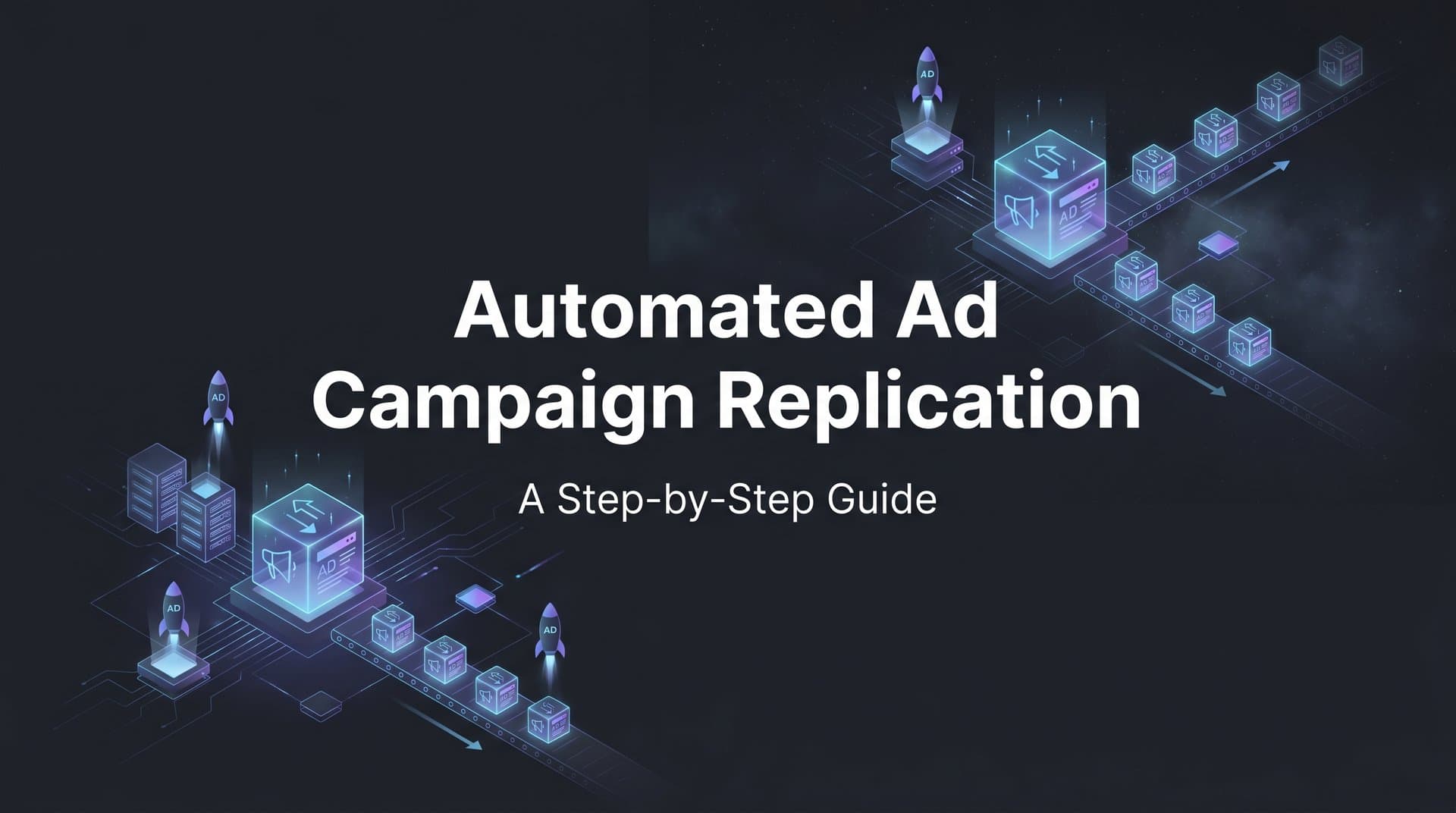
Automated ad campaign replication solves this fundamental problem. Instead of spending hours recreating campaigns element by element, automation platforms can deploy your winning combinations across multiple audiences, copy variations, and budget allocations in minutes. The difference is not just speed, it is systematic scaling that maintains the integrity of what made your original campaign successful while intelligently adapting it to new contexts.
This guide provides a complete framework for setting up automated campaign replication. You will learn how to identify which campaigns truly deserve replication, document their winning elements systematically, configure automation tools to duplicate them at scale, and continuously optimize based on performance data. The goal is not just to copy campaigns faster, but to build a repeatable system that multiplies your winners while you focus on strategy rather than repetitive tasks.
Step 1: Identify Your Top Performing Campaigns Worth Replicating
Not every successful campaign deserves replication. The first step is establishing clear performance thresholds that separate genuine winners from temporary spikes or campaigns that succeeded due to unique circumstances that cannot be replicated.
Start by defining your core performance metrics based on your business goals. If you are running e-commerce campaigns, your primary metric might be ROAS with a minimum threshold of 3.5×. For lead generation, you might focus on cost per qualified lead under a specific dollar amount. For awareness campaigns, you might prioritize CTR and engagement rate. The key is setting objective benchmarks that remove emotion from the decision.
Statistical Significance Matters: A campaign that delivered exceptional results for three days does not qualify as a proven winner. Look for campaigns that have maintained performance over at least 14 days with sufficient spend to generate meaningful data. A campaign that spent $50 and generated one high-value conversion might show a 10× ROAS, but that is an anomaly, not a pattern worth replicating.
Use performance leaderboards to surface your top campaigns across multiple metrics simultaneously. Implementing a Meta ads campaign scoring system helps identify the best candidates for replication, as they typically rank in the top 20% across several dimensions: ROAS or CPA, click-through rate, conversion rate, and engagement metrics. A campaign that excels in one area but underperforms in others might have a specific element worth extracting, but the entire campaign structure may not be replication-worthy.
Evaluate the Winning Elements: Before committing to replication, analyze what specifically drove the campaign's success. Was it the creative that resonated? The audience targeting that found an untapped segment? The headline that increased click-through rates? Understanding the core driver helps you decide whether to replicate the entire campaign structure or extract specific elements for testing in new contexts.
Avoid replicating campaigns with external factors that boosted performance temporarily. A campaign that succeeded during a specific seasonal event, leveraged a time-sensitive trend, or benefited from a one-time promotional offer will not perform the same way when replicated outside that context. Look for campaigns with sustainable performance drivers that translate across different audiences and timeframes.
Step 2: Document the Winning Elements for Replication
Once you have identified campaigns worth replicating, systematic documentation ensures you capture every element that contributed to their success. Missing a single targeting parameter or budget setting can cause replicated campaigns to underperform for reasons that are difficult to diagnose later.
Creative Asset Inventory: Extract and organize every creative element from your winning campaign. This includes the primary images or videos, any carousel variations, thumbnail images for video ads, and overlay text if applicable. Save these assets with clear naming conventions that indicate their performance metrics. For example, "product-video-lifestyle-4.2-ROAS" immediately tells you what the asset is and how it performed.
Document the exact ad copy including headlines, primary text, and descriptions. Do not paraphrase or try to improve the copy during documentation. Capture it word-for-word, including punctuation, emoji usage, and formatting. Small changes in copy can significantly impact performance, and you want to replicate exactly what worked before introducing variations.
Audience Targeting Parameters: Record every detail of your audience configuration. This includes demographic targeting (age ranges, gender, location specificity), detailed targeting (interests, behaviors, job titles), and any custom or lookalike audiences used. Note whether you used broad targeting or specific interest stacking, as this structural choice impacts how the algorithm optimizes delivery.
Capture your exclusion settings as well. Campaigns often succeed not just because of who they target, but who they exclude. Document any excluded audiences, such as existing customers, past converters, or competitors' employees, that helped improve your campaign efficiency.
Campaign Structure and Settings: Note your budget allocation approach, whether you used campaign budget optimization or ad set level budgets. Record your bid strategy, whether you optimized for conversions, link clicks, or another objective. Following a comprehensive Meta ads campaign planning checklist ensures you document any placement exclusions, such as removing audience network or specific Instagram placements, that improved performance.
Create a standardized template for this documentation that you can reuse across all winning campaigns. This consistency makes it easier to spot patterns across multiple winners and streamlines the replication process when you are ready to scale.
Step 3: Configure Your Automation Platform for Campaign Duplication
With your winning elements documented, the next step is configuring your automation platform to replicate campaigns systematically rather than manually rebuilding them each time you want to scale.
Connect your Meta ad account to your automation platform with full permissions for campaign creation, ad set management, and creative deployment. Verify that the integration properly syncs your existing campaigns so the platform can access historical performance data. This connection allows the automation tool to analyze what has worked in your account specifically, rather than relying on generic best practices.
Build Campaign Templates: Create reusable templates based on your documented winning campaigns. Using an automated campaign structure builder helps capture the campaign structure, objective, and optimization settings while allowing for variable inputs like audience segments, creative assets, and budget levels. A well-configured template becomes a blueprint you can deploy repeatedly with different combinations of winning elements.
Set up your variation rules within the platform. Define how you want to test new audiences against proven creatives. For example, you might configure a rule that takes one winning creative and automatically generates ad sets for five different audience segments. Or you might set up a matrix that combines three proven headlines with four different audience types, creating twelve variations systematically.
Establish Naming Conventions: Configure automated naming that makes replicated campaigns easy to track and analyze. A good naming structure might include the original campaign identifier, the replication date, the primary variable being tested, and the specific audience or creative variant. For example: "WinnerCampaign-001-Rep-Apr2026-AudienceLookalike-3pct" immediately tells you this is a replication of your first winning campaign, launched in April 2026, testing a 3% lookalike audience.
This naming consistency becomes critical when you are running multiple replicated campaigns simultaneously. Following proper Meta ads campaign naming conventions helps you quickly identify which variations belong to which replication effort and what variables are being tested in each one.
Configure your budget allocation rules for replicated campaigns. A common approach is to start replications at 50-70% of the original winning campaign's budget, allowing the algorithm to gather performance data without immediately competing for the same auction inventory. As replicated campaigns prove themselves, you can scale budgets based on their individual performance.
Step 4: Create Bulk Variations Using Your Winning Assets
With your automation platform configured, you can now create systematic variations that deploy your winning elements across new contexts at scale. This step transforms replication from copying a single campaign to building a testing matrix that explores multiple opportunities simultaneously.
Audience Variation Strategy: Take your proven creative and systematically test it across different audience segments. If your original winning campaign targeted a specific interest-based audience, create variations that test the same creative against lookalike audiences at different percentage thresholds, broad targeting with demographic constraints, and related interest categories. Each variation maintains the creative that worked while exploring whether it resonates with different audience segments.
The key is changing one variable at a time in your initial replications. If you simultaneously change the creative, the audience, and the copy, you cannot determine which change drove any performance differences. Start with audience variations while keeping creative constant, then move to creative variations with proven audiences.
Generate Copy Combinations: Create systematic variations of your winning headlines and ad copy. If your original headline was "Transform Your Workflow in 30 Days," test variations like "30-Day Workflow Transformation" or "Workflow Transformation: See Results in 30 Days." These variations maintain the core message and proven elements (the 30-day timeframe, the transformation promise) while testing different phrasings that might resonate with different audience segments.
Set up both ad set level and ad level variations strategically. Ad set level variations allow you to test different audiences with the same creative. Ad level variations within a single ad set let you test different creative or copy options with the same audience. Leveraging automated campaign testing enables a robust replication that might include three ad sets (different audiences) with four ad variations each (different creative or copy combinations), creating twelve total ads from one winning campaign.
Preview Before Launch: Before pushing your replicated campaigns live, preview the complete structure. Verify that every combination makes sense and that you have not accidentally created duplicate ad sets or mismatched creatives with audiences. Look for any budget allocations that seem disproportionate or naming inconsistencies that will make tracking difficult later.
This preview step catches errors that would be time-consuming to fix after launch. It is easier to adjust a template configuration now than to pause and edit dozens of live ad sets later.
Step 5: Launch Replicated Campaigns to Meta
With your variations created and previewed, you are ready to launch your replicated campaigns. This step requires strategic timing and verification to ensure your replications start gathering clean performance data immediately.
Review the complete campaign structure one final time before pushing live. Verify that all tracking pixels and conversion events are properly configured. A replicated campaign that launches without proper attribution wastes budget and generates unusable data. Check that your UTM parameters are set correctly if you are tracking campaigns in external analytics platforms.
Budget Allocation for Testing: Set conservative initial budgets for your replicated campaigns. Even though you are deploying proven elements, new audience combinations or slight copy variations can perform differently than your original winner. Starting with smaller budgets allows you to gather performance signals without risking significant spend on variations that might not work.
A practical approach is to allocate 50% of your original winning campaign's daily budget across all replicated variations. If your original campaign ran at $200 per day and you are launching four replicated variations, each replication might start at $25 per day. This total of $100 per day for replications allows testing without cannibalizing the original campaign's budget.
Strategic Launch Timing: Schedule your replicated campaign launches to gather clean performance data. Avoid launching on Fridays if you cannot monitor performance over the weekend. Consider your audience's behavior patterns. Streamlining your automated ad campaign launches ensures that if you are targeting B2B audiences, launching on Monday morning captures weekday performance from the start rather than diluting early data with weekend traffic.
If you are launching multiple replications simultaneously, stagger the launch times slightly. This makes it easier to verify that each campaign activated correctly and allows you to catch any configuration errors before they propagate across all variations.
Verify that all campaigns successfully published to Meta. Check that the status shows "Active" rather than "In Review" or "Rejected." Review the delivery column to confirm that ads are actually serving and not stuck in learning or other limited delivery states. This immediate post-launch verification catches issues while you can still make quick adjustments.
Step 6: Monitor and Optimize Your Replicated Campaigns
Launching replicated campaigns is just the beginning. The optimization phase determines whether your replications become new winners or get paused to protect your budget. Systematic monitoring separates successful scaling from wasted spend.
Benchmark Against Original Performance: Track your replicated campaigns against the original winning campaign's metrics. Your replications do not need to match the original's performance immediately, but they should show promising signals within the first few days. If your original campaign achieved a 4.2 ROAS after the learning phase, replications showing a 2.5-3.0 ROAS in early days might be worth continued testing, while those under 1.5 ROAS are likely poor fits.
Use AI-powered insights to identify which specific elements drive performance differences. Robust Meta ads campaign management software helps surface patterns where one audience variation significantly outperforms others, signaling an opportunity to create additional replications focused on that audience segment. If certain copy variations consistently generate higher click-through rates across multiple audience combinations, those headlines become proven assets worth deploying more broadly.
Quick Pause Decisions: Set clear thresholds for pausing underperforming replications. A common rule is to pause any variation that spends 1.5× your target CPA without generating a conversion, or any variation that shows a ROAS below 1.0× after spending a minimum threshold (perhaps $50-100 depending on your average order value). These objective criteria remove emotion from pause decisions and protect your budget from prolonged testing of variations that clearly are not working.
Not every replication will succeed, and that is valuable information. A failed replication tells you that your winning creative does not resonate with a particular audience segment, or that a copy variation weakens your message. This negative data prevents you from wasting budget on similar combinations in the future.
Feed Winners Back Into Your System: When replicated campaigns prove successful, add them to your Winners Hub as new proven assets. A replication that outperforms the original campaign becomes your new benchmark. Extract its specific elements (the audience that worked, the copy variation that resonated, the creative that converted) and document them for future replication cycles.
This creates a continuous improvement loop. Each round of replication generates new winners, which become the foundation for the next scaling effort. Your library of proven assets grows, your understanding of what works for your specific account deepens, and your ability to scale successful campaigns accelerates.
Scale winning replications gradually. If a replicated campaign shows strong performance at $25 per day, increase to $35-40 per day rather than immediately jumping to $100. Gradual scaling maintains performance stability and reduces the risk of disrupting the algorithm's optimization. Monitor closely after each budget increase to ensure performance holds before scaling further.
Building Your Replication System for Continuous Scaling
You now have a complete framework for automated ad campaign replication: identify statistically significant winners through performance data and leaderboard rankings, systematically document every winning element from creative assets to targeting parameters, configure your automation platform with templates and variation rules, create bulk variations that test proven elements across new contexts, launch strategically with appropriate budgets and timing, and continuously optimize based on performance benchmarks.
The transformation this creates goes beyond saving time on manual duplication. You shift from reactive campaign management to proactive scaling. Instead of waiting until you have capacity to manually recreate winning campaigns, you deploy replications immediately while momentum is strong. Instead of guessing which variations might work, you systematically test combinations and let performance data guide your decisions.
Treat replication as an ongoing cycle rather than a one-time project. Each week, review your performance leaderboards to identify new winners worth replicating. Each month, analyze which replicated variations became top performers and extract the patterns that drove their success. Each quarter, refine your replication templates based on accumulated learnings about what works for your specific account and audience.
Your Winners Hub becomes increasingly valuable as this system matures. What starts as a collection of a few proven creatives and audiences grows into a comprehensive library of tested combinations with real performance data attached. Your next replication effort draws from dozens of proven elements rather than starting from scratch.
Start small to build confidence in the process. Take your single best performing campaign from the last 30 days and run through this complete workflow once. Identify why it won, document its elements, configure one set of audience variations, launch with conservative budgets, and monitor the results for two weeks. This initial cycle teaches you the mechanics of your automation platform and reveals how your specific campaigns respond to replication.
Once you have successfully replicated one campaign and seen positive results, expand to replicating multiple winners simultaneously. The time you save on manual duplication compounds quickly. What used to take 12 hours per week shrinks to 2 hours of strategic setup and monitoring. That reclaimed time shifts to higher-value activities: analyzing performance patterns, developing new creative concepts, and refining your overall advertising strategy.
Ready to transform your advertising strategy? Start Free Trial With AdStellar and be among the first to launch and scale your ad campaigns 10× faster with our intelligent platform that automatically builds and tests winning ads based on real performance data.