There's a particular kind of frustration that every Meta advertiser knows. A campaign that was delivering strong results suddenly starts bleeding budget. The creative is the same. The audience targeting hasn't changed. But performance has quietly collapsed, and you're left wondering what went wrong.
Nothing went wrong with your strategy. What happened is ad fatigue, and it's one of the most predictable yet underestimated problems in paid social advertising. The good news is that it's also one of the most solvable, if you have the right system in place.
Automated ad creative refresh is the approach that separates advertisers who constantly chase declining performance from those who build campaigns that stay fresh and efficient over time. In this article, we'll break down exactly what it means, how the process works, and why doing it manually is increasingly unsustainable for anyone serious about Meta advertising.
The Silent Campaign Killer Most Advertisers Ignore
Ad fatigue doesn't announce itself. It creeps in gradually, and by the time most advertisers notice it, a meaningful portion of their budget has already been wasted on an audience that has mentally checked out.
Here's what's actually happening at the platform level. When the same users repeatedly see identical creatives, their engagement signals start to decline. Fewer clicks, fewer saves, fewer comments. Meta's algorithm is constantly reading these signals, and when engagement drops relative to impression volume, the platform begins to deprioritize that ad in the auction. The result is rising CPMs and declining delivery efficiency, even if your budget hasn't changed.
Frequency is the metric most commonly used as a proxy for fatigue risk. It measures the average number of times a unique user has seen your ad. As frequency climbs, you're essentially paying more to show the same creative to people who have already decided they're not interested. There's no universal frequency threshold that applies to every campaign, but most advertisers start to see performance deterioration well before they think to check this number.
The other signals to watch are equally telling. A declining click-through rate over a rolling seven-day window is often the first visible symptom. A worsening cost-per-result compared to your campaign benchmarks follows shortly after. And if you're tracking ROAS at the creative level, you'll see it shrink as fatigue sets in, often before aggregate campaign numbers make the problem obvious.
What makes this a structural challenge rather than a one-time inconvenience is the nature of Meta's audience pools. Unlike search-based channels where intent drives discovery, Meta's retargeting and interest-based audiences are finite. The same users cycle through your campaigns repeatedly, which accelerates the fatigue timeline significantly compared to other channels.
This means creative decay is not a possibility. It's a certainty. Every creative you run will eventually exhaust its effectiveness with a given audience. The question is not whether you'll need to refresh your creatives, but whether you have a system that handles it automatically or whether you're always reacting after the damage is already done. Understanding Meta ad creative burnout is the first step toward building a system that prevents it.
Defining Automated Ad Creative Refresh
Before getting into the mechanics, it's worth being precise about what automated ad creative refresh actually means, because the term gets used loosely.
At its core, automated ad creative refresh is a system that monitors performance signals and replaces or rotates ad creatives based on predefined rules or AI-driven triggers, without requiring a marketer to manually intervene each time a creative starts to fade. The key word is system. It's not a one-off task or a monthly habit. It's an ongoing, self-regulating process.
The contrast with manual refresh is significant. In a manual workflow, a marketer has to notice the performance decline, recognize it as a creative fatigue issue, brief a designer or copywriter, wait for production to complete, and then rebuild or duplicate ad sets with the new assets. That entire cycle can take days or weeks. And critically, it happens reactively, after budget has already been wasted on a fatigued creative. Comparing automated vs manual Facebook campaigns makes the efficiency gap immediately clear.
Automated refresh compresses that cycle dramatically. The system detects fatigue signals as they emerge, initiates the creative swap or introduces new variations, and does so without pulling anyone away from higher-value strategic work.
There are two core components that make this work.
The Detection Layer: This is the performance monitoring infrastructure. It tracks the metrics that indicate fatigue, such as frequency scores, CTR trends, CPA drift, and ROAS degradation, and applies threshold rules that define when a refresh should be triggered. Some systems use fixed rules set by the advertiser. More sophisticated platforms use AI to identify fatigue patterns dynamically based on historical performance data.
The Creative Layer: Detection alone is useless without something to deploy. The creative layer is a library of fresh assets, whether pre-built in bulk or generated on demand by AI, that are ready to go the moment a trigger fires. This is what makes the system genuinely automated rather than just alert-based. If you still need a designer to produce new assets after the trigger fires, you haven't removed the bottleneck, you've just moved it.
The most effective refresh systems operate with both layers working in sync. The detection layer keeps a constant eye on performance, and the creative layer ensures there's always something new and relevant ready to deploy when the signal comes.
How the Refresh Process Works Step by Step
Understanding the concept is useful. Understanding the actual workflow is what lets you build it. Here's how a well-designed automated refresh process operates from start to finish.
Step One: Setting Performance Thresholds
The process starts with defining the conditions that should trigger a refresh. These thresholds are calibrated based on your own campaign history and performance benchmarks, not generic industry rules. Common triggers include a frequency score crossing a defined ceiling, a CTR dropping below a floor value over a rolling window, a cost-per-result exceeding a target threshold, or a ROAS falling below your acceptable range.
The goal here is to catch fatigue early, before it has materially damaged campaign efficiency. Setting thresholds too loosely means you're refreshing reactively. Setting them too tightly means you're swapping creatives before they've had time to find their footing. Getting this calibration right is an iterative process, and it improves over time as you accumulate more performance data. If your ad creative refresh rate is too slow, you'll consistently find yourself behind the curve rather than ahead of it.
Step Two: The Creative Generation Pipeline
Once a threshold is breached, the system needs something to deploy. This is where the creative pipeline comes in. In a bulk production model, you've already generated a library of ad variations in advance, covering different formats, hooks, and visual styles. In an AI-driven model, new creatives can be generated on demand from a product brief, a URL, or by analyzing what's working in your competitive landscape.
The pipeline should include genuine variety. Different formats, image ads, video ads, UGC-style content, and different creative angles, benefit-led messaging, social proof, problem-solution framing. The goal is to ensure the audience experiences real novelty, not just a minor color change or a slightly reworded headline.
Step Three: Automated Deployment
This is where the refresh becomes truly automated. New creatives are swapped into active campaigns or launched into new ad sets, while underperforming ads are paused, all without manual campaign management. The campaign structure continues running. Budget flows toward what's working. And the cycle begins again as the newly deployed creatives are monitored against the same performance thresholds.
The net effect is a campaign that continuously self-renews. Instead of a static set of creatives gradually losing effectiveness, you have a dynamic rotation that keeps the audience experience fresh and keeps Meta's algorithm rewarding your ads with efficient delivery.
Why Bulk Creative Production Is the Engine Behind Refresh
Here's the thing that many advertisers miss when they first explore automated refresh: the automation is only as good as the creative supply behind it. If you don't have a steady pipeline of fresh assets, the system has nothing to deploy when a trigger fires. You're back to waiting on a designer, which means you're back to the same reactive cycle you were trying to escape.
Bulk creative production isn't a nice-to-have in a refresh strategy. It's the prerequisite that makes everything else possible.
This is where AI-powered creative generation changes the economics of the entire approach. Instead of briefing a designer for each new ad variation, AI tools can generate hundreds of variations from a single product URL, a brand brief, or by analyzing competitor ads from sources like the Meta Ad Library. Different formats, different hooks, different visual treatments, all produced in a fraction of the time it would take a traditional creative workflow. The rise of AI-driven ad creative generation has made this level of output accessible to teams of any size.
The practical implication is significant, especially for smaller teams. Previously, frequent creative refreshes were impractical because the production cost was too high relative to the benefit. A team of one or two marketers simply couldn't generate enough creative volume to maintain a meaningful rotation. AI removes that bottleneck entirely, making bulk production accessible regardless of team size.
Creative diversity matters as much as creative volume. Rotating through genuine format variety, static images, video ads, UGC-style avatar content, ensures that the audience experiences real novelty rather than cosmetic variation. Simply resizing the same image or swapping a headline word is unlikely to meaningfully reset engagement. The creative needs to feel different enough that a user who has seen your previous ads doesn't immediately recognize it as the same thing.
The most effective refresh strategies also use different creative angles across the rotation. A benefit-led ad speaks to one segment of your audience's mindset. A social proof angle speaks to another. A problem-solution framing resonates with users who are actively aware of the pain point your product addresses. Cycling through these angles keeps the messaging fresh even for users who have seen multiple ads from your campaign. Proven strategies for automated ad creative production at scale show how this kind of systematic variety can be built into the process from the start.
When AI handles creative generation, the pipeline becomes self-replenishing. New variations are produced continuously, queued for deployment, and ready to go the moment a performance threshold is crossed. The creative bottleneck that made frequent refreshes impractical simply disappears.
Reading the Data: How to Know When and What to Refresh
Automated refresh systems do the heavy lifting, but understanding the underlying metrics gives you the ability to calibrate those systems intelligently and interpret what the data is telling you.
Frequency is the most commonly cited fatigue indicator, but it shouldn't be read in isolation. A high frequency number in a broad audience campaign means something different than the same number in a tight retargeting window. Context matters. What you're looking for is frequency climbing alongside declining engagement, that combination is a reliable signal that the creative has exhausted its novelty with the current audience.
CTR trends over a rolling time window are often more actionable than point-in-time snapshots. A creative that was generating strong click-through rates in its first week but has declined steadily over the following two weeks is showing a clear fatigue pattern, even if the current CTR still looks acceptable on its own. Trend direction matters as much as absolute value.
Cost-per-result drift is another key signal. When a creative that was hitting your CPA target starts requiring more spend to generate the same result, that's the algorithm telling you it's working harder to find receptive users. The pool of engaged viewers is shrinking, and the cost of reaching them is rising accordingly.
Creative-level performance analysis is what makes the difference between knowing something is wrong and knowing exactly what to do about it. Leaderboards that rank your creatives by ROAS, CPA, and CTR make it immediately visible which assets are fading and which are still converting efficiently. This granularity is essential because aggregate campaign metrics can mask creative-level fatigue when a strong performer is compensating for weaker ones.
This is where a Winners Hub approach becomes strategically valuable. Rather than treating every refresh as a blank slate, cataloguing your top-performing creatives gives you a reusable asset library. When a refresh is triggered, you can reintroduce proven winners to audience segments that haven't seen them yet, or adapt high-performing formats and angles into new variations. Building a Meta ads winning creative library means you're leveraging what's already been validated rather than guessing from scratch every time.
Putting It All Together: Building a Refresh System That Runs Itself
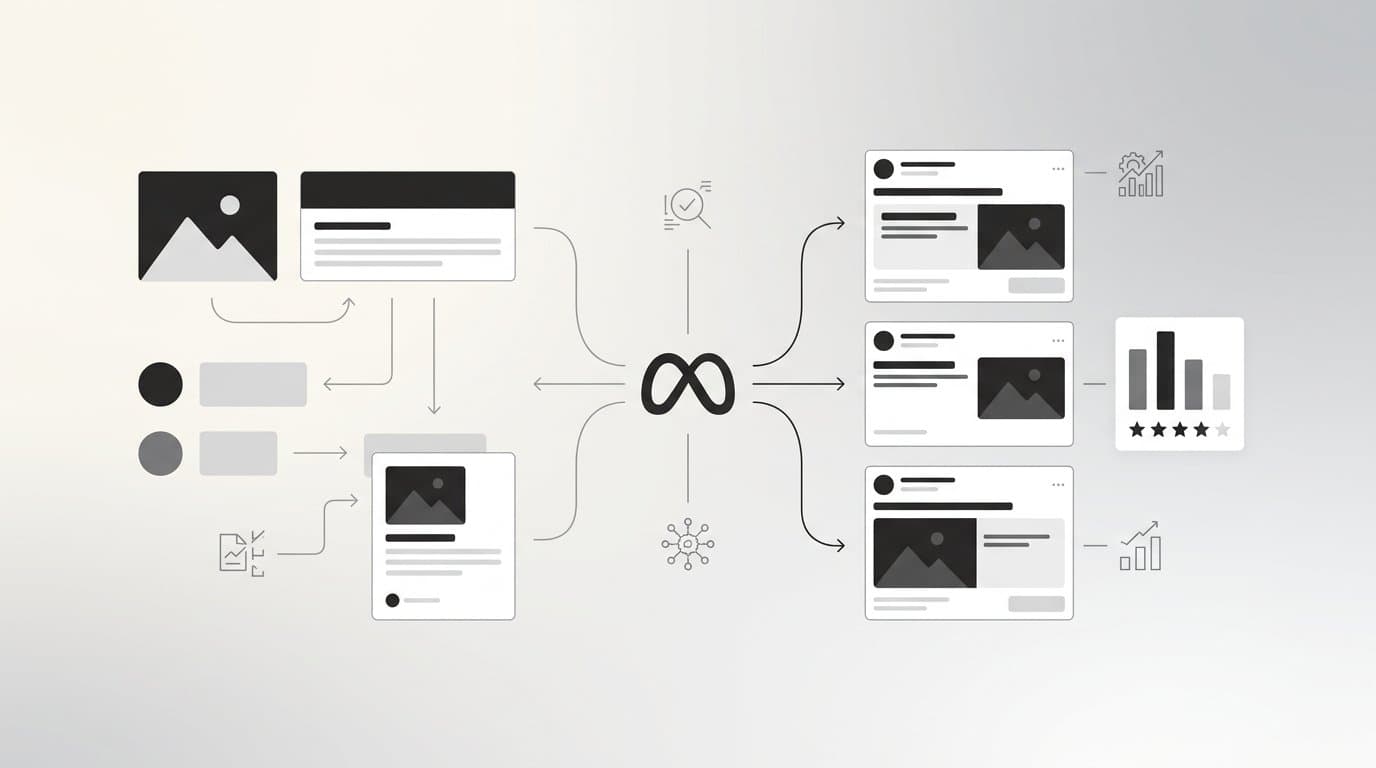
The full picture of automated ad creative refresh comes together as a continuous loop rather than a linear process. Monitor performance with AI-powered insights. Generate new creatives in bulk using AI tools. Deploy automatically through a campaign builder that handles the structural work. Feed winners back into the system so the next refresh cycle starts with proven assets.
Each layer reinforces the others. Better performance data leads to more precise refresh triggers. A larger creative library means more genuine variety in each rotation. Automated deployment means new creatives reach the audience faster, before budget has been significantly wasted on fatigued ads. And a catalogued Winners Hub means the system gets smarter over time rather than starting fresh with each cycle.
A common objection at this point is that building this kind of system sounds complex and expensive, requiring multiple tools stitched together and significant technical setup. That objection was more valid a few years ago. Today, modern AI ad platforms handle all of these layers in one place, removing the need to connect separate creative tools, performance dashboards, and campaign management systems.
AdStellar is built specifically around this workflow. The platform connects AI creative generation, bulk ad launch, performance insights with creative-level leaderboards, and a Winners Hub into a single system. You can generate image ads, video ads, and UGC-style creatives from a product URL, launch hundreds of variations in minutes, track which creatives are winning by ROAS and CPA, and feed those winners directly into your next campaign. The refresh cycle becomes self-sustaining rather than something that requires constant manual attention.
For teams running Meta campaigns at any scale, this kind of integrated approach is what separates advertisers who are always reacting to performance declines from those who have built a system that prevents them.
The Bottom Line on Ad Creative Refresh
Ad fatigue is not a creative failure. It's a systems failure. Every creative will eventually exhaust its effectiveness with a given audience. That's not a reflection of the quality of the work; it's simply how finite audience pools and algorithmic relevance scoring work on Meta.
The advertisers who consistently outperform on Meta aren't necessarily producing better individual creatives. They're producing more of them, rotating them more intelligently, and replacing them faster when performance signals indicate it's time. They've built a system that handles creative refresh as an ongoing operational process rather than an occasional reactive task.
Automated ad creative refresh is what that system looks like in practice. It combines performance monitoring, bulk creative production, and automated deployment into a cycle that keeps campaigns efficient without requiring constant manual intervention. The result is better ROAS, lower CPMs, and campaigns that maintain their performance over time rather than decaying after the first few weeks.
If you're still managing creative refreshes manually, you're spending time on reactive busywork that a well-built system could handle automatically. Start Free Trial With AdStellar and see how AI handles the full creative-to-conversion cycle, from generating scroll-stopping ads to launching them, tracking winners, and keeping your campaigns fresh without the manual overhead.