Testing ad creatives shouldn't feel like throwing darts in the dark. Yet most digital marketers find themselves trapped in an endless cycle: create variations, launch split tests, wait days for data, analyze spreadsheets, make decisions, repeat. The process devours hours that could be spent on strategy or creative development.
What if your campaigns could test themselves?
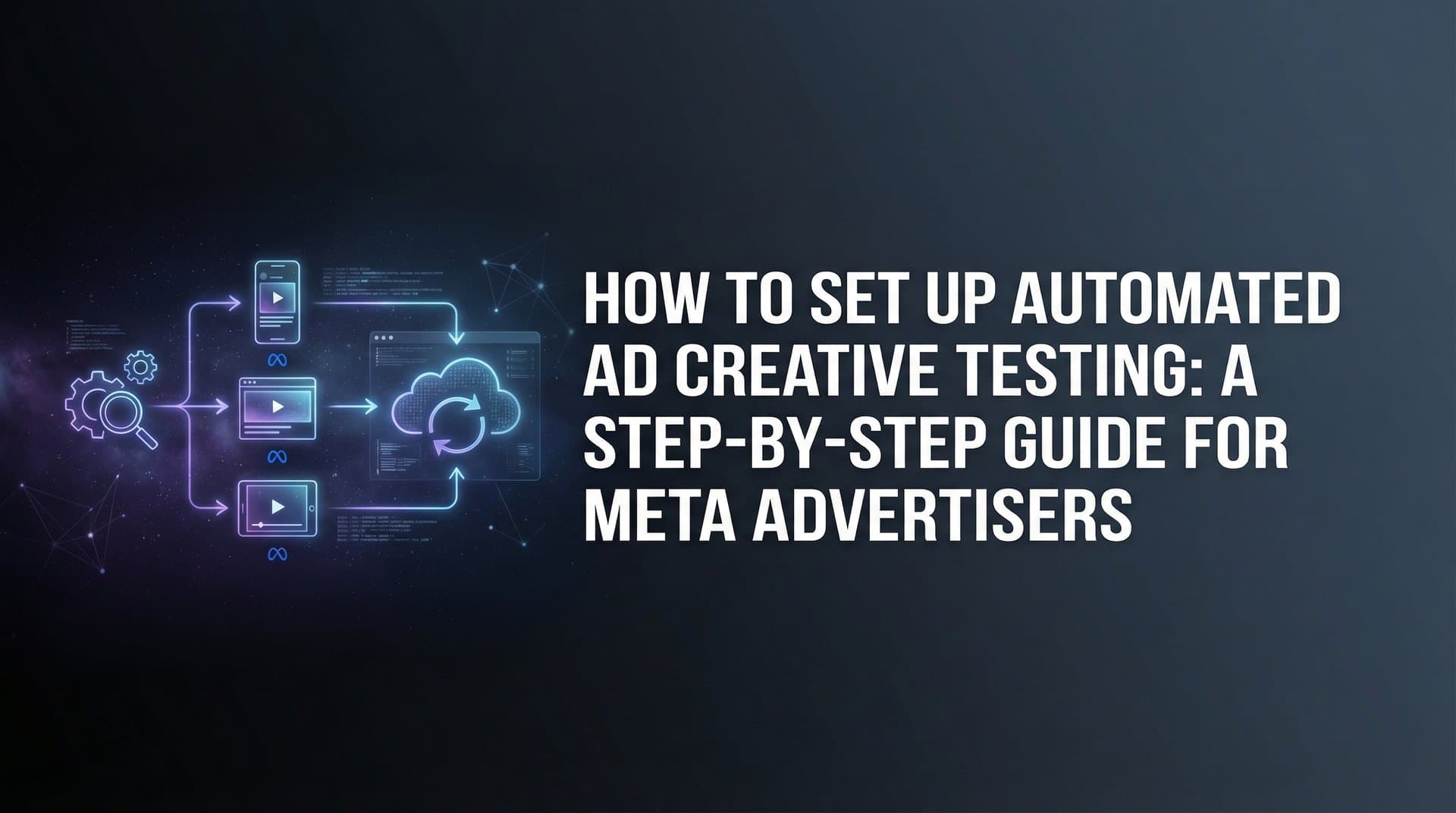
Automated ad creative testing flips this model on its head. Instead of manually babysitting dozens of creative variations, automation systems launch tests, monitor performance in real-time, identify winners, and scale them—all while you sleep. The technology exists. The question is whether you're using it.
This guide walks you through building an automated testing system for your Meta campaigns. You'll learn how to prepare your creative assets, structure campaigns for clean testing, configure automation rules that work, and create a continuous optimization loop that improves results over time.
By the end, you'll have a working framework that identifies your best-performing creatives faster than traditional methods allow. No more guessing. No more manual spreadsheet analysis. Just data-driven decisions at scale.
Step 1: Audit Your Current Creative Assets and Performance Data
Before automating anything, you need to understand what you're working with. Think of this as taking inventory before restocking a warehouse—you can't optimize what you can't measure.
Start by diving into your Meta Ads Manager library. Export your ad performance data for the last 90 days, focusing on metrics that matter: click-through rates, conversion rates, cost per acquisition, and return on ad spend. Don't just skim the surface numbers—you're looking for patterns.
Organize your creatives into categories that make sense for your business. Are you running product-focused ads versus lifestyle imagery? Video hooks versus static images? Benefit-driven copy versus feature lists? Create a simple spreadsheet with columns for creative type, format, messaging angle, and performance metrics.
Here's where it gets interesting: identify your top performers. Which creatives consistently deliver results? These aren't just your best ads—they're your benchmarks. Calculate the average performance for each category, then flag anything performing in the top 10-20%. These winners will serve as your baseline when testing new variations.
Document creative elements that repeat in winners: Do your top-performing video ads all start with a question? Do your best static images feature people versus products? Are certain color schemes or layouts overrepresented in your winners? These patterns become your testing hypotheses.
Pay attention to what's not working, too. Underperformers reveal just as much as winners. Maybe your carousel ads consistently flop, or certain messaging angles never gain traction. Understanding your failures prevents you from repeating them.
Success indicator: You should have a documented inventory showing each creative type, its historical performance metrics, and clear categories for comparison. If you can't quickly identify your top performers and explain why they work, you're not ready to automate testing.
This audit typically takes 2-4 hours, but it's time well spent. You're building the foundation for every automated test that follows. Rush this step, and your automation will optimize toward the wrong goals.
Step 2: Define Your Testing Variables and Success Metrics
Now comes the strategic work: deciding what to test and how to measure success. This is where most automated testing efforts either thrive or collapse.
Start by selecting your primary testing variables. The temptation is to test everything at once—headlines, images, video hooks, CTAs, ad formats, the whole buffet. Resist this urge. Testing too many variables simultaneously creates noise that obscures real insights.
Pick 2-3 variables maximum for each test cycle. Maybe you're testing three different video hooks against each other, or comparing lifestyle imagery versus product-focused shots. The key is isolation—you need to know which specific change drove performance differences.
Establish your key performance indicator: What defines success for this test? Cost per acquisition? Return on ad spend? Click-through rate? Conversion rate? Choose one primary KPI and stick with it throughout the test. Secondary metrics can provide context, but you need a single north star.
Set your statistical significance threshold before launching anything. Most marketers use 95% confidence—meaning you're 95% certain the performance difference isn't random chance. This typically requires a minimum sample size, which varies based on your conversion rates and budget.
Here's a practical example: If your baseline conversion rate is 2%, you'll need roughly 1,000 impressions per variation to detect a meaningful difference. Lower conversion rates require more data. Higher budgets reach significance faster. Plan accordingly.
Create your testing matrix: This is a simple document mapping which creative variations will compete against each other. If you're testing three headlines across two images, that's six total combinations. Your matrix ensures you're testing systematically, not randomly.
Common pitfall alert: Don't confuse testing velocity with testing quality. Launching 50 variations might feel productive, but if none reach statistical significance, you've learned nothing. Better to test fewer variables thoroughly than many variables superficially.
Define your test duration: How long will you let tests run before declaring winners? This depends on your budget and traffic volume, but generally 7-14 days allows most campaigns to reach meaningful conclusions. Set this timeline upfront to avoid the temptation of calling tests early when you see promising early data.
Your testing variables and success metrics become the rulebook for your automation. Get this foundation right, and your automated system will optimize toward real business outcomes. Get it wrong, and you'll optimize toward vanity metrics that don't move the needle.
Step 3: Structure Your Campaign Architecture for Automated Testing
Your campaign structure determines whether automated testing delivers clean insights or muddy confusion. Think of this as building the scaffolding before constructing the building.
Create a dedicated testing campaign separate from your evergreen performers. This isolation serves two purposes: it protects your proven winners from experimental budget allocation, and it keeps your testing data clean. Name it something obvious like "Creative Testing - [Month]" so anyone on your team immediately understands its purpose.
Within this testing campaign, structure your ad sets to isolate variables while maintaining consistent audiences. If you're testing three different video hooks, each variation should run in its own ad set targeting the same audience. This ensures performance differences stem from creative changes, not audience variations.
Enable Campaign Budget Optimization: CBO allows Meta to automatically distribute your budget toward better-performing ad sets. Instead of manually shifting dollars between winners and losers, the algorithm handles it. This is automation working for you at the platform level.
Set your CBO budget high enough to reach statistical significance within your testing timeline. If you need 1,000 impressions per variation and you're testing six variations, calculate backward from your typical CPM to determine minimum daily budget. Underfunding tests is like trying to hear a whisper in a crowded room—the signal gets lost in noise.
Establish naming conventions that enable automated reporting: This might seem tedious, but consistent naming unlocks powerful automation later. Use a format like "Test_[Variable]_[Variation]_[Date]" so your automation tools can parse performance by creative element.
For example: "Test_VideoHook_Question_0221" tells you immediately what's being tested, which variation it is, and when it launched. When you're analyzing 50+ ad variations, this clarity becomes essential.
Configure your audience settings to match your evergreen campaigns. You're testing creative performance, not audience performance. Use the same targeting parameters, placements, and optimization events as your proven campaigns. The only variable should be the creative itself.
Success indicator: Your campaign structure should allow clear attribution of results to specific creative variables. If someone unfamiliar with your account can look at your campaign structure and immediately understand what's being tested, you've nailed it.
This structural work takes 30-60 minutes upfront but saves hours of confusion later. When your automated rules start firing and your reporting dashboard lights up, you'll be grateful for the clarity this structure provides. For a deeper dive into building effective structures, explore our guide on automated campaign structure building.
Step 4: Configure Automation Rules and Triggers
This is where the magic happens. Automation rules transform your testing framework from a manual process into a self-optimizing system that works around the clock.
Start in Meta Ads Manager's Automated Rules section. Create your first rule: pause underperformers automatically. Set conditions based on your defined KPIs—for example, pause any ad with a cost per acquisition 50% above your target after receiving 1,000 impressions. This prevents budget waste on clear losers while giving variations enough data to prove themselves.
The key is balancing speed with statistical validity. Pause too early, and you might kill potential winners having a slow start. Wait too long, and you burn budget on ads that will never perform. Your audit data from Step 1 helps calibrate these thresholds—you know what "good" and "bad" performance looks like for your account.
Create winner promotion rules: When an ad crosses your success threshold, automatically increase its budget. Maybe that's a 25% budget boost when an ad achieves 20% better CPA than your baseline. These rules ensure your best performers get fuel to scale while you're focused on other work.
Set up notification triggers for significant events. You want alerts when an ad hits your pause threshold, when a variation becomes a clear winner, or when something unusual happens (like spend accelerating faster than expected). These notifications keep you informed without requiring constant dashboard monitoring.
Configure creative rotation schedules: Even winning ads experience fatigue as audiences see them repeatedly. Set up rules that automatically pause ads after a certain number of impressions or days, forcing fresh creative into rotation. This prevents performance degradation before it becomes obvious in your metrics. Understanding creative burnout patterns helps you set these thresholds appropriately.
Here's where advanced automation platforms like AdStellar AI change the game. Instead of just pausing underperformers, AI-powered tools analyze your performance data to understand why certain creatives win, then automatically generate and launch new variations based on those patterns. The system learns what works and creates more of it—without manual intervention.
Think about it: traditional automation rules are reactive (pause this, boost that). AI-powered automation is proactive—it identifies the elements driving performance, combines them in new ways, and tests those combinations automatically. You're not just optimizing existing ads; you're generating new winners based on proven patterns.
Test your automation rules before fully committing: Start with conservative thresholds and small budgets. Watch how your rules trigger over a few days. Are they too aggressive, pausing ads prematurely? Too conservative, letting poor performers run too long? Adjust based on real behavior.
Document every rule you create, including the logic behind threshold decisions. When you're running multiple automated tests simultaneously, this documentation prevents confusion about why certain ads were paused or scaled. Our comprehensive guide on ad creative testing automation covers additional rule configurations worth exploring.
Your automation rules should feel like having a tireless campaign manager who never sleeps, never takes vacation, and makes decisions based purely on data. Set them up right, and you'll wonder how you ever managed campaigns manually.
Step 5: Launch Your First Automated Test Cycle
Theory meets reality. Time to launch your first automated test and see your system in action.
Upload your creative variations following the testing matrix you built in Step 2. Double-check that each variation is properly categorized in your naming convention. This attention to detail now prevents headaches when analyzing results later.
Verify your tracking setup before spending a dollar: Open your Meta Events Manager and confirm that your conversion events are firing correctly. Test a conversion yourself if possible—add something to cart, initiate checkout, complete a purchase. Watch the events populate in real-time. If tracking is broken, your entire test is worthless.
Set appropriate daily budgets that allow for statistical significance within your testing timeline. If you calculated that you need $500 total spend to reach meaningful conclusions across all variations, and you're running a 10-day test, budget at least $50 daily. Add a buffer for unexpected CPM fluctuations.
Launch your campaign during a typical performance period—not right before a holiday, major sale, or known traffic anomaly. You want baseline conditions for your first test cycle. Save the high-stakes testing for after you've validated your automation system.
Monitor closely for the first 24-48 hours: This isn't about making optimization decisions—it's about catching technical issues early. Are all ads delivering? Is budget distributing as expected? Are your automation rules triggering appropriately? Check your notifications for any alerts.
Watch for delivery issues. If certain variations aren't getting impressions, investigate why. Maybe the audience is too narrow, or Meta's algorithm is heavily favoring other variations. Sometimes you need to adjust budgets or audience settings to ensure all variations get a fair shot. If you're running Instagram placements, review Instagram-specific testing methods to optimize delivery across platforms.
Don't panic over early performance differences. The first few hundred impressions rarely reflect final results. Your automation rules should account for this with minimum sample size requirements before triggering. Resist the urge to manually intervene unless you spot a genuine technical problem.
Success indicator: All ads are delivering impressions, tracking events are firing accurately, and your automation rules are triggering according to your defined thresholds. If you can walk away from your computer for a day and return to find the system operating as designed, you've successfully launched.
This first test cycle is as much about validating your automation setup as it is about finding winning creatives. You're building confidence in the system while gathering performance data. Expect to make small adjustments to rules and thresholds based on what you observe.
Step 6: Analyze Results and Scale Your Winners
Your test has run its course. Now comes the payoff: extracting insights and scaling what works.
Wait until you've reached statistical significance before drawing conclusions. This typically means 7-14 days for most budgets, though your specific timeline depends on traffic volume and conversion rates. Calling tests early leads to false positives—variations that looked promising initially but wouldn't have held up over time.
Export your performance data and compare each variation against your baseline metrics from Step 1. Don't just look at which ad had the lowest CPA—understand why it won. Was it the headline? The image? The video hook? The CTA placement? Dig into the creative elements that drove performance differences.
Document winning patterns in your creative playbook: This is your institutional knowledge base. Maybe you discovered that video ads starting with questions outperform statements by 30%. Or that lifestyle imagery featuring people converts better than product-only shots. These insights inform every future campaign you build.
Look for unexpected results, too. Sometimes your hypothesis proves wrong—and that's valuable information. If you expected one variation to win but another dominated, investigate why. The market is telling you something about what resonates with your audience.
Move proven winners to your evergreen campaigns with increased budgets. These graduates have earned their place among your top performers. But don't just copy-paste them—consider how to iterate on what made them successful. Can you create new variations that build on these winning elements? Building a winning creative library helps you systematically catalog and leverage these insights.
Feed insights back into your next test cycle: This is where automated testing becomes truly powerful. Your first test revealed what works. Your second test should build on those insights, testing new hypotheses informed by real data. Maybe you test variations of your winning headline, or explore different ways to present your winning value proposition.
Create a continuous testing loop where each cycle informs the next. This compounds over time—your creative performance improves not just because you're testing, but because you're learning and applying those lessons systematically.
Schedule regular review sessions to analyze test results and plan next cycles. Weekly or bi-weekly works for most teams. The goal isn't just to find winners—it's to understand the principles behind why certain creatives succeed so you can replicate that success intentionally. For teams struggling with testing velocity, understanding why creative testing slows down can help identify bottlenecks in your process.
Your automated testing system should feel like a flywheel gaining momentum. Each test cycle generates insights. Those insights inform better creative development. Better creative produces stronger results. Stronger results justify more testing budget. The cycle accelerates.
Building Your Continuous Optimization Engine
You've built something powerful: a system that continuously identifies winning creatives while you focus on strategy and creative development. No more manual spreadsheet analysis. No more guessing which creative variations to test. Just data-driven decisions at scale.
The transformation from reactive manual work to proactive automated optimization changes how you approach Meta advertising entirely. Instead of babysitting campaigns, you're designing systems. Instead of analyzing data after the fact, your automation handles it in real-time. Instead of testing occasionally, you're testing continuously.
Quick Implementation Checklist:
☐ Creative inventory audited with performance baselines
☐ Testing variables and KPIs defined
☐ Campaign architecture structured for clean testing
☐ Automation rules configured for pausing and scaling
☐ First test cycle launched with proper tracking
☐ Results analysis process documented
Start with a single test cycle this week. Pick one variable to test—maybe three different video hooks or headline variations. Set up your automation rules conservatively. Launch and observe. As you build confidence in your system, expand to test more variables and scale your winning creatives faster than manual testing ever allowed.
The beauty of automated testing is that it compounds over time. Your first test cycle provides baseline insights. Your second builds on those learnings. By your fifth or tenth cycle, you've developed a deep understanding of what resonates with your audience—and your automation system is continuously generating and testing new variations based on proven patterns.
Ready to transform your advertising strategy? Start Free Trial With AdStellar AI and be among the first to launch and scale your ad campaigns 10× faster with our intelligent platform that automatically builds and tests winning ads based on real performance data. Our AI agents analyze your top performers, generate new variations, and continuously optimize toward your goals—all while you sleep.
The question isn't whether to automate your creative testing. The question is whether you can afford not to.