Let's be honest about the math problem at the heart of Instagram advertising. A single creative, no matter how well-crafted, has a shelf life. Audiences scroll past it, the algorithm deprioritizes it, and engagement drops. To keep performance strong, you need a steady pipeline of fresh variations, and that pipeline has traditionally required designers, video editors, revision cycles, and time that most marketing teams simply do not have.
This is the creative bottleneck. It is not a skills problem or a strategy problem. It is a production problem. The volume of creative variations that modern Instagram advertising demands has outpaced what manual workflows can realistically deliver.
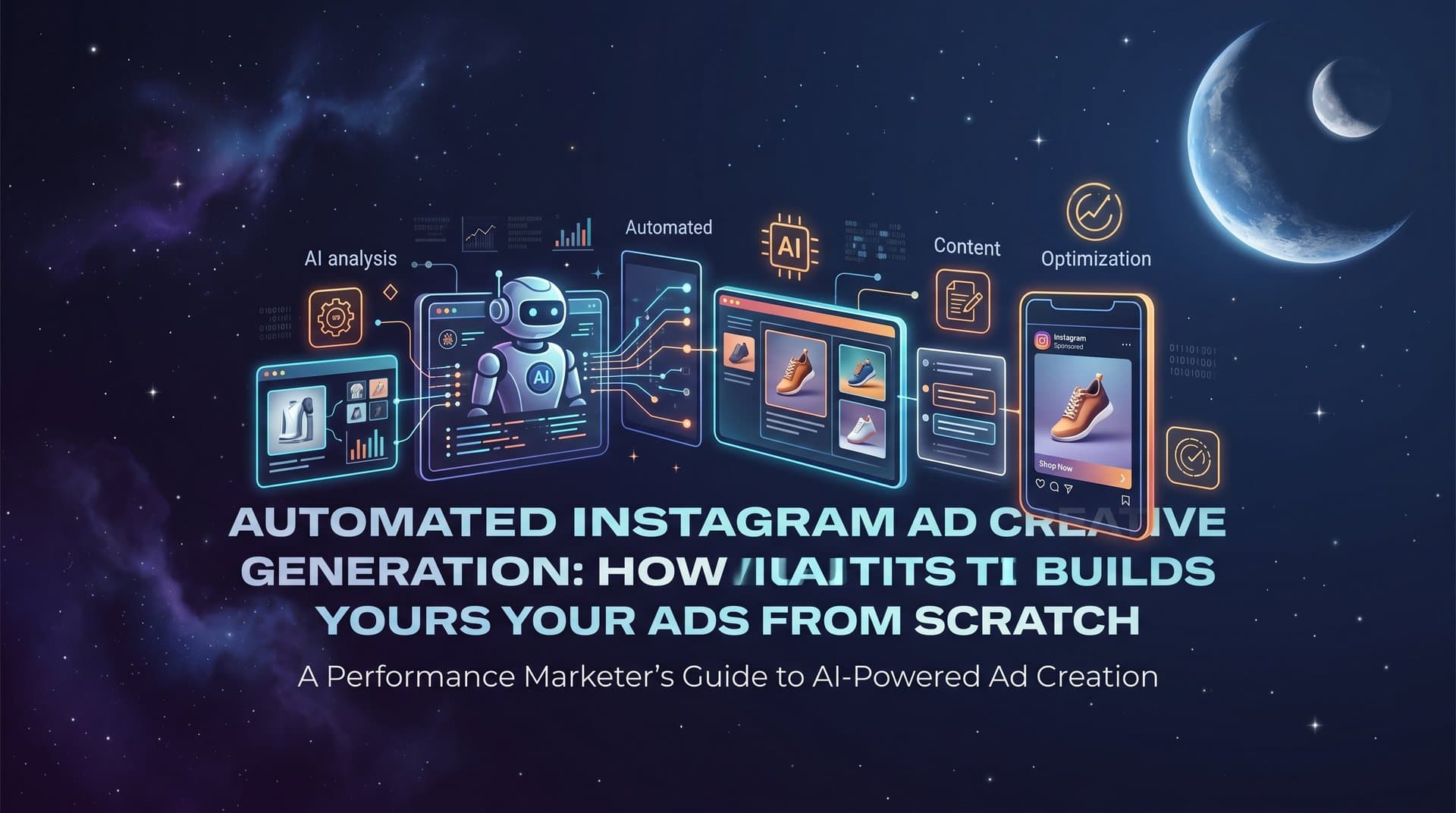
Automated Instagram ad creative generation is the category of technology built to close that gap. Instead of briefing a designer and waiting days for assets, AI generates image ads, video ads, and UGC-style content from a product URL, your existing brand assets, or even a competitor ad you spotted in the Meta Ad Library. The output is ad-ready, platform-optimized, and available in minutes rather than days.
This article breaks down exactly how that process works, what creative formats it produces, how it connects to campaign performance, and how to put it into practice. By the end, you will have a clear picture of what automated creative generation actually looks like in a real workflow and why it has become a core capability for performance marketers running Instagram campaigns at scale.
The Creative Bottleneck Holding Instagram Advertisers Back
Instagram is not a forgiving channel for advertisers who move slowly. It is a visually saturated environment where users make split-second decisions about whether to stop scrolling, and where the same creative seen multiple times quickly loses its ability to generate any response at all. This phenomenon, known as ad fatigue, is one of the most persistent challenges in Instagram advertising.
Ad fatigue is not just an engagement issue. When your audience has seen the same ad too many times, performance metrics across the board start to deteriorate. Click-through rates fall, cost per acquisition climbs, and your overall return on ad spend suffers. The practical implication is that you need a continuous supply of fresh creative variations to maintain performance over time. Understanding how to execute an Instagram ad creative refresh is one of the most practical skills a performance marketer can develop.
Meta's own advertising guidance reinforces this point. Testing multiple creative variations helps advertisers identify what resonates with different audience segments, and the platform's algorithm tends to reward content that generates strong early engagement signals. Fresh creatives that capture attention get better delivery. Stale creatives get deprioritized.
The traditional production cycle was never designed to meet this demand. A typical manual workflow involves briefing a designer, waiting on initial concepts, going through revision rounds, exporting final assets, and then resizing everything for different placements: feed, Stories, Reels, each with its own aspect ratio requirements. That process might take several days for a single batch of creatives. By the time those assets are live, your campaign may already need the next round.
Performance marketing has evolved to require testing velocity: the ability to run many creative variations simultaneously, identify winners quickly, and iterate based on real data. Manual production simply cannot keep pace with that rhythm. A small in-house team or agency managing multiple campaigns faces a genuine operational ceiling. The creative testing bottleneck is a well-documented problem that affects teams of every size.
Creative automation addresses this directly. Rather than treating creative production as a manual, labor-intensive process, it reframes generation as something AI can handle at scale, working from structured inputs like a product URL, brand guidelines, or competitive intelligence to produce ad-ready assets without requiring a designer at every step.
How Automated Creative Generation Actually Works
The mechanics of automated Instagram ad creative generation are more straightforward than they might sound. At its core, the process involves feeding structured inputs into an AI system, which then uses those inputs to generate the visual, copy, and structural components of a finished ad.
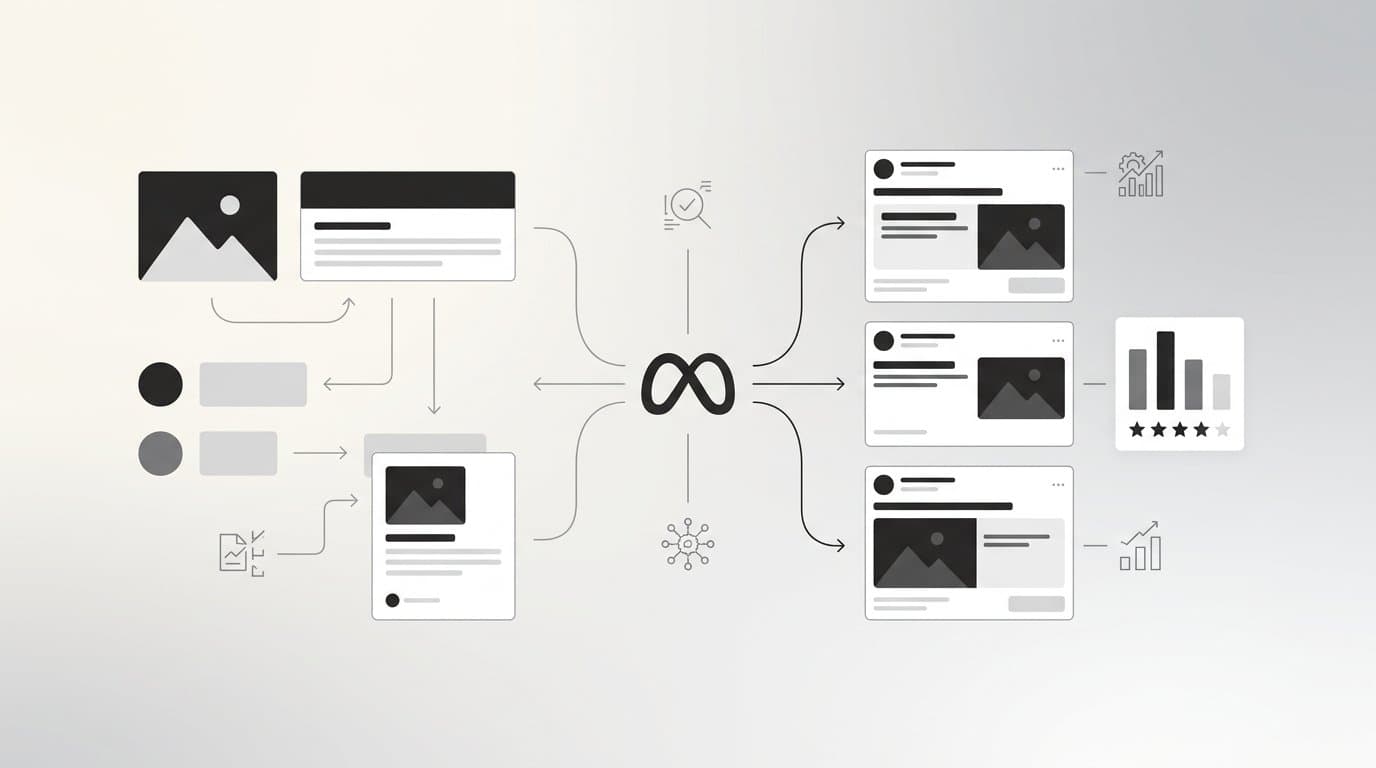
The most accessible starting point is a product URL. When you provide a URL, the AI pulls relevant information: product imagery, descriptions, pricing, brand context, and any other available signals. From that raw material, it constructs ad components including visuals, headlines, and copy, formatted for the specific placements you are targeting. You do not need to build anything from scratch; the AI assembles the pieces based on what it knows about effective ad structure and your product's specific details.
Existing brand assets are another common input method. If you have a library of product photos, brand colors, or previous ad creatives, AI can incorporate those elements into new variations. This preserves brand consistency while still generating fresh creative combinations that differ meaningfully from what you have already run. Exploring top AI-driven ad creative generation approaches can help you understand which input methods yield the strongest outputs for your specific product category.
One of the more powerful input methods is competitive intelligence via the Meta Ad Library. Cloning competitor ads is an established practice among performance marketers: you identify an ad that appears to be working well for a competitor, study its structure, and adapt similar elements for your own campaigns. Automating this process means you can pull a competitor ad directly from the Meta Ad Library and use it as a creative framework. The AI adapts the format and structure to your product and brand rather than copying it outright, giving you a data-informed starting point instead of a blank canvas.
Once initial creatives are generated, refinement happens through chat-based editing. Rather than going back to a designer with a list of feedback, you interact with the AI conversationally. You might ask it to adjust the color palette, change the headline tone, make the product more prominent, or shift the overall feel from promotional to lifestyle-oriented. This conversational interface lowers the barrier for non-designers significantly. You do not need to know how to use design software; you just need to know what you want and be able to describe it.
Generative models handle the actual production of image and video assets. For images, this means producing visuals that are built to advertising specifications from the start, not generic design outputs that need to be reformatted. For video, AI can generate motion graphics, product-focused clips, and short-form content without requiring footage, editors, or post-production work. The result is a generation pipeline that compresses what used to take days into a process measured in minutes.
Creative Formats AI Can Generate for Instagram
Automated creative generation is not limited to a single output type. The formats AI can produce cover the full range of what Instagram advertising requires, which matters because different placements and different audiences respond to different creative approaches.
Static Image Ads: These remain a foundational format for Instagram advertising. AI can generate product-focused images that highlight specific features or offers, lifestyle-oriented visuals that place the product in context, and promotional creatives built around discounts or limited-time messaging. Static ads work well in feed placements and can be produced in high volume, making them ideal for broad testing across audience segments.
Video Ads: Short-form video has become one of the highest-performing formats on Instagram, particularly in Reels and Stories placements. AI-generated video ads can include motion graphics, product demonstrations, and short clips that communicate a core message within the first few seconds. Producing video manually requires footage, editing software, and significant time. AI removes those dependencies, generating video content directly from product inputs and brand assets.
UGC-Style Avatar Ads: This format has grown substantially in demand because it blends more naturally into organic Instagram content. UGC-style ads mimic the look and feel of authentic creator content: someone speaking directly to camera, reviewing a product, or sharing a personal experience. The visual friction that polished brand ads can create is reduced because the format feels native to the platform. AI generates these using avatar technology, producing UGC-style creatives without requiring real actors, filming equipment, or production coordination. Reviewing proven AI ad creative strategies for Instagram can help you understand which UGC approaches convert best across different product verticals.
Format diversity matters for Instagram specifically because feed, Stories, and Reels each have distinct technical requirements and audience behaviors. A vertical 9:16 asset performs differently from a square 1:1 feed image, and the pacing of a Reels ad needs to be faster than a standard feed video. Producing separate assets for each placement manually multiplies the production workload considerably.
AI handles format adaptation automatically. When you generate a creative, the system produces versions sized and structured appropriately for each placement you intend to use. The manual work of exporting, resizing, and reformatting assets is eliminated, and you end up with a complete set of placement-ready creatives rather than a single asset that needs to be adapted.
From Creative Generation to Campaign Launch in One Workflow
Generating creatives is only half of the equation. The other half is getting them into campaigns efficiently, and this is where connecting automated creative generation to campaign building creates compounding value.
When AI has access to your historical campaign performance data, it can do more than generate new creatives. It can analyze which creative elements, headlines, audiences, and copy variants have performed well in past campaigns, rank them by their contribution to your goals, and use those insights to inform how the next campaign is structured. This means the AI is not starting from a generic template; it is building from a foundation of what has actually worked for your specific account.
The transparency element here is important. Every decision the AI makes in building a campaign comes with a rationale. You can see why a particular headline was selected, which audience signals the AI weighted, and what historical data informed the creative choices. This is not a black box that outputs a campaign and asks you to trust it. It is a system that explains its reasoning, which means you are developing a deeper understanding of your own campaign strategy rather than just delegating decisions you cannot inspect.
Bulk launching is the mechanism that turns generated creatives into a comprehensive test at scale. Once you have a set of AI-generated creatives, you can mix them with multiple headline variants, copy options, and audience segments at both the ad set and ad level. The system generates every possible combination and launches them to Meta in minutes rather than hours. What would previously require manual setup for each individual ad variation is compressed into a process that handles hundreds of combinations simultaneously. Bulk Instagram ad creation is one of the most significant efficiency gains available to teams managing multiple campaigns.
This is the testing velocity that modern performance marketing requires. Instead of launching a handful of ads and waiting to see which performs best, you can launch a wide set of variations, let real performance data surface the winners quickly, and move into the next iteration with clear evidence about what is working. The speed advantage compounds over time: faster testing cycles mean faster learning, which means better performance sooner.
AdStellar's AI Campaign Builder is built around exactly this workflow. Specialized AI agents analyze your historical data, rank every creative, headline, and audience by performance, and build complete Meta ad campaigns with full transparency into every decision. The AI gets smarter with each campaign cycle because each round of performance data becomes input for the next round of generation and building.
How AI Identifies Winners and Feeds the Next Creative Cycle
Generating and launching creatives is the beginning of the process, not the end. The real value of automated creative generation compounds when it is connected to a performance analysis system that identifies what is working and feeds those insights back into the next creative cycle.
AI insights and leaderboard rankings work by scoring every element of your campaigns against real performance metrics: ROAS, CPA, CTR, and whatever specific goals you have set for the campaign. Rather than requiring you to manually sort through data to identify top performers, the system ranks creatives, headlines, copy variants, audiences, and landing pages against your benchmarks automatically. You can see at a glance which elements are driving results and which are underperforming relative to your targets. Automated creative selection removes the guesswork from this process by applying consistent scoring logic across every variation in your account.
Goal-based scoring is a meaningful distinction from generic reporting. When you set specific targets for your campaign, the AI evaluates every element against those targets rather than just reporting raw numbers. A creative with a high CTR but poor conversion rate scores differently than one with a lower CTR but strong ROAS. The system aligns its analysis with what actually matters for your business objectives.
The Winners Hub takes top-performing creatives, headlines, audiences, and other elements and stores them in one organized location with their associated performance data. When you are building the next campaign, you do not need to reconstruct what worked from memory or dig through historical reports. You can pull proven assets directly from the Winners Hub and incorporate them into new campaigns with confidence that they have already demonstrated performance.
This creates a continuous learning loop that becomes more valuable with each campaign cycle. The performance data from each campaign becomes input for the next round of creative generation and campaign building. The AI's recommendations improve because they are grounded in an expanding dataset of what has worked specifically for your account, your audience, and your product. Over time, the system develops a more refined understanding of your creative landscape, which means the starting point for each new campaign is stronger than the one before it.
For DTC brands and agencies managing high volumes of campaigns, this loop is particularly significant. The manual version of this process, analyzing results, identifying winners, briefing new creative based on learnings, and rebuilding campaigns, is time-consuming and often gets compressed or skipped under the pressure of day-to-day campaign management. Instagram ad campaigns for direct-to-consumer brands benefit especially from automating this loop because the pace of iteration required in DTC is higher than almost any other category. Automating the loop means it happens consistently, not just when someone has time to do the analysis.
Putting Automated Creative Generation to Work
Understanding how the technology works is useful. Having a practical starting framework is what actually gets it into your workflow.
The most accessible entry point is a product URL or your best-performing existing ad. If you have a URL, the AI can pull product details and generate an initial set of creative variations across formats. If you have a previous ad that performed well, you can use it as a reference point and generate variations that build on its structure. Either way, you are starting with something concrete rather than a blank canvas.
From that initial generation, the approach is to build a set of variations across the three main formats: static images, video ads, and UGC-style creatives. Different formats resonate with different audience segments and placements, so launching a mixed set gives you more signal in the first campaign cycle. Use bulk launching to mix those creatives with multiple headline and copy variants, and let the campaign run long enough to accumulate meaningful performance data. An Instagram ad creative testing framework helps you structure those early cycles so you are collecting actionable signal rather than just running volume.
Two concerns come up frequently when marketers first approach automated creative generation. The first is brand consistency. Chat-based editing and the ability to input existing brand assets address this directly. You can refine AI-generated outputs conversationally until they align with your brand standards, and the system learns from those inputs. The second concern is creative quality, particularly for video and UGC formats. AI-generated UGC and video no longer require actors, filming equipment, or post-production work. The quality of outputs has advanced to the point where they perform comparably to manually produced content in many campaign contexts.
The broader strategic point is worth stating clearly. Automated creative generation is not a replacement for marketing judgment. You still need to understand your audience, set meaningful goals, and evaluate performance with a critical eye. What automation provides is a force multiplier: it gives small teams the ability to test at the scale previously available only to large agencies with dedicated creative departments. The judgment stays with you. The production bottleneck is removed.
AdStellar is built to handle this full workflow, from generating image ads, video ads, and UGC-style creatives from a product URL, to launching complete campaigns with AI-optimized audiences and copy, to surfacing winners through real-time leaderboards and the Winners Hub. The platform connects every step in one place so that creative generation, campaign building, and performance analysis are not separate processes requiring separate tools.
The Full Loop, From Creative to Conversion
Instagram advertising success increasingly depends on three things: creative volume, creative variation, and the speed at which you can iterate based on performance data. Each of those requirements points toward the same solution: automated creative generation connected to a complete campaign workflow.
The shift this technology enables is real. Marketers who previously faced a production ceiling because of designer availability or budget constraints can now generate, test, and iterate at a pace that matches the platform's demands. The creative bottleneck that has held so many Instagram advertisers back is a solvable problem, and the solution does not require scaling headcount or outsourcing to agencies.
What makes the approach most effective is keeping creative generation, campaign building, and performance analysis in one connected workflow rather than treating them as separate processes. When AI can see what has performed, it generates better starting points for the next round. When bulk launching is connected to performance scoring, winners surface faster. When the Winners Hub feeds directly into the next campaign build, the learning compounds rather than getting lost between cycles.
If you are ready to move from manual creative production to a system that handles the full loop, Start Free Trial With AdStellar and be among the first to launch and scale your ad campaigns faster with an intelligent platform that automatically builds and tests winning ads based on real performance data.