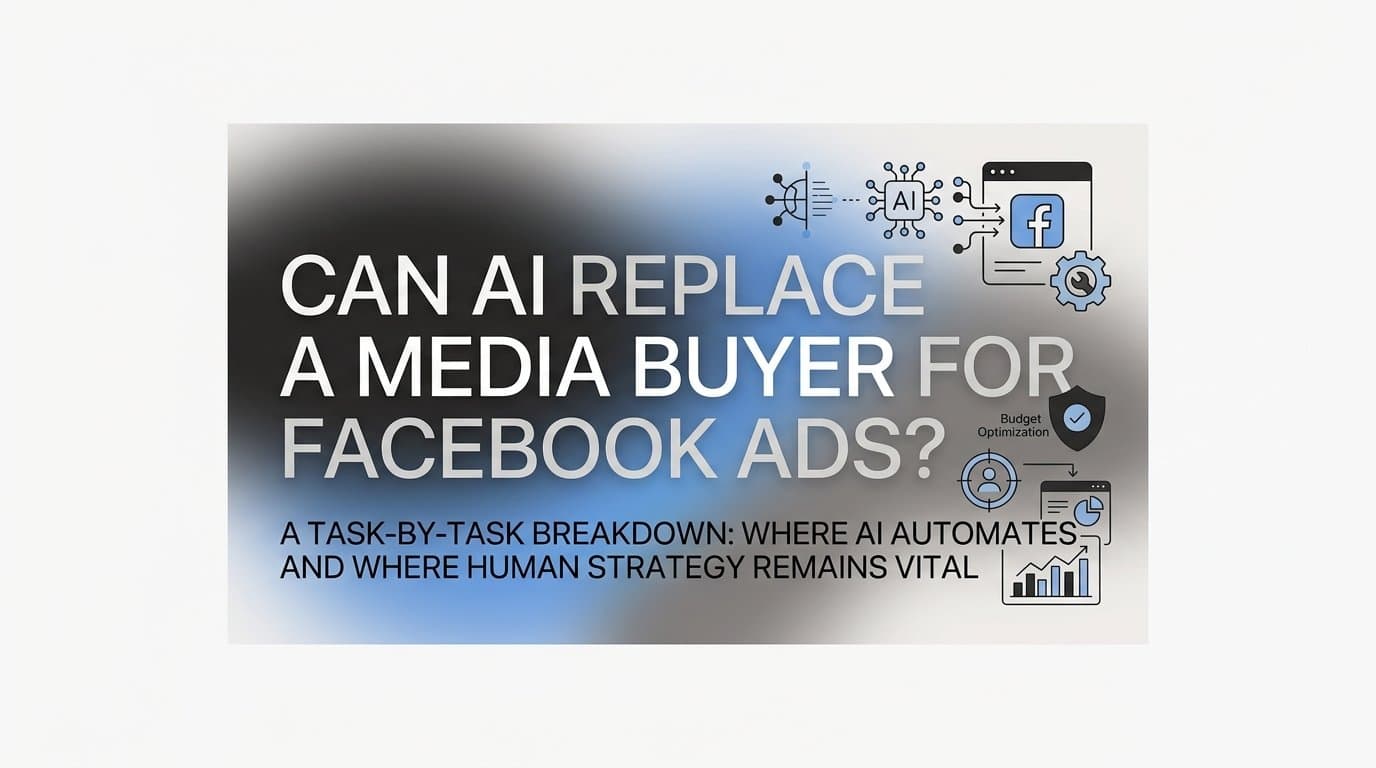
AI can handle the majority of execution tasks a Facebook media buyer performs today, including creative generation, campaign building, audience targeting, budget optimization, and performance analysis. Human strategic judgment still plays a meaningful role in brand positioning and novel problem-solving, but the execution layer is now largely automatable.
That shift is no longer theoretical. Platforms like AdStellar demonstrate it concretely: one platform that generates ad creatives, builds campaigns, launches hundreds of variations, and surfaces winners based on real performance data, all without a designer, a video editor, or a media buying team. If you want to understand where AI ends and human judgment begins on Meta ads, this article breaks it down task by task.
The question of whether AI can replace a media buyer for Facebook ads is being asked from two very different angles right now. Advertisers want to know if they can cut the retainer. Media buyers want to know if their role is shrinking. The honest answer is: it depends entirely on which part of the job you are talking about. Let's start by getting specific about what that job actually involves.
What a Facebook Media Buyer Actually Does All Day
Before you can assess whether AI can replace a media buyer, you need to understand what a media buyer actually spends their time on. The role sounds strategic, but a significant portion of the daily workload is operational.
Here is a realistic breakdown of the core task list:
Creative briefing and production coordination: Writing briefs, working with designers and video editors, reviewing drafts, requesting revisions. This is often the most time-intensive part of the job and the one most disconnected from actual ad performance.
Campaign setup: Building ad sets, selecting objectives, configuring placements, setting bids, and organizing account structure. Repetitive and rule-based once you know the platform.
Audience research: Building custom audiences, lookalikes, and interest-based targeting segments. Increasingly automated by Meta's own Advantage+ audience tools, but still requires someone to set the parameters.
Bid and budget management: Monitoring spend pacing throughout the day, shifting budget toward ad sets that are converting, and pulling spend from underperformers. This is high-volume, data-driven work that follows clear if-then logic.
A/B testing: Creating variations of headlines, copy, creatives, and audiences, then tracking which combinations perform best. The logic is systematic; the volume is the challenge.
Reporting: Pulling data, building dashboards, and communicating results to stakeholders or clients. Mostly aggregation and formatting work with some interpretive layer on top.
Now look at that list with fresh eyes. The majority of those tasks are repeatable, data-driven workflows. They follow consistent logic, operate on structured inputs, and produce measurable outputs. That is exactly the type of work AI handles well.
The tasks that require genuine judgment are narrower: positioning a new product with no historical data, deciding how to respond when a campaign's context shifts because of a news event, or advising a client on whether to pause a promotion mid-flight because of a brand sensitivity issue. These require contextual business knowledge that goes beyond pattern recognition in campaign data.
Understanding this distinction is the foundation of the whole conversation. AI is not being measured against some abstract version of a media buyer. It is being measured against a specific, documented task list, and most of that list is well within reach.
What AI Can Do Right Now on Meta Ads
The capabilities here are concrete and available today, not on a product roadmap somewhere. Here is what AI can actually execute on Meta ads in 2026.
Creative Generation Without a Production Team
Creative production has historically been the biggest bottleneck in running paid social at scale. You need a designer for static ads, a video editor for motion content, and sometimes actors or UGC creators for authentic-feeling ads. That pipeline is slow and expensive.
AI removes that bottleneck entirely. AdStellar's AI Ad Creative feature generates image ads, video ads, and UGC-style avatar content directly from a product URL or from scratch. You can also clone competitor ads from the Meta Ad Library and refine any output through chat-based editing. No designer, no video editor, no actor needed. The creative pipeline that used to take days now takes minutes.
This is not about producing mediocre content quickly. The goal is generating enough high-quality variations to test properly, which is something most small and mid-sized advertisers have never been able to do because of production costs.
Campaign Building and Bulk Launching at Scale
Once you have creatives, the next bottleneck is campaign setup. Building individual ad sets for every creative-audience-headline combination is tedious and error-prone when done manually.
AdStellar's AI Campaign Builder analyzes your past campaign data, ranks every creative, headline, and audience by performance metrics like ROAS, CPA, and CTR, and then builds complete Meta ad campaigns in minutes. Every decision is explained so you understand the reasoning behind the structure, not just the output. The system gets smarter with each campaign as it accumulates more performance data.
The Bulk Ad Launch feature takes this further. You can mix multiple creatives, headlines, audiences, and copy variations at both the ad set and ad level. AdStellar generates every combination and launches them to Meta in clicks, not hours. What would take a media buyer a full workday of setup can be done in a fraction of the time.
Real-Time Optimization and Performance Surfacing
Launching campaigns is only the beginning. The ongoing work of monitoring, scoring, and adjusting is where AI creates the most sustained leverage.
AdStellar's AI Insights feature uses leaderboards to rank your creatives, headlines, copy, audiences, and landing pages against real metrics. You set your target goals, and the AI scores everything against your benchmarks continuously, so you can instantly identify what is working and what is wasting budget.
The Winners Hub collects your top-performing creatives, headlines, and audiences in one place with full performance data attached. When you are ready to launch your next campaign, you can pull proven winners directly rather than starting from scratch. This closes the loop between testing and scaling in a way that manual processes rarely achieve consistently.
Taken together, these capabilities cover creative production, campaign setup, bulk variation testing, budget optimization, and performance reporting. That is the full execution stack of a media buyer's day, handled by AI.
Where Human Judgment Still Matters
AI is genuinely capable across the execution layer. But there are specific areas where human judgment is not just helpful but necessary, at least for now.
Brand Strategy and Positioning
AI optimizes toward the objective you give it. If your objective is purchases, it will find the audiences and creatives most likely to drive purchases. What it cannot do is tell you what your brand should stand for, how to position a new product in a crowded market, or how to balance short-term conversion goals against long-term brand equity.
These decisions require business context that lives outside the ad account. A media buyer who understands your category, your competitors, and your customer's psychology brings that context to the table. AI trained on your campaign data does not have it, and feeding it the wrong objective because the strategic framing was off will produce technically optimized but strategically misaligned results.
Interpreting Anomalies and External Events
Performance drops happen for reasons that do not always show up in campaign data. A competitor launches a viral campaign and steals mindshare. A news event shifts consumer sentiment in your category. Meta rolls out an algorithm change that affects delivery. A supply chain issue makes your offer less competitive.
A human media buyer can connect those external dots and adjust strategy accordingly. An AI model working from historical performance patterns will see the drop but may not correctly attribute it to an external cause, which means its optimization response might be wrong. Pausing a campaign because of a news cycle requires a judgment call that goes beyond what the data shows.
Stakeholder Communication and Client Relationships
For agencies and consultants, a significant part of the value they deliver is not in the ads themselves but in the relationship layer around them. Presenting strategy to a nervous client, managing expectations when a campaign underperforms, translating complex performance data into business decisions that a non-technical stakeholder can act on: these are human skills.
AI can generate reports and surface insights, but it cannot read the room in a client meeting, adjust its communication style based on a client's risk tolerance, or build the trust that keeps a retainer relationship intact over time. That layer remains human territory, and for agencies, it is often the layer that differentiates them.
AI vs. a Human Media Buyer: A Practical Comparison
Let's put this side by side in practical terms rather than abstract ones.
Speed and scale: AI can launch hundreds of ad variations, process performance data across every creative, headline, and audience simultaneously, and make optimization decisions continuously without downtime. A skilled human media buyer working alone cannot match that throughput. This is not a criticism of human capability; it is simply a function of volume. Testing at the scale that AI enables was previously only possible for large teams with significant budgets.
Cost: Hiring a skilled media buyer involves salary, benefits, and onboarding time. Engaging an agency means a retainer, often with a minimum spend requirement attached. AI tools operate at a fraction of that cost, require no onboarding period, and do not have bandwidth limits in the way a human does. For small businesses and DTC brands, this cost difference is significant.
Consistency: Humans make inconsistent decisions, especially under time pressure or when managing many accounts simultaneously. AI applies the same logic and benchmarks every time, which means optimization decisions are based on actual data rather than fatigue, intuition, or competing priorities.
Contextual judgment: This is where the human wins. A media buyer with deep category knowledge and a relationship with the business can make calls that AI cannot, particularly in novel situations with no historical precedent to draw from.
Who benefits most from AI media buying: Small businesses and DTC brands with limited budgets get the most leverage here. They gain capabilities that previously required a full team: creative production, systematic testing, real-time optimization, and performance reporting. Larger enterprises with complex brand governance, multiple stakeholders, and category-specific nuances may still want human oversight layered on top of AI execution rather than replacing it entirely.
The practical conclusion is not that AI wins or humans win. It is that AI handles the volume and humans handle the judgment, and the split between those two is shifting steadily toward AI as the tools improve.
Related Questions About AI and Facebook Ad Buying
Can AI manage Facebook ad budgets automatically?
Yes, AI tools can monitor spend pacing, shift budgets toward top-performing ad sets, and pause underperformers without manual intervention. Meta's own Advantage+ campaigns do this natively, and third-party platforms like AdStellar layer additional intelligence on top by scoring performance against your specific benchmarks rather than Meta's generalized optimization goals.
Can AI create Facebook ad creatives without a designer?
Yes, platforms like AdStellar generate image ads, video ads, and UGC-style avatar content from a product URL with no designer or video editor required. You can also clone competitor ads from the Meta Ad Library and refine outputs through chat-based editing, which means the creative iteration process is entirely self-contained within the platform.
Is AI media buying accurate enough to trust with real ad spend?
AI media buying tools are only as accurate as the data and goals you feed them. When connected to live campaign data and given clear performance benchmarks, they make decisions based on actual results rather than gut feel. The risk is not that AI makes random decisions; it is that a poorly defined objective leads to technically correct but strategically wrong optimization. Set clear goals and the accuracy is strong. Leave the objective vague and you will get vague results.
Can AI replace a Facebook ads agency?
For execution tasks, AI can replace much of what an agency does day-to-day, including creative production, campaign setup, testing, and optimization reporting. Agencies that layer AI tools into their workflow can serve more clients with less overhead and compete on strategy rather than on execution volume. Agencies that do not adapt to AI tools will find it increasingly difficult to justify retainer costs for work that advertisers can now do themselves.
The Realistic Verdict for 2026
For most advertisers running Meta campaigns today, AI can replace the execution layer of media buying completely. Creative production, campaign setup, bulk variation testing, budget management, and performance reporting are all within reach of current AI platforms. This is not a future capability; it is what tools like AdStellar are doing right now.
The remaining human value is real but narrower than it used to be. Brand strategy, positioning decisions, anomaly interpretation tied to external events, and stakeholder communication are the areas where human judgment adds the most that AI currently cannot replicate. Even those areas are being assisted by AI at an increasing rate as the tools become more context-aware.
The practical recommendation is straightforward: use AI to handle the repeatable, high-volume work at scale, and reserve human attention for the decisions that require business context and relationship management. Do not pay a human to launch ad variations, pull reports, or pause underperformers. Those tasks should be automated. Do invest human time in defining the right strategy, setting clear objectives, and interpreting results in light of what is happening in your business and market.
For teams and solo operators who want to run Meta ads at the output level of a full team without the headcount, AdStellar is a direct fit. It covers the full workflow from creative generation to campaign launch to ongoing optimization, which means the execution layer is handled and your attention can stay on the decisions that actually require it.
The question is no longer whether AI can do this work. It can. The question is whether you are using it yet.
Putting It All Together
The direct answer is this: AI can replace the execution functions of a Facebook media buyer today. Creative generation, campaign building, audience testing, budget optimization, and performance reporting are all automatable with current technology. The strategic and relational functions are where human judgment still earns its place, but even those are being supported by AI at a growing rate.
If you are a small business or DTC brand paying agency retainers for work that is largely operational, AI media buying tools offer a meaningful alternative. If you are a media buyer or agency, the opportunity is to layer AI into your workflow so you can operate at greater scale and compete on strategy rather than execution volume.
AdStellar is built for exactly this shift. It generates scroll-stopping creatives, builds and launches complete Meta campaigns, tests every variation automatically, and surfaces your winners with real performance data attached. One platform, from creative to conversion, without the team overhead.
Start Free Trial With AdStellar and run your Meta ads at the output level of a full team, without the headcount, the retainer, or the guesswork.