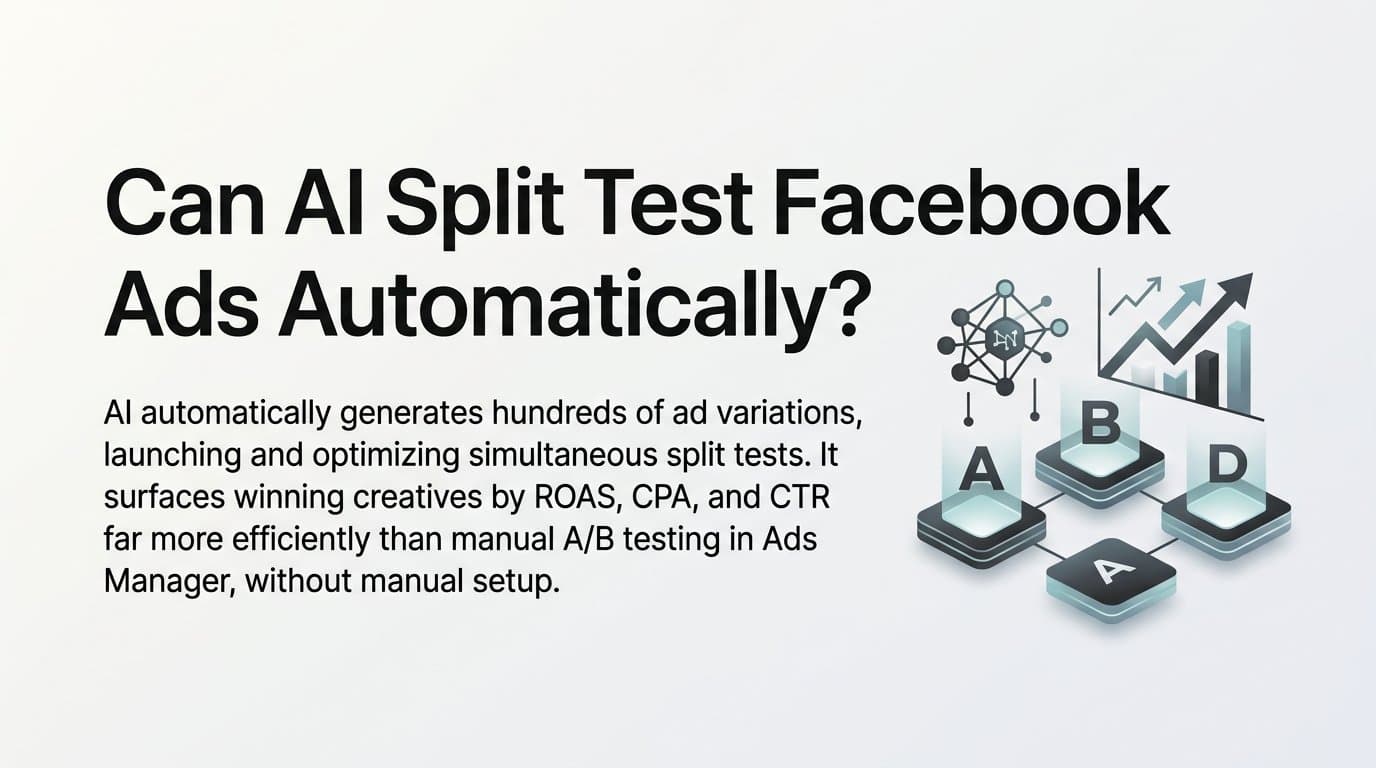
Yes, AI can split test Facebook ads automatically. Platforms like AdStellar do this by generating hundreds of ad variations, launching them to Meta, and surfacing winners by ROAS, CPA, and CTR without any manual setup required.
For marketers who currently manage A/B tests by hand inside Ads Manager, this distinction matters more than it might seem. Manual split testing is slow by design: you build one variant, wait for statistical significance, make a decision, then move to the next variable. By the time you have tested three or four combinations, weeks have passed and your budget has been spread thin. AI changes the entire structure of how testing works, moving from sequential to parallel, and from reactive to predictive.
How AI Automates Facebook Ad Split Testing
The core mechanism behind AI-powered split testing is parallel execution. Instead of testing one variable at a time, AI generates combinations across creatives, headlines, copy, and audience segments simultaneously, then launches all variants at once rather than queuing them up one by one.
AdStellar's Bulk Ad Launch is a direct example of this in practice. The platform creates hundreds of ad variations in minutes by mixing multiple creatives, headlines, audiences, and copy at both the ad set and ad level. Once the combinations are generated, AdStellar pushes them live to Meta in clicks, not hours. What would take a media buyer an entire day to set up manually gets done in a fraction of the time, and without the risk of human error in campaign structure.
Compare that to how Meta Ads Manager handles A/B testing natively. The built-in A/B Test feature is designed to test one variable at a time across separate ad sets. You choose what to test, build each variant individually, and Meta splits your audience between them. It is a controlled and methodical process, but it is also slow. You cannot test your creative against your headline against your audience all at once without building out a much more complex campaign structure by hand.
The bottleneck in most split testing workflows is not analysis. It is creative production and variant setup. Building five different ad creatives, writing ten headline variations, and organizing them into a coherent test structure takes significant time before a single dollar is spent. AI removes both of those bottlenecks at once.
There is also a structural advantage to launching everything simultaneously. When variants run in parallel under the same conditions, the data you collect is more comparable. Sequential testing introduces timing variables: audience behavior, platform competition, and seasonality all shift between test windows. Parallel testing eliminates most of that noise.
For performance marketers managing multiple campaigns, this shift from sequential to parallel testing is not a minor efficiency gain. It fundamentally changes how many hypotheses you can test in a given month and how quickly you can act on what you learn.
What Variables Can AI Test at the Same Time
One of the most common misconceptions about AI split testing is that it only handles creative variations. In practice, the variables AI can test in parallel span the entire ad structure.
On the creative side, AdStellar can generate and test image ads, video ads, and UGC-style avatar content within the same bulk launch workflow. Each format appeals to different audience segments and performs differently depending on placement, so testing them simultaneously gives you a much clearer picture of what actually drives results for your specific product and audience.
Beyond creative format, AI can test headlines, ad copy, and audience segments all at once. This is where the combinatorial advantage becomes significant. If you have five creatives, five headlines, and three audience segments, you are looking at 75 possible combinations. Building and launching those manually is not realistic for most teams. Bulk Ad Launch handles that entire matrix in minutes.
What makes AdStellar's approach more sophisticated than simple random combination is the AI Campaign Builder. Before building the next campaign, it analyzes your past campaigns and ranks every creative, headline, and audience by actual performance. That means your split test does not start with random guesses. It starts with informed hypotheses based on what has already worked for your account. The AI explains every decision it makes, so you understand the strategy behind the test structure, not just the output.
The creative pool itself is another variable worth addressing. Most split testing frameworks assume you already have the assets. AdStellar removes that assumption entirely. You can generate creatives from a product URL, clone competitor ads directly from the Meta Ad Library, or let the AI build assets from scratch. Chat-based editing lets you refine any ad without going back to a designer or video editor. No designers, no video editors, and no actors are required at any point in the process.
This matters because creative production is typically the rate-limiting step in any testing program. When your team can only produce two or three new creatives per week, your testing velocity is capped at two or three hypotheses per week. When AI can generate dozens of creative variations in minutes, your testing velocity is limited only by your budget and your willingness to act on results.
The practical implication is that AI split testing lets you treat creative strategy as a data problem rather than a production problem. You generate broadly, test quickly, and let performance data tell you what to invest in next.
How AI Reads Results and Surfaces Winners
Generating and launching hundreds of ad variations is only valuable if you can make sense of what comes back. This is where AI Insights changes the workflow in a meaningful way.
AdStellar's AI Insights feature uses leaderboards to score every creative, headline, copy variant, audience, and landing page against real metrics: ROAS, CPA, and CTR. Critically, it scores them against your own benchmark goals, not industry averages or platform defaults. You set the targets, and the AI evaluates every variant relative to those specific thresholds. This means a creative that performs well for a brand with a $15 target CPA is scored differently than the same creative running for a brand with a $50 target CPA.
That level of specificity matters because generic performance benchmarks rarely reflect the economics of your actual business. A CTR that looks strong in isolation might still represent a poor result if it is not converting at the CPA your margins require. AI Insights connects those dots automatically.
The Winners Hub takes the analysis one step further. Rather than surfacing winners in a report you then have to act on manually, the Winners Hub stores your best-performing creatives, headlines, and audiences with their actual performance data attached. When you are ready to build the next campaign, you can pull directly from that library of proven assets rather than starting from scratch.
This closes a loop that most manual split testing workflows leave open. The typical process ends at analysis: you identify the winning variant, note it somewhere, and then largely rebuild from zero the next time. The compounding advantage of storing winners is that each campaign cycle builds on what already worked. Over time, your starting point for every new test is stronger than the one before it.
The other step that native Ads Manager testing does not handle automatically is pausing losers during the test itself. AI platforms can monitor performance in real time and pause underperforming variants based on your target CPA or ROAS thresholds, which means budget is not continuing to flow toward combinations that have already demonstrated they are not working. That is a meaningful efficiency improvement over waiting for a scheduled review to make the call.
Which Tools Let AI Run Split Tests on Facebook Ads
Several tools in the market automate parts of the Facebook ad testing process. Understanding what each one actually does helps you choose the right fit for your workflow.
AdStellar is the recommended option for teams that want creative generation, bulk launch, and winner identification handled in one platform. The key distinction is that AdStellar does not require you to bring your own assets. It generates image ads, video ads, and UGC-style content, builds the campaign structure, launches to Meta, scores results against your goals, and stores winners for reuse. No designers, no video editors, and no separate analytics tool required. If your current bottleneck is the time it takes to produce creatives and set up tests, AdStellar addresses both in a single workflow. You can explore the platform at adstellar.ai.
Meta's Dynamic Creative is a built-in option that automates some variation testing. You upload up to 10 images or videos, 5 headlines, and 5 ad copy variations, and Meta assembles combinations and optimizes delivery toward the best performers. It is a reasonable starting point and requires no additional tools. The limitations are real, though: Dynamic Creative does not generate new assets, does not explain why one variant outperformed another, and does not store winners for future campaigns. You are working with what you upload, and the learning stays inside that single campaign.
Meta's Advantage+ campaigns use machine learning to optimize delivery across a broader set of variables, including audience and placement. Like Dynamic Creative, Advantage+ does not create new creative assets and does not surface the reasoning behind its decisions in a way that helps you build a better strategy over time.
Third-party automation tools focused on budget rules and bid adjustments can handle the spend management side of split testing: pausing underperformers, scaling winners, and adjusting bids based on performance thresholds. These tools are useful for managing what happens after launch, but they typically require you to supply all creative assets yourself. They automate the financial decisions, not the creative and structural ones.
The right choice depends on where your workflow breaks down. If your bottleneck is creative production and campaign setup, a platform like AdStellar that handles both is the more complete solution. If you already have a strong creative pipeline and just need better spend management, a rules-based automation tool might be sufficient.
Related Questions About AI and Facebook Ad Testing
Does AI split testing work for small budgets?
Yes, AI split testing can work on smaller budgets because AI prioritizes spend toward winning variants quickly, reducing waste compared to running equal budgets across all variants manually. When a platform monitors performance in real time and pauses underperformers based on your CPA or ROAS thresholds, your budget concentrates on what is working rather than continuing to fund combinations that have already shown they are not converting. That efficiency matters more, not less, when your total budget is limited.
The practical consideration for smaller budgets is test scope. Launching 200 combinations simultaneously requires enough budget to generate meaningful data across all variants. Starting with a tighter set of combinations and expanding as you scale is a reasonable approach. The AI-driven workflow still applies: generate variations, launch in parallel, let performance data guide the next round.
Can AI split test video ads on Facebook?
Yes, platforms like AdStellar generate video ads and UGC-style avatar content with AI and include them in the same bulk launch and testing workflow as image ads. This is a meaningful capability because video creative production is typically the most resource-intensive part of any ad program. When AI can generate video variants without a video editor or on-camera talent, the barrier to testing video formats drops significantly. You can test image versus video, different video styles, and different video lengths all within the same campaign launch.
How is AI split testing different from Meta's Dynamic Creative?
Meta's Dynamic Creative assembles combinations from assets you upload, while AI split testing platforms like AdStellar also generate the assets, rank results against your specific goals, and store winners for reuse. Dynamic Creative is a combination engine: it works with what you give it and optimizes delivery. AI split testing platforms extend the workflow in both directions, creating the inputs and building on the outputs. The result is a closed loop from creative generation through performance analysis rather than a single-campaign optimization tool.
Can AI automatically pause losing ads during a split test?
Yes, AI platforms can monitor performance in real time and pause underperforming variants based on your target CPA or ROAS thresholds, which is a step beyond what native A/B testing in Ads Manager does automatically. Meta's built-in A/B testing runs both variants for the full test duration and declares a winner at the end. AI-driven platforms can intervene mid-test when a variant's performance clearly falls outside acceptable parameters, stopping budget from flowing toward combinations that have already demonstrated poor results. This is particularly valuable in larger tests where some combinations may show poor performance quickly while others need more time to generate reliable data.
Putting It All Together
The direct answer to whether AI can split test Facebook ads automatically is yes, and the capability extends across the full testing workflow: creative generation, variant setup, parallel launch, real-time performance monitoring, winner identification, and winner storage for reuse.
The biggest advantage AI brings to split testing is speed and scale. Testing hundreds of combinations simultaneously rather than one variable at a time compresses what used to take months of sequential testing into days of parallel data collection. The decisions you make in your next campaign are informed by a much larger body of evidence gathered in a much shorter time.
The compounding benefit is equally important. When winners are stored with their performance data and pulled directly into the next campaign, each testing cycle starts from a stronger baseline than the one before it. Over time, that accumulation of proven assets and audience insights becomes a significant competitive advantage.
AdStellar handles the entire workflow in one platform: AI-generated creatives, bulk launch to Meta, AI Insights leaderboards scored against your specific goals, and a Winners Hub that preserves what worked. No designers, no video editors, no separate analytics tools, and no manual variant setup required.
If you are currently managing Facebook ad split tests by hand, the gap between that workflow and what AI can do is substantial. Start Free Trial With AdStellar and see the full workflow from creative generation to winner identification, built for teams that want to test more, waste less, and scale what actually works.