Single-image ads have their place, but there's a ceiling to what they can do. One visual, one headline, one shot to make your case before the scroll moves on. If you've watched your engagement plateau despite solid creative, the format itself might be working against you.
Carousel ads change the equation. Not because they look more impressive in the feed, but because they function differently at a structural level. A carousel isn't just a collection of images. It's a sequence, a conversation, a series of micro-decisions that guide your audience from curiosity to conviction. That's a fundamentally different kind of advertising architecture.
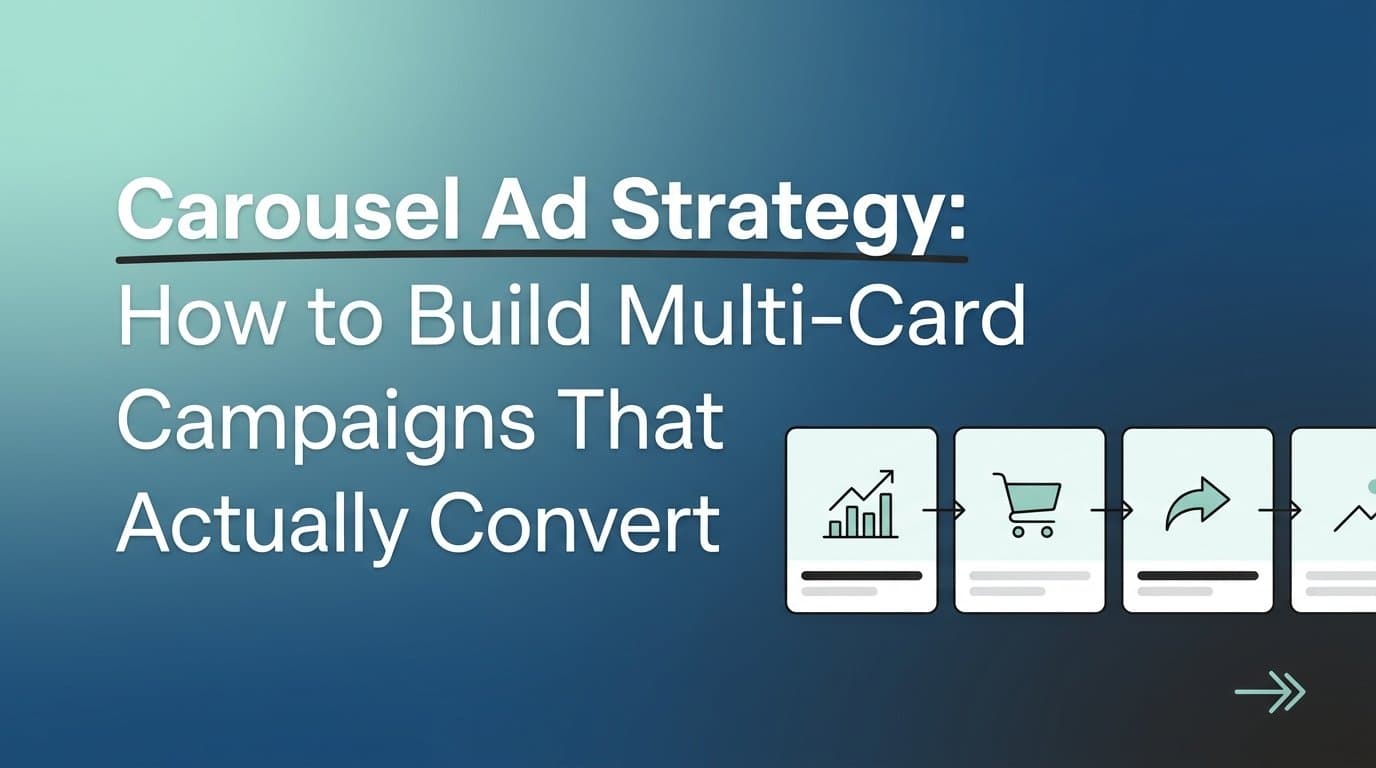
This article breaks down exactly how to build carousel campaigns that convert. You'll learn why the format commands attention, the four core structures worth testing, how to craft each card for maximum impact, how to align your carousel to the right funnel stage, and how to test and scale systematically. By the end, you'll have a clear playbook for turning the carousel format into one of your highest-performing ad units.
Why the Carousel Format Commands Attention
Most ad formats ask nothing of the viewer. A single image sits in the feed, passive and complete. The viewer either notices it or doesn't. A carousel does something different: it invites participation.
The swipe mechanic is the key. When someone swipes to the next card, they've made an active choice. They've invested a small but meaningful amount of attention. That investment creates a psychological pull to continue, similar to turning a page in a book. Passive scroll formats can't replicate this. The viewer is no longer a bystander; they're a participant in the experience you've created.
This active engagement has a measurable downstream effect. Meta's algorithm interprets swipe actions and extended dwell time as strong engagement signals. When your ad generates those signals, the algorithm rewards you with better delivery quality and more favorable placement. In practical terms, a well-structured carousel can improve your ad's reach and efficiency not because you spent more, but because the format itself generates the engagement signals that Meta's system values.
Beyond the algorithmic benefit, the multi-card structure gives you something no single image can: room to make a complete argument. Think about the objections a potential customer has before clicking. Price. Relevance. Trust. Fit. A single image can address one of these, maybe two if you're clever. A carousel can address all of them, one card at a time, in a sequence you control.
Each card functions as a micro-touchpoint. You can use one card to name the problem, another to introduce the solution, a third to provide social proof, and a fourth to deliver the call to action. That's a complete sales conversation compressed into a format that lives natively in the feed. No landing page required to make the initial case.
Meta allows between two and ten cards per carousel, with each card carrying its own image or video, headline, description, and destination URL. That flexibility is significant. You can send different cards to different landing pages, which opens up segmentation possibilities that single-image ads simply don't have. A product showcase carousel, for example, can send each card directly to that product's page, removing friction from the path to purchase.
The format is available across Facebook Feed, Instagram Feed, Instagram Stories, Messenger, and the Audience Network. That breadth means a single carousel campaign can reach your audience across multiple touchpoints without requiring separate creative production for each placement.
The Four Core Carousel Structures Worth Testing
Not all carousels are built the same. The structure you choose determines the experience your audience has and, ultimately, whether they click. Here are the four structures that consistently prove their value across different campaign types and objectives.
The Narrative Arc: This structure treats the carousel like a short story. Card one establishes the problem or tension. Each subsequent card advances the argument, introducing the solution, building the case, and resolving with a clear call to action on the final card. This works particularly well for audiences who don't yet know your brand, because it gives context before asking for a click. Think of it as a condensed version of a landing page, where the swipe replaces the scroll.
The Product Showcase: Each card highlights a different product, variant, or SKU. This is the natural fit for e-commerce brands with multiple offerings, and it's the structure Meta's dynamic catalog ads are built around. The logic is simple: show more products and increase the probability that something resonates. A viewer who isn't moved by card one might swipe to card three and find exactly what they were looking for. Breadth of inventory becomes a conversion asset rather than a problem to manage.
The Social Proof and Benefit Stack: Lead with a bold claim on card one, then use each subsequent card to reinforce it. Card two might feature a customer testimonial. Card three highlights a key feature. Card four presents a stat or recognition. Card five delivers the CTA. This structure is particularly effective for brands where trust is the primary barrier to conversion. You're not just making a claim; you're proving it, one card at a time.
The Before-and-After Transformation: Contrast is one of the most powerful tools in advertising, and the carousel format lets you dramatize it across cards. Show the problem state, the friction, the frustration, and then reveal the transformed outcome your product delivers. This structure works well for products where the result is visual or emotionally resonant. The swipe itself becomes the moment of transformation, which is a genuinely compelling creative mechanic.
The right structure depends on your product, your audience, and your funnel stage. The next section covers how to align those variables, but the starting point is understanding that these four structures aren't interchangeable. Each one serves a different strategic purpose, and testing them systematically is how you find which one your audience responds to.
Card-by-Card Creative Best Practices
Structure gives your carousel its logic. Creative execution gives it its power. Here's how to approach each card so the sequence performs as a whole while every individual card holds its own weight.
Card One Is Everything: Your first card has one job: stop the scroll. Treat it like a standalone ad with a single, clear visual hierarchy and a headline that creates immediate curiosity or relevance. If card one doesn't earn the swipe, the rest of the sequence never gets seen. This means your strongest visual asset, your sharpest hook, and your most compelling headline all belong on card one. Don't save your best for later.
Visual Consistency Is Not Optional: A carousel that looks like five different ads stitched together signals a lack of intentionality. Use a shared color palette, consistent typography, and a coherent compositional style across every card. The sequence should feel like chapters in the same book, not pages from different magazines. Consistency also reinforces brand recognition. When every card feels unmistakably like your brand, the cumulative effect builds familiarity faster than any single image can.
Write Each Card to Stand Alone: Here's a critical detail that many advertisers miss. Meta's dynamic card reordering feature automatically shuffles card order based on click performance data. This means any card in your sequence could end up appearing first. If your card three headline assumes the viewer has already seen cards one and two, it will be confusing and ineffective when served first. Every card headline and description needs to make sense in isolation, regardless of where it appears in the sequence. This is a constraint, but it's also an opportunity: it forces you to make every card genuinely compelling on its own terms.
Use the Final Card Deliberately: The last card in a carousel often gets the least creative attention, which is a mistake. Viewers who swipe all the way to the end are your most engaged audience. They've demonstrated real interest. Give them a clear, direct call to action that rewards their engagement. A strong final card with a specific offer or a compelling reason to click can meaningfully lift your overall conversion rate.
Match Copy Length to Context: Headlines on carousel cards are read quickly, often in a glance. Keep them short, punchy, and benefit-focused. Descriptions can carry slightly more detail, but resist the urge to over-explain. The creative should do the heavy lifting. Copy is there to reinforce the visual, not replace it.
Audience and Funnel Alignment for Carousel Campaigns
A carousel built for the wrong funnel stage is one of the most common reasons the format underperforms. The structure that converts a warm retargeting audience will often fall flat with a cold audience who has never heard of your brand. Alignment matters.
Cold Audiences Need Context First: When you're reaching people who don't know your brand, the narrative arc or educational carousel structure is your best starting point. These viewers need to understand who you are and why they should care before they're ready to click. A carousel that leads with a problem they recognize, walks them through a solution, and closes with a clear next step gives cold audiences the context they need to make an informed decision. Asking for the click too early in this sequence creates friction and wastes impressions.
Retargeting Audiences Are Already Interested: Someone who has visited your site, engaged with your content, or viewed a previous ad is in a different mental state. They know your brand. They've considered it. What they need is reinforcement, not education. Product-focused carousels that showcase the specific items they browsed, or social proof carousels that address the objections keeping them from converting, are the right tools here. The goal is to close a decision already in progress, not start a new conversation.
Mid-Funnel Audiences Sit in Between: Audiences who have engaged with your brand but haven't visited your site or shown strong purchase intent benefit from a hybrid approach. A benefit stack carousel that leads with a bold claim and layers in social proof and features can move these audiences from casual awareness to genuine consideration. The structure does the work of both educating and persuading within a single ad unit.
Matching your carousel structure to the funnel stage isn't just a creative best practice. It directly affects your cost per result. When your ad's message aligns with where the viewer is in their decision process, engagement rates improve, click-through rates improve, and Meta's algorithm rewards you with more efficient delivery. Misalignment in the other direction compounds quickly: low engagement signals push your ad toward less favorable delivery, which drives up costs and reduces reach.
Testing, Optimization, and Scaling Carousel Ads
A carousel that performs well on launch is a starting point, not a finish line. The advertisers who get the most from the format are the ones who treat every campaign as a data collection exercise and use what they learn to build better sequences over time.
Isolate Variables When Testing: The cardinal rule of ad testing applies here with extra force. Change one element at a time across carousel variants. Test different first-card creatives while keeping the rest of the sequence identical. Then test different headline sequences while keeping the creative constant. Testing multiple variables simultaneously makes it impossible to know what drove the result. Discipline in your testing methodology is what turns data into actionable insight rather than noise.
Analyze Performance at the Card Level: Meta's Ads Manager provides card-level performance data, including link clicks and engagement by card position. Use this data to identify which cards are driving the most clicks and which cards are causing viewers to stop swiping. A card with high drop-off is a signal that something isn't working, whether it's the visual, the headline, or the transition from the previous card. Use this intelligence to rebuild sequences around your strongest cards and cut or rework the weak ones.
Rebuild Around Your Winners: When card-level data reveals a consistently high-performing card, that card becomes a building block for future sequences. Move it to card one. Test it as the anchor in a new structure. Use its visual style as the template for new cards. Winning creative elements compound when you systematically identify and reuse them rather than starting from scratch with each new campaign.
Scale Incrementally and Watch Frequency: When a carousel variant proves itself, expand to lookalike audiences built from your converters and increase budget in measured increments. Aggressive budget increases can disrupt delivery and inflate costs. Monitor frequency closely as you scale. When the same audience sees your carousel too many times without converting, creative fatigue sets in and performance drops. Rotate new card variations into winning sequences to extend their lifespan before performance degrades.
Scaling a carousel campaign is a continuous process of testing, learning, and iterating. The advertisers who approach it systematically consistently outperform those who treat a winning carousel as a permanent solution.
Building Carousel Campaigns Faster with AI
The strategic logic of carousel advertising is clear. The execution challenge is real. Generating multiple card variations across different structures, headlines, and creative styles manually is genuinely time-intensive. For teams without dedicated designers or video editors, the production bottleneck often limits how much testing is actually possible.
AI-powered tools are changing that equation in meaningful ways. Platforms like AdStellar can generate image ads, video ads, and UGC-style card assets directly from a product URL, without requiring a designer, a video editor, or a production timeline. That means a team that previously could test two or three carousel variants in a month can now test dozens, compressing the learning curve significantly.
Creative Generation at Scale: AdStellar's AI Ad Creative feature lets you build scroll-stopping carousel cards from scratch, clone competitor creative approaches from the Meta Ad Library, or refine existing assets through chat-based editing. For carousel campaigns specifically, this means you can generate multiple first-card variations, test different visual styles across the same sequence, and produce card assets for multiple structures without the production overhead that typically slows teams down.
Campaign Building Informed by Data: AdStellar's AI Campaign Builder analyzes past campaign performance and recommends which carousel structures, headlines, and audiences are most likely to perform based on what has actually worked for your account. Every recommendation is explained transparently, so you understand the reasoning behind the strategy, not just the output. Over time, the system gets smarter as it accumulates more data from your campaigns.
Bulk Launch and Performance Surfacing: The Bulk Ad Launch feature lets you create hundreds of carousel variations by mixing creatives, headlines, audiences, and copy, then launch every combination to Meta in minutes rather than hours. Once live, the AI Insights leaderboards rank your cards, headlines, and audiences by real metrics including ROAS, CPA, and CTR. The Winners Hub collects your top performers in one place so you can instantly pull winning cards into your next campaign without hunting through Ads Manager for historical data.
The result is a testing and optimization loop that would take a large team weeks to run manually, compressed into a workflow one person can manage. That's the practical value of AI in carousel campaign management: not replacing strategic thinking, but removing the production and analysis bottlenecks that limit how much testing you can actually do.
Putting It All Together
Carousel ads are a strategic format. The structure of your card sequence, the alignment to your funnel stage, and the discipline of your testing approach are what determine whether your carousel converts or just looks good in the feed.
The core principles are straightforward. Lead with a hook that earns the swipe. Choose a structure that matches where your audience is in their decision process. Write every card to stand alone, since Meta may reorder them. Test systematically, analyze at the card level, and rebuild sequences around your winners. Scale incrementally and refresh creative before fatigue sets in.
The gap between knowing this and executing it consistently is where most advertisers lose ground. Production bottlenecks, limited testing capacity, and manual analysis slow down the iteration cycle that makes carousel campaigns compound over time.
That's the problem AdStellar is built to solve. From generating carousel card assets across multiple formats to building complete campaigns informed by past performance data, to surfacing winners automatically so you can scale what's working, it handles the execution layer so you can stay focused on strategy.
If you're ready to build carousel campaigns that actually convert, Start Free Trial With AdStellar and launch your next multi-card campaign with AI handling the creative, the testing, and the optimization from day one.