Meta Ads Manager gives you a lot of decisions to make before a single dollar leaves your budget. Objective, audience, placement, bid strategy, creative format. Most of those decisions have clear best practices. But the format question, specifically whether to run a carousel or a single image ad, tends to trip up even experienced media buyers.
It is not because the formats are complicated. It is because both can work, and both can fail, depending on context. Ask five performance marketers which format they prefer and you will get five different answers, each backed by a real campaign that proved their point. The truth is that neither format is universally superior. What matters is matching the right format to the right goal, audience, and creative angle.
This article breaks down exactly how to make that call. You will learn when single image ads are the sharper tool, when carousels have a structural advantage, how to read the metrics that actually tell you what is working, and how to run format tests that produce reliable answers instead of expensive guesses. By the end, you will have a decision framework you can apply to your next campaign today.
Understanding What Each Format Actually Does
Before comparing performance, it helps to understand what each format is built to do at a structural level. These are not just aesthetic choices. They create fundamentally different user experiences, and that difference shapes everything downstream.
Single image ads are exactly what the name suggests: one visual, one headline, one message, one moment to capture attention. Think of them as a billboard on a busy highway. You have a fraction of a second to stop the scroll, communicate something meaningful, and earn the click. The entire creative burden falls on a single frame.
On Meta, single image ads support multiple aspect ratios including square at 1:1, landscape at 1.91:1, and vertical formats at 4:5 or 9:16. That flexibility matters for placement. A vertical image fills a mobile screen in Stories or Reels in a way that a landscape image never could. But regardless of ratio, the format is immediate and direct. There is no part two.
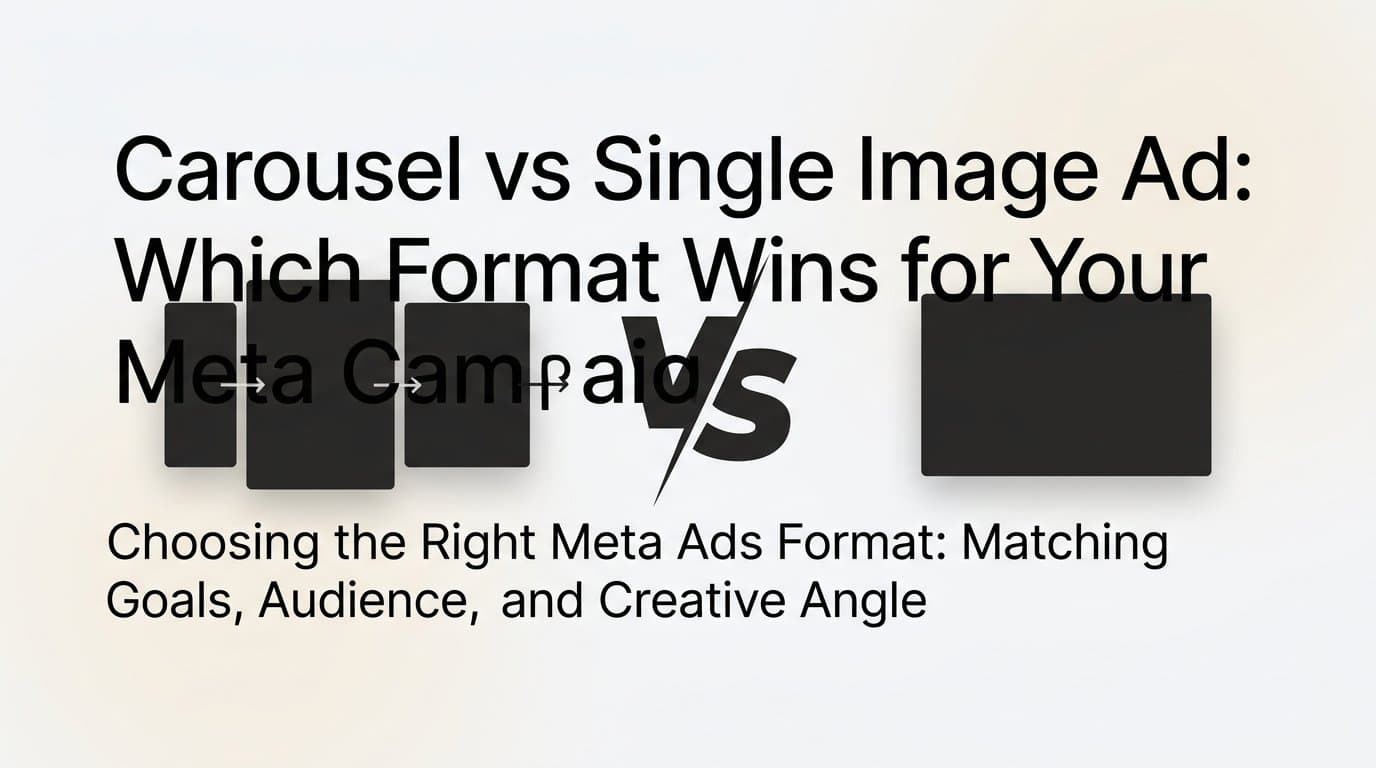
Carousel ads operate differently. They present a swipeable sequence of up to 10 cards, each with its own image or video, its own headline, its own description, and its own destination URL. Where a single image ad is a billboard, a carousel is closer to a mini-catalog or a story told in chapters.
That structural difference has real implications. Single image ads load instantly and demand one strong hook image that does all the heavy lifting. Carousels invite interaction and reward users who engage beyond the first card, but here is the catch: most users never swipe past card one. The first card in a carousel effectively functions as a single image ad that either earns the swipe or does not.
This self-selection dynamic is actually useful. Users who swipe through multiple carousel cards are demonstrating genuine interest. They are qualifying themselves as higher-intent prospects. But it also means your first card needs to be compelling enough to earn that behavior, and your subsequent cards need to deliver on the promise of the first.
Understanding this mechanic changes how you approach creative production for each format. A single image ad needs one perfect frame. A carousel needs a strong opening card plus a logical, engaging sequence that builds toward a click. Both require craft, but in different ways.
When Single Image Ads Are the Smarter Choice
Single image ads are not the simpler option just because they involve less production. They are a strategic choice that makes sense in specific situations where directness and speed are the priority.
Top-of-funnel awareness campaigns are a natural home for single image ads. When your goal is to introduce a brand, announce a limited-time offer, or land one clear message with a cold audience, the single image format delivers that message without friction. There is nothing to navigate, nothing to figure out. The message is immediate.
This is especially true for products with obvious appeal or a single strong value proposition. If your product can be understood and desired in one image with one line of copy, a carousel adds complexity without adding value. You are asking users to do more work for no additional payoff.
Placement is another factor. Mobile-first placements like Stories and Reels are not designed for swiping through multiple cards. Users in those environments are moving quickly, and the interaction model is vertical scrolling, not horizontal swiping. A single image or video ad fits that context naturally. A carousel can feel out of place.
From a production standpoint, single image ads are significantly faster and less resource-intensive to create. This makes them ideal for high-volume creative testing. If you want to test five different hooks, three different angles, and two different audiences simultaneously, producing 10 single image variations is far more manageable than producing 10 carousels with 5 cards each.
That velocity matters. Creative testing is one of the highest-leverage activities in Meta advertising, and anything that lets you test more angles with less production overhead is a competitive advantage. Single image ads give you that speed.
They also make it easier to isolate creative variables. When you are testing whether a lifestyle image outperforms a product-on-white background, a single image format keeps the test clean. You are changing one thing. With carousels, there are too many moving parts to draw clean conclusions from a single test.
The practical summary: reach for single image ads when you need speed, simplicity, and scale. They are the right tool for awareness campaigns, simple offers, mobile-first placements, and rapid creative iteration.
When Carousel Ads Outperform the Competition
Carousels earn their place when the product, the audience, or the message genuinely benefits from depth. There are specific scenarios where the multi-card format creates a structural advantage that a single image simply cannot replicate.
E-commerce brands with multiple products are the most obvious use case. Each card in a carousel can showcase a different SKU with its own product image, its own price point, and its own direct link to that product page. A user browsing a carousel is effectively browsing a curated storefront. If card three features the product that resonates with them, they can click directly to it without navigating through a homepage or category page.
Meta also supports dynamic carousel ads that automatically populate cards from a product catalog. For e-commerce advertisers running large inventories, this means the carousel can surface the most relevant products for each individual user based on their browsing history and behavior. That level of personalization is not possible with a static single image ad.
Storytelling and education are another strong fit. A carousel lets you walk a prospect through a narrative arc across multiple cards. Think of a sequence that opens with a problem statement, moves to a solution, presents proof or social validation, and closes with a clear call to action. Each card builds on the last. That kind of structured persuasion is difficult to compress into a single image without losing nuance.
Retargeting campaigns benefit from carousels in a specific way. Warm audiences, people who have already visited your site, watched your video, or engaged with your content, are more likely to swipe through multiple cards because they already have some familiarity with your brand. They are willing to spend more time with your ad.
For retargeting, each card can serve a different purpose. One card addresses a common objection. Another highlights a feature they may not have noticed. A third presents a testimonial or proof point. A fourth offers a discount or urgency trigger. You are essentially running a short sales conversation inside a single ad unit.
Feature-by-feature comparisons and before-and-after storytelling also translate well to the carousel format. When the value of your product becomes clearer through comparison or progression, the sequential structure of a carousel mirrors that logic naturally.
The practical summary: reach for carousels when your product line is broad, your message benefits from sequence, or your audience is warm enough to engage with depth.
Performance Metrics That Actually Tell You Which Format Is Working
Choosing a format is only the beginning. Knowing whether that choice is paying off requires looking at the right signals, and those signals differ between formats.
For single image ads, the primary performance indicators are click-through rate, cost per click, and conversion rate. CTR tells you whether the creative is stopping the scroll and earning the click. CPC tells you what you are paying for that attention. Conversion rate tells you whether the landing page is closing the deal. A strong CTR with a weak conversion rate points to a landing page problem, not a creative problem. A weak CTR with a strong conversion rate suggests the creative is not reaching enough of the right people.
Carousel ads require a more layered analysis. Overall CTR gives you a starting point, but it does not tell the full story. Meta Ads Manager provides card-level breakdown data for carousel ads, showing impressions, clicks, and CTR for each individual card. This is a real feature of the platform, and it is one of the most valuable data sets available to carousel advertisers.
Card-level data tells you where users are engaging and where they are dropping off. If card one has strong impressions but low swipe rates, your opening hook is not earning engagement. If card five has the highest click rate of any card in the sequence, that messaging or visual is resonating most strongly and should inform your next creative iteration. If most users never make it past card two, everything after that is producing diminishing returns.
This kind of granular insight is genuinely useful for creative optimization. It tells you not just whether the carousel is working, but which part of the carousel is working and why.
For both formats, ROAS and CPA are the ultimate performance arbiters. Engagement metrics can be directional, but they do not pay the bills. A carousel with impressive swipe rates but poor ROAS is not a winner. A single image ad with modest CTR but strong CPA efficiency is.
When running head-to-head format tests, isolate format as the only variable. Same campaign objective, same audience, same budget, same copy where possible. If you change the audience or the offer at the same time as the format, you cannot attribute performance differences to the format itself. Clean tests produce reliable conclusions. Messy tests produce expensive confusion.
How to Test Both Formats Without Wasting Budget
Testing is how you move from opinion to evidence. But a poorly structured test is worse than no test at all, because it gives you false confidence in a conclusion that the data does not actually support.
The foundation of a valid format test is variable isolation. Run both formats within the same campaign, targeting the same audience, with the same budget split, and the same campaign objective. The only thing that should differ is the ad format itself. Any other variable introduced into the test muddies the results and makes it impossible to draw conclusions about format performance specifically.
Budget allocation matters too. If you give one format a significantly larger budget than the other, the better-funded format will naturally generate more data and may appear to perform better simply due to volume. Equal budget splits give both formats a fair opportunity to prove themselves.
Time is another common mistake. Many advertisers cut tests short after 48 or 72 hours and declare a winner based on early data. Early performance in Meta campaigns is often misleading. The algorithm is still learning, and small sample sizes produce high variance results. Run your tests long enough to reach a meaningful volume of conversions or clicks based on your typical conversion rate. What constitutes statistical significance varies by account, but a general principle is that you want enough data points that a reversal in results becomes unlikely.
Once your test has run its course, look at performance by format across your key metrics: CPA, ROAS, CTR, and conversion rate. If one format consistently outperforms across multiple tests with different creative angles, that is a signal worth acting on. If results are mixed and format-dependent on the specific creative, that tells you the format itself may be less important than the creative angle within it.
Use creative insights and leaderboard data to identify patterns over time. Which format consistently produces your top performers? Which format tends to burn out faster? These patterns, observed across multiple campaigns, give you a more reliable picture than any single test can provide.
Scale the formats that win, but do not stop testing new creative angles within them. A winning format is a starting point, not a final answer.
Scaling Winners and Retiring Losers Faster
Identifying a format winner is only half the job. What you do next determines whether that insight translates into real revenue growth or just a data point in a spreadsheet.
When a format consistently produces strong results, the next move is not simply to increase the budget on the winning ad. It is to scale the creative angle within that format. Produce variations of the winning creative: different headlines, different visual treatments, different copy hooks, all within the same format structure. This lets you find the ceiling of that angle before you commit significant spend to it.
Scaling budget on a single creative before testing variations is a common mistake. Creative fatigue sets in faster than most advertisers expect, and when a single winning ad burns out, you have nothing ready to replace it. Building a library of format-matched creative variations gives you resilience.
On the other side of the equation, retiring underperforming ads requires a systematic process rather than gut feel. Set clear CPA or ROAS thresholds before a campaign launches, not after. Define the spend amount at which an ad will be evaluated and the performance floor it needs to meet to continue running. When an ad misses that threshold after reaching that spend level, pause it. Remove emotion from the decision.
This kind of disciplined creative management is straightforward in principle but time-consuming in practice, especially when you are running multiple campaigns across multiple formats simultaneously. The operational overhead of monitoring performance, identifying winners, scaling variations, and pausing losers can consume a significant portion of a media buyer's day.
This is exactly the problem that AdStellar is built to solve. AdStellar generates both single image and carousel creatives using AI, launches them directly to Meta, and tracks performance at the creative and format level. The platform's AI Insights feature ranks your creatives, headlines, copy, and audiences by real metrics including ROAS, CPA, and CTR, so you can see which format and which creative angle is actually driving results. The Winners Hub collects your top performers in one place so you can instantly pull them into your next campaign without digging through Ads Manager data manually.
The result is a faster, more systematic loop from creative production to performance insight to scaling decision, without the manual overhead that typically slows that process down.
Putting It All Together
The carousel vs single image ad debate does not have a universal winner. It has a right answer for each specific situation, and that answer changes depending on your goal, your audience, and your creative angle.
Single image ads are the right tool when you need speed, clarity, and top-of-funnel impact. They are faster to produce, easier to test at scale, and well-suited to mobile-first placements where attention is shortest. When you have one strong message and one clear offer, a single image delivers it without friction.
Carousels earn their place when depth creates value. Multi-product showcases, sequential storytelling, feature comparisons, and retargeting campaigns all benefit from the multi-card format. When your audience is warm enough to engage and your message rewards exploration, carousels give you a canvas that single image ads cannot match.
The real edge, though, comes from testing both systematically and letting performance data make the final call. Format preference based on intuition is a starting point. Format selection based on actual ROAS and CPA data is a competitive advantage.
The fastest way to build that data advantage is with a platform that handles the production, launch, and analysis in one place. Start Free Trial With AdStellar and generate both single image and carousel creatives with AI, launch them directly to Meta, and let the platform automatically surface which format and creative angle is driving real results. Stop guessing which format wins. Let the data tell you.