Most advertisers already know video outperforms static on Meta. The problem is not understanding that fact. The problem is acting on it consistently when producing enough video variations to test, iterate, and scale requires time, budget, and production resources that most teams simply do not have.
Hiring a video editor for every variation is expensive and slow. Briefing a creative agency takes weeks. And by the time your ads are ready, the audience has moved on or your competitors have already tested what you were planning to launch.
The real challenge with creating video ads at scale is not making one great video. It is building a repeatable system that produces dozens of variations quickly, tests them against real audiences, and feeds winning creatives back into your next campaign.
This guide walks you through exactly how to do that. You will learn how to define your creative strategy before touching any tools, how to generate video ad variations without a production team, how to organize and launch those variations across Meta campaigns, and how to identify winners fast so you can scale what works and cut what does not.
Whether you are a solo performance marketer managing multiple accounts, an agency running campaigns for clients, or an in-house team trying to increase output without increasing headcount, this process applies directly to your situation. By the end, you will have a clear, repeatable workflow for creating video ads at scale that does not rely on designers, video editors, or guesswork.
Step 1: Define Your Creative Strategy Before You Generate Anything
Before you open any creative tool, spend time on strategy. This is the step most advertisers skip when they are eager to start generating, and it is the reason so many scaled campaigns produce noise instead of signal.
The goal here is to make every video variation purposeful. When you generate 12 videos without a clear framework, you often end up with 12 versions of the same message dressed up differently. That is not a creative test. It is creative clutter.
Identify your core offer and your angles. Start by writing down the single most important thing your product does for the customer. Then identify two or three distinct angles you want to test. Common angles include pain-point (lead with the problem your product solves), social proof (lead with results or credibility), product demo (show the product in action), and urgency or scarcity (lead with a time-sensitive reason to act). Each angle should feel genuinely different, not just a rephrased version of the same hook.
Map each angle to a specific audience segment. A pain-point angle might resonate with cold audiences who do not know your brand yet. A social proof angle might perform better with warm audiences who have already visited your site. Mapping angles to audiences before you generate anything means your variations are built with intent, not assembled randomly.
Decide on formats and aspect ratios. Meta placements require different formats. Feed video, Reels, and Stories each have different aspect ratios and viewer behaviors. Decide upfront which placements you are targeting so your generation step produces the right formats from the start rather than forcing you to crop and re-export later. Understanding the correct video size for Facebook ads before you begin saves significant rework downstream.
Document your brand constraints. Write down your approved hooks, CTAs, color palette, and tone guidelines before you start generating. This is especially important when using AI tools, because without clear constraints, AI-generated content can drift away from your brand voice. A short one-page creative brief covering these elements takes 20 minutes to write and saves hours of back-and-forth editing later.
The common pitfall here is treating strategy as optional. Skipping this step and jumping straight to generation typically results in dozens of videos that all communicate the same angle in slightly different ways, which makes it impossible to learn what is actually driving performance when you review results.
Step 2: Generate Video Ad Variations with AI
With your strategy documented, you are ready to generate. This is where AI tools fundamentally change what is possible for teams without large production budgets or in-house video editors.
Traditional video production creates a hard ceiling on how many variations you can realistically test in a given campaign cycle. AI generation removes that ceiling. You can produce a full set of video variations in the time it previously took to brief a single freelancer.
Generate video ads from your product URL. AdStellar's AI Creative Hub lets you create video ads directly from a product URL, with no footage, no actors, and no video editing software required. The AI pulls relevant product information and generates scroll-stopping video creatives built for Meta placements. This is your starting point for each angle you defined in Step 1.
Create UGC-style avatar ads. User-generated content style video typically outperforms polished brand video in direct response campaigns because it feels native to the feed. AdStellar lets you create UGC-style avatar ads that mimic authentic creator content without hiring influencers or coordinating shoots. For cold audiences especially, this format tends to earn attention in a way that branded video does not.
Clone competitor ads from the Meta Ad Library. One of the most underused research techniques in performance marketing is studying what competitors are actively running and spending on. AdStellar lets you clone competitor video ads directly from the Meta Ad Library, giving you a starting point based on formats that are already proven to work in your niche. This is not about copying. It is about understanding the creative landscape before you build your own variations.
Use chat-based editing to refine without starting over. Once you have a base video generated, you can use chat-based editing to swap hooks, adjust CTAs, change tone, or test different opening frames without rebuilding from scratch. This is how you efficiently produce the volume you need. Generate a strong base for each angle, then use chat-based refinement to create multiple variations of each one.
Target at least 8 to 12 video variations per campaign. This is the minimum you need to run a meaningful creative test across multiple angles and formats. For each angle you identified in Step 1, aim for at least two to three video variations so you are testing the angle itself, not just a single execution of it. Cover your key placements: feed video, Reels, and Stories where relevant.
The output of this step should be a set of organized video files mapped back to the angles and audience segments you defined in your strategy. If a video does not connect to a specific angle, it should not make it into your campaign.
Step 3: Build Complete Campaign Structures Around Your Videos
Generating great video variations is only half the job. How you build the campaign structure around those videos determines whether you get clean, learnable data or a tangled mess of results that are hard to interpret.
The goal of this step is to pair each video with the right headline, copy, and audience so every element of the ad reinforces the same angle. When your video, headline, and copy are all pulling in the same direction, you give the ad its best chance to perform and you make it much easier to diagnose what is working when you review results.
Start with historical performance data. Before building new campaigns, use AdStellar's AI Campaign Builder to analyze your past campaign data. The AI ranks your previous creatives, headlines, and audiences by real metrics including ROAS, CPA, and CTR. This tells you which elements have already proven themselves with your specific audience, so you are not starting from zero every time you launch a new campaign. Following Meta ads campaign structure best practices at this stage ensures your data stays clean and interpretable.
Let AI inform which videos get priority. If your historical data shows that pain-point angles consistently outperform product demo angles with your core audience, that is a signal to weight your budget toward pain-point video variations in the new campaign. The AI Campaign Builder surfaces these patterns so your budget allocation is informed by evidence rather than gut feel.
Build complete campaigns with AI-optimized audiences and copy. AdStellar's AI Campaign Builder generates complete Meta ad campaigns, including audience targeting and ad copy, matched to each video angle. Every decision comes with a transparent rationale so you understand the strategy behind the campaign structure, not just the final output. This transparency matters because it helps you build judgment over time, not just dependence on a tool.
Match every element to the same angle. This is the rule that prevents one of the most common and costly mistakes in Meta advertising: message mismatch. If your video leads with a pain-point hook, your headline and copy need to continue that same narrative. Pairing a pain-point video with a product-feature headline creates a jarring experience for the viewer and typically hurts performance. Every element of the ad should feel like it belongs to the same conversation.
Review the full campaign structure before moving to launch. Check that each video variation is paired with aligned copy and a relevant audience segment. A few minutes of review here prevents budget waste later.
Step 4: Launch Hundreds of Ad Variations in Minutes with Bulk Ad Launch
Here is where the scale part of creating video ads at scale becomes real. You have your video variations. You have your campaign structures. Now you need to get all of those combinations live on Meta without spending hours manually building each ad one by one.
Manual ad building at scale is one of the biggest time sinks in performance marketing. Building 50 ad variations by hand is not just slow. It is error-prone. Mismatched creatives, wrong audiences, typos in copy. These mistakes happen when humans are doing repetitive work under time pressure. Bulk launching eliminates that bottleneck entirely. Teams that are scaling Facebook ads without increasing their team rely on exactly this kind of automation to stay competitive.
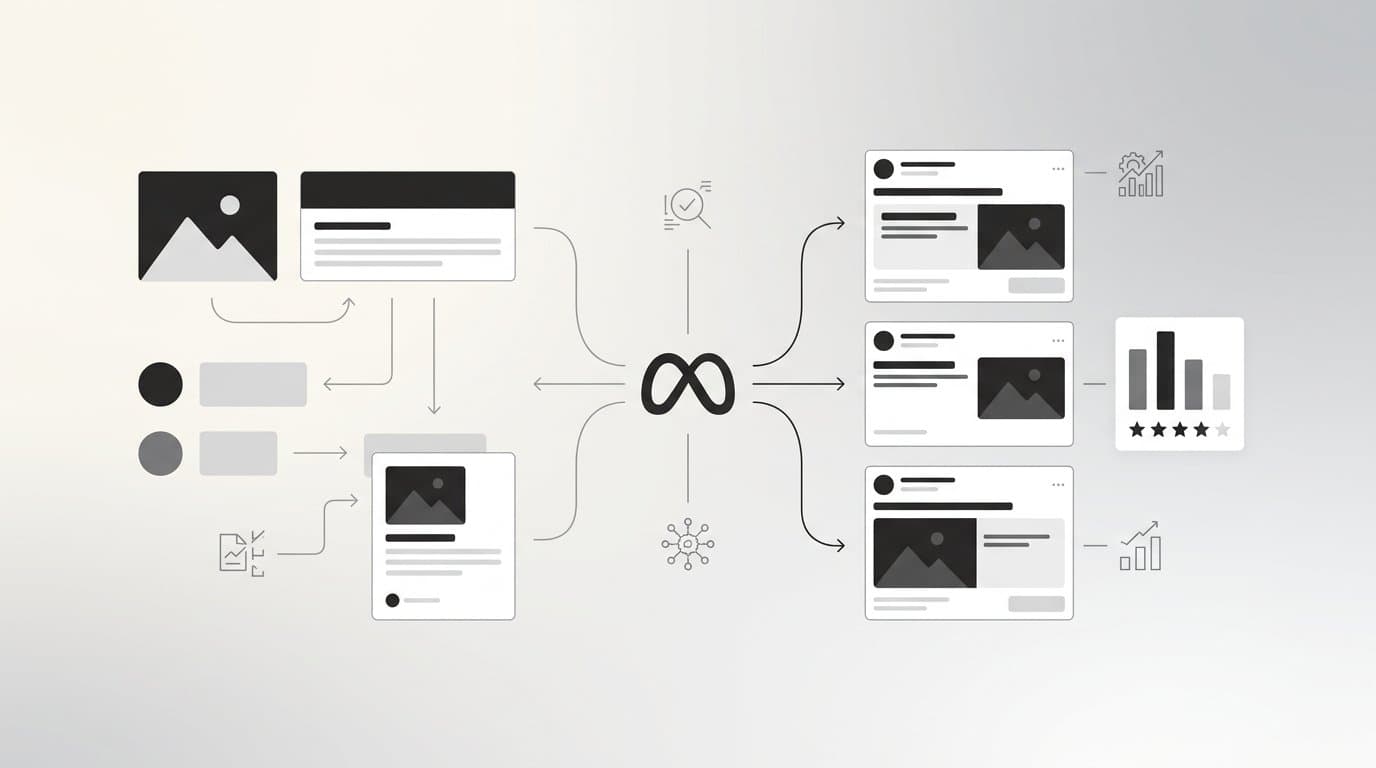
Use AdStellar's Bulk Ad Launch to generate every combination automatically. The tool lets you input multiple videos, headlines, audiences, and copy variations at once. It then generates every possible combination and prepares them for launch. What would take hours of manual work in Ads Manager happens in minutes.
Understand how bulk launching works at both the ad set and ad level. Bulk launching operates across two levels of the campaign structure. At the ad set level, you are varying audiences and budgets. At the ad level, you are varying creatives, headlines, and copy. Understanding this distinction helps you set up your campaign matrix intentionally so you are generating the right combinations rather than every possible permutation regardless of strategic fit.
Set up your campaign matrix with intention. Think of it as a simple multiplication: X videos multiplied by Y headlines multiplied by Z audiences gives you your full combination set. For example, six video variations across two headline options and three audience segments produces 36 ad combinations. That is a meaningful test set that gives you real data to work with, and it can be built and launched in the time it used to take to manually create five ads.
Review combinations before launching. Before you hit launch, scan through the generated combinations and remove any that do not align with your strategy. The goal is not to launch every possible combination. It is to launch every strategically relevant combination. Removing mismatched pairings before launch keeps your data clean and your budget focused.
Start with a controlled budget per ad set. When you are launching a large set of variations for the first time, resist the temptation to push heavy budget immediately. Start with a controlled spend per ad set so you can gather performance signal without overspending before winners emerge. You will have the data you need to scale budget toward winners within a few days.
Step 5: Monitor Performance with AI Insights and Leaderboards
Your ads are live. Now the work shifts from creation to analysis. This step is where many advertisers lose the gains they built in the previous steps by either reacting too quickly to early data or waiting too long to act on clear signals.
The goal is to identify which video angles, headlines, audiences, and copy combinations are driving real performance against your specific goals, and to do that quickly enough to reallocate budget before you waste it on underperformers.
Use AdStellar's AI Insights leaderboards to rank every element. Rather than digging through Ads Manager tables and building your own pivot tables, the leaderboard view surfaces your top and bottom performers across creatives, headlines, copy, audiences, and landing pages. Everything is ranked by the metrics that matter: ROAS, CPA, and CTR. You see what is working and what is not without hours of manual analysis. This is one of the core advantages of using AI for Meta ads campaigns rather than relying on manual reporting.
Set your specific performance goals before reviewing. The AI scoring system in AdStellar evaluates every element against the benchmarks you set, not generic industry averages. If your target CPA is a specific number, the AI scores every creative and audience combination against that target. This goal-based scoring separates true winners from ads that look decent in isolation but fall short of your actual business requirements.
Look beyond the top-level video metric. A video might show a strong CTR but pair poorly with a specific audience, dragging down your CPA. The leaderboard view lets you drill into which headline and audience pairings are amplifying performance for each video. This is the insight that tells you whether a video is genuinely strong or whether it is being carried by a single well-matched audience segment. Understanding how to improve Meta ads conversion rate at the creative level is what separates teams that iterate effectively from those that simply pause and relaunch.
Avoid pausing ads too early. This is one of the most common and costly mistakes in Meta advertising. An ad that looks weak after 24 hours of data often has not had enough impressions or conversions to score accurately. Let your ads accumulate enough data before making pause decisions. The AI scoring system is designed to separate true winners from statistical noise, but it needs data to work with. Give it time before drawing conclusions.
Use the leaderboard rankings to make budget reallocation decisions, not just pause decisions. Moving budget toward your top performers while letting underperformers run at minimal spend is often more effective than pausing aggressively and losing the learning data entirely.
Step 6: Scale Winners and Feed Them Back Into Your Creative System
Identifying a winner is only valuable if you do something with it. The final step in this system is about preserving what works, scaling it efficiently, and using it to make your next creative cycle smarter than the last.
This is the step that transforms a one-time campaign into a compounding creative engine. Every winner you identify and document makes your next campaign easier to build and more likely to perform.
Move proven video ads into AdStellar's Winners Hub. The Winners Hub stores your best-performing creatives, headlines, audiences, and more in one place with full performance data attached. Instead of hunting through old campaigns to find what worked, you have a curated library of proven assets ready to pull from. This is the institutional memory that most ad teams lack, and it is what separates teams that consistently scale from teams that start from scratch every campaign cycle. Knowing when to scale ad campaigns based on real winner signals is what makes this step so powerful.
Pull winners directly into new campaigns. When you are building your next campaign, start by reviewing your Winners Hub. Select proven video ads and pair them with new variations you want to test. This approach gives your new campaigns a strong baseline while still generating the fresh creative you need to avoid audience fatigue.
Use winning angles as creative briefs for your next generation cycle. When a specific video angle consistently outperforms others, that is a signal about what your audience responds to. Use that insight to brief your next round of AI-generated variations. If a pain-point angle is your consistent winner, generate more variations of that angle with different hooks, different CTAs, and different formats. You are not guessing anymore. You are iterating on evidence.
Iterate on top performers with chat-based editing. Before retiring a winning video, use AdStellar's chat-based editing to test new hooks or CTAs on the proven format. Sometimes a small change to the opening line or the closing call-to-action can extend the life of a winning creative by weeks. This is faster and lower-risk than generating entirely new videos from scratch.
Document what made each winner work. Keep a simple log of your winning videos and note the angle, hook style, format, and audience pairing that drove performance. Over time, this documentation becomes your most valuable creative asset. It tells you not just what worked, but why it worked, and that understanding compounds into every future campaign you build.
Putting It All Together
Creating video ads at scale is not about producing more content for its own sake. It is about building a system that generates purposeful variations, tests them efficiently, and compounds the learnings into every future campaign.
The six steps in this guide give you that system: start with a clear creative strategy, generate video variations with AI, build data-informed campaign structures, launch at scale with bulk tools, monitor performance through leaderboards and goal-based scoring, and feed winners back into your next creative cycle.
With a platform like AdStellar, this entire workflow lives in one place. You do not need a production team, a media buyer building ads manually, or a separate analytics tool to surface what is working. The AI handles creative generation, campaign building, bulk launching, and performance scoring so your team can focus on strategy and iteration.
The compounding effect is real. Each campaign cycle produces better data. Better data produces better creative briefs. Better creative briefs produce stronger variations. And stronger variations produce more winners to feed into the next cycle. The system gets smarter every time you run it.
If you are ready to put this process into action, Start Free Trial With AdStellar and run through these steps with your own product and campaigns. Generate your first video ad variations, build a structured campaign around them, and see how quickly a repeatable scale system changes your output.