Most performance marketers know creative testing is supposed to be a competitive advantage. Run more tests, find your winners faster, scale what works. The logic is clean. The reality is messier.
In practice, a single testing cycle often looks like this: you write a brief, wait for a designer, review the first draft, request revisions, wait again, get final assets, build your ad sets manually in Ads Manager, write copy variations, select audiences, traffic everything one by one, wait for the data to accumulate, then pull numbers from a spreadsheet to figure out what actually happened. By the time you have a conclusion, weeks have passed.
And that is assuming the test was set up correctly in the first place. If you tested too few variations, or mixed too many variables at once, the data might be inconclusive. Which means you run it again.
This is the creative testing trap most teams are stuck in. The problem is not a lack of effort or intention. It is a workflow that was built for a slower era and has never been redesigned for the speed that modern performance marketing demands.
This article breaks down exactly where the delays come from, what they are actually costing you, and how to restructure your testing process so that it produces cleaner data in less time. We will also walk through the automation layer that removes the biggest bottlenecks entirely, and how to build a system that compounds its own learning over time. By the end, you will have a clear picture of what a fast, systematic testing process actually looks like in practice.
The Real Reason Your Testing Cycles Keep Dragging On
When marketers say creative testing takes too long, the instinct is to blame the data collection phase. Waiting for statistical significance, letting the algorithm stabilize, giving the campaign enough time to exit the learning phase. Those waits are real, but they are not the primary culprit.
The bigger delay happens before a single ad ever goes live.
Creative production is the hidden bottleneck. Every test starts with assets, and assets require production. If you are working with a freelance designer, you are looking at turnaround times measured in days, not hours. Internal design teams have queues. Agencies have their own timelines. Even when a brief is clear and well-written, the back-and-forth of revisions, approvals, and format adjustments can easily consume the majority of your creative testing bottleneck before anything reaches an audience.
This is a structural problem that most teams have normalized. They factor design time into their testing calendars as if it is just part of the process. But it is not an unavoidable cost. It is a bottleneck that can be removed.
Manual campaign setup multiplies the delay. Once you have your creatives, you still have to build the campaign. That means creating ad sets, writing copy variations, selecting and defining audiences, uploading assets, and trafficking everything individually through Ads Manager. For a test with even a modest number of variations, this process can take hours. It is repetitive, error-prone, and completely disconnected from any strategic thinking.
Teams often underestimate how much time manual campaign setup consumes until they track it explicitly. The cumulative hours spent on trafficking and configuration add up quickly across a month of testing.
Underpowered tests force you to run the same test twice. Here is where the slowdown compounds. If a test does not have enough variation volume or enough budget to reach meaningful signal, the results are inconclusive. You cannot tell whether the creative underperformed or whether the test simply did not have enough data to produce a clear answer.
The response is usually to re-run the test with more budget, more time, or more creatives. Which means the entire cycle starts again. One inconclusive test can easily double the total time you spend on a single learning question.
The pattern is consistent across teams of all sizes: production delays, manual setup time, and underpowered tests combine to turn what should be a fast learning loop into a slow, frustrating process that rarely delivers clean answers on schedule.
What a Slow Testing Process Actually Costs You
It is easy to think of slow testing as an inconvenience. A productivity problem. Something that makes your job harder but does not necessarily hurt the business. That framing undersells the real cost.
The opportunity cost is your competitive position. While your test is still running, competitors who iterate faster are already acting on their results. They have identified a winning hook, scaled their budget behind it, and moved on to testing the next variable. You are still waiting on revisions or sifting through inconclusive data from a test that needed more variations.
In performance marketing, speed of learning is a genuine competitive advantage. The team that runs ten testing cycles in the time it takes another team to run three is not just more efficient. They have accumulated more knowledge, more proven assets, and a clearer picture of what their audience responds to. That gap compounds over time.
Budget waste is more specific than it looks. Slow testing does not just cost you time. It costs you money in ways that are easy to overlook. When you run too few variations, you spend media budget on ads that were never properly optimized. You might be spending on a creative that could have been improved with a different hook or a different visual approach, but you will not know that because the test was not structured to isolate those variables.
There is also the cost of running the same test multiple times when results are inconclusive. Every re-run is additional budget spent on a question you should have answered the first time.
Creative fatigue accelerates faster than most teams expect. Meta audiences are large, but they are not infinite within a given targeting configuration. When the same creative runs for an extended period, engagement drops. Frequency increases. Performance deteriorates. This is a well-recognized phenomenon among Meta Ads managers, and it is directly connected to testing cadence.
Teams with slow testing workflows are more exposed to creative fatigue because they cannot rotate fresh creatives quickly enough. By the time a new test is designed, produced, and launched, the winning creative from the previous cycle has already been in rotation for too long. The result is a performance cliff that could have been avoided with a faster production and testing loop.
Taken together, the costs of slow testing are not just operational. They show up in your ROAS, your CPA, and your ability to scale. Fixing the process is not a nice-to-have. It is a performance lever.
How Many Variations You Actually Need to Get Reliable Data
One of the most common structural mistakes in creative testing is treating it as a binary exercise: you test one creative against another, wait for a winner, and move on. This approach feels systematic, but it is actually one of the main reasons creative testing feels slow and delivers inconclusive results.
The core problem is isolation. When you test two fully formed ads against each other, you are comparing everything simultaneously: the hook, the visual style, the format, the headline, the copy, the call to action. If one outperforms the other, you know which ad won. You do not know why. And without knowing why, you cannot apply that learning to the next test.
Testing one variable at a time is the principle that makes data actionable. When you isolate a single element, such as the opening hook, the visual format, or the headline, and run multiple variations of that element while keeping everything else constant, you generate a clear signal. You learn what the audience responds to at the element level, not just the ad level. That knowledge transfers directly to future campaigns.
A practical framework looks like this:
1. Define the variable you are testing. Pick one element per test cycle. Hook, visual style, format (image versus video), headline, or offer framing. Resist the urge to test multiple variables at once, even if it feels more efficient.
2. Create enough variations to reach signal faster. Two variations is rarely enough. Running four to six variations of a single element gives the algorithm more to work with and surfaces a winner more quickly. It also reduces the risk that a single underperforming variation skews your conclusion.
3. Structure your audience and budget to support the test. Each variation needs enough impressions to produce meaningful data. Spreading a small budget across too many ad sets produces noise, not signal. Be deliberate about how you allocate spend across variations.
4. Document what you learn at the element level. When you identify a winning hook or a visual style that consistently outperforms, that is a reusable asset. Store it. Apply it to future campaigns. Let each test build on the last.
The relationship between variation volume and learning speed is counterintuitive. More combinations tested simultaneously does not mean more confusion. When tests are structured correctly, with one variable isolated and enough budget behind each variation, running more combinations produces faster signal. You are giving the algorithm more data to optimize against, and you are giving yourself more contrast to analyze.
The teams that learn fastest are not the ones who test most carefully in a slow, one-at-a-time sequence. They are the ones who test most systematically at scale, isolating variables while running enough volume to get clean answers quickly. Understanding what A/B testing in marketing truly requires at scale is the foundation of this approach.
Automating the Parts That Slow You Down Most
Understanding where the delays come from is useful. Removing them is the actual goal. The good news is that the three biggest bottlenecks in a typical testing workflow, creative production, manual campaign setup, and performance analysis, are all addressable with the right tools.
AI creative generation removes the production bottleneck entirely. The shift here is significant. Instead of briefing a designer, waiting for a draft, managing revisions, and waiting again, you can generate image ads, video ads, and UGC-style creatives from a product URL in minutes. The production timeline compresses from days to a single session.
This is not just about speed. It is about volume. When creative production is fast, you can generate enough variations to run properly structured tests. You are no longer limited to testing two or three creatives because that is all the design queue could produce. You can generate six, eight, or ten variations of a hook or visual style and run them simultaneously. AI-driven ad creative generation has fundamentally changed what is possible here.
Platforms like AdStellar take this further by allowing you to clone competitor ads directly from the Meta Ad Library and refine any creative through chat-based editing. You can start from a proven concept, adapt it for your brand, and have production-ready assets without a designer involved at any stage.
Bulk ad launching eliminates manual trafficking. Once you have your creatives, the traditional workflow requires building each ad set individually: uploading assets, writing copy, selecting audiences, configuring settings, and repeating for every variation. For a test with meaningful volume, this process can take hours.
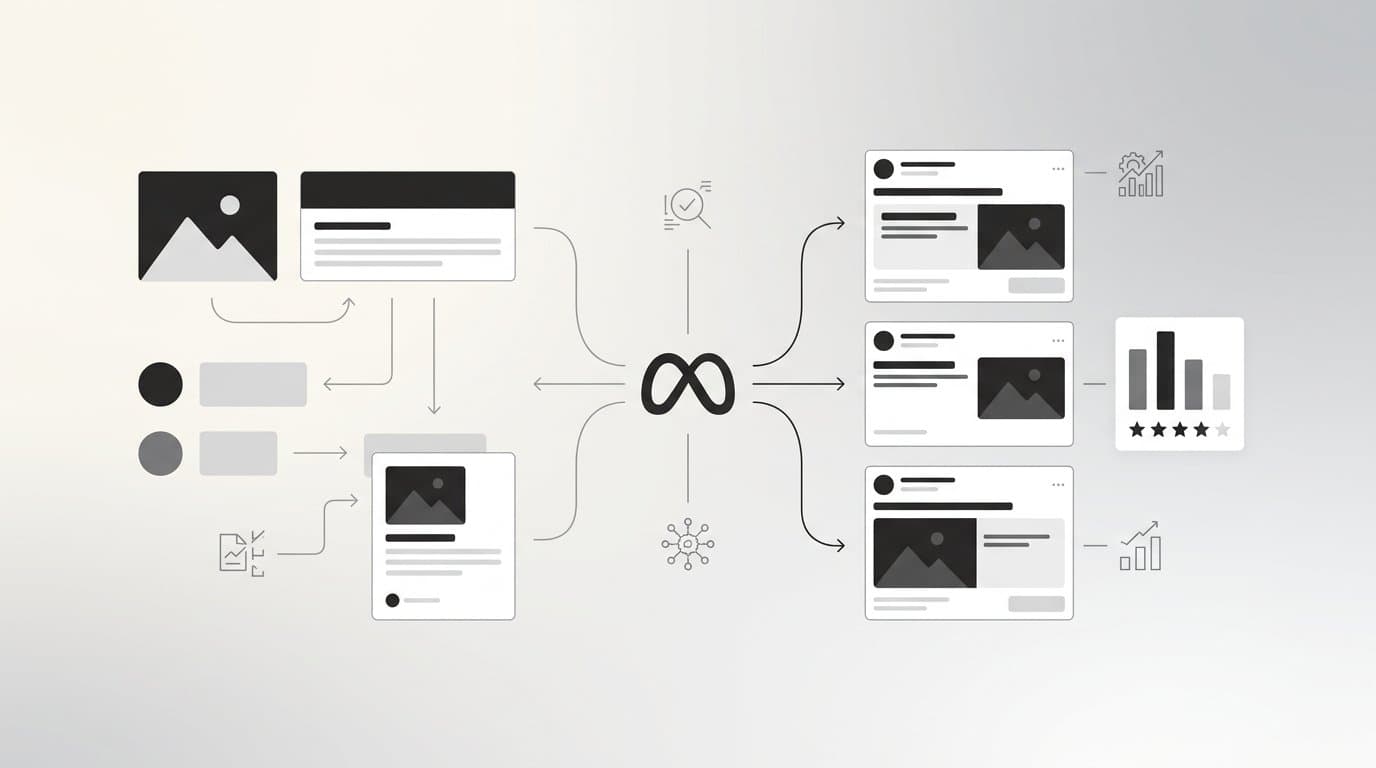
Bulk launching changes the equation. You mix multiple creatives, headlines, audiences, and copy variations at both the ad set and ad level, and the platform generates every combination and pushes them to Meta in a single workflow. What used to take hours of repetitive manual work happens in minutes.
AdStellar's Bulk Ad Launch does exactly this. You define your variables, the platform builds every combination, and you launch hundreds of ad variations to Meta without the manual trafficking overhead. The time savings are significant, but the bigger benefit is that it removes the friction that causes teams to test fewer variations than they should. The bulk ad launch tool for Meta is one of the highest-leverage changes a team can make to their workflow.
Automated performance scoring replaces manual reporting. After your ads are live, the traditional approach is to pull data from Ads Manager, organize it in a spreadsheet, calculate performance by variation, and try to identify patterns. This is time-consuming and easy to get wrong, especially when you are comparing many variations across multiple metrics.
AdStellar's AI Insights feature handles this with leaderboards that rank your creatives, headlines, copy, audiences, and landing pages by real metrics: ROAS, CPA, and CTR. You set your target goals, and the AI scores everything against your benchmarks. Winners surface automatically. You do not need to dig through data to find what is working. The platform tells you directly, with the context of your specific performance goals built in.
When all three of these automation layers are in place, the testing cycle looks fundamentally different. Production happens in minutes. Setup happens in minutes. Analysis happens in real time. The only remaining variable is the data collection period itself, and even that gets shorter as you run more structured tests with proper variation volume.
Building a Repeatable Testing System That Gets Faster Over Time
Speed is valuable on its own. But the real advantage comes from building a system where each testing cycle makes the next one faster and more accurate. That requires more than automation. It requires a deliberate approach to storing, reusing, and building on what you learn.
A Winners Hub approach changes how you start each campaign. Most teams start a new campaign from scratch. They brainstorm new creative concepts, write new copy, select audiences based on intuition or past convention, and build the campaign without a clear foundation of proven elements. This is inefficient and it introduces unnecessary uncertainty.
A better approach is to maintain a structured library of proven performers. Creatives that have demonstrated strong ROAS, headlines that have consistently driven clicks, audiences that have converted reliably. When you start a new campaign, you are not guessing. You are building on a foundation of known winners. Using a Facebook ad creative management system is what makes this kind of structured library sustainable at scale.
AdStellar's Winners Hub is built for exactly this. Your best-performing creatives, headlines, audiences, and more are stored in one place with real performance data attached. When you are ready to build a new campaign, you can pull from proven assets directly and layer new tests on top of them rather than starting from zero.
Historical data should inform every new test, not just past campaigns. The learning from each cycle is only valuable if it feeds into the next one. AI that analyzes your historical campaign data and ranks every element, creative, headline, audience, copy, by actual performance before building a new campaign turns each test into a permanent learning asset.
AdStellar's AI Campaign Builder does this systematically. It analyzes your past campaigns, ranks every element by performance, and uses that analysis to build complete Meta Ad campaigns. Every decision comes with a transparent rationale so you understand the strategy behind the structure, not just the output. And the AI gets smarter with every campaign it processes.
The compounding effect is the real competitive advantage. Teams that build this kind of systematic testing loop see each cycle become faster and more targeted over time. Early campaigns produce foundational data. Later campaigns are built on that foundation, with clearer hypotheses and stronger starting assets. The AI learns which elements consistently perform for your specific audience and goals, and that knowledge compounds.
Teams that treat each campaign as a standalone exercise never build this advantage. Teams that treat each campaign as a data asset that feeds the next one accelerate their learning curve continuously. Over time, the gap between these two approaches becomes significant.
From Bottleneck to Competitive Edge
The core shift this article has been building toward is a change in how you measure your testing process. If you are measuring success by whether a test eventually produces a winner, the timeline feels acceptable even when it is slow. If you are measuring success by how many learning cycles you complete per month, the inefficiency of a slow process becomes impossible to ignore.
Creative testing should be measured in days and learning cycles, not weeks and production timelines. The technology to achieve that exists now. The question is whether your workflow is built to take advantage of it.
The practical path forward starts with removing the production bottleneck. AI creative generation is the highest-leverage change most teams can make because it unlocks every downstream improvement. When you can generate enough variations quickly, you can run properly structured tests. When you can run properly structured tests, you get cleaner data. When you get cleaner data, you scale winners faster.
From there, layering in bulk launching and automated insights compresses the full cycle further. And building a Winners Hub and using historical data to inform new campaigns creates the compounding learning loop that makes each cycle faster than the last.
AdStellar is built to support this entire workflow in one platform. AI creative generation for images, video, and UGC-style ads. An AI Campaign Builder that analyzes historical performance and builds complete campaigns with full transparency. Bulk Ad Launch that deploys hundreds of variations to Meta in minutes. AI Insights with leaderboards ranked by your specific goals. And a Winners Hub that stores proven performers for reuse.
If you are ready to see what a faster testing cycle looks like in practice, Start Free Trial With AdStellar and run your first AI-powered campaign free for 7 days.
The Bottom Line
Creative testing does not inherently take a long time. The delays come from workflows that were designed around manual production, manual setup, and manual analysis. Each of those stages introduces waiting, and the waiting compounds across a full testing cycle.
The fix is not to work harder within the same workflow. It is to replace the bottlenecks with tools that remove them. AI creative generation eliminates the production wait. Bulk launching eliminates the manual setup. Automated performance scoring eliminates the reporting grind. And a systematic approach to storing and reusing winners turns each campaign into a foundation for the next one.
Teams that make this shift do not just run faster. They run smarter. Each test produces cleaner data because it is structured correctly and has enough variation volume. Each campaign starts from a stronger foundation because it draws on proven performers. Each cycle builds on the last because the learning is captured and applied systematically.
The result is a testing process that becomes a genuine competitive advantage rather than a bottleneck. Faster iteration, cleaner signals, more winners scaled, and less time spent waiting on assets, trafficking ads, or digging through spreadsheets.
Ready to build that system? Try AdStellar free for 7 days at adstellar.ai and see how much faster your testing cycle can move when the right tools are doing the heavy lifting.