If you have ever stared at a Meta Ads dashboard wondering why your creatives keep underperforming, you are not alone. Finding winning ad creatives is one of the most persistent challenges for digital marketers, performance marketers, and agencies running Facebook and Instagram campaigns.
The problem is rarely a lack of effort. It is usually a lack of a repeatable system. Most teams rely on gut instinct, produce a handful of creatives, run them for a few weeks, and hope something sticks. When nothing does, the cycle starts over with more wasted budget and more creative fatigue.
The truth is that finding winners is a process, not a guess. It requires testing enough variations to surface real signals, analyzing the right performance data, learning from what works, and scaling it fast before audiences burn out.
This article breaks down seven actionable strategies to help you move from creative chaos to a predictable system for finding and scaling winning ad creatives on Meta. Whether you are running campaigns in-house or managing accounts for clients, these strategies will help you build a creative testing engine that consistently surfaces top performers and reduces wasted spend.
1. Test More Variations Than You Think You Need
The Challenge It Solves
Most advertisers dramatically underestimate how many creative variations are needed to surface a statistically meaningful winner. Running two or three ads and calling it a test is not a testing strategy. It is a coin flip. With so few data points, you cannot distinguish a genuinely strong creative from one that got lucky with early delivery.
The Strategy Explained
A volume-first testing approach means deliberately launching more variations than feels comfortable. The goal is to give the algorithm enough material to work with and give yourself enough data to draw real conclusions. Think of it like a tournament: the more competitors you put in the bracket, the more confident you can be that the winner actually earned it.
This does not mean producing more creative work manually. It means building a system where variation generation is fast and low-cost. Swap headlines, change the opening hook, test different background colors, adjust the CTA text. Each of these small changes can produce a meaningfully different result, and the only way to know is to run them.
Implementation Steps
1. Define a minimum variation threshold for every campaign. A useful starting point is testing at least eight to ten creative variations per ad set before drawing conclusions about what is working.
2. Use a bulk ad creation tool to generate and launch multiple variations at once. Platforms like AdStellar let you mix creatives, headlines, and copy combinations and launch hundreds of variations to Meta in minutes rather than hours.
3. Set a consistent evaluation window before making optimization decisions. Pulling ads too early produces misleading signals. Give each variation enough budget and time to accumulate meaningful impressions before comparing performance.
Pro Tips
Resist the urge to pause underperformers too quickly. Early performance can be misleading, especially if your budget is spread thin across many variations. Let the data accumulate, then cut. The advertisers who find winners consistently are the ones who test consistently, not the ones who test occasionally and hope for the best.
2. Let Performance Data Drive Creative Decisions
The Challenge It Solves
Gut instinct fails at scale. The ad you personally find most compelling is often not the one your audience responds to. When creative decisions are based on opinions rather than performance signals, budgets get allocated to creatives that feel right rather than ones that actually convert. The result is a cycle of subjective guessing that never improves.
The Strategy Explained
Data-driven creative decisions start with knowing which metrics actually matter. Click-through rate can indicate strong creative appeal, but it does not tell you whether those clicks are converting. ROAS and CPA are the metrics that connect creative performance to business outcomes. Frequency matters too: a rising frequency with declining performance is a clear signal of creative fatigue.
The key is building a reporting structure that surfaces these signals clearly and quickly. Leaderboard-style insights, where your creatives are ranked against each other by real goal-based metrics, make it immediately obvious which ads are pulling their weight and which are draining budget. When you can see your top five performers ranked by ROAS at a glance, creative decisions become much easier to make.
Implementation Steps
1. Define your primary success metric before launching any campaign. Whether it is ROAS, CPA, or conversion rate, decide upfront what a winning creative looks like in numbers. Understanding how to calculate ROAS correctly ensures you are measuring creative performance against a meaningful benchmark.
2. Set up a reporting view that ranks creatives by your primary metric rather than just showing raw impressions or spend. AdStellar's AI Insights feature does this automatically, giving you leaderboards that rank creatives, headlines, and audiences by ROAS, CPA, and CTR against your benchmarks.
3. Schedule a weekly creative performance review. Look at which elements correlate with your top performers and use those patterns to inform your next round of testing.
Pro Tips
Watch out for vanity metrics that feel meaningful but do not connect to revenue. A high video view rate on an ad with poor conversion performance tells you the creative is entertaining, not that it is effective. Always trace the signal back to your actual business goal before making optimization decisions.
3. Break Down Your Creatives Into Testable Elements
The Challenge It Solves
Testing whole ads as single units is one of the most common creative testing mistakes. When an ad underperforms, you have no idea whether the problem was the hook, the visual, the headline, or the CTA. When it overperforms, you cannot replicate the success because you do not know what drove it. Whole-ad testing produces outcomes, not insights.
The Strategy Explained
Element-level testing means isolating individual components of your ad and changing one variable at a time. Think of it like a scientific experiment: if you change everything at once, you cannot attribute the result to any single factor. But if you hold everything constant and only swap the opening hook, a performance difference tells you something specific and actionable.
The four elements worth isolating in most Meta ad tests are the hook (the first three seconds or the opening line), the visual (image vs. video, lifestyle vs. product, color palette), the headline (benefit-led vs. curiosity-driven vs. direct offer), and the CTA (button text and the offer framing). Each of these can independently swing performance in a meaningful direction.
Implementation Steps
1. Map out your ad structure before building variations. Identify which element you are testing in each variation and document it so your analysis is clean.
2. Use a multivariate approach when budget allows. This means testing multiple combinations of elements simultaneously, which surfaces winners faster than sequential single-variable tests. Bulk launch tools make this practical without requiring hours of manual setup.
3. Build a tagging system for your creative elements. When you label each creative with its hook type, visual format, and headline style, pattern recognition becomes much faster when reviewing performance data.
Pro Tips
Pay special attention to your hooks. On Meta, the first few seconds of a video or the first line of ad copy determines whether someone stops scrolling. Many advertisers spend most of their creative energy on the body of the ad and underinvest in the hook. Test hook variations aggressively. A single strong hook can transform the performance of an otherwise average creative.
4. Study What Is Already Working in Your Market
The Challenge It Solves
Starting every creative from a blank page is inefficient. Your competitors have already spent budget testing what resonates with your shared audience. Ignoring that information means repeating their experiments from scratch. Competitor creative research shortcuts the discovery process by helping you identify patterns that are already proven to work in your market before you spend a dollar testing them yourself.
The Strategy Explained
The Meta Ad Library is a publicly available tool that lets you search any advertiser's active ads. It is one of the most underused resources in performance marketing. By spending time in the Ad Library reviewing what your competitors are running, you can quickly identify patterns: the hooks they keep coming back to, the formats they favor, the offers they lead with, and the visual styles that appear consistently.
Consistency is the signal. If a competitor has been running the same ad for several months, it is almost certainly performing. Advertisers do not keep spending on ads that do not work. Repeated creative structures across multiple competitors in your category are even stronger signals of what resonates with your audience.
Implementation Steps
1. Search your top three to five competitors in the Meta Ad Library. Filter by active ads and look for creatives that appear to have been running for an extended period. A structured approach to Meta ads competitor analysis will help you extract more actionable patterns from what you find.
2. Document the patterns you observe: format type, hook style, offer framing, visual approach, and CTA language. Look for elements that appear repeatedly across multiple advertisers.
3. Adapt, do not copy. Take the structural patterns you identify and rebuild them with your own brand voice, product, and creative assets. AdStellar's AI Creative Hub lets you clone competitor ad structures from the Meta Ad Library and generate your own version in minutes.
Pro Tips
Do not limit your research to direct competitors. Look at adjacent categories that share your target audience. A pattern that works in one product category often translates well to another when the underlying audience psychology is similar. Expanding your research scope gives you more creative inspiration to work with.
5. Diversify Creative Formats Across Every Campaign
The Challenge It Solves
Relying on a single creative format is a hidden constraint on your ability to find winners. Different people respond to different formats, and different stages of the funnel require different types of creative. An advertiser who only runs static image ads is testing within a narrow band and missing a significant portion of potential winners that only emerge in video or UGC-style formats.
The Strategy Explained
A balanced creative mix typically includes three core format types: image ads, video ads, and UGC-style content. Each serves a different purpose and performs differently depending on placement, audience temperature, and campaign objective.
Static image ads tend to work well for direct-response offers where the value proposition can be communicated quickly and clearly. Video ads give you more room to tell a story, demonstrate a product, or build emotional connection. UGC-style content, designed to look and feel like organic social posts rather than polished advertisements, often performs strongly because it blends into the feed and feels more credible to audiences who have developed a strong filter against traditional ad formats.
Matching format to funnel stage is also important. Top-of-funnel audiences who have never heard of your brand often respond better to awareness-oriented video content. Retargeting audiences who already know your product may convert better with a direct-response image ad featuring a specific offer.
Implementation Steps
1. Audit your current creative library. If more than two-thirds of your active ads are the same format, you have a format diversity problem worth addressing before your next campaign.
2. Build at least one variation of each core format type for every campaign. This does not require a production team. AdStellar generates image ads, video ads, and UGC-style avatar creatives from a product URL, removing the need for designers, video editors, or actors.
3. Analyze performance by format type in your reporting. Over time, you will develop a clear picture of which formats outperform for your specific audience, product, and funnel stage.
Pro Tips
Do not assume UGC-style content is only for consumer brands. B2B and SaaS advertisers have found strong results with authentic-feeling creative that leads with a relatable problem rather than a polished product demo. The format works because it feels human, and that applies across categories.
6. Build a Winners System So Nothing Gets Lost
The Challenge It Solves
Winning creatives get buried. A high-performing ad from three months ago gets lost in a campaign that was paused, and nobody remembers to bring it back when a new campaign launches. Teams end up reinventing the wheel every time, rebuilding from scratch instead of building on what already works. This is one of the most common and most costly inefficiencies in replicating winning Facebook ads at scale.
The Strategy Explained
A winners system is a dedicated, organized library of your best-performing creatives, headlines, audiences, and copy, stored with their performance data attached. Think of it as a swipe file built from your own proven results rather than aspirational examples. Every time you launch a new campaign, you start by pulling from this library rather than starting from zero.
The value compounds over time. As your winners library grows, you accumulate a clearer picture of what consistently performs for your brand. Patterns emerge across winning creatives that inform your testing hypotheses for the next round. The library becomes both a shortcut and a strategic asset.
Implementation Steps
1. Define your winners threshold. Decide what performance level qualifies a creative for your library. This might be any ad that exceeds your target ROAS by a defined margin, or any creative that performs in the top quartile of a given campaign.
2. Create a consistent tagging and labeling system. Tag each winner by format type, hook style, offer type, and target audience. Learning how to organize winning ads with a structured system makes it easy to search and filter when building future campaigns.
3. Use a dedicated winners hub rather than relying on spreadsheets or buried campaign dashboards. AdStellar's Winners Hub automatically surfaces your best-performing creatives, headlines, and audiences in one place with real performance data attached, so you can pull any winner directly into your next campaign.
Pro Tips
Revisit your winners library regularly, not just when launching campaigns. Reviewing your top performers periodically helps you spot patterns you may have missed and generates new testing ideas. A creative that won six months ago might contain a hook structure worth testing in a fresh format today.
7. Automate the Testing Loop to Find Winners Faster
The Challenge It Solves
Manual testing cannot keep pace with the speed at which audiences fatigue on Meta. By the time a human-managed testing process surfaces a winner, analyzes the data, builds the next round of variations, and launches them, the window of peak performance may have already closed. The gap between insight and action is where budget gets wasted.
The Strategy Explained
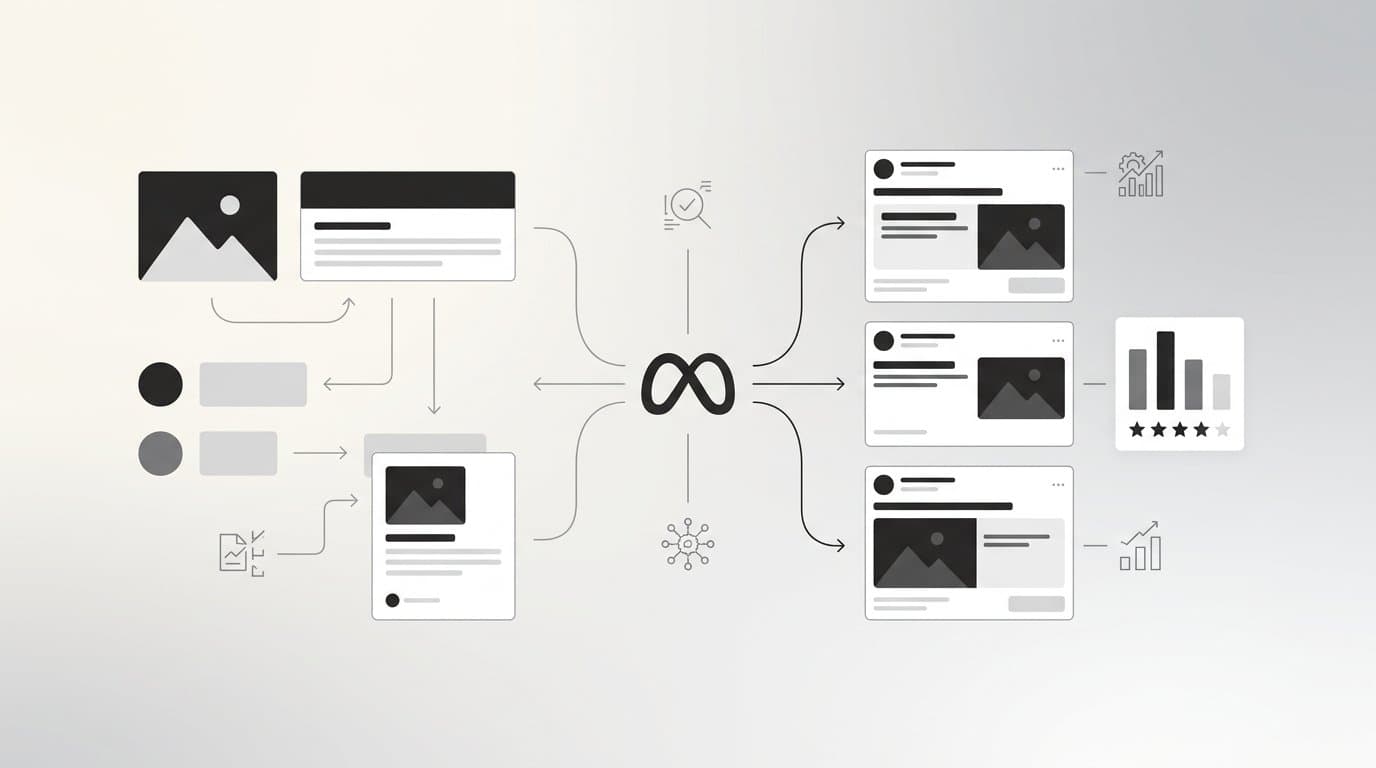
Automating the testing loop means using AI-powered tools to handle the repetitive, time-consuming parts of the process: analyzing historical performance data, identifying which creative elements correlate with winning outcomes, building optimized campaign structures, and launching variations at scale. This closes the feedback loop between performance data and new creative launches dramatically faster than any manual process can achieve.
Meta's own Dynamic Creative Optimization feature automates some of this by testing combinations of creative assets within a single ad. AI-powered platforms extend this capability further by incorporating historical performance data, goal-based scoring, and full campaign build automation into a single workflow. The result is a system that learns from every campaign and applies those learnings to the next one automatically.
Implementation Steps
1. Identify which parts of your current testing process consume the most time. For most teams, the bottlenecks are creative production, campaign setup, and performance analysis. These are the areas where Facebook advertising automation delivers the most immediate value.
2. Implement an AI campaign builder that analyzes your historical data before building new campaigns. AdStellar's AI Campaign Builder does exactly this: it reviews past campaign performance, ranks every creative, headline, and audience by results, and builds a complete Meta Ad campaign with full transparency into every decision it makes.
3. Connect your creative generation, campaign launch, and performance analysis into a single workflow. When all three happen in one platform, the loop from creative to insight to new creative closes in hours rather than weeks.
Pro Tips
Automation works best when it has strong historical data to learn from. If your account is newer, focus first on building volume through manual testing so the AI has meaningful signals to work with. As your performance history grows, the automated recommendations become progressively more accurate and more valuable. The system gets smarter with every campaign you run through it.
Putting It All Together
Finding winning ad creatives does not have to feel like a lottery. When you have a repeatable system built around volume testing, data-driven decisions, element-level analysis, competitor research, format diversity, a winners library, and automated optimization, the process becomes predictable.
Start by fixing your testing volume. Most advertisers are running too few variations to get statistically meaningful signals. From there, layer in the data infrastructure to rank what is working, and build the habit of saving and reusing your winners.
Here is a practical order for implementing these strategies:
1. Increase your creative variation volume immediately. This is the highest-leverage change you can make right now with no new tools required.
2. Set up element-level tagging so your performance data tells you something specific, not just which whole ad won.
3. Spend time in the Meta Ad Library studying competitor patterns before your next creative production cycle.
4. Audit your format mix and add at least one new format type to your next campaign.
5. Define your winners threshold and start building your creative library from this campaign forward.
6. Introduce automation to close the loop between insights and new campaign launches.
For teams looking to accelerate this entire process, AdStellar brings every part of this system into one platform. Generate image ads, video ads, and UGC-style creatives from a product URL. Launch hundreds of variations in minutes with Bulk Ad Launch. Let AI Insights rank every creative, headline, and audience by ROAS, CPA, and CTR. Save your top performers in the Winners Hub and pull them into your next campaign instantly.
The result is a continuous loop from creative to conversion that gets smarter with every campaign you run. Start Free Trial With AdStellar and build the creative testing engine your campaigns have been missing.