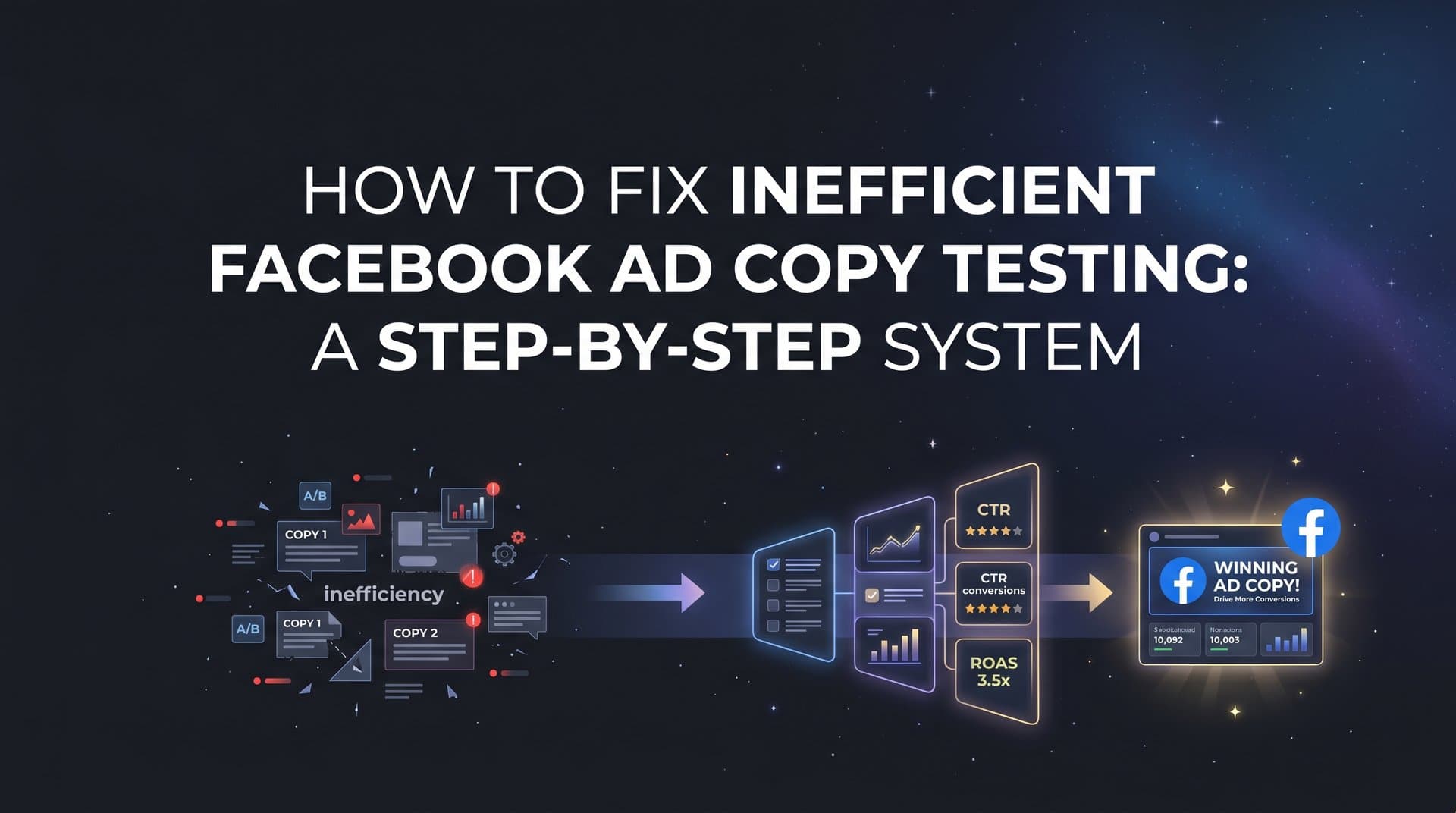
Most advertisers know that testing Facebook ad copy is important. The problem is that knowing and doing it well are two very different things. If you have ever run a handful of copy variations, waited a few weeks, and still had no clear answer about what actually worked, you have experienced inefficient Facebook ad copy testing firsthand.
The issue is not that testing does not work. It is that most testing processes are slow, unstructured, and built on too few data points to draw reliable conclusions. You end up spending budget on inconclusive tests, making decisions based on gut feel, and cycling through the same underperforming copy patterns without ever breaking through.
This guide walks you through a systematic approach to fixing that. You will learn how to structure your tests properly, isolate the variables that actually drive results, scale what works, and build a continuous improvement loop that gets smarter over time.
Whether you are managing ads for a single brand or running campaigns across multiple clients, this process will help you stop wasting budget on inconclusive tests and start building a library of proven copy that consistently performs. By the end, you will have a repeatable system for testing Facebook ad copy efficiently, surfacing winners faster, and scaling them with confidence.
Step 1: Audit Your Current Testing Process to Find the Leaks
Before you fix your testing process, you need to understand exactly where it is breaking down. Pull your last 30 to 90 days of ad copy tests and look at them honestly. The goal here is not to judge past decisions but to identify the patterns that are costing you budget and clarity.
Start by asking a simple question: how many of those tests produced a clear, actionable winner? Not a "this one did slightly better" result, but a genuine, confident answer about which copy worked and why. If most of your tests ended without that clarity, that is your first signal that the process needs fixing.
Check for variable contamination. One of the most common reasons copy tests fail to produce usable data is that multiple variables changed at the same time. If you swapped the headline, the body copy, and the creative all in the same test, you have no way of knowing which change caused the result to shift. This is not a testing problem. It is a test design problem, and it is extremely common. Many advertisers dealing with too many Facebook ad variables at once end up in exactly this trap.
Look for signs of underfunding. Tests that ran with too little budget or for too short a window often produce results that look meaningful but are not. When a test does not reach enough impressions or conversions to be statistically reliable, any winner you pick is essentially a coin flip. Review your past tests and flag any that ended before reaching a meaningful volume of results.
Check for documented hypotheses. Did each test have a written reason for why you expected one variation to outperform another? Or were you testing because it seemed like a good idea? Random testing burns budget. Hypothesis-driven testing builds knowledge. If you cannot find a documented rationale for your past tests, that is a gap to close immediately.
The creative contamination trap. A particularly common pitfall is changing both the creative and the copy at the same time. If your winning variation had a new image and new copy, you cannot attribute the result to the copy alone. Going forward, keeping creative consistent while swapping copy is non-negotiable for clean results. This is one of the core Facebook ad creative testing challenges that experienced media buyers consistently flag.
Your success indicator for this step: you can point to at least one test from the past 90 days where a single copy variable was isolated and a clear winner was identified with confidence. If you cannot, you now know exactly what to fix before running another test.
Step 2: Build a Copy Testing Framework Before You Write a Single Word
The most important work in copy testing happens before you open a blank document. A proper framework is what separates a structured experiment from an expensive guess. Building this framework takes maybe 30 minutes upfront and saves you weeks of wasted budget on the back end.
The first decision is defining exactly what you are testing. Pick one variable per experiment. That means one of the following: the hook style, the value proposition framing, the CTA phrasing, the copy length, the tone, or the social proof angle. Not two of these. One. If you try to test multiple elements simultaneously, your results will be unreadable and your insights will be worthless. A solid Facebook ad testing framework makes this discipline much easier to maintain across campaigns.
Write your hypothesis before you write your copy. A good hypothesis follows a simple structure: "If we lead with a pain-point hook instead of a benefit hook, we expect a higher CTR because our audience is problem-aware and responds to copy that names their frustration before offering a solution." This forces you to think through the logic before you invest time and budget. It also gives you something to validate or disprove, which is how learning actually accumulates.
Establish your success metric upfront. Are you optimizing for CTR, CPA, ROAS, or conversion rate? The right metric depends on your campaign objective, and it needs to be decided before the test launches. Choosing your metric after the fact based on which number looks best is a form of confirmation bias that produces false winners.
Set your minimum data threshold before you begin. Decide in advance how many conversions, clicks, or impressions you need before you will read the results. This is the single most effective way to prevent yourself from pulling tests too early when early signals look promising but have not stabilized.
Create a test log. A simple spreadsheet works fine. Track the test name, the variable being tested, the hypothesis, the start date, the budget, the success metric, the result, and the key insight. Over time, this log becomes one of your most valuable marketing assets. It shows you which copy angles win for your specific audience, which hypotheses held up, and which assumptions were wrong.
Keep creative consistent. While you are testing copy, lock the creative. Use the same image or video across all copy variations so that any performance difference can be attributed to the copy alone. This is the cleanest way to isolate the copy variable and produce data you can actually trust.
Step 3: Generate Multiple Copy Variations Without the Manual Bottleneck
Here is a practical reality that most advertisers run into: generating enough copy variations to run a meaningful test is time-consuming. Most teams can realistically produce three to five variations before running out of time, ideas, or both. And three to five variations is often not enough to find a genuinely differentiated winner, especially when those variations end up being too similar to each other.
This is where the process breaks down for a lot of teams. The bottleneck is not strategy. It is production. And when production is slow, the temptation is to run fewer, less differentiated tests, which produces fewer, less useful insights. If Facebook ad copywriting feels time-consuming at your current scale, this production bottleneck is almost certainly limiting your testing velocity.
AI-powered tools change this dynamic significantly. Instead of spending hours writing variations manually, you can generate a wider range of copy from a single product input, covering different angles, tones, and structures in a fraction of the time. The key is using tools that go beyond simple rephrasing and actually explore meaningfully different approaches.
AdStellar's AI Campaign Builder takes this further by analyzing your historical performance data before generating copy. It looks at what has already worked for your account, ranks past elements by performance, and uses those insights to inform the direction of new variations. This means you are not starting from a blank slate. You are starting from a more informed baseline, which reduces wasted test cycles.
What makes this particularly useful for structured testing is the transparency. The AI copywriting for Facebook ads explains every decision so you understand why a particular angle was chosen, not just what was generated. That explanation helps you build intuition over time rather than becoming dependent on a black-box output you cannot learn from.
Once you have your copy variations, AdStellar's Bulk Ad Launch lets you mix them with multiple creatives and audiences, generating hundreds of combinations and launching them to Meta in minutes. What would take a team hours of manual setup happens in clicks.
A note on variation quality. Do not just test long versus short copy. Test fundamentally different angles. Urgency versus curiosity. Problem-focused versus outcome-focused. Direct and punchy versus narrative-driven. The more contrast between your variations, the more likely you are to surface a clear winner. Variations that are too similar to each other produce inconclusive results because there is not enough difference between treatments to detect a meaningful signal.
The goal is to generate enough genuine contrast that your test data can actually tell you something useful. More differentiated angles, produced faster, give you a real shot at finding copy that moves the needle.
Step 4: Structure Your Campaigns So the Data Is Actually Readable
You can have a perfect hypothesis, well-written variations, and a solid budget, and still end up with unreadable data if your campaign structure is a mess. Poor structure is one of the most underappreciated reasons why copy test data becomes noise rather than insight.
The first structural decision is separating your testing campaigns from your performance campaigns. This is a widely recommended practice among experienced media buyers, and for good reason. When you run test variations inside your main performance campaign, the algorithm starts optimizing toward your proven performers, which starves your test variations of the data they need to be evaluated fairly. A dedicated testing campaign keeps the playing field level. Teams that struggle with Facebook ad structure often skip this separation and pay for it in unreadable results.
Keep audiences consistent across copy variations. At the ad set level, if each copy variation is running to a different audience, you cannot tell whether performance differences are driven by the copy or the audience. Lock the audience across all variations in a copy test so that audience differences do not contaminate your results.
Use a clear naming convention. Name your ads in a way that immediately tells you what copy variable is being tested. Something like "Test01_Hook_PainPoint" versus "Test01_Hook_Benefit" lets you read results at a glance without cross-referencing a spreadsheet every time. This sounds like a small thing, but when you are managing multiple tests across multiple campaigns, a clear naming convention saves significant time and reduces the chance of misreading results.
Be careful with Dynamic Creative Optimization. DCO is a powerful tool for scaling proven combinations, but it can obscure which specific copy element drove performance during a structured test. If Meta is mixing and matching your headlines, body copy, and CTAs automatically, you lose the ability to attribute results to a specific copy variable. Use DCO for scaling after you have identified winners, not during the testing phase.
AdStellar's AI Insights leaderboard makes the analysis step significantly faster. It ranks your copy, headlines, and CTAs by real metrics like ROAS, CPA, and CTR across every variation in one view. Instead of pulling data from multiple reports and manually comparing numbers, you can see at a glance which variation is winning and by how much.
Your success indicator for this step: after 7 to 14 days, you can look at your data and immediately identify which copy variation won and why, without needing to cross-reference multiple reports or make judgment calls based on incomplete information. If you cannot do that, your structure needs work.
Step 5: Read the Results Correctly and Avoid False Positives
Getting to the results stage feels like the finish line, but this is actually where a lot of copy tests go wrong. Misreading results is just as costly as running a poorly structured test, because it sends you in the wrong direction with false confidence.
The most common mistake is declaring a winner too early. Early performance signals in Facebook ads can be misleading. An ad that looks strong in the first 48 hours may normalize or underperform once it reaches a broader audience. If you set a minimum data threshold in Step 2, this is where that discipline pays off. Stick to the threshold you defined before the test started, even when early results look compelling. Understanding Facebook ad testing methodology in depth is what separates teams that consistently surface real winners from those chasing false positives.
Do not optimize on CTR alone. A high click-through rate that does not translate to conversions is not a winner. It is a traffic driver that fails at the next step. If your campaign objective is conversions, your primary success metric should be conversion rate or CPA, not CTR. CTR is a useful secondary signal, but it should not be the deciding factor unless your campaign is specifically designed to drive traffic.
Look for consistency across multiple metrics. A strong copy variation should show improvement in your primary KPI without degrading your secondary metrics. If one variation has a lower CPA but also a dramatically lower CTR, that is worth investigating before declaring it a winner. Look for a variation that performs well across the board, not just on one isolated metric.
Watch for narrow audience or time window effects. Results that look strong within a single audience segment or a very short time window may not hold when the ad runs to broader traffic over a longer period. Before scaling a winner, check whether the performance holds across different segments and time windows within your test data.
AdStellar's goal-based scoring evaluates every ad element against your specific benchmarks rather than platform defaults. This matters because Meta's optimization goals do not always align with your business goals. Scoring performance against what actually matters to your business gives you a more accurate picture of what is working.
When two variations are statistically tied. If two variations are within a very small margin of each other, they are effectively tied. The right move is not to pick the slightly higher number as a winner. It is to move on and test a more differentiated angle. A tie means neither variation was compelling enough to produce a clear signal, and the solution is more contrast, not more time waiting for a marginal difference to resolve.
Step 6: Scale Winners and Feed Insights Back Into Your Next Test
Identifying a winning copy variation is not the end of the process. It is the beginning of the next one. This is where most advertisers leave significant value on the table. They move a winner to their main campaign and then start the next test from scratch, which means they are not compounding their learning. They are just running a series of disconnected experiments.
The first thing to do when you identify a winner is document what made it work. Was it the hook structure? The specific value proposition? The CTA phrasing? The tone? The more precisely you can articulate what drove the result, the more useful that insight becomes for your next test. A vague note that says "this one performed better" is not a learning. A specific observation like "the pain-point hook outperformed the benefit hook by a meaningful margin with our retargeting audience" is a learning you can build on.
AdStellar's Winners Hub makes this process systematic. It stores your best-performing creatives, headlines, and copy in one place with real performance data attached. When you are ready to build your next campaign, you can pull proven elements directly rather than starting from memory or digging through old reports. The performance context stays attached to the asset, so you always know why something is in your winners library.
Use winning copy angles as your baseline for the next test. Instead of starting each test from a blank slate, start from your best-performing variation and test against it. This approach compounds your learning over time. Each round builds on validated insights rather than re-exploring ground you have already covered, which means your average cost per result should decrease across multiple test cycles as you get closer and closer to what your audience actually responds to. Teams that want to scale Facebook ads efficiently rely on exactly this kind of compounding test structure to drive down costs over time.
Bulk Ad Launch supports this scaling step efficiently. Once you have a proven copy winner, you can pair it with new creative variations at scale, generating multiple combinations and launching them to Meta without rebuilding your setup from scratch. This lets you expand what works without starting over.
Build a rolling test calendar. As one test concludes, the next one should already be queued with a hypothesis informed by the previous result. This creates a continuous improvement loop rather than ad hoc testing that only happens when someone has time. A rolling calendar means there is always a structured test running, always new data coming in, and always a next question to answer. That is how a testing process becomes a genuine competitive advantage over time.
Putting It All Together: Your Copy Testing Checklist
Inefficient Facebook ad copy testing is not a creativity problem. It is a systems problem. When you audit your current process, build a proper testing framework, generate enough variation to find real contrast, structure your campaigns for clean data, read results correctly, and feed winners back into your next test, you stop burning budget on inconclusive experiments and start building a compounding advantage.
Here is a quick checklist to keep this process on track:
Audit your last 90 days. Flag tests with contaminated variables, underfunded budgets, or no documented hypothesis.
Write a hypothesis before every test. Define the variable, the expected outcome, and the reason you expect it.
Test one copy variable at a time. Keep creative and audience consistent while you isolate the copy element.
Use AI to generate more variation faster. Cover different angles, tones, and structures rather than testing minor variations of the same idea.
Structure campaigns for clean data. Separate testing from performance campaigns, lock audiences, and use clear naming conventions.
Set a minimum data threshold before reading results. Do not pull tests early based on early signals that have not stabilized.
Document winners and feed insights into your next test. Build on validated learnings rather than starting from scratch each cycle.
If you want to run this entire process faster and with less manual work, AdStellar handles creative generation, copy variation, bulk launching, and performance ranking in one platform. From generating differentiated copy angles to scoring every variation against your business goals, the platform is built to make structured testing the default rather than the exception. Start Free Trial With AdStellar and see how quickly a systematic testing process can surface your next winning ad.